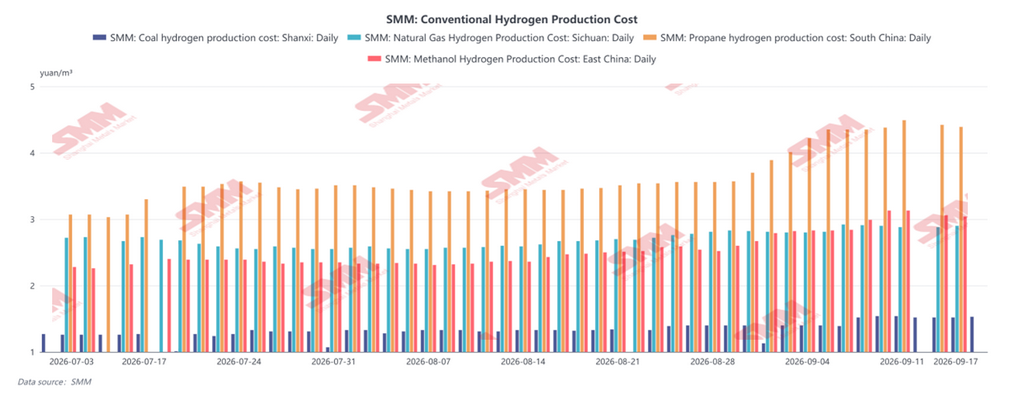
Over the past two months, domestic green hydrogen, green ammonia and green methanol — three major green new-energy chemical products — have exhibited a highly consistent steady market trend, with prices trading sideways for a long time and nearly no volatility. In contrast, prices of conventional grey hydrogen, grey ammonia and grey methanol have surged sharply, leading to a passive narrowing of the premium for green products. This has triggered a widespread misinterpretation that "green parity is arriving at an accelerated pace". From the perspective of the pricing mechanism, cost structure and industrial progress of green products themselves, this round of premium contraction is not attributable to technological cost reduction and market-oriented parity in the green hydrogen-ammonia-methanol sector. Instead, it is a false signal driven by external market fluctuations of conventional products. At the current stage, the green hydrogen, green ammonia and green methanol industries are characterized by static sideways prices, steady commissioning of production capacity, structural optimization of costs and prominent bottlenecks in end-user demand. Substantial industrial parity has not yet materialized.
I. Overall Market of Green Hydrogen, Ammonia and Methanol: Stable Operation, Decoupled from the Price Cycle of Conventional Products
In the past two months, the three green chemical products have maintained stable price trends, largely independent of the price hike logic of traditional energy and chemical commodities. This is not market stagnation, but an inherent feature dictated by the exclusive trading system and pricing model for green hydrogen, ammonia and methanol. Unlike conventional chemical products traded in open spot markets and vulnerable to supply-demand dynamics, geopolitics and market sentiment, green products are dominated by long-term agreements, with pricing anchored to green certification and carbon compliance frameworks. Short-term spot market disturbances exert minimal impact, thereby forming a bipolar pattern: grey products swing violently with market shifts while green products stay stable, anchored to industrial fundamentals.
In terms of premiums, the premiums of green methanol and green ammonia relative to conventional counterparts have contracted markedly. However, the core driver is the price rally of grey products; green products themselves have not seen any substantive price cuts. Such passive premium convergence cannot prove improved competitiveness of the green hydrogen-ammonia-methanol industry and lacks long-term sustainability.
II. Current Status of the Green Hydrogen, Green Ammonia and Green Methanol Industries
a. Green Ammonia and Green Methanol: Long-Term Agreements Lock in Prices to Form Price Barriers, Overseas Demand Supports Industrial Rollout
Market-wise, green methanol prices have remained stable over the past two months, with narrow fluctuations in mainstream quotations at home and abroad.
The primary reason is that there is no open short-term spot trading market for domestic green methanol, eliminating speculative trading and price volatility caused by short-term supply-demand swings. Industrial transactions are mainly export long-term orders, largely catering to low-carbon compliance requirements for international marine fuel. Large-scale domestic green methanol capacity has been successfully commissioned and delivered overseas in bulk volumes. Leading enterprises have secured annual stable orders of millions of tonnes with international shipping firms.
b. Green Hydrogen: Sticky End-User Prices, Partial Parity Breakthrough Achieved at the Production End
A flat price index does not equate to an unchanged market. Changes are occurring on the cost side rather than the quotation side. Large-scale wind-and-solar-to-hydrogen projects in Inner Mongolia and Xinjiang have cut production costs to 14–18 yuan per kilogram. Projects optimally utilizing curtailed wind and solar power can achieve costs of 11.2–14 yuan per kilogram, while the cost of coal-based grey hydrogen in the same regions stands at 12–15 yuan per kilogram. Local parity between green and grey hydrogen at the production stage has emerged in Northwest China.
Nevertheless, end-user prices have not declined accordingly, due to bottlenecks in storage and transportation. For tube trailer transport beyond a 500-kilometer radius, storage and transportation costs can add over 20 yuan per kilogram, erasing all cost advantages at the production end. A notable development this year is the framework green hydrogen supply agreement signed by Sinopec Nova and Binhai Investment, which plans to deliver green hydrogen from Ulanqab in Inner Mongolia to Tianjin starting in 2029, with a benchmark pipeline delivery price locked at 19–22 yuan per kilogram. This represents the most commercially realistic pricing reference for "West-to-East Hydrogen Transmission" to end users to date.
III. Passive Premium Contraction ≠ Parity for the Green Industry
The substantial narrowing of green product premiums observed in the current market is a signal prone to misinterpretation. From the perspective of the green hydrogen-ammonia-methanol industry itself, the perceived competitiveness gain is an apparent, false dividend with no substantive industrial implications. True green parity means green products achieve cost declines through technological iteration, falling green power costs and process optimization, eventually reaching or undercutting prices of conventional products. Such cost reduction is endogenous, sustainable and irreversible. In contrast, the current premium contraction stems entirely from the temporary price surge of conventional chemical products caused by short-term maintenance, geopolitical disruptions and supply-demand mismatches. Green hydrogen, green ammonia and green methanol have not witnessed breakthrough changes in their own prices, core costs or production processes. Once the supply of conventional energy and chemical products returns to normal and grey product prices retreat, green premiums will rebound.
In line with the real logic of industrial parity, the full-scale parity of green hydrogen, ammonia and methanol hinges on lower green electricity costs. Taking green ammonia as an example, power costs account for 70%–80% of total production costs; minor adjustments in electricity prices can trigger thousand-yuan-per-tonne swings in total costs, while equipment iteration contributes less than 10% to cost reduction. Based on industry estimates, with improved carbon market mechanisms, the window for full market-oriented parity of green hydrogen, ammonia and methanol will arrive during the 15th Five-Year Plan period. The industry is currently in a critical phase of cost accumulation, infrastructure improvement and demand cultivation.
![[SMM survey] Hydrogen energy industry weekly review, 20260912-0917](https://imgqn.smm.cn/usercenter/MjfPv20251217171728.jpg)
![[SMM Hydrogen Cost Daily Review] 20260917](https://imgqn.smm.cn/usercenter/tKgKv20251217171725.png)