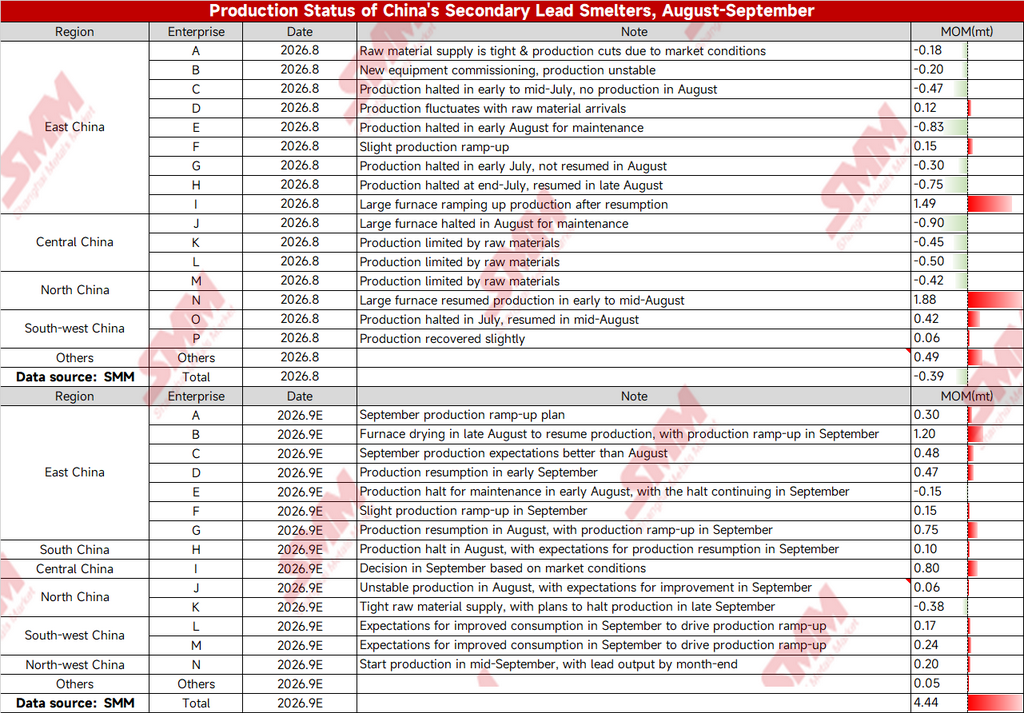
1. September production schedule: production resumptions and ramp-ups as the main theme, with a net growth of 44,400 mt expected
The growth is driven by three main lines.
First, collective production ramp-ups after resumptions in east China. Of the 9 operating samples, 7 saw MoM increases: Enterprise 2 started furnace drying in late August and continued to ramp up production in September, with an expected monthly increase of 12,000 mt; Enterprise 7 resumed production in August and ramped up in September, contributing 7,500 mt; Enterprise 3 (September production expectations better than August) and Enterprise 4 (resumed production in early September) contributed 4,800 mt and 4,700 mt respectively; Enterprise 1 planned to ramp up production by 3,000 mt, and Enterprise 6 made a small production increase of 1,500 mt. East China totaled 33,500 mt, the core source of September growth.
Second, southwest and northwest China released new supply. Southwest Enterprises 12 and 13 ramped up production by 1,700 mt and 2,400 mt respectively based on expectations of improving consumption in September; northwest Enterprise 14 planned to start production in mid-September and produce lead by month-end, contributing 2,000 mt.
Third, central China retained upside room. Enterprise 9 had not yet set a clear production schedule after the shutdown and maintenance of its large furnace ended in August, and under a neutral output assumption based on a wait-and-see market stance, September output was up 8,000 mt MoM; south China Enterprise 8 had production resumption expectations in September after halting production in August, contributing 1,000 mt.
On the reduction side, north China Enterprise 11 planned to halt production in late September due to tight raw material supply, with an impact of -3,800 mt; east China Enterprise 5's maintenance extended into September, reducing output by another -1,500 mt. After deducting these, September's total net growth was 44,400 mt.
2. August review: raw materials and maintenance double pressure, net decrease of 3,900 mt
In August, dragged by tight scrap battery supply and concentrated maintenance, east China and central China were the main reduction regions—east China's 6 samples saw a MoM decrease of about -27,300 mt, and central China's 3 samples all decreased by about -18,500 mt; north China Enterprise 14's large furnace production resumption (18,800 mt) and east China Enterprise 9's production ramp-up (14,900 mt) partially offset the decline. The full-month total net decrease was -3,900 mt.
3. September reality disruptions: raw materials and macro double suppressionWhether the production schedule can be realized depends on two practical clues.
First, raw material supply remains tight. In early September, scrap battery arrivals showed no obvious improvement, and a large smelter in Inner Mongolia has already halted production ahead of schedule, confirming that raw material constraints have not yet eased. The willingness of raw material-sensitive smelters to ramp up production is directly suppressed.
Second, macro front disturbances are intensifying. In mid-September, expectations for US Fed interest rate hikes heated up, and macro anomalies dragged commodity prices broadly lower, with lead prices weakening in tandem. The decline in lead prices directly squeezed secondary lead smelting profits, and some smelters that had originally planned to ramp up production turned hesitant, with both transaction activity and purchase willingness weakening in sync.
4. Outlook: Actual growth in September will most likely fall short of 44,400 mt
Overall, the 44,400 mt production schedule growth is largely based on the assumption of "stable lead prices + normal scrap battery arrivals." If the macro front continues to exert downward pressure and lead prices remain in the doldrums, while scrap battery supply stays tight, the production ramp-up slope of 12,000 mt in east China and the new supply in southwest and northwest China will be difficult to fully materialize. September secondary refined lead production growth will most likely fall short of production schedule expectations.
If lead prices stabilize and rebound in late September, scrap battery arrivals improve marginally, and downstream restocking occurs ahead of the National Day holiday, some production ramp-up plans may still be realized before month-end, and actual production may converge toward production schedule levels. However, if macro pessimism persists, expectations for production cuts may spread from northeast China to other raw material-constrained regions, further widening the gap between production schedules and actual output.
![Bears increased positions to pressure prices, SHFE lead tumbled 1.92%, losing the 16,000 mark [Lead Futures Brief]](https://imgqn.smm.cn/usercenter/lIHfM20251217171721.jpeg)