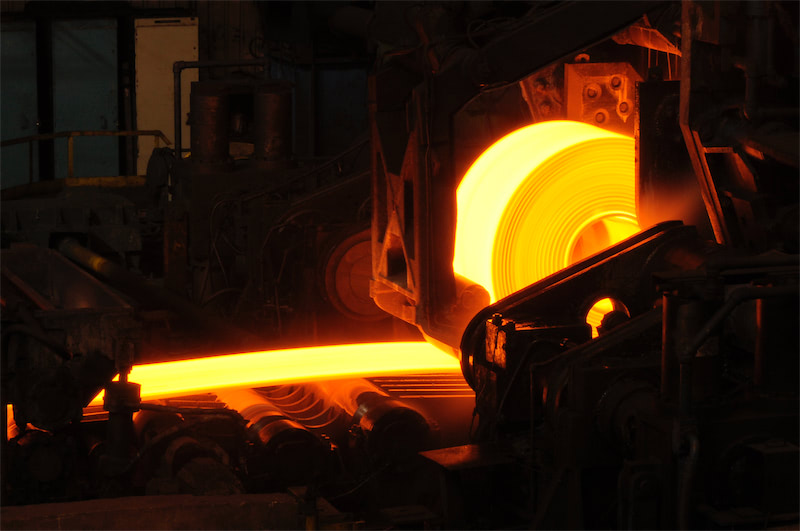
Australian miner Mineral Resources (MinRes) recently posted simultaneous records across three business lines in FY2026, with the standout performance coming from its Onslow iron ore operation. Onslow Iron reached its nameplate capacity of 35 million mt/year in August 2025 and has since progressively moved into stable, ramped-up operation; Q4 FY26 shipments of 9.6 million wet mt equated to an annualised run rate of roughly 38.4 million mt/year. While MinRes remains far from comparable in scale to Australia's top-tier miners, it is the only new model in Western Australia over the past decade to be built entirely in-house from mine to shiploading and to have actually been made to work.
The Australian iron ore market has long fostered a certain illusion: that any discussion of seaborne supply must revolve around Rio Tinto, BHP, Fortescue and Roy Hill. These majors own the mines, railways, ports and long-term customer relationships that form the most stable backbone of Western Australian iron ore exports. But in 2026, MinRes opened up a new angle on that narrative.
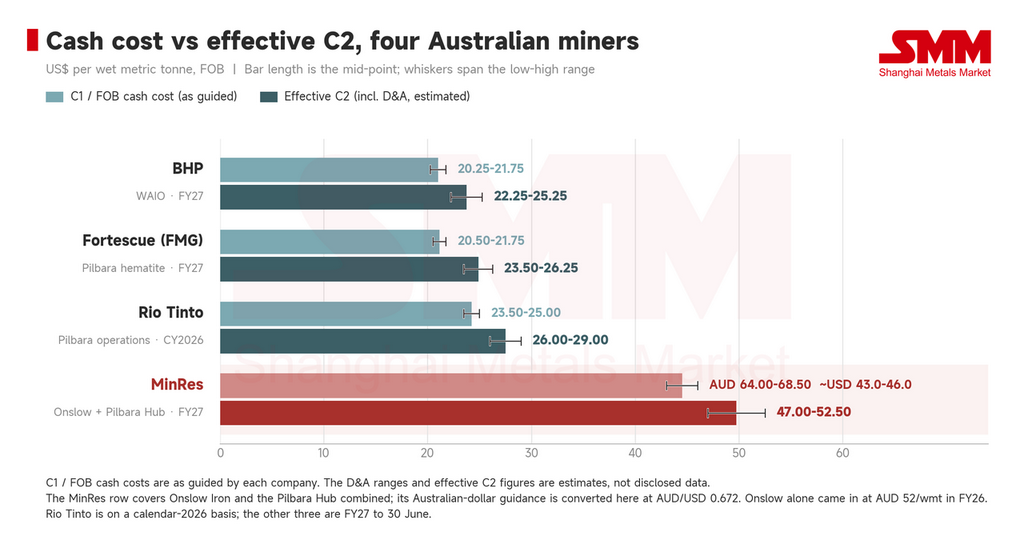
The most noteworthy thing about MinRes is not that it delivered 34.1 million mt of iron ore output in FY26, but that it has finally got Onslow Iron running properly. In FY2026, Onslow Iron shipped 34.1 million wet mt on a 100% project basis and 19.7 million wet mt attributable to MinRes , both above the company's previously upgraded guidance. Project FY26 FOB costs came in at just AUD 52/wet mt, below the AUD 54-59/wet mt guidance range. This marks the point at which Onslow ceases to be merely a new project in ramp-up and begins to function as a stable node of seaborne iron ore supply.
I. From Ramp-Up to Steady Shipments: Onslow Has Delivered
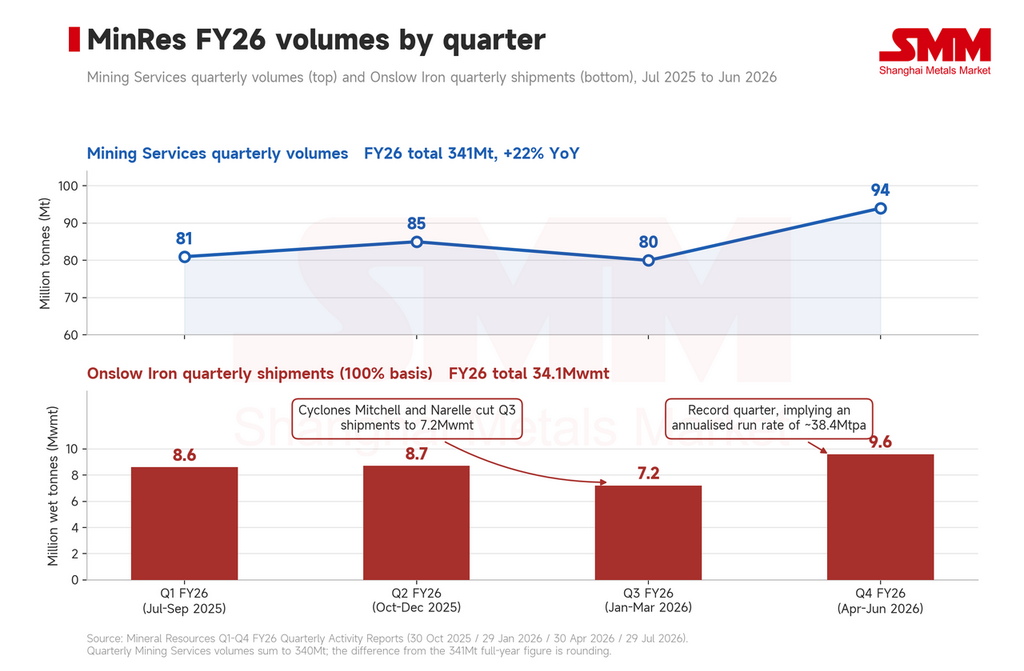
Onslow's development moved quickly. By June 2025, monthly project shipments had already reached 2.7 million wet mt, equivalent to a run rate of 32.4 million mt/year; by August 2025, the project formally achieved its nameplate capacity of 35 million mt/year. MinRes then sustained a run rate of around 35 million mt/year for three consecutive months from August to October 2025, triggering an AUD 200 million contingent payment tied to the infrastructure transaction. The real test of the project's stability, however, came in the quarters that followed.
From July to September 2025, Onslow shipped 8.6 million wet mt; from October to December, this rose further to 8.7 million wet mt. In the January-March 2026 quarter, tropical cyclones Mitchell and Narelle successively affected northern Western Australia, interrupting road haulage and transhipment operations for three days and five days respectively, and quarterly shipments fell back to 7.2 million wet mt. Notably, neither weather event caused damage to critical infrastructure, and the project returned rapidly to design levels after the disruptions.
From April to June, Onslow shipped 9.6 million wet mt in a single quarter which is a project record equivalent to an annualised run rate of around 38 million mt/year, well above the 35 million mt/year design capacity. Full-year shipments ultimately reached 34.1 million wet mt.
In other words, Onslow has moved from reaching design capacity to proving that design capacity can be sustained in operation.
For a newly commissioned mine, hitting 35 million mt does not in itself mean the supply chain has matured. Mining and stripping, crushing and screening, long-haul road transport, port stockyards, transhipment vessels and offshore loading. A bottleneck at any single link can open a wide gap between nameplate capacity and actual shipments. Onslow's most important achievement to date is demonstrating that the chain can run as a whole.
II. Once Mining for Others, Now Producing for Itself
MinRes did not start out as a major iron ore company. In 1992, Chris Ellison founded a business centred on infrastructure and mining services, initially providing crushing, engineering and mining contracting services to mine operators. The company listed on the ASX in 2006. At that time MinRes was still a modestly sized Western Australian mining services firm whose core capability lay in building and operating the production stages of mines, rather than in owning large-scale resource assets. That business model gradually changed.
MinRes transitioned from contractor to conventional miner, progressively extending decades of accumulated engineering, crushing, haulage and mine operating capability upstream into the resource itself. It is the concentrated realisation of a business model built over more than thirty years: having once dug ore out of the ground for others, the company now decides for itself where to mine, how to haul, how to load, and how to turn an entire supply chain into a single project. This is one of the biggest differences between Onslow and conventional Australian iron ore projects.
III. The Real Game-Changer Isn't the Ore , It's How to Get It Out
The West Pilbara region where Onslow sits is rich in iron ore resources, but the question has always been how to move that ore to the coast at low cost. This has long been the defining obstacle to opening up new mines in the West Pilbara. Onslow's core resource belongs to the Channel Iron Deposits of the western Hamersley Province. The mine's resource base had previously been upgraded to 744 million mt at a grade of around 56.3% Fe, with reserves of approximately 359 million mt at around 57.5% Fe. Planned project life exceeds 30 years.
The resource itself is far from poor, but what the location lacks are the infrastructure conditions most essential to a traditional Australian iron ore project. MinRes therefore chose not to replicate the Big Four's playbook wholesale:
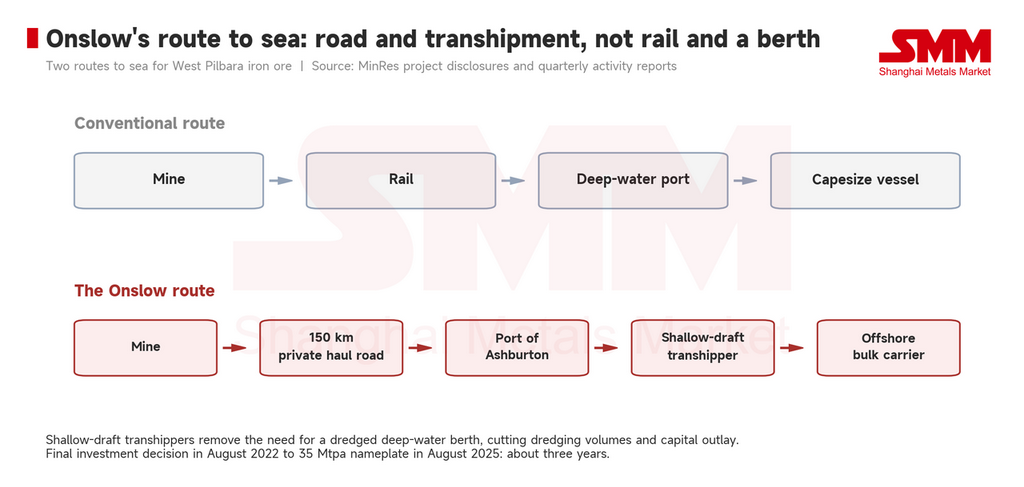
Ore is crushed, screened and stockpiled at Ken's Bore, then hauled roughly 150 km along a dedicated haul road to the Port of Ashburton. At the port, purpose-built transhipment vessels carry the ore to an anchorage some 40 km offshore for loading into ocean-going bulk carriers. The transhippers use a shallow-draft design, removing the need for a conventional deepwater berth and reducing the dredging and infrastructure investment that a deep channel would require.
The greatest value of this system is that it converts a resource that would otherwise have needed rail and a large deepwater port into a supply chain built around road haulage and offshore transhipment.
Onslow achieved its first shipment in May 2024, only around 11 months after works began at Ken's Bore. MinRes took just about three years from final investment decision to reaching the 35 Mtpa nameplate capacity. For the Western Australian mining market as a whole, this may be more significant than the existence of a 35-million-tonne mine in itself, because it proves that stranded West Pilbara resources do not have to follow the majors' capital-intensive infrastructure model to reach the seaborne market.
IV. Onslow Brings Not Just New Tonnes, but a Different Supply Profile
From a global iron ore supply perspective, 35 million mt is not a figure capable of shifting the overall balance. But for Australian supply it matters: for decades, incremental Australian iron ore supply has been highly concentrated among a handful of super-major miners, which control not only vast resources but also the railways, ports, shipping and extensive long-term sales channels. Onslow offers another possibility, which is outside the Big Four, a new supply node running at an annualised 35 million mt, with its own mine and a complete logistics chain, can sustainably deliver product into the seaborne market.
That scale is not yet enough to challenge the market position of the majors, but it is enough to appear on the supply lists of traders and mill procurement teams.
On product structure: Onslow's resource grades sit in the 56% to 58% Fe range, and commercial output at present is predominantly fines. The project's H1 FY26 report shows an average Fe grade of around 58.2% for product actually shipped. This means Onslow adds not simply another block of Australian iron ore supply, but a block of medium- to low-grade Australian ore that can be supplied at stable scale. For Chinese mills and traders, that is one more option.
With high-grade resources at Australia's mainstream mines long since locked into established supply systems, future supply growth will increasingly come from new projects — and new projects typically mean different grades, sizings, impurities and pricing structures. What Onslow provides is a relatively scarce combination among them: large enough in scale, stable in supply, Australian in origin, but lower in grade than traditional mainstream high-grade material.
Onslow's realised price in Q3 was USD 95/dry mt, equivalent to 91% of the Platts 61% CFR index. Against a backdrop of generally declining grades across mainstream fines, a reliably supplied 58%-grade source matters more for blending strategy than its position in the volume tables would suggest. On flows, MinRes sells 50% of its attributable ore to Baowu under long-term contract, with Baowu holding an option for a further 25%, and the remainder marketed jointly by MinRes and AMCI.
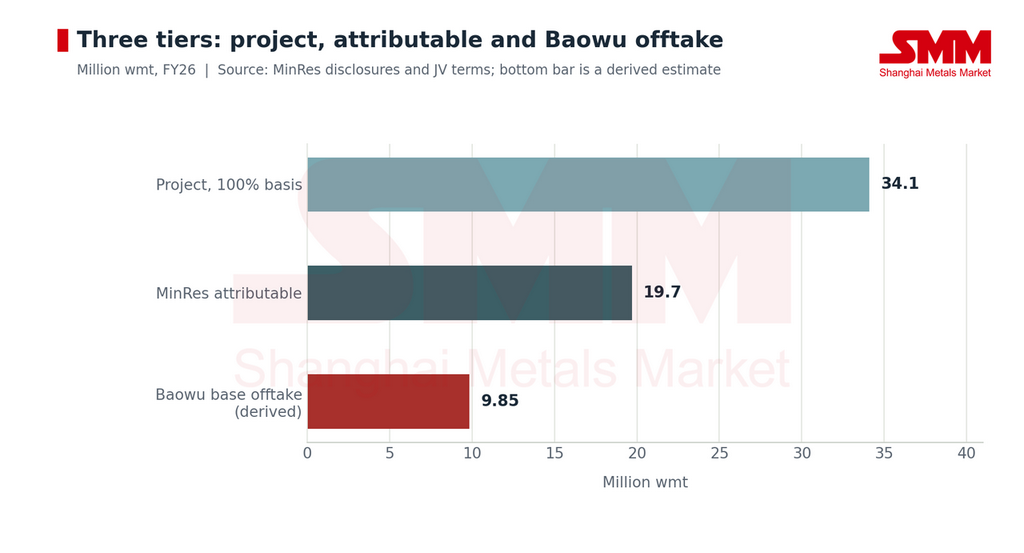
The hardest phase of the project is now behind it. If Onslow can hold above 35 million mt over the long run, those several million tonnes above design capacity will represent a persistent marginal increment in Australian seaborne supply.
At the same time, MinRes's Pilbara Hub is also changing. Lamb Creek achieved its first ore shipment in March 2026 and is progressively replacing Wonmunna, extending the mine life of this production hub. Pilbara Hub shipments totalled 9.9 million wet mt in FY26, at the top end of guidance.
This is shifting MinRes's role. It is no longer merely a contractor operating mines on behalf of others, nor simply a mid-tier miner owning several mines, but is becoming a supplier able to develop resources, organise mining, design logistics on its own terms, and ultimately deliver product reliably into the international seaborne market. That may be what genuinely warrants the market's attention about Onslow.
The Big Four will continue to dominate Australian iron ore exports for a long time to come, and Onslow's arrival does not change that. But alongside them, Australia is seeing the emergence of a growing number of new supply forces capable of independently contributing stable tonnage. What Onslow proves is not that Western Australia has gained another 35-million-tonne mine, but that a resource left stranded for years does not necessarily have to wait for a traditional mining major to develop it. So long as someone can reassemble the mine, haulage, port and transhipment links, it too can become a seaborne iron ore supply chain that genuinely makes money, ships consistently, and ultimately reshapes the supply structure.
![[SMM Iron Ore] Weaker spot and higher freight deepen imported iron ore losses](https://imgqn.smm.cn/usercenter/rKOND20251217171716.jpg)
![[SMM India Domestic Market Weekly Review] Indian Domestic Steel Market Maintains Upward Trend](https://imgqn.smm.cn/usercenter/udPED20251217171747.jpg)
![[SMM Steel] India’s Domestic Steel Prices Rise on Higher Raw Material Costs](https://imgqn.smm.cn/usercenter/OOCfp20251217171746.jpg)