SMM tracking shows approximately 98,458 tonnes of India-loaded coils and plates on Ravenna voyages, with a further 64,600-tonne mixed parcel on a probable Europe or Mediterranean route as workable Indian HRC indications reach 695–700USD/tonne CFR Europe and offer test 715USD/tonne.
Indian flat-steel cargoes from Mumbai, Dhamra and Paradip are converging on Ravenna just as Indian HRC offers into Europe test levels above 680USD/tonne. SMM tracking and current AIS destinations identify three ships carrying a combined 98,458 tonnes of coils and plates to the Italian port. A fourth ship, carrying a further 64,600-tonne mixed coil-and-plate parcel, has reached Port Said after an armed-guard Gulf of Aden passage and Suez transit. The physical pipeline is making customs timing the decisive variable for the next Indian HRC trade.
Europe remains the strongest visible export outlet while Southeast Asian buying levels remain less workable for Indian mills. At the same time, domestic HRC at 628–649USD/tonne (60,000–62,000INR/tonne) EXW Mumbai continues to support seller discipline. The European premium therefore has to compensate for freight, customs-window exposure and the working capital tied up when cargo is discharged into bond.
I. Cargo timing tightens the October quota window
India’s Category 1A allocation for non-alloy and other alloy hot-rolled sheets and strips is 149,318.61 tonnes per quarter in the July 2026–June 2027 quota year. The latest September 8 snapshot showed 38,357 tonnes still available under order 09.9803, equivalent to 74.3% utilization. Those balance records point to accepted customs claims; it does not capture material already held under customs control or cargo still approaching European discharge ports.
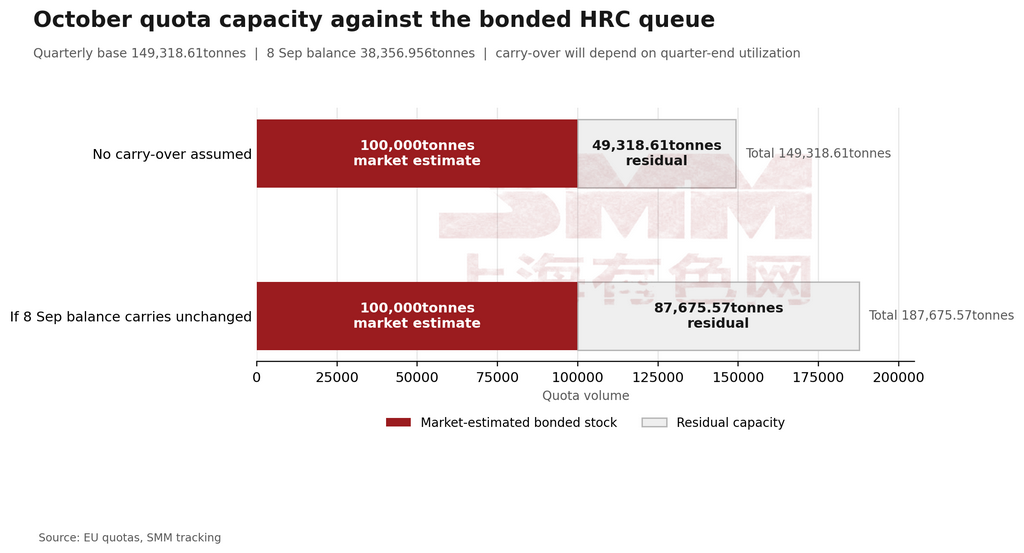
Market participants estimate that approximately 100,000 tonnes of Indian HRC is already positioned in European bonded or customs-controlled warehouses for the next window. On the base October–December allocation, that stock would represent 66.97% of available quota and leave 49,319tonnes. One additional 30,000-tonne claim would cut the residual to 19,319 tonnes, while a 40,000-tonne parcel would leave only 9,318.61 tonnes.
Unused July–September volume must carry into the following quarter within the same quota year. If the full 38,357 tonnes visible on September 8 survives to quarter-end, October–December availability would rise to 187,676 tonnes. The 100,000-tonne bonded estimate would then leave 87,676 tonnes before new claims. A 30,000–40,000-tonne cargo would reduce that headroom to 57,676–47,676 tonnes. Further September claims will determine the final carry-over.
The on-water vessel total should not be added mechanically to the bonded-stock estimate. Some material may enter the warehouse estimate after discharge, and not every steel-coil cargo necessarily clears under Category 1A. Even so, three tracked Ravenna voyages across Mumbai, Dhamra and Paradip show that the forward pipeline is already physical rather than a future booking assumption.
II. Ravenna becomes the visible landing point
Ship 1 sailed from Mumbai on August 20 with 20,000 tonnes of steel coils and was approaching Ravenna for a 9 September arrival. Ship 2 left Dhamra on August 19 with 39,279 tonnes of HRC coils, crossed the Suez system and was sailing through the East Mediterranean toward Ravenna for September 11. Ship 3 departed Paradip on September 7 with 38,063 tonnes of steel coils and 1,116 tonnes of steel plates, with Ravenna declared for September 30.
Together, the three cargoes represent 98,458 tonnes of India-loaded coils and plates on confirmed Ravenna voyages. The Dhamra and Paradip movements are important because they broaden the Europe-facing pipeline beyond west-coast loadings and bring east-coast mill tonnes into the same customs window.
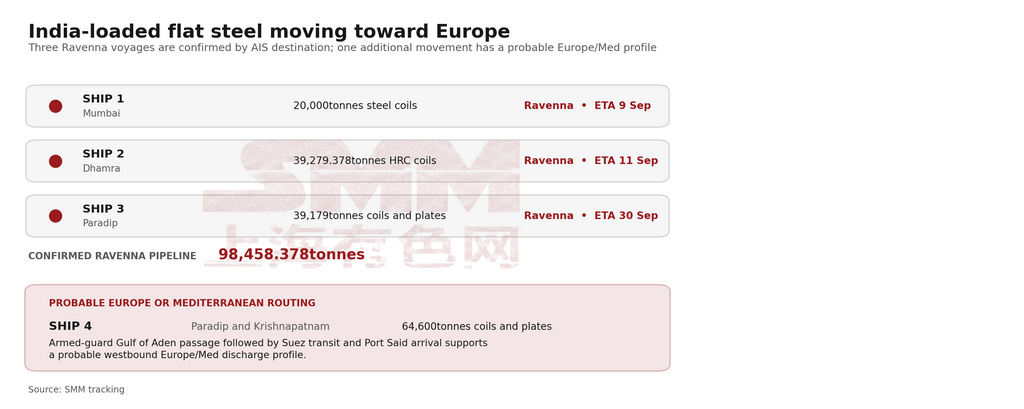
Ship 4 adds a further 64,600 tonnes of coils and plates to the Europe-facing picture. SMM tracking shows the vessel loading across Paradip and Krishnapatnam before departing on 16 August. Its armed-guard passage through the Gulf of Aden, subsequent Suez transit and arrival at Port Said support a probable Mediterranean or European discharge profile. The final discharge port was not declared at the cut-off, so the cargo remains a probable rather than named EU arrival.
The four-vessel Europe-facing pipeline reaches approximately 163,058 tonnes on SMM’s shipment data, comprising 98,458 tonnes on named Ravenna voyages and 64,600 tonnes on probable Mediterranean or European routing. This is a gross flat-steel shipment measure, not a one-for-one Category 1A quota claim. Product classification, discharge timing and customs status will decide how much of it competes for India’s HRC allocation.
III. Europe offer levels strengthen
SMM’s daily and weekly reports show Indian HRC discussions moving higher through late August and early September. Early-August indications were heard at 630–650USD/tonne CFR Europe. A possible transaction around 680USD/tonne was discussed by August 31 but remained unconfirmed. Sellers were heard seeking around 660USD/tonne on September 1, while some negotiations were heard at 680–690USD/tonne on September 2.
By September 9, some offers were also heard around 715USD/tonne CFR Europe, extending the upper end beyond levels tracked a week earlier. Market feedback placed practical workable levels at 695–700USD/tonne CFR Europe. The 715USD/tonne offer was regarded as slightly high rather than impossible, but no concluded deal was confirmed at that level; one exporter described 700USD/tonne CFR as optimistic. The firmer tone coincided with reports that ArcelorMittal had raised its Southern European HRC offer by 20EUR/tonne (23USD/tonne) to approximately 790EUR/tonne delivered for November.
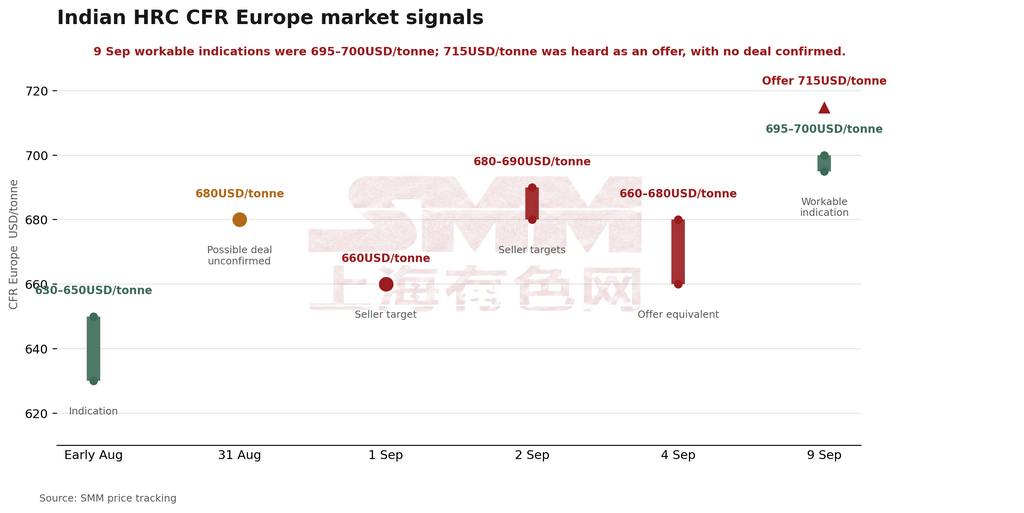
The sequence points to a firmer offer environment rather than a uniform clearing-price increase. Sellers have pushed headline offers into the low 700s as European prices strengthened and Indian availability tightened, but practical workable indications remained around 695–700USD/tonne and no deal was confirmed at 715USD/tonne. Quota certainty is increasingly separating executable cargoes from headline offers.
IV. Quota access becomes part of the price
The 50% out-of-quota duty removes a practical fallback for exposed cargo. At a customs value of 660–680USD/tonne, the safeguard duty alone would add 330–340USD/tonne before other applicable customs and carbon costs. Buyers therefore have to value the same CFR offer differently depending on whether quota access is secured, expected or deferred to a later window.
Cargo discharged into bond carries storage, finance and price risk until customs release. A shipment arriving in September may still target the October window, while cargo shipped later in the autumn may be structured around January access. Both strategies depend on the queue already in customs control and on how contracts allocate storage charges and the risk of a failed quota claim.
This explains why the physical pipeline matters more than vessel count alone. A small number of Supramax-scale cargoes can absorb a large share of a 149,318-tonne quarterly allocation. Once the bonded position is included, the marginal cargo is trading customs certainty and working-capital exposure as much as steel price.
V. Domestic realization raises the export hurdle
On September 4, Indian export offers neared 580USD/tonne FOB, while the domestic market was around 628–649USD/tonne (60,000–62,000INR/tonne) EXW Mumbai, exclusive of GST. The gross domestic premium over the FOB offer was therefore 48–69USD/tonne before deducting inland movement, port costs, finance and insurance from the export realization. The EXW-equivalent export netback would be lower than the FOB headline.
Strong domestic realization gives mills room to remain selective in Europe rather than discount simply to secure tonnage. European offers can stay firm where buyers provide a credible quota route, accept deferred customs release or absorb part of the carrying cost. Cargo without that structure has to overcome both the domestic realization gap and the risk of a delayed clearance window.
VI. The next trade is customs access
The next market move will be set by the final July–September carry-over, the customs status of the Ravenna cargoes and the volume that remains in bond when the October allocation opens. The current 38,356.956-tonne balance can still change as additional claims are allocated through the quarter-end process.
Ravenna will provide the clearest physical test. Ship 1 and Ship 2 are scheduled to arrive first, followed by Ship 3 late in September. Their discharge and customs treatment will show whether the market-estimated bonded queue is growing as expected and how quickly importers position claims for October.
Europe remains the key premium outlet for Indian HRC, but the trade has moved beyond a simple CFR comparison. With around 100,000 tonnes already estimated in bond and at least 98,458 tonnes of India-loaded flat steel on tracked Ravenna voyages, the next executable price will be determined by quota access, clearance sequencing and who finances the wait.
![[Domestic Iron Ore Brief] Prices in the Liaodong area may consolidate](https://imgqn.smm.cn/usercenter/exdqc20251217171717.jpg)

![[SMM Analysis] El Niño-Water Scarcity in Indonesia: Coking Coal Disruption & The Effect to Indonesian Steel Prices](https://imgqn.smm.cn/usercenter/rBCZR20251217171716.jpg)