The EU is considering a shift in its approach to aluminium scrap exports. Rather than relying on export duties and other trade measures discussed previously, it is exploring a delegated act under the Waste Shipment Regulation (WSR) to further restrict waste exports, including aluminium scrap, to non-OECD countries, with possible exceptions for certain EU candidate countries. The measure has not been formally adopted, and its scope, implementation timetable and relationship with the existing application process remain unresolved.
In SMM analysis, the key question is not simply where European scrap will go, but where it will be processed and in what form it will enter international markets. With European downstream demand yet to show clear growth and Asian buyers remaining cautious, tighter export channels could initially redistribute existing material before influencing the location of recycling and processing capacity.
Policy Shift: From Export Costs to Market Access
The European aluminium industry previously advocated export duties and other measures to retain scrap for domestic use. A rate of around 15% featured in industry discussions, but this should not be confused with an implemented duty. The latest policy direction places greater emphasis on the WSR and environmental compliance.
The distinction matters for trade. An export duty primarily changes transaction costs, whereas destination eligibility and environmental requirements can determine whether a trade route remains available at all. Businesses therefore need to assess not only potential costs, but also eligible destinations, covered waste categories and receiving-facility requirements.
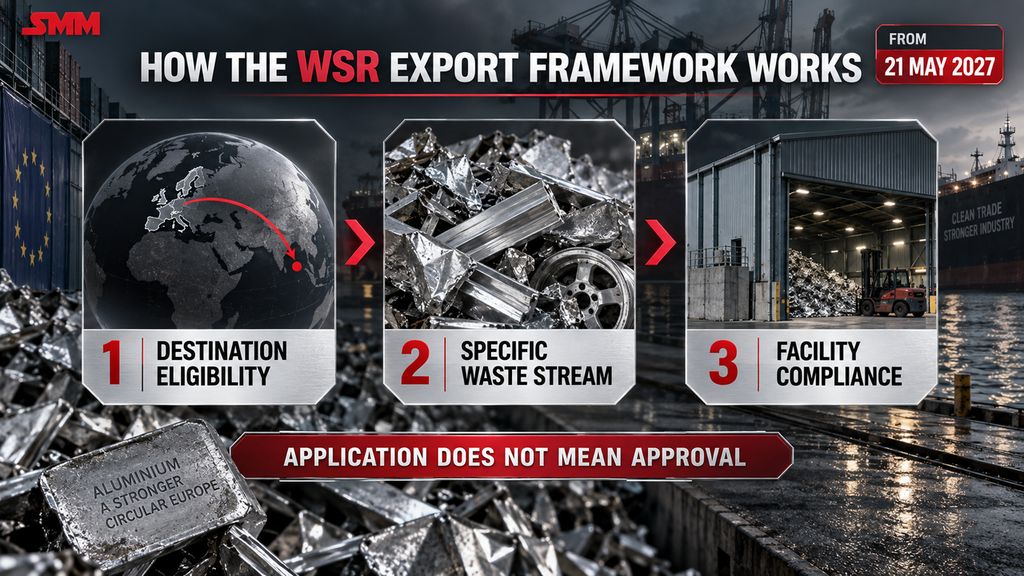
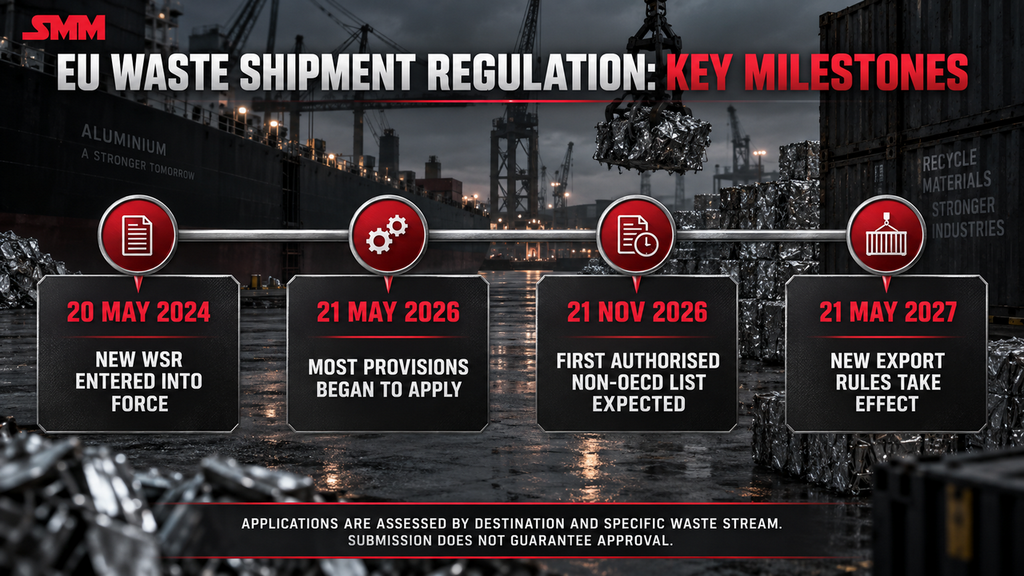
Under the existing WSR framework, stricter rules on non-hazardous waste exports to non-OECD countries are scheduled to apply from May 21, 2027. Applicants must demonstrate their ability to manage the relevant waste in an environmentally sound manner. India, Malaysia, Thailand, Indonesia and Vietnam were among the initial applicants. Under the current timetable, the first authorised list is to be established by November 21, 2026.
Submitting an application does not constitute approval. If broader restrictions are adopted, their interaction with this process—and the destinations and waste streams that remain eligible—will be central to future trade flows.
Europe: Greater Scrap Use Does Not Guarantee Full Absorption
Recent SMM market discussions indicate that European aluminium extrusion demand remains broadly stable, without a clear increase. Meanwhile, reduced availability of some Middle Eastern primary aluminium billets has supported production at certain European billet producers and casthouses, alongside greater use of recycled feedstock.
Industry participants reported that scrap input can reach 70% or more in certain recycled billet operations, with a substantial share coming from new and pre-consumer scrap. This demonstrates the capabilities of some producers, rather than an industry-wide average or evidence that Europe can absorb all additional scrap retained locally.
Feedstock compatibility remains crucial. Clean production scrap, old extrusion scrap and automotive shredder material have different compositions and processing requirements. Increased recycled billet production does not automatically generate equivalent demand for automotive shredder scrap or mixed-metal feedstock.
If export channels narrow, Europe will therefore face a feedstock-matching challenge, not simply a need to increase melting volumes. Sorting capacity, alloy chemistry control and downstream orders will determine which materials can enter local production and which still require overseas outlets.
Trade Flows: More Local Processing Could Change the Form of Exports
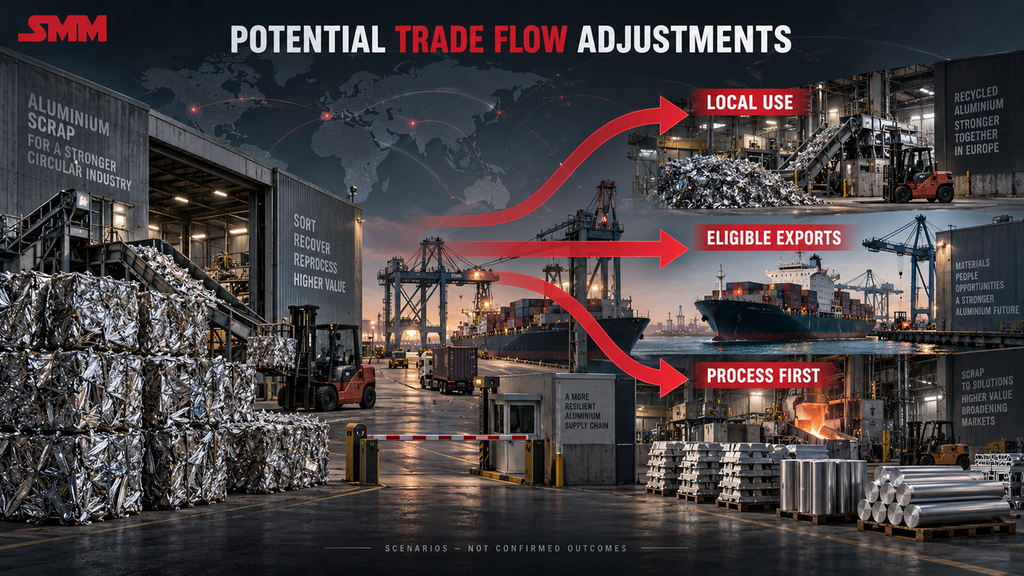
Under tighter export restrictions, European scrap could follow two broad routes: greater domestic consumption or shipment to other eligible destinations; and further processing into remelt ingots, recycled billets or secondary aluminium alloys before export.
The latter could shift some melting and alloying activity from importing markets towards the source of the scrap. However, that transition requires equipment, energy, technical capabilities and customer qualification. It would not occur immediately following the introduction of restrictions. Processed material must also meet applicable product-classification and import requirements.
The US and other markets with suitable demand could become sales destinations for European recycled aluminium producers. Their capacity to absorb additional supply would depend on specifications, trade arrangements and actual orders, rather than market size alone.
Similarly, simple transshipment through non-EU OECD countries should not be treated as a guaranteed alternative. Changing the transport route does not automatically change the material’s waste status or remove requirements concerning shipment, treatment and destination.
Southeast Asia: Sourcing Adjustments Could Extend to Processing Roles
For Malaysia, Thailand, Indonesia and Vietnam, the initial impact would centre on the reliability of feedstock access. Companies dependent on particular European grades would need to assess alternative origins, domestic collection and regional sourcing.
Substitution is not simply a matter of changing suppliers. Scrap from different origins can vary in composition, contamination and batch consistency, requiring material trials, adjustments to furnace charges and import-compliance checks. Producers with diversified supply networks and stronger sorting capabilities would have greater flexibility.
Recent customer discussions suggest that some Southeast Asian secondary aluminium producers continue to purchase according to orders. Consequently, changes in sourcing patterns are more likely in the near term than a broad increase in imports or production.
Over time, greater European exports of recycled aluminium products could create two developments for Southeast Asia: additional options for intermediate feedstock, such as remelt ingots, and more competition in overseas alloy markets. The policy could therefore influence not only raw-material origins, but also the distribution of sorting, melting and product-supply activities between regions.
China: Not an Automatic Destination for Redirected Material
China’s overall aluminium supply position should be distinguished from demand for specific recycled feedstocks. Although the country has a substantial domestic supply base, certain imported scrap grades remain useful for particular alloy compositions and production requirements. Changes in European availability could prompt affected buyers to adjust sourcing or use more domestic alternatives, without necessarily creating an industry-wide shortage.
Compliance also needs to be assessed at both ends of the transaction. China’s classification of imported recycled raw materials and the EU’s regulation of exported waste must each be satisfied; a commercial product name alone does not determine whether trade can continue.
With domestic buyers remaining cautious and import economics unfavourable for some products, European scrap processed into ingots would not automatically flow to China. Sustainable trade would still require suitable specifications and actual orders. Chinese buyers may seek alternative feedstock, while European suppliers assess other sales markets.
The initial effect on China is therefore more likely to appear in particular grades and procurement channels than across its entire aluminium supply system.
Market Outlook: Trade Routes Adjust First, Processing Capacity Follows
SMM expects any further tightening of EU scrap export rules to shift attention from finding an export destination towards deciding where material should be processed and what products should cross borders. Procurement, sales channels and contracts would likely adjust first; investment and processing capacity would respond over a longer period.
Europe’s ability to retain more scrap depends on compatible capacity and orders. Southeast Asia’s production continuity depends on alternative supply and processing capabilities. China and other markets’ ability to absorb recycled aluminium products remains tied to downstream demand and trading conditions.
The result could be greater recycling and processing within regions, alongside more cross-regional trade in recycled aluminium products. However, changing trade routes does not create additional demand. The final policy scope and buyers’ ability to absorb material will jointly determine the pace and scale of the adjustment.