Executive Summary
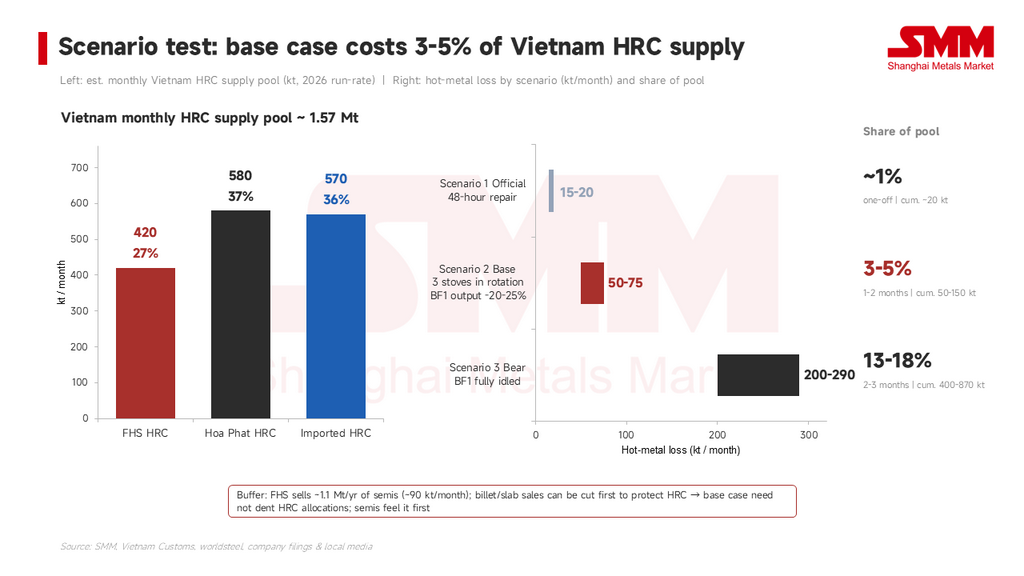
On the morning of September 4, an equipment anomaly occurred at hot blast stove No. 3 of blast furnace (BF) No. 1 at Formosa Ha Tinh Steel (FHS), Vietnam's largest integrated steelmaker. Under SMM's baseline scenario—assuming BF No. 1 operates at a 20%–25% reduction for 1–2 months—the monthly hot metal impact is estimated at 50,000–75,000 tonnes, representing only 3%–5% of Vietnam's monthly hot-rolled coil (HRC) supply pool.
SMM evaluates this event as a "limited aggregate supply shock accompanied by significant structural trade realignment". Through the consumption of existing intermediate slab/billet inventories and the strategic advancement of scheduled maintenance, FHS can smooth out short-term volume contractions without compromising its established annual operational targets.
In pricing and trade distribution, domestic market pricing power is shifting decisively toward Hoa Phat, pushing CFR import levels toward the 530–545 USD/tonne range. FHS is expected to prioritize domestic flat roll delivery by cutting merchant billet and slab exports, directly testing the supply stability of ASEAN-4 countries currently in a rapid development phase. Indian resources will serve as a strategic price ceiling rather than an immediate volume substitute, while Chinese resources will capture indirect spillover demand. Over the medium to long term, while EU Carbon Border Adjustment Mechanism (CBAM) requirements and stringent traceability rules elevate downstream compliance costs, the core export fundamentals of Southeast Asian blast furnace–basic oxygen furnace (BF-BOF) assets remain robust.
I. Official Disclosures and Timeline Reconstruction: Maintenance Front-Loading Offsets Production Loss
According to reporting by VnExpress, Ha Tinh Newspaper, and official communications submitted by FHS to the Ha Tinh provincial authorities, equipment anomaly occurred at stove No. 3 of BF No. 1 at approximately 08:10 on September 4. The ejection of sparks and elevated-temperature refractory materials ignited adjacent vegetation. By 08:30, BF No. 1 completed an emergency slack-wind (draft stoppage) and the fire was extinguished, with no fatalities.
Subsequent technical investigations indicated that structural failure or degradation of the refractory lining inside the combustion chamber allowed gas flow at roughly 1,200°C and 4.2 kg/cm² to impinge directly against the shell steel plate, causing localized detachment and ejection. By 02:00 on September 8, BF No. 1 had successfully resumed blast air and tapped hot metal. The furnace is currently operating on three hot blast stoves (Stoves No. 1, 2, and 4) at an initial ~50% capacity rating, scaling up progressively.
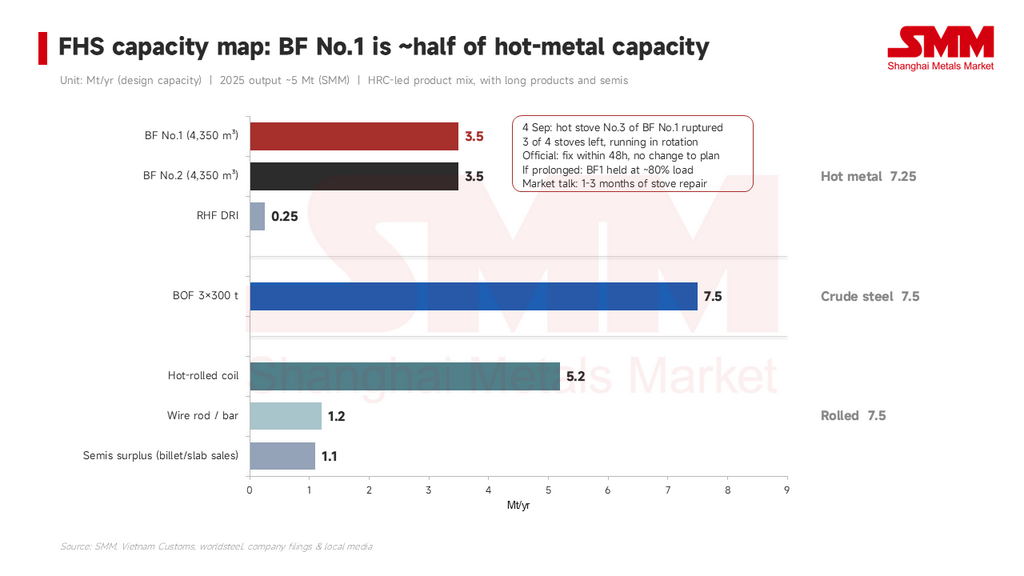
SMM's evaluation resolves the apparent tension between company guidance ("incident does not affect the 2026 production plan") and market projections of extended curtailments:
- Preventive Stoppage vs. Structural Damage: The emergency slack-wind was a precautionary safety measure; the blast furnace core structure sustained no mechanical damage.
- Maintenance Arbitrage: FHS advanced its routine maintenance schedule (originally slated for September 8–9) to begin at midday on September 4, effectively neutralizing down-time.
- Inventory Smoothing: Any brief reduction in liquid iron output is buffered by internal stocks of semi-finished slabs and billets, leaving cumulative full-year volume balances intact.
II. Production Loss Scenarios: Base Case Hot Metal Impact of 50,000–75,000 mt/Month with Robust Buffers
FHS operates two 4,350 m³ blast furnaces (3.5 million tonnes (Mt) per year hot metal each), a 250,000 tonnes per year rotary hearth furnace (RHF), and three 300-ton basic oxygen converters (7.5 Mt per year crude steel capacity). Downstream finishing comprises a 5.2 Mt per year hot-rolled coil line and a 1.2 Mt per year wire rod/bar mill, leaving around 1.1 Mt per year of surplus crude steel distributed as merchant billets and slabs.
SMM has evaluated three distinct operating scenarios benchmarked against Vietnam's monthly HRC supply pool of 1.57 Mt (comprising FHS at 420,000 mt, Hoa Phat at 580,000 mt, and imports at 570,000 mt):
Two structural buffers insulate the flat-rolled market under the baseline scenario:
- Semi-Finished Redirection: FHS sells 90,000 tonnes per month of merchant billets and slabs. Curtailing external semi-finished allocations preserves liquid steel availability for internal rolling, insulating prime HRC contract volumes.
- Buyer Inventories: Following consecutive list-price cuts through August, Vietnamese converters had accumulated precautionary inventories, creating an immediate supply cushion.
III. Pricing Dynamics and Macroeconomic Spillovers: Favorable Consolidation Window and FX Friction
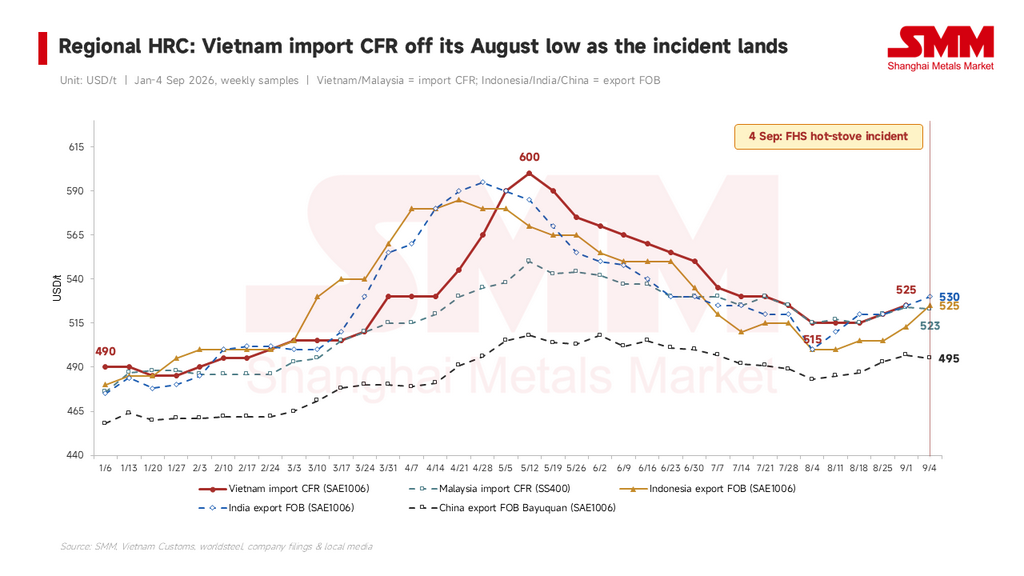
The incident occurred during a broader regional stabilization window fueled by metallurgical coal cost pressures, post-monsoon replenishment, and tighter European quotas. Vietnam CFR HRC prices had already rebounded from an early-August low of 515 USD/tonne to 525 USD/tonne by early September. Concurrently, regional pricing exhibited clear support: Indonesia FOB rose to 525 USD/tonne, India FOB stabilized at 530 USD/tonne, and Chinese SAE1006 FOB stood at 495 USD/tonne.
1. Domestic Pricing Power Tilts to Hoa Phat
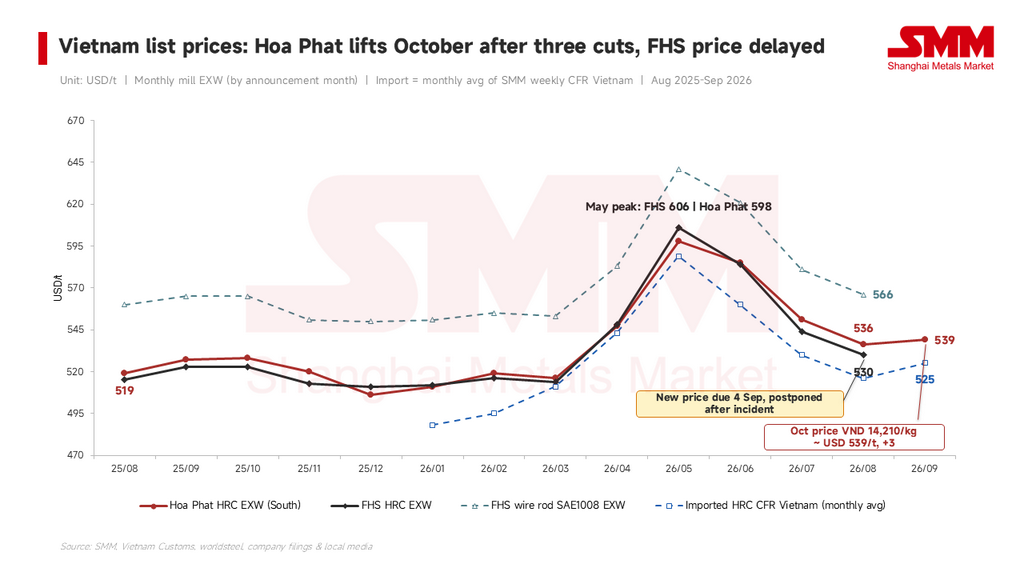
Prior to the incident, Hoa Phat announced its October shipment list prices at 14,210–14,240 VND/kg EXW (539–540 USD/tonne), marking its first price increase following three consecutive monthly reductions. With FHS's production stability temporarily in question, Hoa Phat's pricing leverage has strengthened, creating scope for a further 5–15 USD/tonne markup. FHS's delayed monthly price release will follow this upward trajectory and likely scale back large-order volume rebates.
2. Import Price Anchors Move Higher
Strengthening domestic mills have lifted the reservation price for import materials, positioning Vietnam CFR import values to test 530–545 USD/tonne.
3. Currency Volatility and Margin Compression
Evaluating cross-border pricing through currency-spread models reveals that recent FX movements across key exporting hubs create an implicit friction threshold. Currency fluctuations can erode exporters' net realized margins or elevate the effective landed cost for Vietnamese buyers in local-currency terms. In the 530–545 USD/tonne CFR range, offshore mills face compressed margins once factoring in exchange rates, deterring aggressive discounting from Indian and Indonesian sellers.
IV. Trade Flow Restructuring: India Caps the Ceiling, ASEAN-4 Demand Tested
Vietnam has historically operated as East Asia's dominant net importer of flat products, importing 7.98 Mt of HRC (averaging 665,000 tonnes per month) in 2025.
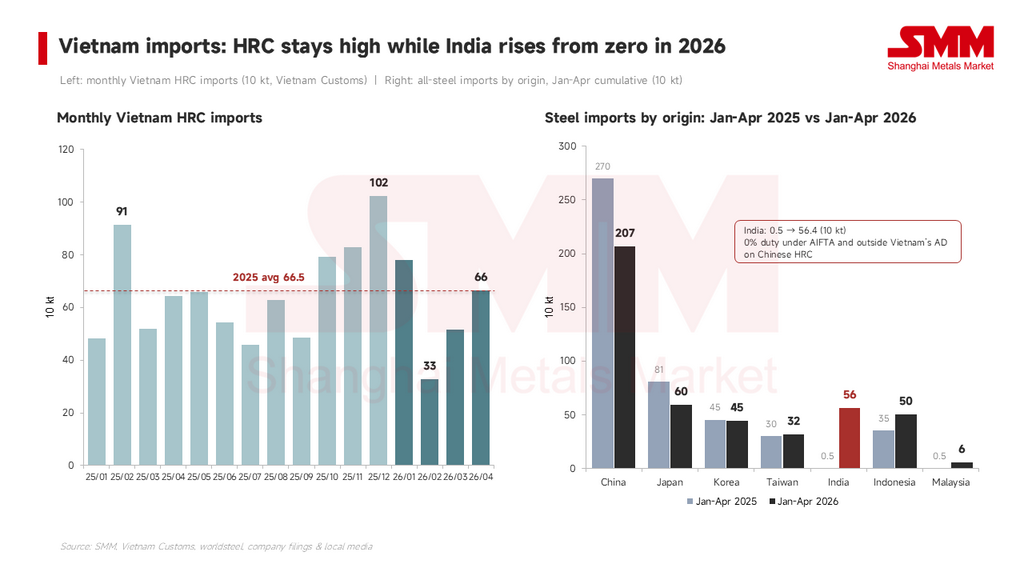
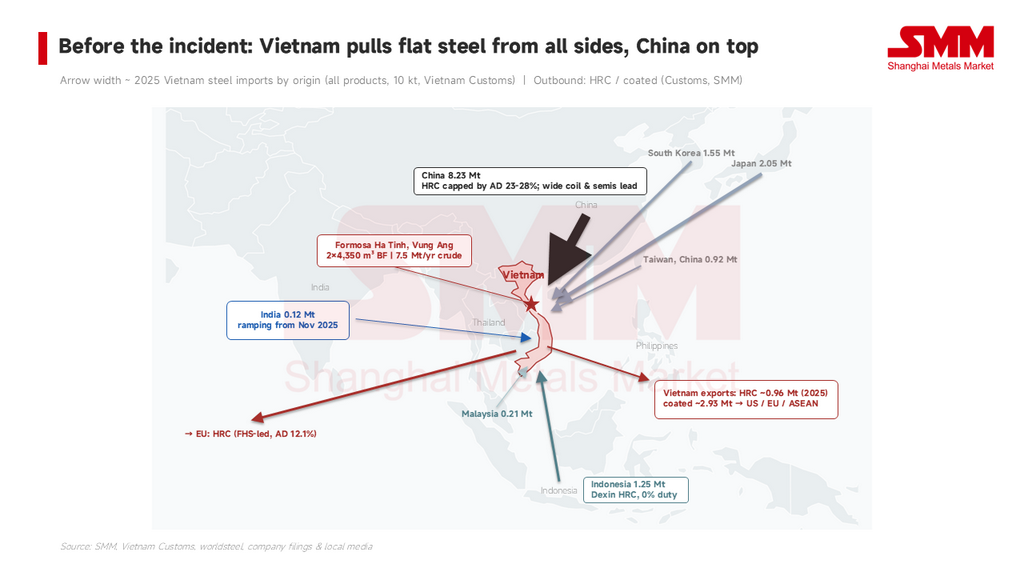
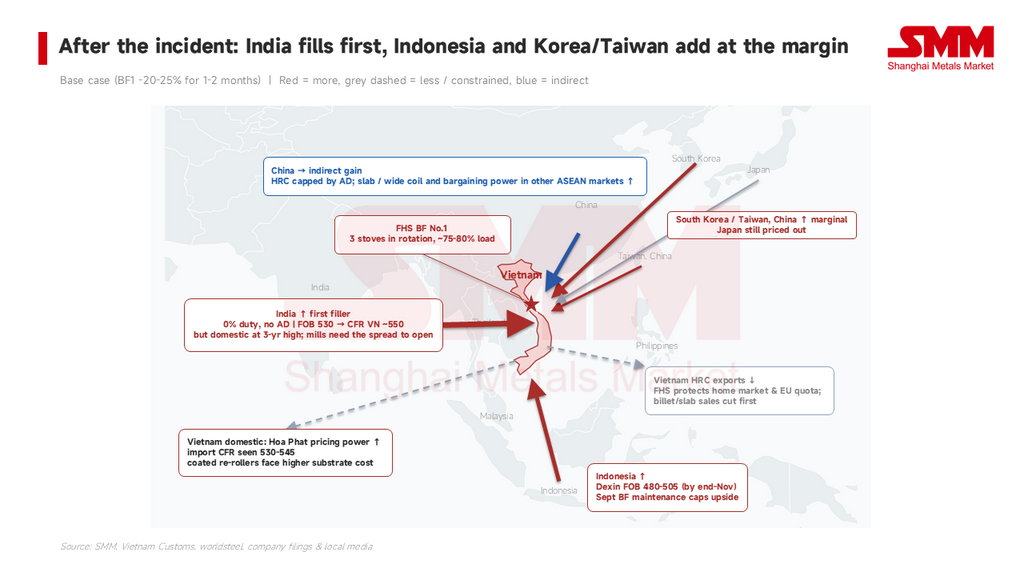
Following the incident, trade flows are expected to shift through the following mechanisms:
1. India as a Strategic Price Ceiling
Benefiting from 0% tariffs under the ASEAN-India Free Trade Agreement and exemption from Vietnam's anti-dumping duties on Chinese origin, India appears to be the primary candidate for replacement supply. However, robust Indian domestic realizations (Mumbai ex-works trading at 628–649 USD/tonne) and commitments to European quotas limit immediate spot interest. Indian FOB offers at 530 USD/tonne equate to approximately 550 USD/tonne CFR Vietnam. Under SMM's base-case import pricing (530–545 USD/tonne), Indian steel cannot generate a substantial arbitrage spread. Thus, India operates primarily as a strategic price ceiling; meaningful replacement volumes will materialize only under Scenario 3, where CFR levels breach 550–570 USD/tonne.
2. Chinese Materials: Indirect Beneficiaries
Vietnam's anti-dumping measures against Chinese SAE1006 HRC (23.1%–27.83% duty) maintain high barriers to entry, with landed duty-paid costs nearing 640 USD/tonne. Direct volume surges of standard HRC will remain constrained. Instead, Chinese exporters will see improved demand in duty-exempt wide coils (>1,880 mm), merchant slab flows, and broader pricing leverage across neighboring ASEAN destinations.
3. Supply Tension in ASEAN-4 Re-rolling Hubs
FHS's prioritization of domestic flat-rolled customers requires curtailing billet and slab merchant allocations. The ASEAN-4 economies (Indonesia, Thailand, Malaysia, and the Philippines) are situated in a rapid development phase, characterized by structural infrastructure expansions and resilient consumption of semi-finished long and flat products. Re-rolling operations across the Philippines, Indonesia, and Thailand will face immediate supply tightness, forcing buyers to source substitute billets from China, Indonesia, and Malaysia at higher replacement premiums.
4. European Trade Barriers and BF-BOF Asset Durability
As Vietnamese galvanized coil manufacturers encounter higher substrate costs, their European export channels face closer scrutiny under the EU's "melted and poured" country-of-origin rules and CBAM calculations. Nevertheless, long-term trade dynamics confirm that CBAM will not force the closure of Southeast Asia's competitive BF-BOF assets. Supported by deep cost curves, coastal logistics advantages, and regional integration, Southeast Asian primary ironmaking remains the foundational base of the regional supply chain.
V. Strategic Outlook and SMM Verification Triggers
SMM maintains that the FHS hot blast stove failure represents a localized equipment disruption with limited aggregate supply impacts. Upstream operational adjustments and merchant semis rationing will insulate the direct HRC balance. The dominant implications are structural: an enhanced domestic pricing posture for Hoa Phat, upward momentum in regional import bids, and inventory competition across ASEAN semi-finished steel markets.
Market participants should track four key operational metrics to evaluate potential transitions between the baseline and bear scenarios:
- Formal Repair Timelines: Official engineering assessments confirming whether the repair duration for stove No. 3 remains bounded within 1–3 months.
- FHS Commercial Action: The release date, base increases, and discount policy adjustments of FHS's delayed domestic price announcements.
- Transaction Resistance: Whether actual spot transactions for imported SAE1006 consistently clear the 535 USD/tonne CFR Vietnam threshold.
- Indian Quotation Resumption: The scale and price levels of renewed Indian mill offers, specifically whether CFR quotes are sustained above 550 USD/tonne.
(Data Disclaimer: Unless explicitly attributed to public statements or disclosures, market data and trade statistics are processed through SMM internal databases, pricing assessments, and industry consultation models. This material is provided for analytical reference and does not constitute operational or investment advice.)
![[SMM Iron Ore] Spot gains lift import margins back into profit, though cost pressure lingers](https://imgqn.smm.cn/usercenter/UqlZJ20251217171717.jpg)
![[NBS: August CPI rose 0.8% YoY, mainly driven by a widening increase in energy prices]](https://imgqn.smm.cn/usercenter/JdqON20251217171718.png)