At the hosted by Shanghai Metals Market (SMM), Lin Ziya, Senior Analyst of SMM Lithium Battery Recycling, shared insights on "The Impact of Global Nickel, Cobalt, and Lithium Price Changes on the Battery Recycling Landscape." She noted that SMM expects the share of recycled resource recovery in the global nickel, cobalt, and lithium raw material supply system to continue rising. On the lithium supply side, the recycling share is on a steady upward trend; by 2030, the spodumene supply share is expected to pull back to 51%, brine and lepidolite shares will see minor changes, and the recycling share will rise to 15%, with recycled lithium's supply weighting continuing to expand. In terms of nickel supply, the recycling supply scale is steadily expanding. By 2030, nickel intermediate products will account for 60%, becoming the primary supply source; nickel matte and NPI supply shares will contract somewhat, while the recycling share will edge up to 19%, playing a stable supplementary role in supply. In the cobalt supply sector, the recycling share shows the most prominent growth. By 2030, the copper-cobalt ore supply share will decline to 45%, the nickel-cobalt ore share will rise to 29%, and the recycling share will climb sharply to 23%. Among nickel, cobalt, and lithium, cobalt's recycling supply growth ranks first.
Global Nickel, Cobalt, and Lithium Price Review
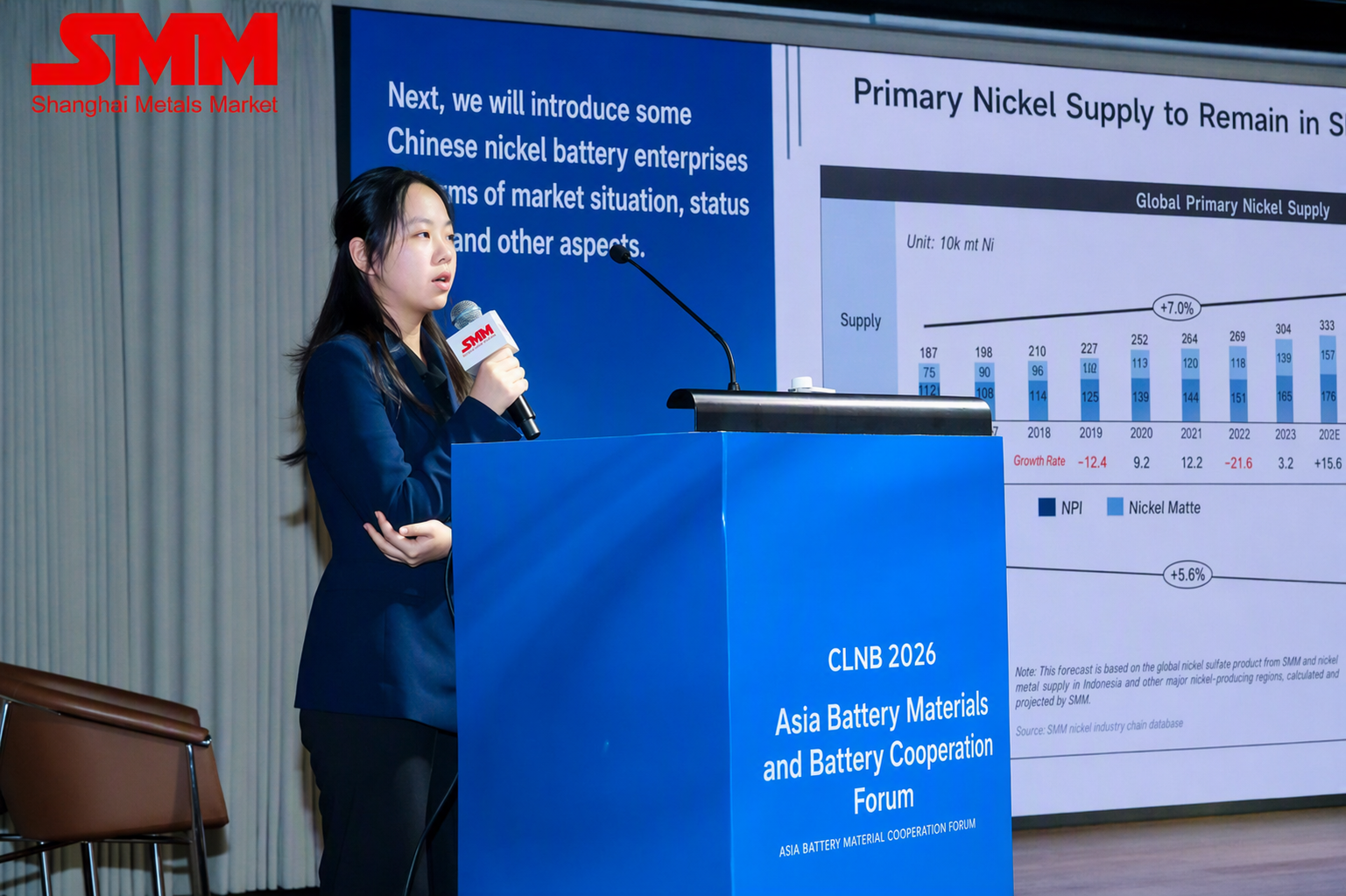
Primary nickel supply remains in surplus, with the surplus narrowing
SMM expects the global primary nickel market to remain in surplus from 2026 to 2028, but the surplus will gradually narrow. From 2029 to 2030, the primary nickel market will shift back to a tight supply situation.
Nickel sulphate: MHP supply is loosening, new raw material projects are gradually ramping up, and under the sales-based production strategy, cost support remains the key price driver
SMM has forecast the supply-demand balance for nickel sulphate from 2026 to 2030, expecting the nickel sulphate market to remain in undersupply in 2026, followed by a slight easing of the tight supply situation.
By raw material category, MHP supply is expected to gradually loosen from 2026 to 2030, with new raw material project capacity continuing to ramp up and release; the industry widely implements a sales-based production strategy, and cost support remains the core driver of current nickel sulphate prices.
Nickel sulphate: China's capacity is expected to gradually peak, with new projects in Indonesia and South Korea becoming key growth drivers
SMM forecasts that from 2025 to 2030, global nickel sulphate and ternary cathode precursor capacity will continue to expand. China will retain some growth, but future global capacity growth will be driven primarily by new projects in Indonesia and South Korea.
Cobalt Price Review
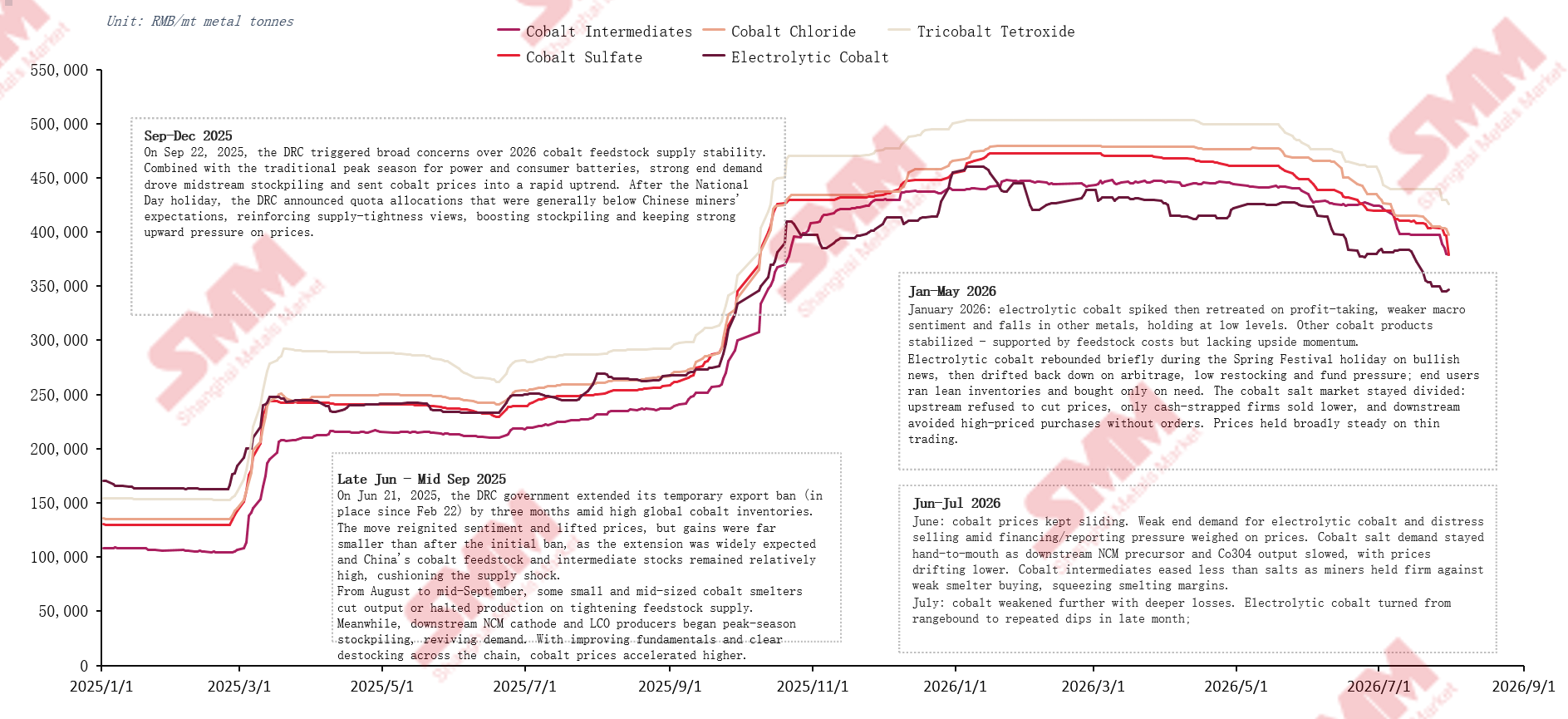
SMM Cobalt Products Price Trends and Analysis
By time period:
September-December 2025:
On September 22, 2025, DRC policy triggered widespread market concerns about the stability of cobalt raw material supply in 2026. Combined with the traditional peak season for power batteries and consumer batteries, strong end-use demand drove midstream stockpiling, and cobalt prices quickly entered an upward channel. After the National Day holiday, the quota allocations announced by the DRC were generally below the expectations of Chinese miners, reinforcing the view of tight supply and further driving stockpiling, with prices continuing to face strong upward pressure.
Late June to mid-September 2025:
On June 21, 2025, against the backdrop of high global cobalt inventories, the DRC government extended the temporary export ban that had been in effect since February 22 for another three months. The move reignited market sentiment and pushed prices higher, but the increase was far smaller than when the ban was first implemented, as the extension had been widely anticipated by the market, and domestic cobalt raw material and intermediate product inventories remained relatively high, cushioning the supply shock.
From August to mid-September, some small and medium-sized cobalt smelters cut production or halted operations due to tightening raw material supply. Meanwhile, downstream ternary cathode and LCO producers began stockpiling for the peak season, and demand recovered. With improving fundamentals and significant destocking across the entire industry chain, cobalt prices accelerated their rise.
January-May 2026:
January 2026: Refined cobalt retreated after a rapid rise due to profit-taking, weakening macro sentiment, and declines in other metals, remaining at low levels. Other cobalt products stabilized on the back of raw material cost support but lacked upward momentum. Refined cobalt briefly rebounded during the Chinese New Year holiday on positive news, then pulled back again due to arbitrage activity, sluggish restocking, and financial constraints; end-users maintained low inventories and only purchased as needed. The cobalt salt market continued to diverge: upstream producers refused to cut prices, with only financially constrained enterprises selling at low prices, while downstream buyers avoided high-price purchases in the absence of orders. Trading was sluggish, and prices remained broadly stable.
June-July 2026:
June: Cobalt prices continued to slide. End-use demand for refined cobalt was weak, compounded by sell-offs driven by financing and financial statement pressures, dragging down prices. Cobalt salt demand remained just-in-time procurement, with downstream ternary cathode precursor and Co3O4 production slowing, and prices gradually declined. Cobalt intermediate products fell less than cobalt salts, as miners held prices firm in the face of weak smelter purchasing, squeezing smelting margins. July: Cobalt prices weakened further, with the decline deepening. Refined cobalt shifted from moving sideways to repeated downward probes in late July;
Cobalt market logic: from deficit to surplus
According to SMM supply-demand balance data, China's cobalt market has been in a supply deficit since June 2025, a situation that persisted until June 2026, after which the tight supply eased and the market shifted back to surplus.
Core logic:
2025:
Policy shock: DRC export ban -> sharp drop in intermediate product imports -> large-scale destocking
Weak demand: end-product price increases -> weakening demand -> slow destocking
2026:
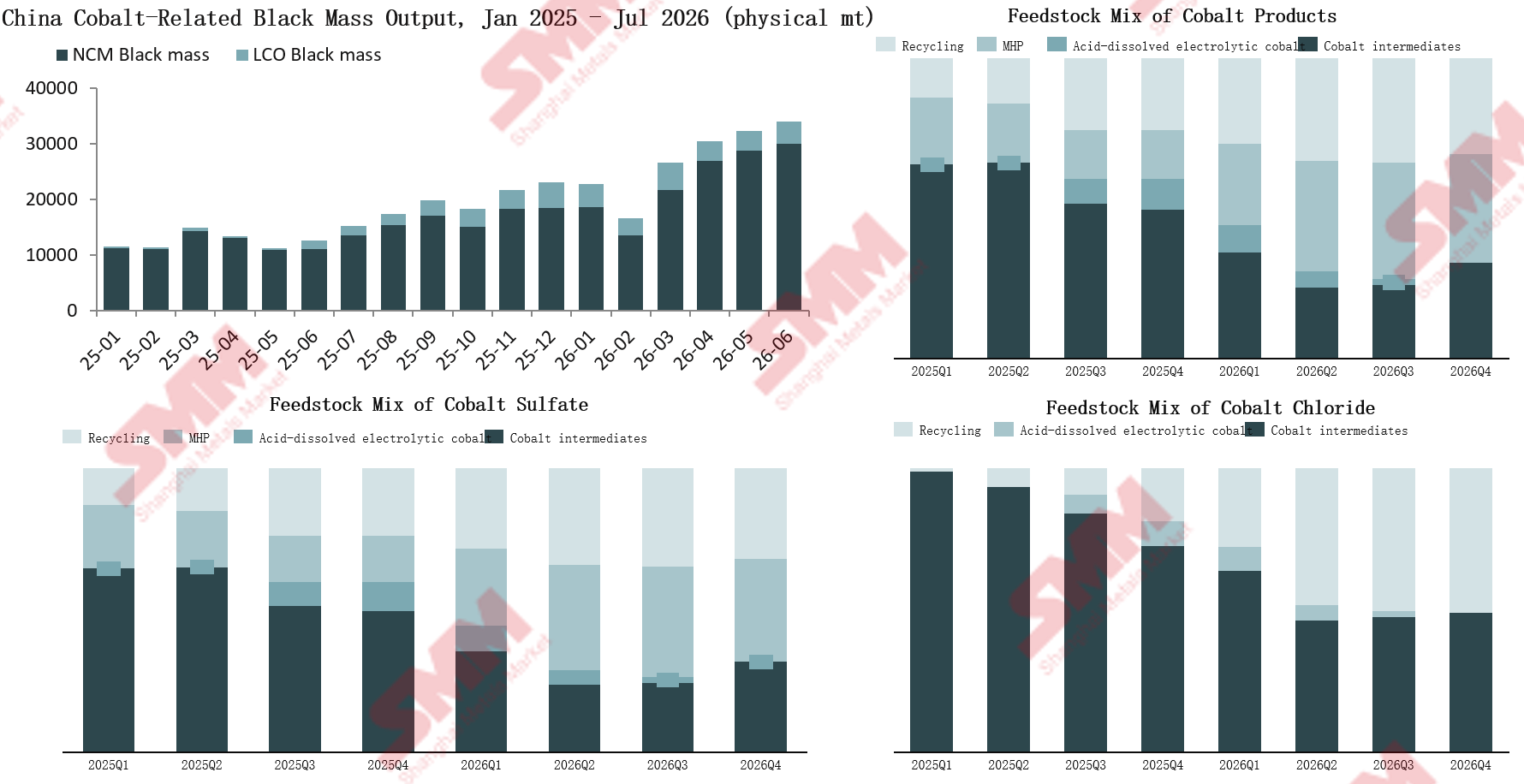
Recycling enters the picture: high profits -> surge in black mass production -> filling the raw material gap
Return to surplus: increased recycling + intermediate products + MHP arrivals -> inventory buildup -> prices under pressure.
Surging black mass production erodes cobalt intermediate products' market share
Lithium price review
By stage:
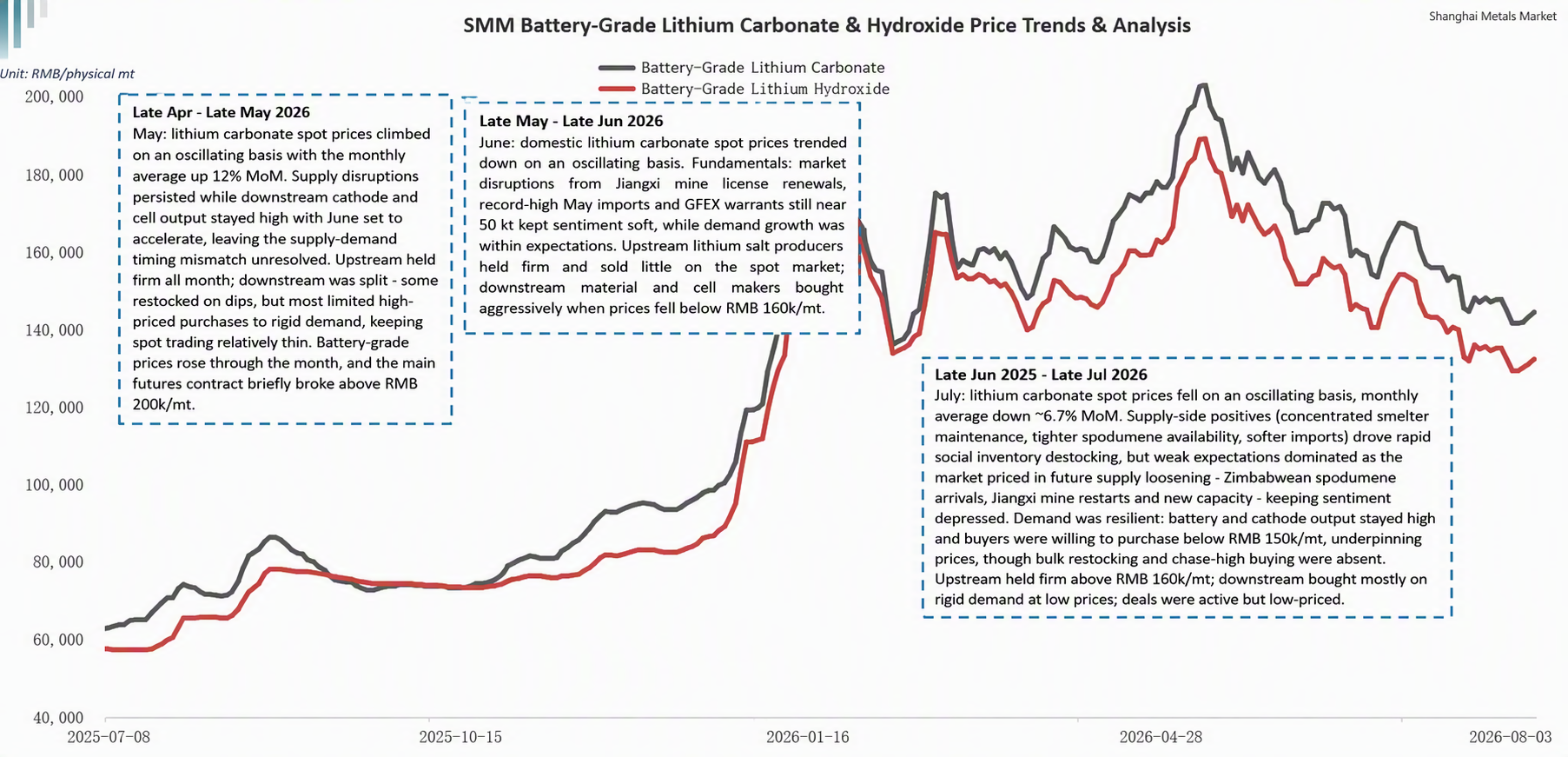
Late Apr 2026-late May 2026:
May: Spot lithium carbonate prices climbed amid consolidation, with the monthly average price up 12% MoM. Supply disruptions persisted, while downstream cathode and battery cell production stayed high, and June production schedules accelerated further, leaving the supply-demand mismatch unresolved. Upstream held prices firm throughout the month; downstream diverged—some restocked on dips, but most limited high-price purchases to rigid demand, leaving spot trades relatively sluggish. Battery-grade prices rose all month, and the most-traded futures contract briefly broke through 200,000 yuan/mt.
Late May 2026-late Jun 2026:
June: China's spot lithium carbonate prices drifted lower. Fundamentals: Market disturbance from Jiangxi mine mining permit renewals, record-high May imports, and GFEX warrants still near 50,000 mt weighed on sentiment, while demand growth met expectations. Upstream lithium chemical producers held prices firm, with few shipments in the spot market; downstream material and battery cell enterprises purchased actively after prices fell below 160,000 yuan/mt.
Late Jun 2025-late Jul 2026:
July: Spot lithium carbonate prices drifted lower, with the monthly average price down about 6.7% MoM. Supply-side positives (concentrated smelter maintenance, tighter availability of spot spodumene concentrates, and a pullback in imports) drove rapid destocking of social inventory, but weak expectations dominated futures—the market traded ahead of future supply loosening, including Zimbabwe spodumene arrivals, Jiangxi mine production resumptions, and new capacity ramping—keeping sentiment under pressure. Demand-side resilience remained: battery and cathode production stayed high, and buyers showed strong purchase willingness below 150,000 yuan/mt, supporting prices, but large-scale restocking and rush buying amid continuous price rises were absent. Upstream held prices firm above 160,000 yuan/mt; downstream mainly made rigid low-price purchases; trading was active but at low prices.
SMM lithium carbonate supply-demand balance forecast, Jun 2026-Jun 2027E
According to SMM analysis, supply side: In June 2026, lithium carbonate production was basically stable, with new capacity from recycling and spodumene routes ramping up steadily. In July, spodumene-based production is expected to pull back slightly due to tighter availability of concentrates, while lepidolite-based production will benefit from production resumptions at major Jiangxi mines. Overall, July total production is expected to be basically flat MoM.
The 2026 production forecast was raised slightly, with growth mainly from lepidolite, as production resumptions at major Jiangxi mines are expected to bring effective supply growth. Spodumene remains the core source of growth: end-use demand resilience and a higher lithium price midpoint boosted toll processing orders and operating rates at non-integrated producers. On the import side, after Zimbabwe lifted its spodumene export restrictions in April, raw material inventories are expected to be restocked in July-August. The brine and recycling routes are also steadily ramping up alongside new capacity, directly contributing to annual growth. Strong demand and higher prices have improved producer profitability, driving operating rates higher; full-year operating rates should exceed last year's levels.
SMM expects China's lithium carbonate market to show a slight supply deficit in 2026, with the situation easing somewhat in 2027.
Global Battery Recycling Market
Global Theoretical Lithium-Ion Battery and Recyclable Metal Content
Retired batteries currently come mainly from production waste; after 2028, the share of recyclable metals from retired batteries will gradually increase.
SMM expects global theoretical lithium-ion battery recycling volume from social retirement channels to grow at a 46% CAGR from 2026 to 2030, while global theoretical lithium-ion battery recycling volume from production waste will grow at an 18% CAGR; in terms of global theoretical recyclable metal content, SMM expects global theoretical recyclable metal content from social retirement channels to grow at a 43% CAGR from 2026 to 2030.
Global Battery Recycling Enterprises - Black Mass Production
China's black mass production is expected to be approximately 720,000 mt in 2026, reaching 1.85 million mt by 2030. Growth in Europe and North America is particularly strong - Europe's black mass production is expected to approach 90,000 mt in 2026, with North America at approximately 68,000 mt.
China Battery Recycling Market
2026: LFP Black Mass Prices Fluctuate with Lithium Chemicals
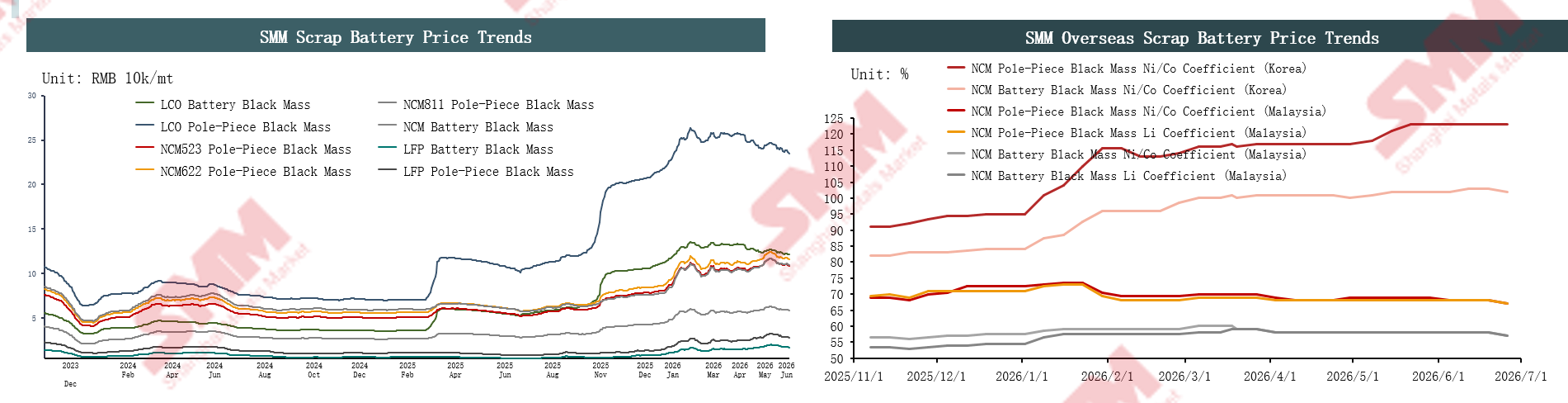
According to SMM analysis:
Hydrometallurgical recycling: In May 2026, nickel and cobalt declined while lithium chemicals consolidated; ternary and LFP recycling payables trended downward overall, and black mass prices diverged. Ternary cathode powder: average nickel/cobalt payables at 79%, lithium payables at 78.5%; LFP cathode powder and battery black mass averaged 8,035 yuan/% lithium and 7,633 yuan/% lithium, respectively; LCO cathode powder: cobalt payables at 82%, lithium payables at 77%.
High-cobalt black mass rebounded slightly in late May due to rigid restocking; ternary black mass edged down but was supported by rising auxiliary material costs; LFP prices followed lithium carbonate futures and spot cargo.
Overseas recycling: In May 2026, the ternary black mass market diverged. South Korea FOB ternary black mass extended its H1 uptrend - cathode powder and battery black mass nickel/cobalt payables stood at 121% and 102%, respectively (up 4.3 ppts MoM / up 2 ppts MoM), with cathode powder outperforming due to tighter supply and lower impurities. Malaysia FOB ternary black mass fell—coefficients at 68% and 57.5% (down 2.9 ppts/3.5 ppts MoM)—dragged by lower cobalt sulphate prices, price transmission from China, unstable battery black mass quality, and purchasing as needed.
H1 2026: Demand recovery and rising nickel and cobalt prices drove hydrometallurgical plants' scrap procurement and utilisation volumes to climb steadily
Overall, scrap procurement volume in H1 2026 increased both MoM and YoY: (1) The recovery in cobalt and lithium prices in 2025 encouraged multiple crushing plants and hydrometallurgical plants to raise production; (2) Although the peak of the retirement wave is expected in 2028-2029, production-side scrap continued to grow YoY. In addition, according to black mass import and export data released in January 2026, black mass imports in 2025 reached 28,000 mt, driving a substantial YoY increase in hydrometallurgical plants' black mass procurement volume in 2026.
Hydrometallurgical production: Most nickel sulphate/cobalt sulphate lines capable of processing scrap are full-extraction lines, meaning they can use MHP, black mass, slag, nickel matte, and other raw materials; producers switch raw materials based on monthly margins. Therefore, the capacity listed for nickel sulphate and cobalt sulphate refers to full-extraction capacity.
Outlook: Recycling's share of global lithium/nickel/cobalt supply is rising; a resource circularity landscape is taking shape
Lithium supply: Recycling share is steadily increasing
By 2030, spodumene's share will fall to 51%, brine and lepidolite will see relatively small adjustments, and recycling's share will rise to 15%—recycled lithium's weight in supply continues to grow.
Nickel supply: Recycled supply is steadily expanding
By 2030, intermediate product will rise to 60%, becoming the dominant source; nickel matte and NPI will contract; recycling's share will edge up to 19%, serving as a stable supplementary channel.
Cobalt supply: Recycling share sees the largest increase
By 2030, copper-cobalt ore will fall to 45%, nickel-cobalt ore will rise to 29%, and recycling's share will jump to 23%—the largest increase among the three metals.
LFP recycling technology is maturing, with capacity and production growing continuously, but its share of total LFP capacity remains relatively small
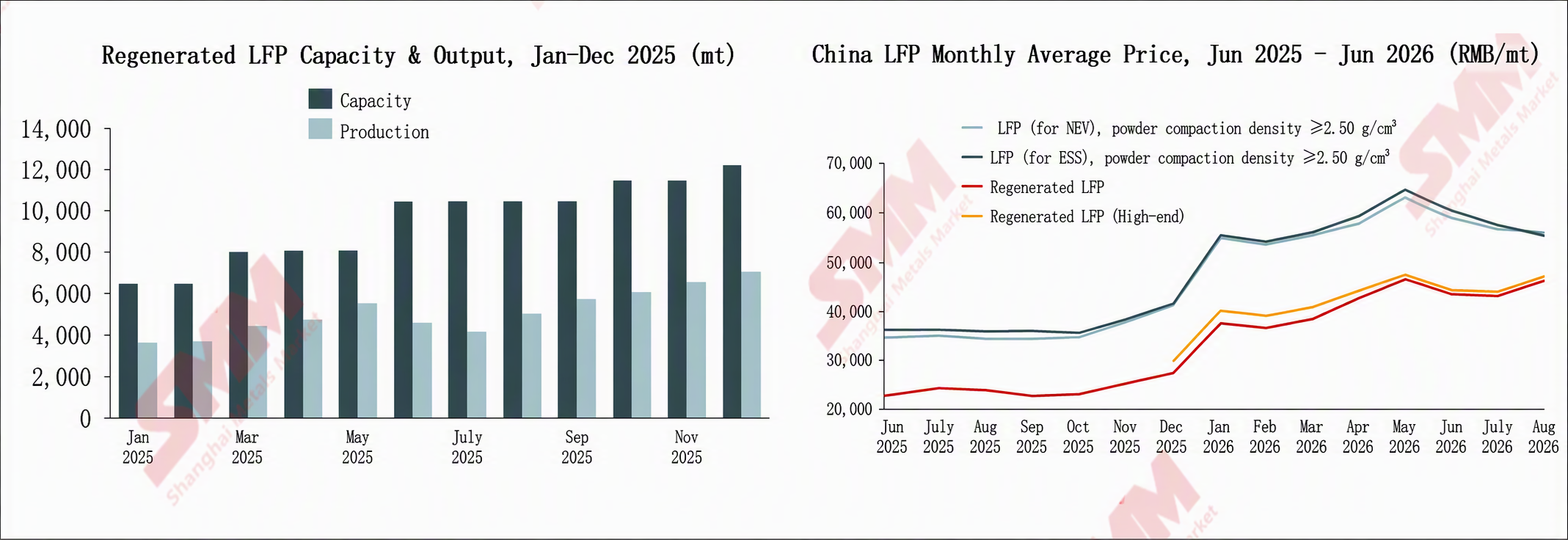
Virgin LFP and recycled LFP:
Price: Recycled = virgin average price × discount (75%-85%)
High-end recycled LFP launched in 2026: tap density ≥2.55 g/cm3.
Capacity and production: Recycled LFP continues to rise alongside rapid growth in the recycling industry—nominal capacity of approximately 150,000-160,000 mt (2025) and approximately 170,000-180,000 mt (2026).
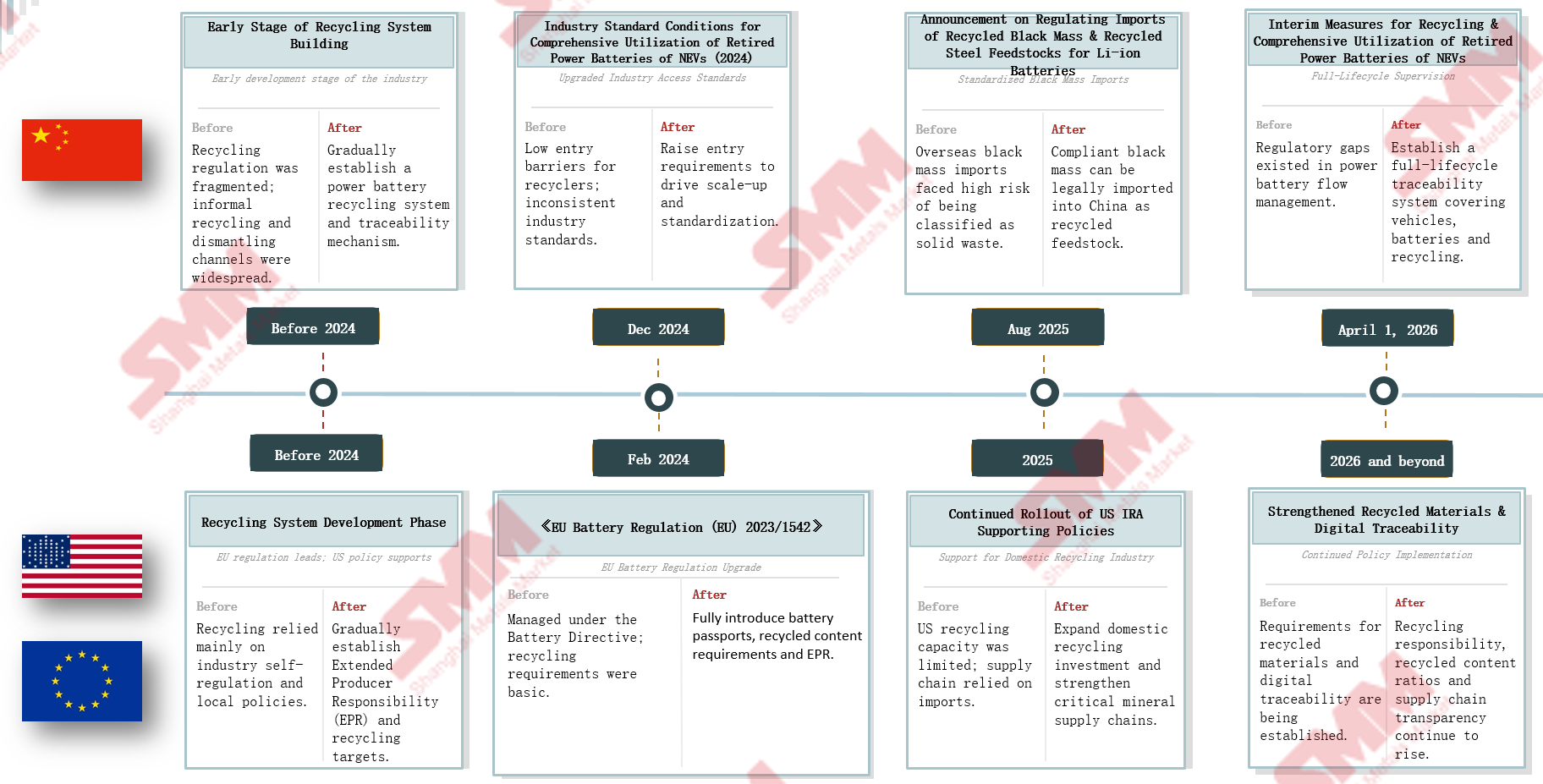
Global policy review (2024-2026): China and outside China (EU and US)

![[SMM Analysis] Cutting 6-series, moving away from CATL: Behind the buzz in August's auto market, ternary is being repriced](https://imgqn.smm.cn/usercenter/DdWJZ20251217171731.jpg)