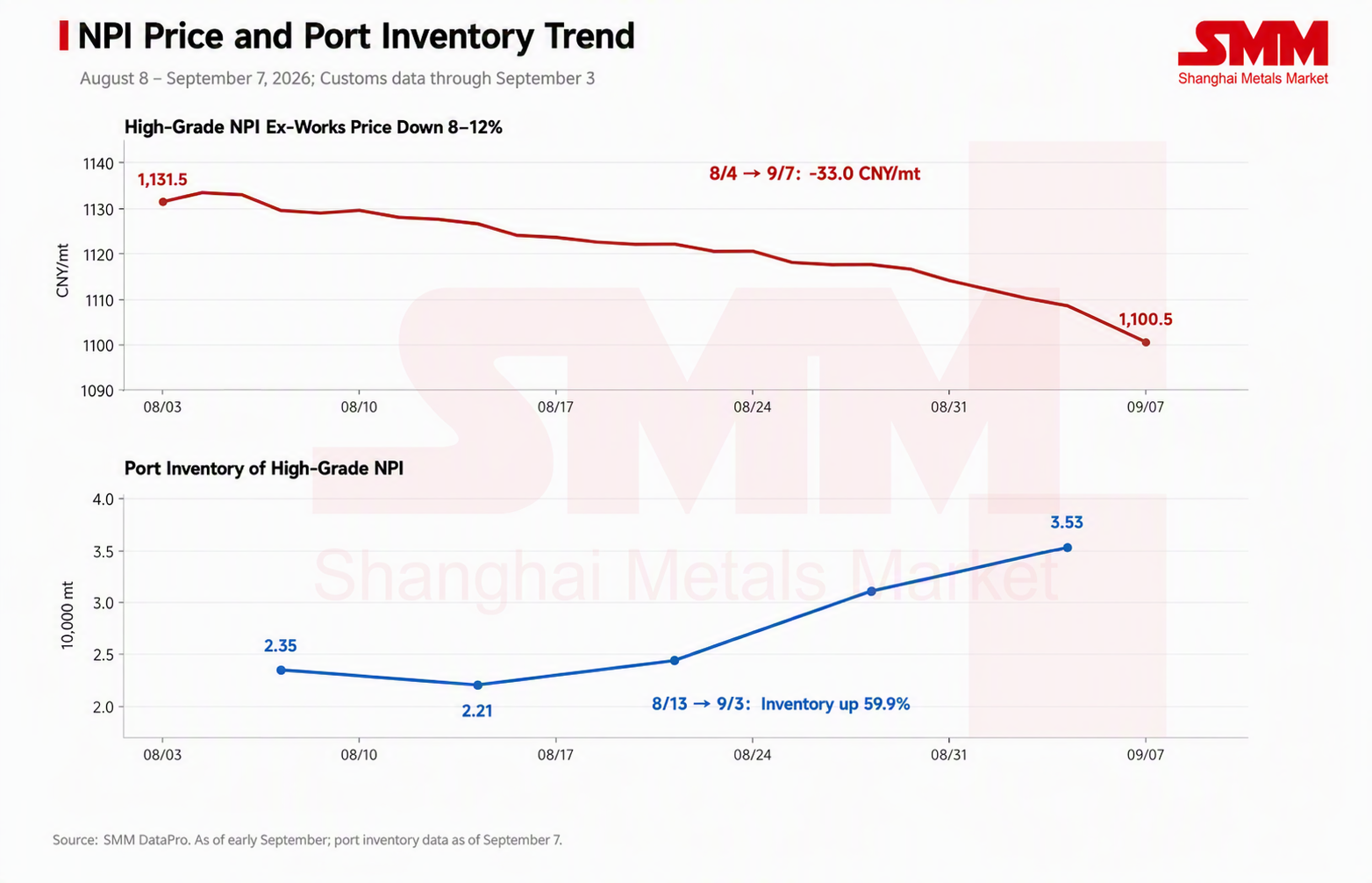
In the second week of September, NPI took another step lower. On September 7, the SMM average EXW price of 8–12% high-grade NPI fell to 1,100.5 yuan/mt Ni, down another 4 yuan from last Friday and a cumulative decline of 13.5 yuan from end-August. A large steel mill lowered its purchase intention to 1,090 yuan/mt Ni, while indicating that its inventory was sufficient and it would not make large purchases for the time being. Some traders reported that offers of 1,100 yuan/mt Ni to steel mills still went unpurchased.
Prices have reached the level discussed repeatedly before, yet buyers have not broadly returned. This says more about the quality of the September peak season than another few yuan of decline would.
On the surface, the peak season has already begun with low-price transactions, and prices should gradually find support. But when raw material inventories are factored in, these two things are not contradictory: steel mills that need material are restocking at low prices, while those with ample inventory continue to wait. Transactions have created a new price reference, but have not yet triggered widespread restocking.
The weak purchasing that was already evident in mid-August remained unchanged into September. Sellers are cutting prices faster than steel mills are resuming purchases.
1. After low-price transactions, steel mills are still waiting
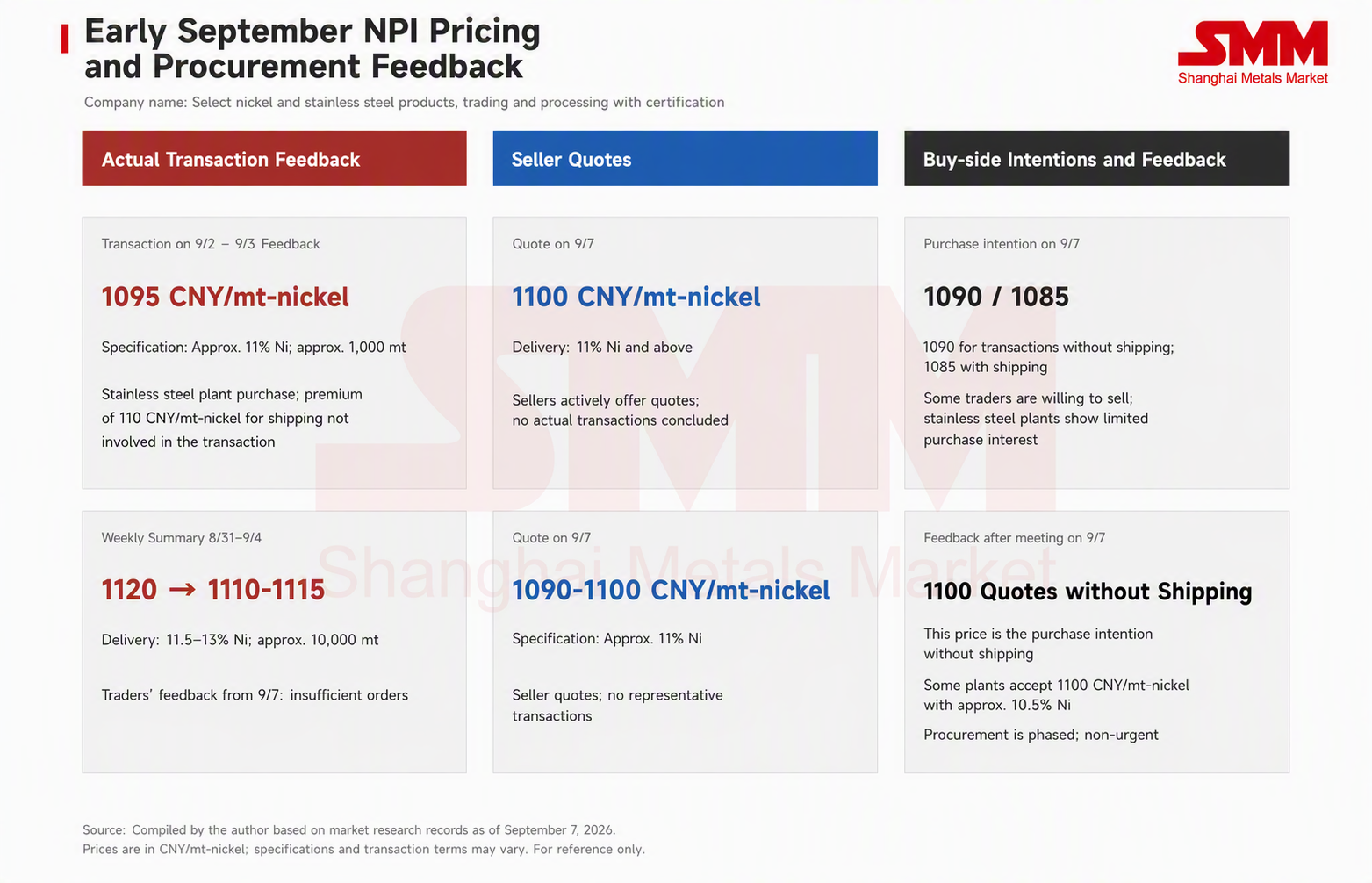
Last week, one steel mill purchased about 10,000 mt of NPI with a grade of around 11% at 1,095 yuan/mt Ni on a delivered basis. A trader also reported cumulative transactions of about 10,000 mt last week, with 11.5–13% material falling from 1,120 yuan/mt Ni delivered at the start of the week to 1,110–1,115 yuan/mt Ni delivered. Low prices have prompted some purchases, but after the transactions, there has been no broad restocking in the market.
By September 7, some traders had received offers of 1,100 yuan/mt Ni delivered for material above 11%, while others reported that steel mills still would not purchase even at 1,100. Sellers continued to cut prices, but buyers did not accelerate purchases as a result.
One large steel mill lowered its purchase intention to 1,090 yuan/mt Ni, while making clear that its inventory was sufficient and it would not make large purchases for the time being. Another steel mill maintained a delivered intention of 1,085 yuan/mt Ni. Traders also reported that many steel mills would only consider purchasing near 1,080 yuan/mt Ni delivered, and buyers' psychological price levels were still moving lower.
Some steel mills are willing to accept current prices. One mill said the same day that it had lowered its purchase grade standard to 10.5% and could accept 1,110 yuan/mt Ni delivered. Purchasing demand still exists, but it is more driven by individual mills' inventory, grade requirements, and material usage plans, and has not yet formed a concentrated force to enter the market.
Steel mills with inventory can continue to wait, while sellers eager to ship need to keep adjusting terms. Whether 1,100 can hold depends on whether purchasing continues after this round of low-price transactions.
2. Premiums are narrowing, but grade differences remain
Buyers' wait-and-see stance is also compressing sellers' premiums.
On August 19, traders reported that some steel mills' purchase intentions had fallen from a premium of 15 to a premium of 5 or parity, and some were in no hurry to buy even at parity. On August 27, market feedback showed that material around 10% had largely fallen to near parity with the SMM average price, and most material below 11% was trading near parity. Premiums for low-grade material loosened first, and the room for sellers to hold prices firm has narrowed.
Higher-grade material still has some support. On September 3, some suppliers were still offering a premium of 10 for 11% material; on September 4, some market participants also reported that 11% material was still trading at a premium. The overall price weakness has not eliminated the supply-demand differences between grades.
But steel mills are also adjusting their purchasing conditions. Some mills have widened their grade standard to 10.5%, meaning their range of acceptable material has expanded. For buyers who can adjust their material usage, higher-grade material will need sufficient use value to justify holding its premium.
Behind this round of premium narrowing is still the change in inventory and purchasing urgency. Steel mills are not short of material, so they have no need to pay more to lock in supply early. Some material can still hold a premium, but that does not necessarily lift the transaction center of the entire market.
3. Inventory replenishment leaves steel mills with little reason to chase material
Caution on the demand side was already evident in mid-August. On August 19, a large steel mill explicitly said its nickel pig iron and steel scrap inventories were sufficient and it was suspending purchases for the time being. By September 7, ample inventory remained its reason for not making large purchases. This purchasing-side thread is more consistent than peak season expectations.
Port cargoes are also increasing. SMM port high-grade NPI inventory rose from 22,100 mt Ni on August 13 to 35,300 mt Ni on September 3, an increase of about 60%. The support previously provided by tight spot supply has gradually weakened as inventory has been replenished, giving steel mills more room to be selective and to wait.
On September 4, some steel mills reported a noticeable increase in sellers proactively asking whether they needed NPI. With more material available, shipping pressure is beginning to show in sellers' actions: beyond quoting prices, they are also proactively seeking buyers willing to take delivery.
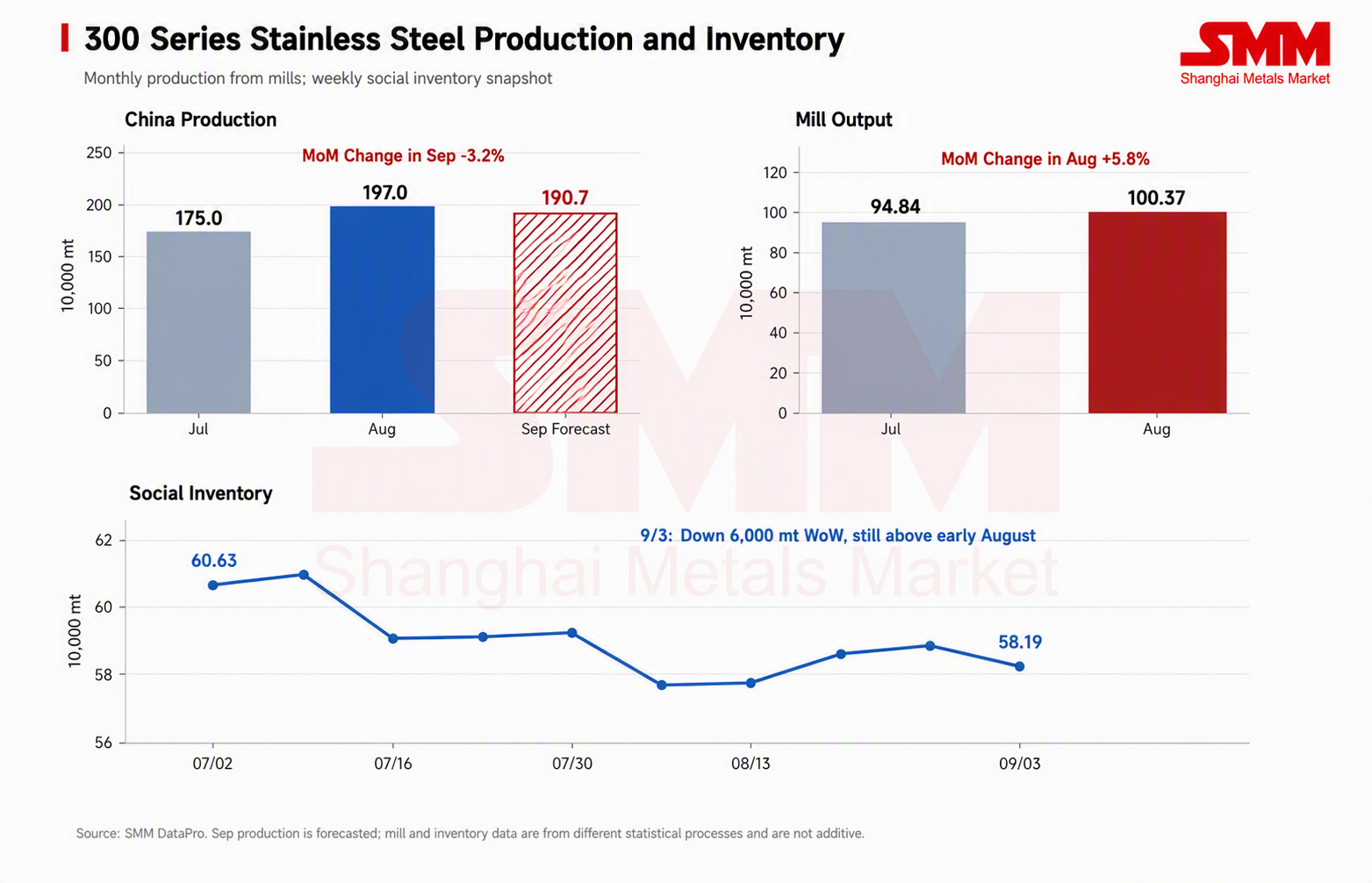
The stainless steel finished product side has likewise not given a strong restocking signal. China's August 300-series production was 1.97 million mt, and the September production schedule is forecast at 1.907 million mt, down 63,000 mt MoM, or about 3.2%. August mill inventory rose from 948,400 mt in July to 1.0037 million mt, meaning produced material still needs to be absorbed, and steel mills have limited motivation to keep adding to raw material reserves.
There are some improvements. On September 3, social inventory was 581,900 mt, down 6,000 mt WoW, but still higher than at the start of August. On September 7, the SMM 304 cold-rolled profit margin rebounded from -0.95% last Friday to -0.76%, with losses narrowing slightly but not yet turning positive.
Weekly destocking and profit recovery have both shown some change, but not enough to prompt steel mills to chase raw material purchases ahead of time. For the peak season to transmit to NPI, finished product sales and inventory digestion need to keep improving, giving steel mills reason to increase external purchases. For now, this process remains slow.
4. Falling ore prices provide a buffer, but Indonesian margins are still narrowing
Domestic purchase prices are moving lower, and Indonesia is adjusting as well. On September 7, the SMM Indonesia NPI FOB index fell to $142.7/mt Ni, down $0.7 from last Friday; the average delivered duty-paid price of 10–12% Indonesian high-grade NPI fell to 1,110 yuan/mt Ni, down 4 yuan from last Friday. Upstream selling prices are already under pressure.
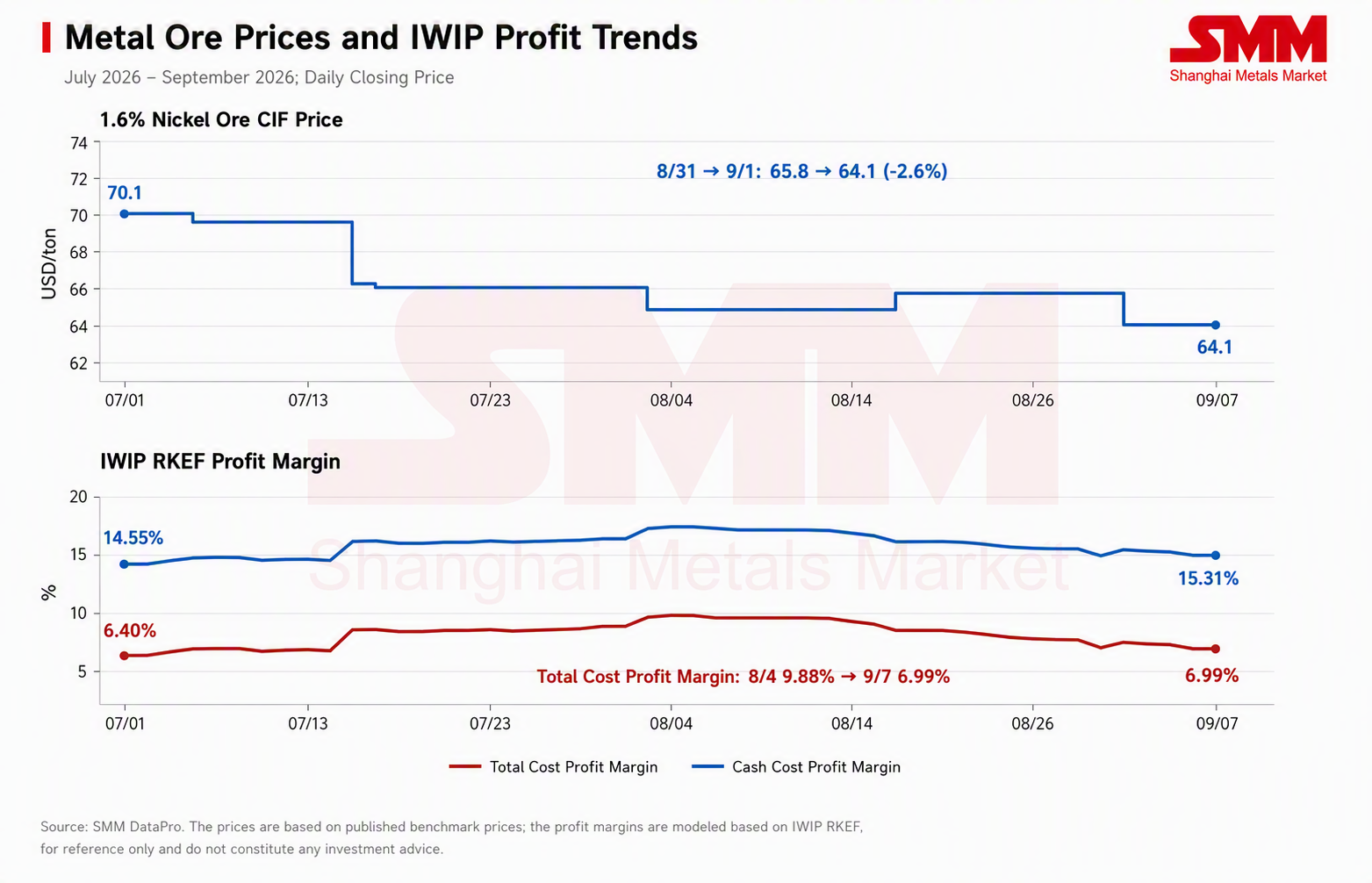
Falling ore prices have provided some buffer for smelters. In early September, the average delivery-to-factory price of Indonesian 1.6% domestic trade ore fell from $65.8/wmt at end-August to $64.1, a decline of about 2.6%, easing raw material purchasing pressure somewhat. Over a longer horizon, compared with $79.3/wmt in late May, the cumulative decline is already close to 20%, and the earlier decline in ore prices has been an important condition for smelters to maintain profits.
But the decline in ore prices has not yet reversed the margin squeeze. On September 7, the SMM IWIP full cost profit margin on current ore was 6.99%, down 2.89 percentage points from 9.88% on August 4; the cash cost profit margin was still 15.31%. Lower raw material prices have eased operating pressure, but the pullback in NPI selling prices continues to squeeze profits. Smelters still have a buffer, but the room to cut prices is narrowing.
On September 7, some suppliers mentioned market talk of drought in parts of Indonesia and reported operating pressure on sellers. If energy, water, and ore conditions continue to deteriorate, production arrangements at some capacity could be affected. This is a supply-side change worth watching.
However, so far, production data still show an expansion in supply scale. Indonesian NPI production rose from 127,500 mt Ni in June to 135,100 mt Ni in August, an increase of about 6% over two months. For the margin squeeze to translate into stronger price support, actual production cuts or a contraction in shipments will need to materialize. The cost buffer from falling ore prices also means some capacity still has room to continue producing.
As the September peak season enters its second week, the market remains constrained by the pace of inventory digestion. Spot price cuts can facilitate some purchases, but they do not necessarily shorten the waiting time for steel mills with ample inventory. The squeeze on upstream margins has also not yet brought a sufficiently clear reduction in supply.
The peak season's boost to raw materials ultimately depends on sustained purchasing. Sellers hope to hold prices near 1,100, but what is really needed is for buyers to keep buying after low-price transactions. Otherwise, the prices being discussed today could still become the starting point for further cuts in the next round of negotiations.
![[SMM Analysis] Golden September: Nickel Pig Iron prices slide as China’s mills delay restocking](https://imgqn.smm.cn/production/admin/votes/imagesFiWYU20260907182545.png)