SMM, September 4:
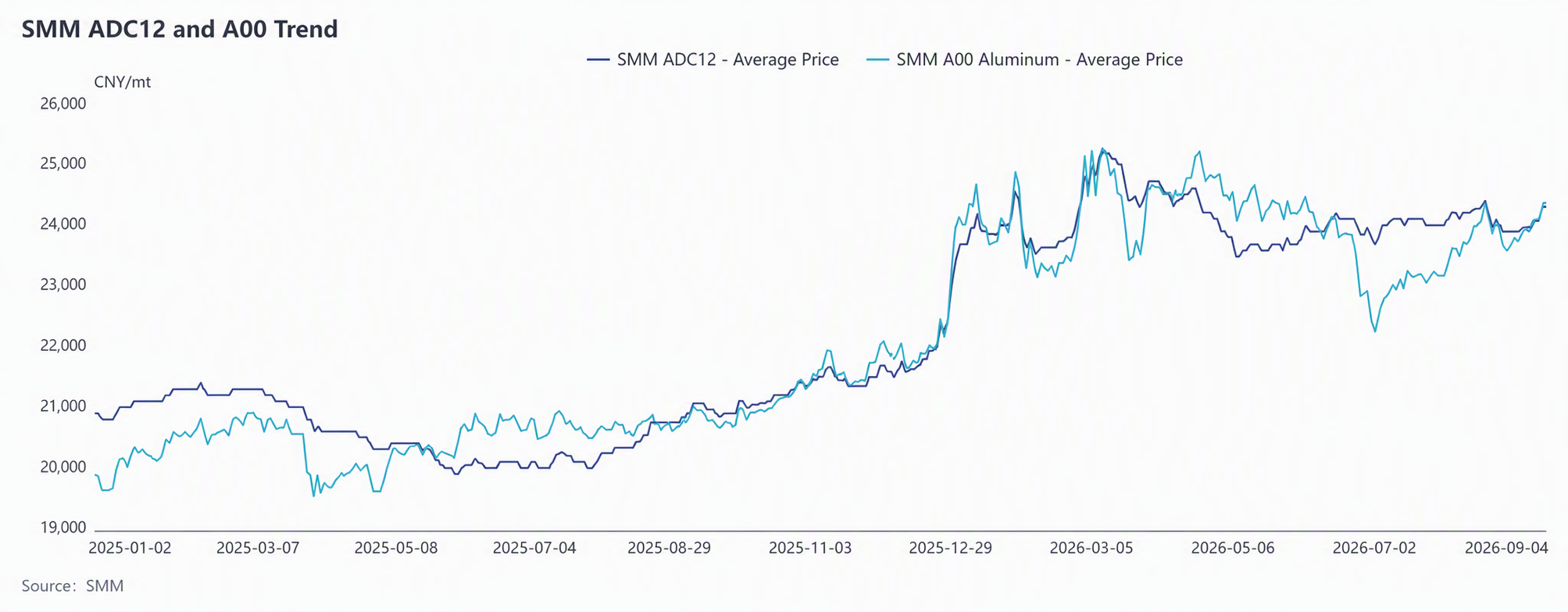
First, a review of secondary aluminum alloy price trends in July: In August, ADC12 prices showed an overall pattern of "strong first, weak later, stabilizing and rebounding at month-end." At the start of the month, prices extended their earlier strength, then gradually pulled back under pressure from weak off-season demand, coming under pressure mid-month. Toward month-end, as aluminum prices strengthened and market sentiment improved, ADC12 prices rose again. As of September 4, SMM's ADC12 quote stood at 24,300 yuan/mt, up a cumulative 200 yuan/mt from early August. Recent A00 and ADC12 price trends and spreads:
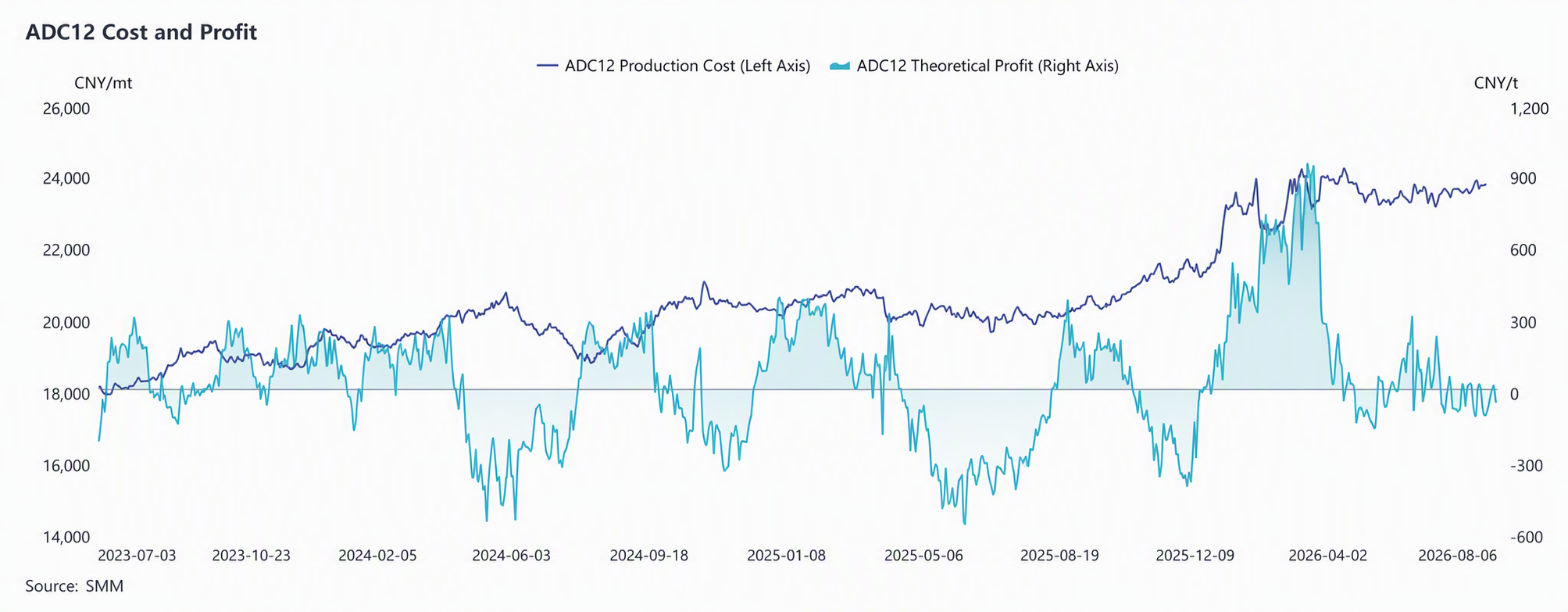
On the cost side, SMM data shows that in August 2026, the industry's theoretical total cost for ADC12 rose 0.2% MoM to 23,577 yuan/mt, with costs of all major raw materials edging up. Among these, aluminum scrap remained the dominant component of ADC12 costs, with per-mt cost rising to 21,286 yuan/mt and its cost share holding at 90.4%; copper cost rose 31 yuan/mt to 902 yuan/mt, accounting for about 3.8%; silicon cost edged up 7 yuan/mt to 487 yuan/mt, accounting for about 2.1%.
In August, the cost side continued to edge up. Although aluminum scrap prices followed aluminum prices lower at times, actual raw material costs remained at relatively high levels due to tight compliant raw material supply, greater procurement difficulty, and a closed import window, providing strong support for ADC12 prices. During the price pullback phase, finished product prices fell faster than costs at one point, narrowing the industry's theoretical profit margin; as ADC12 prices rebounded toward month-end, profit levels recovered somewhat in tandem. Entering September, the industry's theoretical cost for ADC12 is expected to stay high, with the cost center shifting slightly higher from August.
National ADC12 theoretical profit/loss trend:
On the demand side, August remained in the traditional off-season overall, with limited improvement in end-user orders. Downstream purchases were mainly need-based restocking, and market acceptance of high-priced cargoes was low, leaving demand-side support for ADC12 price increases relatively insufficient. However, in late August, market inquiry and purchasing activity picked up from mid-month levels. Entering September, with the arrival of the traditional "September peak season" and the gradual fading of high-temperature off-season effects, orders from major downstream sectors such as automobiles are expected to improve further. ADC12 demand is expected to rebound MoM, with purchasing enthusiasm improving from August; however, the strength of the recovery in actual end-user orders still needs further verification, and the pace and magnitude of demand improvement require continued monitoring.
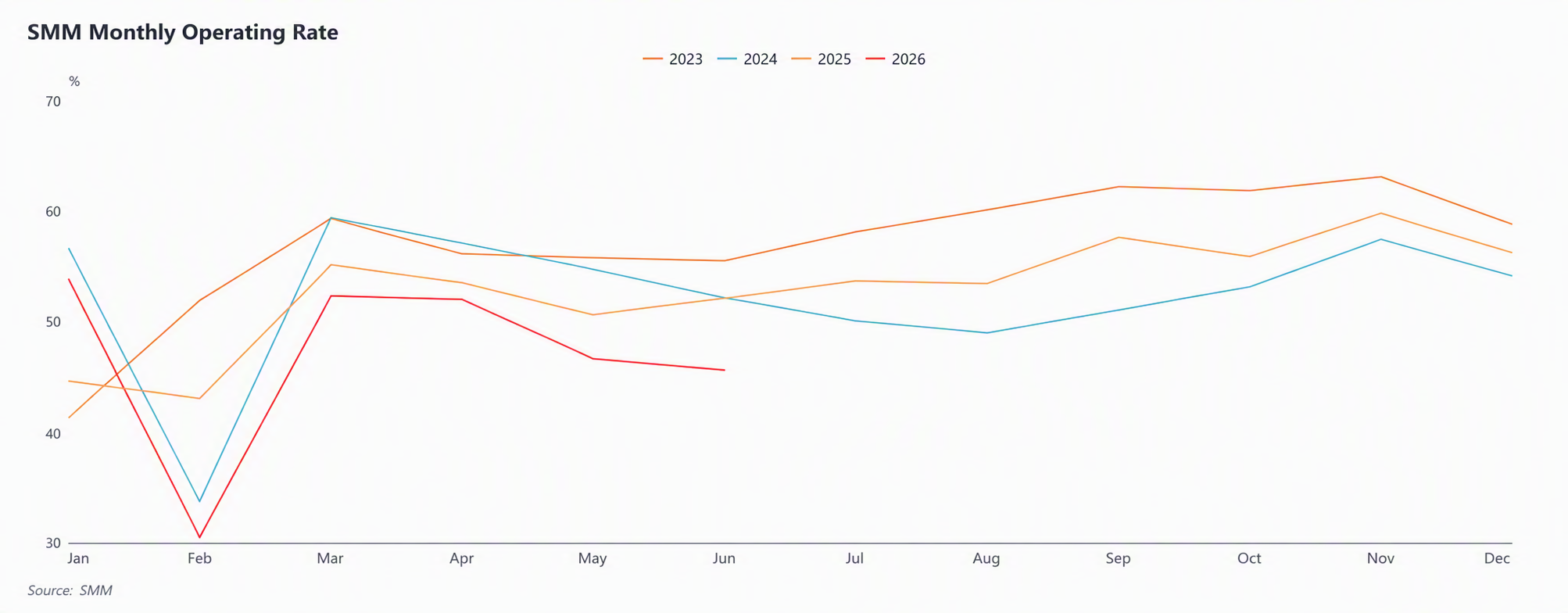
In terms of supply, the operating rate of the secondary aluminum industry was 47.4% in August, up 0.7 percentage points MoM but still 6.0 percentage points lower YoY, with production edging up but falling short of the same period last year. The rebound was mainly driven by a slight easing in orders and raw material supply for some enterprises, coupled with stronger futures at the beginning of the month and increased purchases by spot traders. Some enterprises alleviated finished product inventory pressure through delivery, releasing some capacity. However, the improvement was limited. Downstream sectors in south China and east China were still in the high-temperature holiday period, with weak demand. Combined with tight supply of compliant aluminum scrap, environmental protection-related controls in some regions, and tax invoice compliance risks, production at some enterprises continued to decline, dampening industry production enthusiasm.
Entering September, as the downstream high-temperature holiday period largely ends and the traditional peak season gradually begins, marginal demand improvement will boost enterprises' enthusiasm for production scheduling, and the operating rate has room for further recovery.However, considering that peak-season order releases remain limited, tax supervision is tightening in some regions, compliant aluminum scrap procurement is difficult, and the Mid-Autumn Festival holiday may affect production at some enterprises and downstream procurement pace, the September operating rate is expected to recover mildly, with the overall level still unlikely to reach the same period last year. Going forward, close attention should be paid to order recovery, tax invoice policy changes, raw material supply in China and overseas, and the impact of holiday factors on production pace.
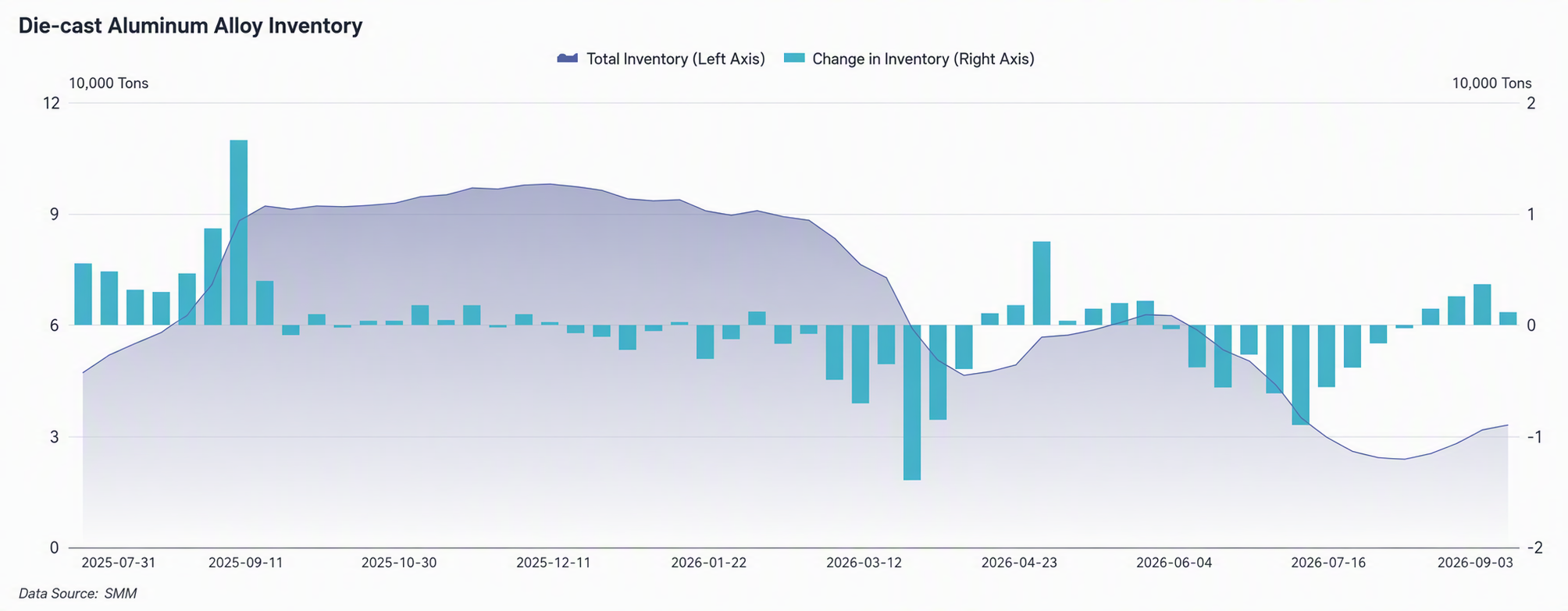
On the inventory side, August social inventory showed a clear shift from destocking to inventory buildup. After ten consecutive weeks of destocking at the beginning of the month, warehouse withdrawal momentum gradually weakened due to weak demand in the high-temperature off-season and downstream procurement dominated by rigid demand. In mid-August, inventory ended its destocking phase and shifted to buildup, with the pace of accumulation subsequently widening. Purchases by some spot traders further increased warehouse inflows. As of September 3, social inventory rose to 33,000 mt, marking the fourth consecutive week of buildup. Recent inventory growth was mainly concentrated in Zhejiang, Guangdong, and Jiangsu. Entering September, although downstream sectors are gradually entering the traditional peak season, demand has not yet fully recovered, and inventory still faces slight buildup pressure in the short term.
Entering September, ADC12 prices are expected to maintain a consolidating-on-a-strong-note pattern, with the price center still having room to move higher, but the pace and sustainability of the rise will depend on whether peak-season demand can be substantively realized.On the cost side, if aluminum prices continue to hold up well, combined with high aluminum scrap prices and tight supply of compliant raw materials, ADC12 cost support will remain solid. Meanwhile, the closed import window limits the replenishment of low-cost overseas supply, leaving relatively limited downside room for prices. The demand side is the key variable for whether prices can break above previous highs in September: if orders from major downstream sectors such as automobiles and motorcycles continue to improve, spot transactions are expected to gradually increase, and ADC12 will gain further upward momentum on top of cost support. Conversely, if peak-season demand improvement falls short of expectations, then against the backdrop of a gradually recovering operating rate and continued social inventory accumulation, spot upward momentum may be insufficient, and prices will return to a pattern of consolidating at highs. Overall, the market logic in September will gradually shift from "cost-driven" to "cost support + demand verification." In the short term, close attention should be paid to tax invoice policy trends, changes in aluminum scrap costs, and the recovery of downstream orders. The expected price range for September is 24,000–24,800 yuan/mt.
![ADC12 Prices Rebound in Late August; Peak-Season Demand to Support September Prices [SMM Analysis]](https://imgqn.smm.cn/usercenter/hRRxy20251217171652.jpg)
![Arbitrage flows between Shanghai and Guangdong continue, lifting SHFE aluminum premiums [SMM Spot Aluminum Midday Review]](https://imgqn.smm.cn/usercenter/gdRUL20251217171651.jpg)