European APT Prices Stagnant at Highs: Price Spread Between Chinese and Overseas Markets Widens to $2,000/mtu
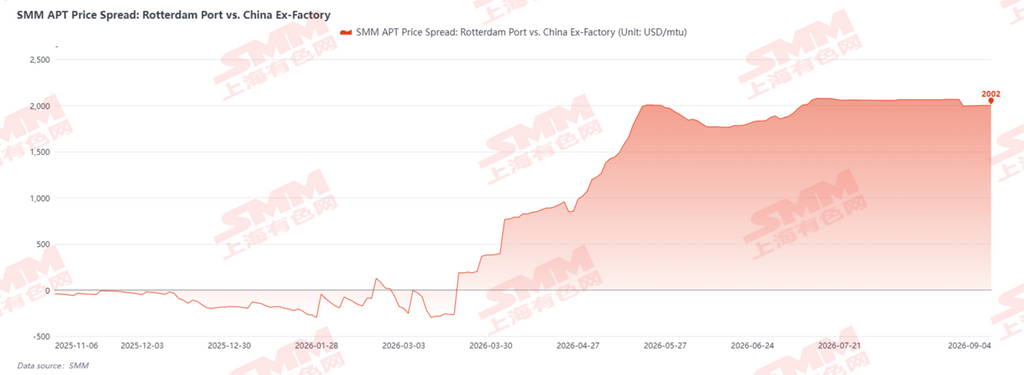
As of September 4, 2026, SMM APT CIF Rotterdam port quotes stood at $2,900-3,100/mtu, with an average price of $3,000/mtu. Since the sharp rally in April, European APT prices have remained above $3,000/mtu. Meanwhile, domestic APT prices in China have continued to grind lower. Based on the current domestic APT price of 595,000 yuan/mt, the price spread between Chinese and overseas markets has widened to approximately $2,000/mtu.
Five Reasons Behind the Consolidation at Highs in Europe
- Prices Without Volume, Long-Term Contracts Dominate: Most European APT smelters are affiliated with downstream tungsten powder and cutting tool enterprises, operating within an internal long-term contract execution system across the entire industry chain. They essentially do not sell spot APT, and spot market circulation is extremely limited.
- Highly Concentrated Smelting Capacity: Independent APT smelters are extremely scarce in the international market. The few existing smelters control retail APT quotes, maintaining a monopolistic structure in spot order pricing.
- Thin Toll Processing Margins: Based on current Rotterdam APT prices, the processing fee margin for mining and resale is extremely limited. Smelters with existing long-term contracts lack the incentive to take on toll processing business.
- Weak Downstream Demand: The summer break off-season, combined with sluggish demand from cutting tool manufacturers, has strengthened the trend of scrap substituting for primary material. Chinese deep-processed finished products are squeezing the market share of small and medium-sized plants, resulting in scarce buying interest and difficulty in realizing APT trade circulation at current prices.
- Difficulty in Expanding Smelting Capacity: Building a new independent APT smelter is far more difficult than a scrap recycling plant, requiring a construction period of 2-3 years, making it hard to generate effective incremental supply in the short term.
Mine-Side Incremental Growth Accelerates, but Smelting Bottleneck Emerges
Overseas mine-side projects have continued to come online this year. The offtake agreement between Almonty-controlled Sangdong tungsten mine in South Korea and GTP has been extended to 21 years, with total contract volume increased by 40% to 4.41 million mtu, and a minimum annual offtake of 210,000 mtu (approximately 3,230 standard tonnes). Canada's Pure Tungsten plans to achieve first production at the Shuangfeng tungsten mine in South Korea in June 2026. Both mines are in the production ramp-up stage, with South Korean tungsten concentrate incremental growth expected at approximately 3,500 standard tonnes in 2026. Additionally, Tungsten West has reached an agreement with the UK National Wealth Fund for an investment of up to £71 million, targeting production commencement in Q3 2026 and full ramp-up in Q1 2027.
On the smelting side, Vietnam's Masan High-Tech Materials has signed a tungsten concentrate processing cooperation agreement with South Korea's GB Innovation to supply APT for the semiconductor industry. However, overall, there is currently no news of new independent APT smelter construction. Existing smelters are either executing long-term contracts across the entire industry chain or have already taken on substantial toll processing business with capacity running at full utilization. New production lines still require more than a year to complete.
Supply-Demand Imbalance Shifts from Mine Side to Smelting Capacity Shortage
The core contradiction in the international tungsten market has gradually shifted from tungsten ore shortages to smelting capacity shortages. Even if more mines come into production, it will be difficult to convert this into tradable APT smelting products in the short term. Currently, the raw material gap for low and mid-end and cutting tool production is primarily filled by the scrap recycling system—Japanese and German cutting tool enterprises have established comprehensive scrap recycling industry chains, and there are also large numbers of scrap tungsten traders operating in Southeast Asia, Europe, and elsewhere.
Until a complete smelting system is rebuilt, overseas end-users will mainly rely on scrap recycling to produce zinc melt material for cemented carbide production, but demand gaps remain in high-end pure tungsten applications. The short-term solution may be to increase procurement of high-value finished products from China, while the medium and long-term approach requires building complete independent APT smelting capacity to address the dilemma of industry chain disruption.
Chinese Market: Supply and Demand Remain Weak, Awaiting Mild Uptick After Inventory Digestion
As of September 4, domestic APT quotes stood at 590,000-600,000 yuan/mt, grinding lower by 2.46% from the beginning of last month. The domestic market is currently in a state of weak supply and demand: the flooding season in July-August affected some domestic ore production, and during the traditional off-season, end-users only maintained essential restocking, with large-scale "September peak season" restocking yet to materialize. Additionally, APT plant inventories remained elevated from the earlier period, and trader willingness to stockpile was weak. Both the mine side and APT side maintained reduced production, focusing primarily on fulfilling long-term contract deliveries. After partial inventory digestion, tungsten prices are expected to see a mild upward adjustment.
In the medium and long term, China's exports of finished tungsten products will gradually increase, boosting domestic demand: first, Chinese products hold a price advantage in the international market; second, with overseas capacity shortages, more high-end production line supply will depend on China. Currently, the Chinese and international tungsten industry chains have gradually moved toward operating independently and becoming disconnected from each other, with industry chain division of labor and linkage clearly weakening. It will still take considerable time for the international tungsten market to establish a complete independent supply system.