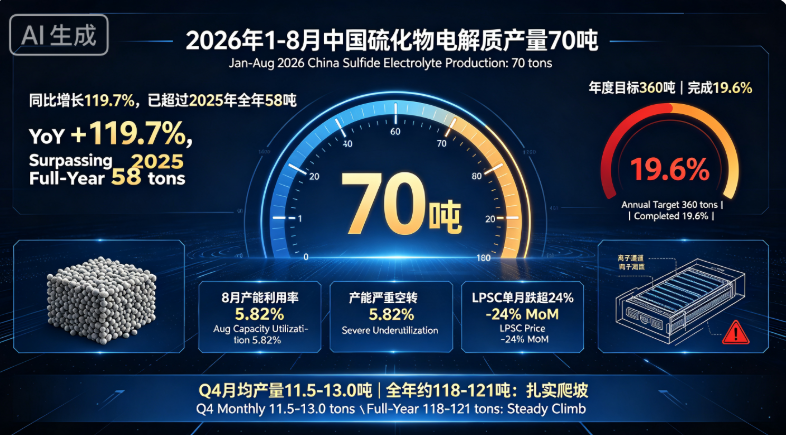
Key takeaway: In January–August 2026, China’s cumulative sulfide electrolyte production reached 70.44 tonnes, up 119.7% year‑on‑year and already surpassing the full‑year 2025 total (58.29 tonnes). However, this impressive growth masks three harsh realities: ① only 19.6% of the annual forecast (360 tonnes) has been achieved; ② capacity utilisation in August stood at just 5.82%, meaning huge idle capacity; ③ product prices continue to plummet (LPSC fell over 24% month‑on‑month). Q4 monthly output is likely to settle in the 11.5–13.0 tonne range, with full‑year total around 118–121 tonnes – a “solid but gradual climb”. Annual forecast 360 tonnes, but only 70 tonnes delivered in the first eight months: the “moderate volume growth” of China’s sulfide electrolyte versus the reality gap.
I. Production Review
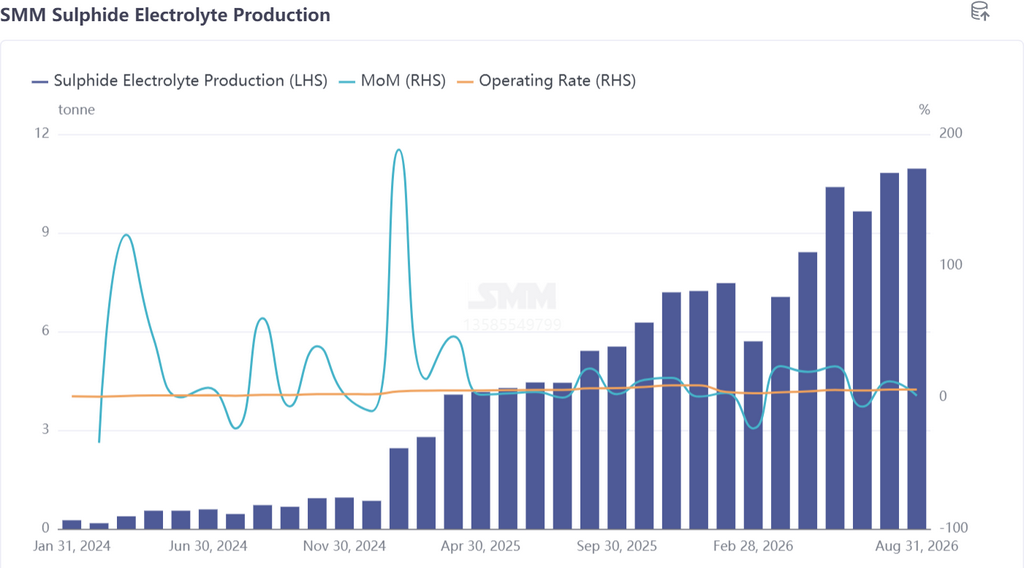
Looking at the cumulative performance for the first eight months, China’s sulfide electrolyte production from January to August 2026 totalled about 70 tonnes, an increase of roughly 120% compared with the same period in 2025 (about 32 tonnes). This volume already approaches 75% of the full‑year 2025 output (94 tonnes), while the entire 2024 annual production was only about 7 tonnes – the industry’s “tonne‑scale release” outline is beginning to take shape. In August, monthly production reached a new record high of nearly 11 tonnes. Despite this record, the month‑on‑month growth rate fell back to single digits from the double‑digit gains seen between May and July (May vs. April: +23.5%, July: +12.1%, but August only +1.2%), indicating that August output was in a “plateau within the climb” phase. This aligns perfectly with the industry cycle: the first half of the year was dominated by “line construction, commissioning, and sample delivery”.
But let’s bring this back to reality: what does 70 tonnes mean? It is roughly equivalent to the daily output of a medium‑sized chemical plant for a basic chemical product. As the core material for solid‑state batteries, this absolute volume clearly shows that the industry is still in the early stage of “sample verification and small‑batch procurement” – far from mass commercial application. Even though production reached 70 tonnes, actual shipments are only just over half of that. Product yield and consistency still need improvement, and the customised procurement model adopted by downstream cell makers means that sulfide electrolyte cannot be sold on a “one‑size‑fits‑all” basis to multiple customers.
Even more critically, this 70 tonnes is “production”, not “effective supply”. According to SMM data, actual sulfide electrolyte shipments are only about 60% of production, leaving a significant gap: a considerable portion of the product is still in the stage of line commissioning, process validation, or quality ramp‑up, and has not yet been accepted or recognised by downstream customers. In other words, not only is the volume small, but the “effective output” that can actually reach end‑users is even smaller.
The root causes lie in two hard constraints:
First, the bottleneck of yield and consistency. Sulfide electrolytes are extremely sensitive to moisture and oxygen, and batch‑to‑batch stability in large‑scale production is a well‑known industry challenge. There remains a huge gap between being able to “make a sample” on a pilot line and being able to “deliver qualified products in bulk”.
Second, customised procurement prevents scalable replication of supply. Currently, downstream cell manufacturers mostly adopt a one‑to‑one joint development model, each with custom requirements for electrolyte composition, particle size, ionic conductivity, etc. This means that for each customer, the material producer often has to adjust formulations and process parameters separately, making it difficult to achieve standardised, high‑volume production and sales like mature lithium‑ion battery materials. The already small output is further fragmented into multiple “custom batches” – a severe test for cost control and delivery efficiency.
Taken together, 70 tonnes of production, 49 tonnes of shipments, capacity utilisation below 6%, and continuously plunging prices paint a clear picture: sulfide electrolytes have indeed crossed the “0‑to‑1” laboratory threshold, but the “1‑to‑100” journey of scale‑up has only just begun.
II. Three Forces Behind August’s High Production
2.1 Supply‑side: production lines coming online in concentration
On 5 August, Sinocera (Guoci Materials) announced that its automated sulfide electrolyte production line had been completed, establishing initial mass‑production capability – seen as a key milestone for China’s sulfide electrolyte transition from “lab samples” to “line‑scale supply”.
Tianci Materials’ 100‑tonne‑per‑year lithium sulfide and sulfide electrolyte pilot line is expected to be completed and put into operation in Q3.
Tianshi Kefeng secured tens of millions of yuan in new financing, accelerating its sulfide electrolyte capacity expansion.
Ronbay Technology also plans to complete a ten‑tonne‑scale sulfide electrolyte production line within the year.
2.2 Demand‑side: stocking momentum continues
In July, a major new‑energy OEM completed a 1‑tonne tender for sulfide electrolyte, with the winning bid below 2 million yuan/tonne – marking the industry’s official transition from “kilogram‑scale transactions” to “tonne‑scale transactions”. Downstream cell makers are gearing up for the 2027 vehicle installation milestone, with procurement and stocking intentions continuing to rise. In August, a series of validation events boosted confidence: Zhongke Yuanben completed China’s first real‑vehicle road test of a sulfide‑based all‑solid‑state battery, and Gaoneng Shuzao’s 20Ah sulfide all‑solid‑state cell passed the 4mm steel‑needle penetration test – both reinforcing optimism for the sulfide route.
2.3 Raw material costs decline, lowering expansion barriers
Battery‑grade lithium sulfide prices have dropped to about 1,300 yuan/kg (down more than 50% from the beginning of the year). High‑purity lithium sulfide accounts for 70%–80% of the total cost of sulfide electrolyte, so the raw material price decline directly reduces the cost of scaled‑up electrolyte production.
III. Capacity Review
What deserves even more attention is capacity. Sulfide electrolyte capacity is now substantial, with players already in production including Guyan, Guolian, Saike, Ruigu, Yili, Sinocera, Yinshi, Tianshi Kefeng, Jiangfeng, Langu, Guneng, etc., and upcoming players like Tianci.
Monthly effective capacity expanded from 39.17 tonnes/month in 2024, to 80 tonnes/month in March 2025, and then jumped to 187.6 tonnes/month in January 2026 – with a slight adjustment to 188.1 tonnes/month in August. Over two years, capacity has grown by 4.8 times (annualised to about 2,257 tonnes), while production has only about doubled.
The result: operating rates have been diluted. In December 2025, the operating rate once climbed to 9.0%; after the capacity jump in January 2026, it plunged to 4.0%; in February (Chinese New Year + capacity ramp) it hit a low of 3.0%; and by August it had recovered only to 5.8%.
Capacity is already in place. The big question for the industry – and one that upstream raw material suppliers are extremely concerned about – is whether Q4 production will accelerate. In the fourth quarter, monthly output is expected to reach the 12–13 tonne range, with full‑year totals likely between 115 and 125 tonnes. A true step‑change will have to wait until demonstration vehicle orders materialise in 2027.
IV. Price Analysis: From “Luxury” Pricing to Affordability
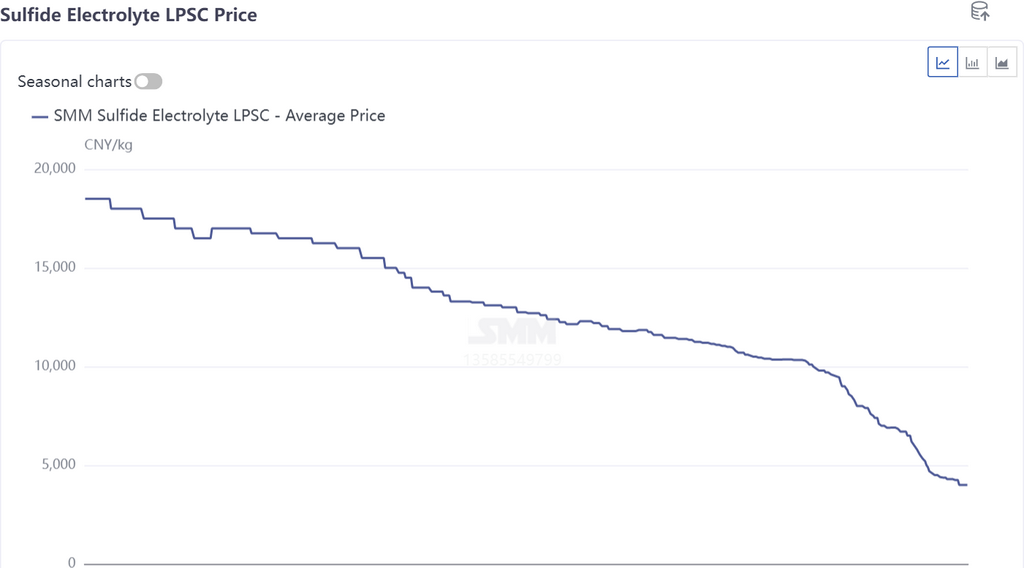
The sulfide electrolyte market is still in the typical “early‑stage commercial pricing” phase, with LPSC prices at about 4 million yuan/tonne (i.e., 4,000 yuan/kg). For the cost‑sensitive power‑battery industry, this is effectively “luxury” pricing.
In contrast to the moderate growth in production, sulfide electrolyte prices continued their accelerating decline in August. The average price of LPSC (Li₆PS₅Cl type, powder D50 ≤ 3μm) fell from 4,500 yuan/kg at the start of August to 4,000 yuan/kg by 26 August – a monthly drop of about 11%. Compared with the 6,700 yuan/kg level at the beginning of July, the cumulative decline is about 40%, and year‑on‑year (vs ~11,800 yuan/kg in August 2025) the drop is roughly 66%.
Downstream battery manufacturers have a clear cost‑reduction roadmap:
Short‑term target (1‑2 years): they expect prices to fall below 2 million yuan/tonne, to provide a basic economic basis for small‑scale demonstration applications.
Long‑term target (3‑5 years): they aim for a price range of 500,000–1,000,000 yuan/tonne. Only at that level can sulfide solid‑state batteries compete substantively with conventional liquid‑electrolyte and semi‑solid batteries on cost.
The significance of these price expectations is not about “bargaining” but about forcing material producers to shift their cost model – from lab‑scale small‑batch preparation (grams, kilograms) to industrial‑scale mass production (tonnes, tens of tonnes). Through scale effects – spreading fixed asset depreciation, lowering raw material procurement costs, and improving yield – it becomes possible to reduce the unit cost from millions of yuan per tonne to under a million.
Looking at the current landscape, the upstream key raw material lithium sulfide has already fallen sharply from its early‑year highs, dropping over 50% in the past six months to around 1,300 yuan/kg. This rapid decline in upstream raw material prices is opening up room for further reductions in final electrolyte product prices. However, we are still only halfway to the 2‑million‑yuan/tonne short‑term threshold set by battery companies – there remains nearly half of the cost‑reduction gap to be closed.


**Note:** For further details or inquiries regarding solid-state battery development, please contact:
Phone: 021-20707860 (or WeChat: 13585549799)
Contact: Chaoxing Yang. Thank you!
![[Solid-state battery: sulphide electrolyte production 70 mt, January-August]](https://imgqn.smm.cn/usercenter/Bwmed20251217171726.jpg)
![August Sulphide Electrolyte Analysis: Production Hits a New High, but Why Is the Operating Rate Still Languishing? [SMM Analysis]](https://imgqn.smm.cn/usercenter/akEdZ20251217171728.jpg)