On the last day of August 2026, SK On announced it had signed a five-year LFP pouch battery cell supply contract with US energy storage company NeoVolta Power, with a total supply volume of 9GWh. An additional 9GWh order may be added within the year, potentially expanding the total collaboration scale to 18GWh.
Almost simultaneously, Samsung SDI was revealed to be about to finalize a three-year LFP battery cell supply agreement worth trillions of won with an ESS integrator, with annual supply volumes reaching several GWh.
Earlier in mid-July, another South Korean battery giant, LG Energy Solution, secured battery orders for Google's largest global "PV+ESS" project. The project has a planned total ESS capacity of 2.9GWh, with LG Energy Solution exclusively supplying all ESS batteries using LFP ESS cells produced locally in North America.
Within less than two months, the three major South Korean battery companies specializing in ternary routes have aggressively secured orders in the ESS sector, collectively shifting to LFP. Behind this move lies their hope to hedge against overall market share declines in the EV market through ESS sector deployments.
Power Battery Slowdown, ESS Sector Retreat
LG Energy Solution, Samsung SDI, and SK On were once key players in the global top 10 power battery rankings, but their market shares have further shrunk in recent years.
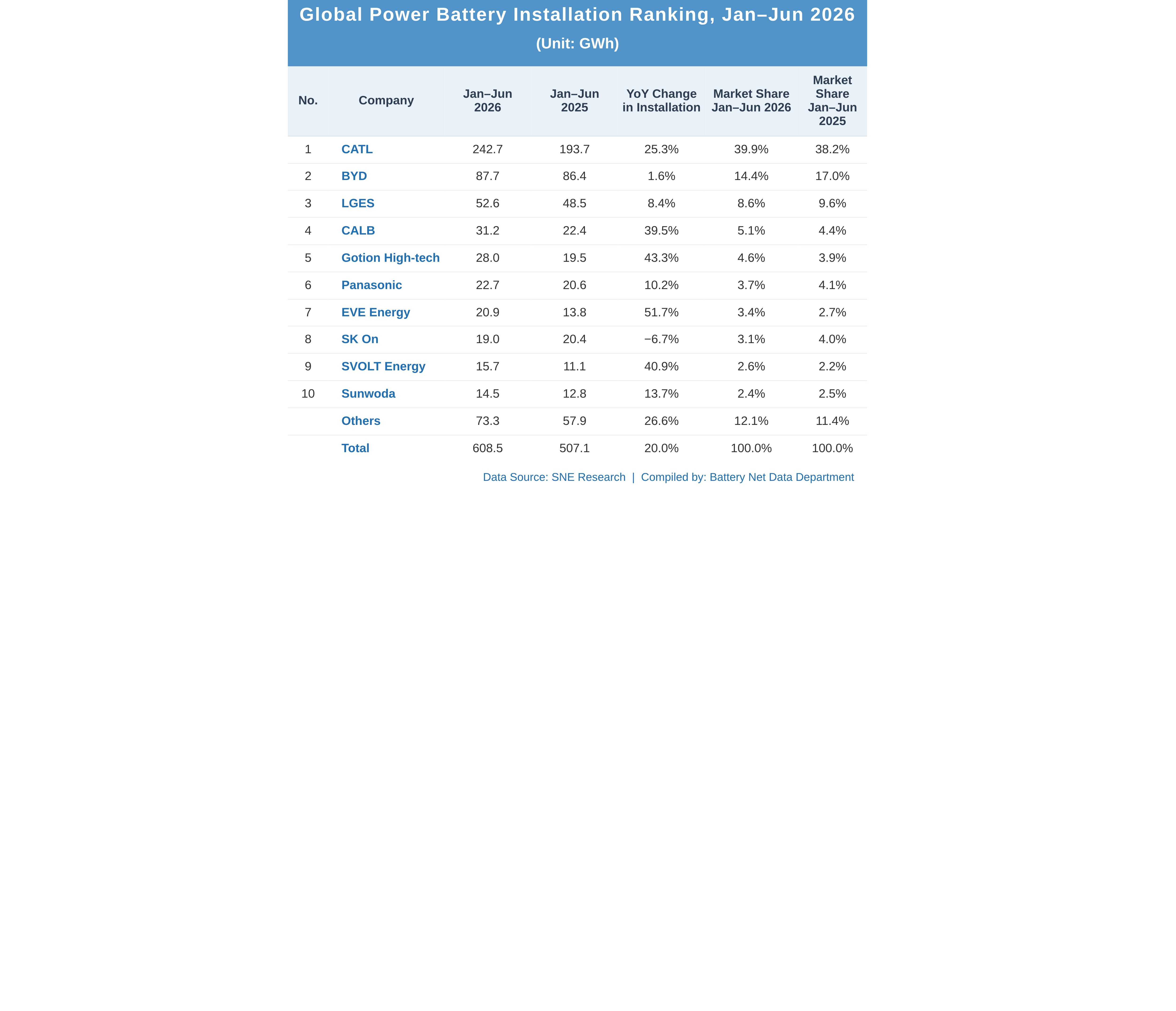
Data from South Korean research firm SNE Research shows that in 2025, the three South Korean battery companies held a global market share of 15.4%, down 3.3% YoY.
In Q1 2026, their market share stood at 15.6%, down 2.1 percentage points YoY. Among them, Samsung SDI's installations fell 27.7% YoY, dropping out of the top 10.
In H1 2026, growth slowed significantly. After Samsung SDI exited the top 10, only LG Energy Solution and SK On remained, with combined installations of 71.6GWh. Their global market share shrank from 13.3% to 11.7% YoY.
Even excluding the Chinese market, these three battery companies saw continued declines in global market share: 36.3% in 2025 (down 7.4 percentage points YoY).
In Q1 2026, their market share was 29.6% (down 8.3 percentage points YoY), with all three companies reporting negative growth in installations.
In H1 2026, their combined installations reached 74.3GWh (down 6.3% YoY), with their collective market share falling from 37.2% to 27.6% YoY (a 9.6-percentage-point drop).
SNE attributes the South Korean battery companies' slowdown in the power battery sector primarily to sluggish EV sales among North American and European automakers.
While their power battery market share declined, South Korean battery companies also faced setbacks in the ESS sector.
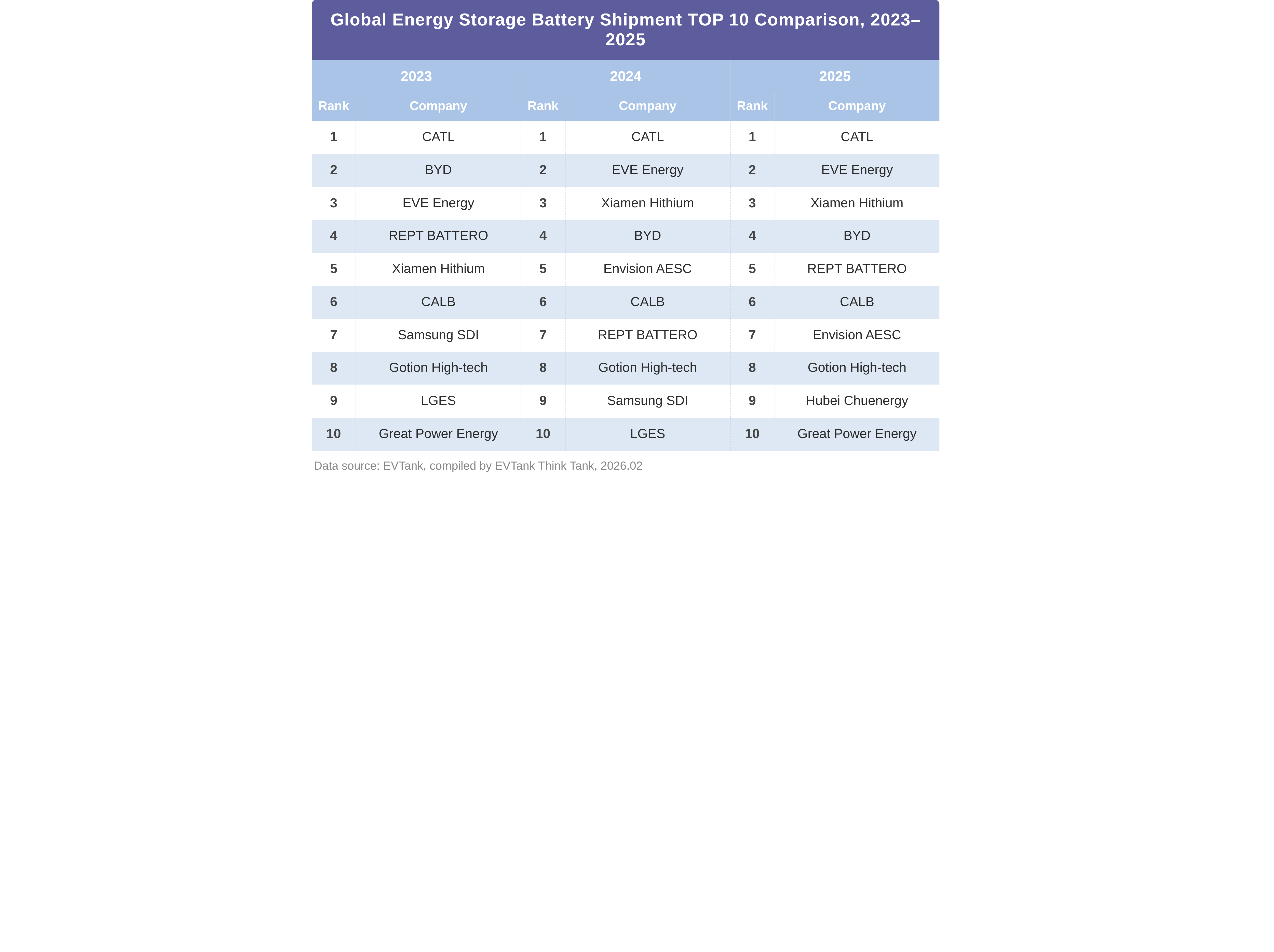
The , jointly released by research firms EVTank, the EV Economic Research Institute, and the China Battery Industry Research Institute, shows that global ESS battery shipments reached 651.5GWh in 2025 (up 76.2% YoY). Chinese companies accounted for 614.7GWh, or 94.4% of global shipments. Notably, all top 10 global ESS battery shipment companies in 2025 were Chinese, with the two South Korean companies in the 2024 top 10 completely pushed out.
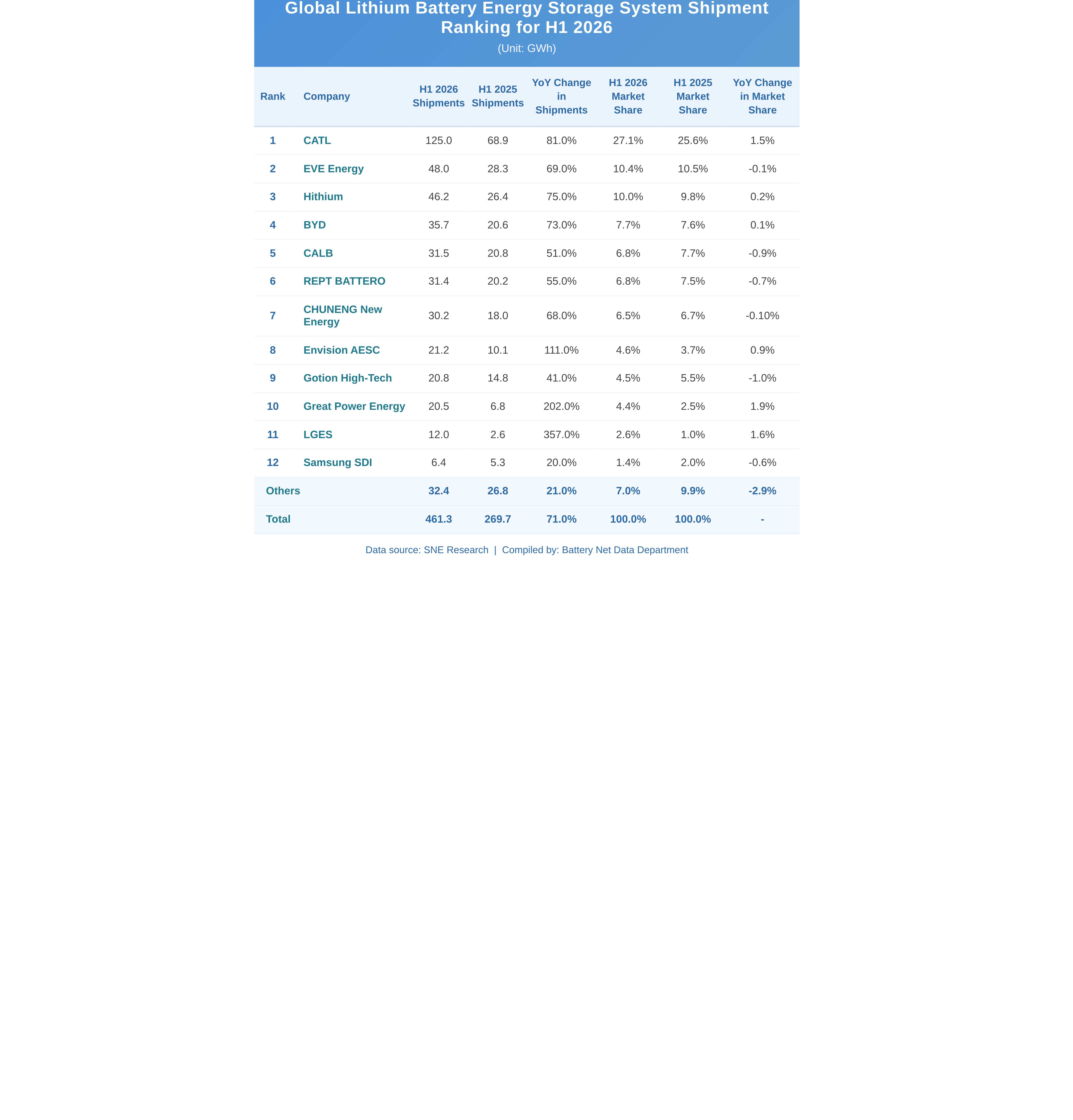
SNE data also reveals that global lithium battery ESS shipments totaled 461.3GWh in H1 2026 (up 71% from 269.7GWh YoY). Among them, LG Energy Solution and Samsung SDI fell out of the top 10, ranking 11th and 12th, respectively.
EVTank notes that South Korean companies' reliance on NCM and NCA ternary lithium batteries has led to their continuous retreat in the ESS market.
Shifting from Power to ESS, Targeting LFP
Behind South Korean battery companies' massive pivot to LFP lies another critical external factor—US policy.
EVTank data shows that LFP batteries accounted for 95.4% of global ESS batteries in 2025, becoming the absolute preferred choice, with Chinese companies further increasing their global market share.
However, US supply chain regulations require that to qualify for ESS investment tax credits, the proportion of battery parts and materials from "foreign entities of concern" (including Chinese companies) must be reduced below a certain threshold.
This opened a window for South Korean battery companies, leading to a surge in ESS sector orders in North America.
With orders secured, where will the capacity come from? The three South Korean battery giants have the same answer: repurpose power battery production lines for ESS.
On August 18, LG Energy Solution's battery plant in Lansing, Michigan, with an annual capacity target exceeding 35GWh, officially began production. The Lansing plant produces large-format batteries for ESS and EVs, including LFP battery cells for ESS.
On July 30, LG Energy Solution disclosed in its Q2 2026 earnings report that its Ultium Cells joint venture with GM and L-H Battery joint venture with Honda had both successfully started mass production of ESS battery cells.
LG Energy Solution plans to increase global ESS capacity to over 60GWh by year-end 2026, with more than 50GWh concentrated in North America. The company aims to convert five of its eight North American plants to ESS battery production by year-end.
On August 11, Samsung SDI announced it had acquired GM's 49.99% stake in their joint venture, Synergy Cells. The battery plant, currently under construction, originally targeted 27GWh capacity, with mass production expected to begin in 2027.
With Samsung SDI now fully taking over Synergy Cells, the plant will prioritize ESS battery production upon completion to rapidly respond to the booming US ESS market.
SK On is also taking action. In South Korea, 3GWh of the 6GWh capacity at its Seosan plant is being converted to LFP ESS production lines. In the US, part of its Georgia plant's EV battery production lines is being repurposed for LFP, with mass production expected in H2 2026.
To ensure a solid capacity foundation for ESS business expansion, SK On has approximately 100GWh of capacity in the US, including its standalone plants SK Battery America and SK On Tennessee, as well as its joint venture HSBMA with Hyundai Motor Group.
Clearly, the three South Korean battery companies are repurposing power battery lines for ESS, with North America as the focal point for capacity deployment.
Conclusion:
The South Korean battery trio's pivot to LFP has already yielded results. In H1 2026, LG Energy Solution and Samsung SDI's combined North American market share rose from 13.9% to 19.7% YoY. The fastest-moving LG Energy Solution saw its ESS revenue surge 4.6x YoY in H1 2026, with new orders exceeding 3 trillion won, contributing over 20% to total revenue.
However, initial victories don't eliminate underlying concerns: Is the ESS market boom a long-term trend or a temporary frenzy? If power battery demand recovers, can repurposed production lines quickly pivot back? Will the US policy "window of opportunity" suddenly close? Most critically, LFP has never been a strong suit for South Korean companies. Robert Lee, president of LG Energy Solution North America, recently admitted: The transition to ESS is complex, requiring LG to develop LFP chemistry, where it has less experience.
This shift by the three South Korean battery giants is undoubtedly a high-stakes gamble. It's no longer a simple business adjustment—ESS has become their last stand. The outcome of this battle may redefine the future of South Korea's battery industry.
![[SMM Analysis] Cost Inversion Fails to Halt Slide as Cobalt Salt Weakness Spreads Down the Chain](https://imgqn.smm.cn/usercenter/yZfeI20251217171727.jpg)
![[ SMM Analysis] September Battery Material Trade Data Released: Lithium Carbonate Imports Continued to Rise YoY, What About Other Segments?](https://imgqn.smm.cn/usercenter/BmqWy20251217171726.jpg)