On 31 August, the last day allowed under the EU Steel Regulation, the European Commission published Implementing Regulation (EU) 2026/1963 on steel imports. It entered into force on 1 September and applies in full from 1 October, rewriting the rules for carbon-steel exports to Europe. Importers have four weeks before declarations begin, and one year before the mill test certificate (MTC) becomes a hard requirement for clearance. From 1 October, every consignment of steel entering the EU must state clearly in which country its liquid steel was melted and from which heat it came.
I. The core threshold: melt country and heat number, and a transition year that is no safe harbour
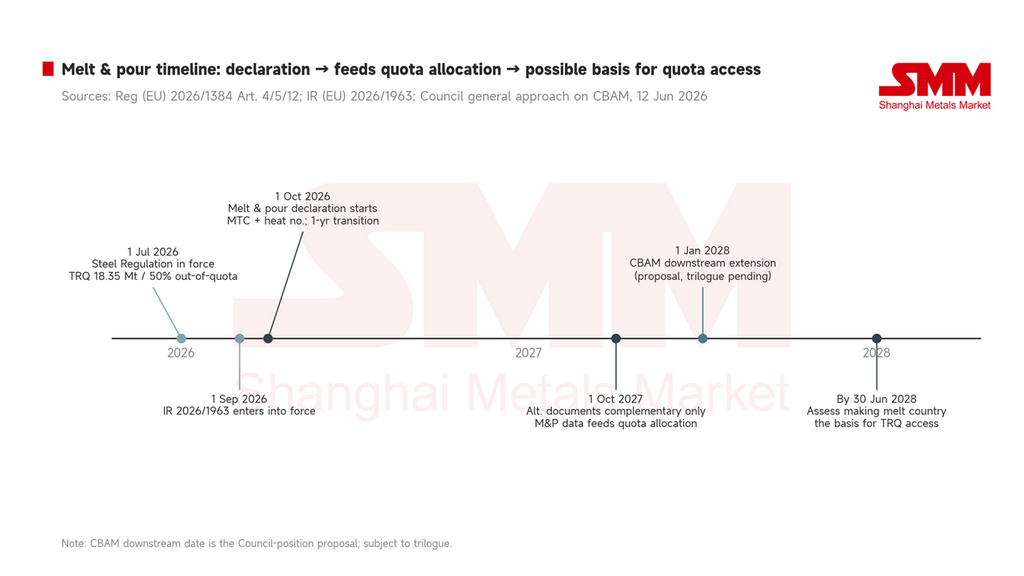
Under the new rules, importers must declare the country of melt and pour on the customs declaration and substantiate it. The primary evidence is the MTC, which must carry two fields: the melt-and-pour country and the heat number. The Commission says the act reflects feedback from its targeted consultation and aims at traceability without unnecessary compliance burden. During the first-year transition (to 30 September 2027), where no MTC can be produced, customs may accept a combination of invoices, delivery notes, quality certificates and purchase-contract clauses, long-term supplier declarations, cost-accounting and production documents, export-country customs documents, commercial correspondence and production descriptions as standalone evidence — provided they supply the same two data points.
The transition does not, however, solve the underlying question of where the melt country and heat number come from. Those two data requirements have not moved. From 1 October 2027, all alternative documents are downgraded to supplements to the MTC and can no longer stand alone. The regulation also sets out an escalation path: from October 2027 melt-and-pour data feeds into country quota allocation, and by 30 June 2028 the Commission must assess whether melt origin should become the basis for quota eligibility. What starts on 1 October is evidence-gathering, not taxation — but the date on which the books are restated is already written into law. For carbon-steel exporters, this year is for opening up upstream supply relationships, not for waiting.
II. The deep end of traceability: for carbon steel the real problem is rebuilding the substrate chain
Unlike stainless, where fragmented heat numbers are the common pain point, carbon steel has a relatively tidy batch structure — coil trade is mostly full-coil delivery, and the heat number travels with the coil without difficulty. The deep end is tracing the substrate chain. A galvanized coil exported from Vietnam may contain liquid steel from a Vietnamese blast furnace or from Chinese hot-rolled coil; rebar shipped from Türkiye may be rolled from the mill's own EAF billet or from imported billet. Under the Steel Regulation, the melt-and-pour country is where raw steel is first produced in liquid form in a steelmaking furnace and first cast into solid form — slab, billet or ingot. Subsequent rolling, coating or drawing does not change that determination; only remelting scrap counts as a new melt.
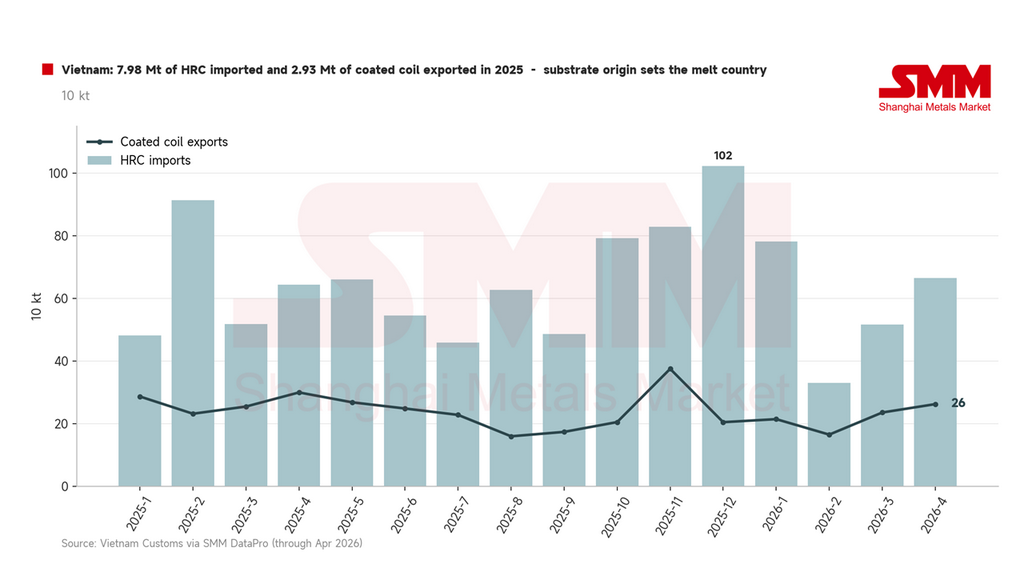
This pushes enormous compliance pressure onto processors that rely heavily on purchased substrate. Take Vietnam: customs data show HRC imports of 7.98 million mt in 2025, against coated-coil exports of about 2.93 million mt. Galvanizing-line substrate may come from domestic blast furnaces (Formosa Ha Tinh, Hoa Phat) or be imported in volume from China. The same galvanizer, in the same month, may therefore ship coils to Europe carrying different melt-country labels — some Vietnam, some China — depending on the substrate. From 1 October, every galvanized coil must trace back precisely to an HRC mill certificate bearing a heat number. That is a complex ledger-management problem, not simple paperwork.
III. The 5.2 million mt HRC quota map: six countries with domestic melting and FTA access have a fallback; MFN-only Taiwan holds a one-way ticket
Layering melt-and-pour onto the country quotas, exporters divide along two core variables: whether the exported product's substrate is melted at home, and whether the quota runs on the most-favoured-nation (MFN) single track or the free-trade-agreement (FTA) dual track. Hot-rolled coil (category 1A) is the largest pool, with an annual quota of 5.2 million mt. The leading country allocations, in order: Türkiye 642,000 mt, India 597,000 mt, Japan 552,000 mt, Ukraine 484,000 mt, South Korea 462,000 mt, Vietnam 415,000 mt, Egypt 405,000 mt, Taiwan 279,000 mt, Serbia 258,000 mt.
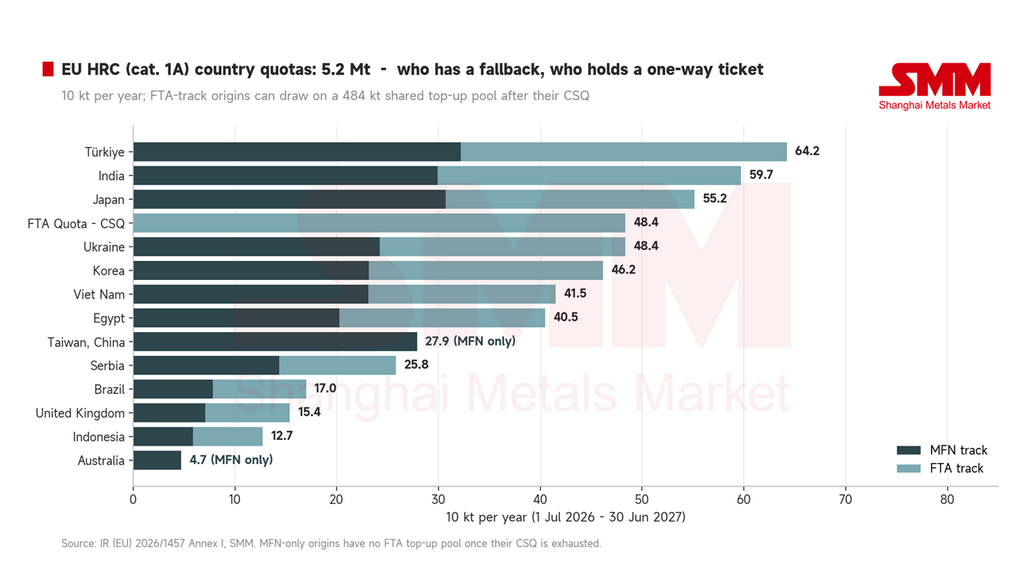
The first group holds a pass with a fallback: Japan, South Korea, India, Ukraine, Türkiye and Egypt. These countries melt mainly at home, so the melt country is certain and MTC and heat number sit in their own production records. More importantly, once their country-specific quota is exhausted they can still draw on the FTA shared top-up pool — 484,000 mt in HRC and 234,000 mt across coated categories 4A and 4B. Türkiye, the largest single allocation holder (642,000 mt HRC, 360,000 mt coated and so on), has flat-steel capacity that is mostly integrated or EAF-based but also includes mills rolling purchased slab. For Türkiye, the task after 1 October is to record the melt country of that purchased slab shipment by shipment, not to rebuild the supply chain.
The second group holds a one-way ticket: Taiwan, Australia, Saudi Arabia and Kazakhstan. They also melt domestically, so traceability is no obstacle, but their quotas sit entirely on the MFN track. Taiwan holds 279,000 mt HRC, 134,000 mt CRC and 135,000 mt coated, with zero FTA component. Once the country quota is used up, the 50% duty applies immediately, with no pool to cushion it. Compared with fellow HRC heavyweight South Korea — 230,000 mt of its 462,000 mt on the FTA track, plus access to the 484,000 mt shared pool — Taiwan's quota constraint is far more rigid.
IV. Processing hubs under the heaviest evidence burden: Vietnam leads coated category 4A with 470,000 mt, and half its substrate may face questions on origin
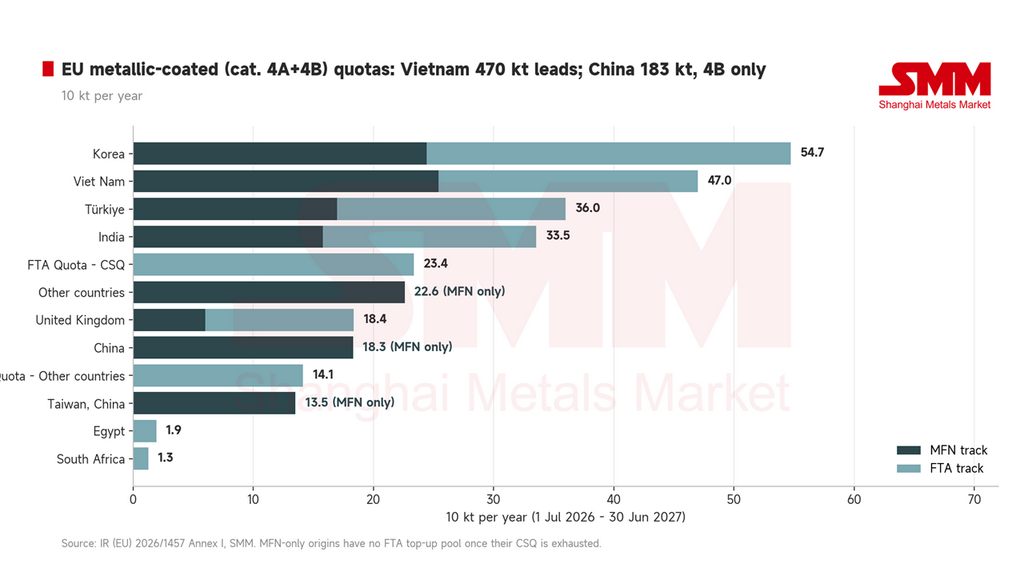
The third group is the processing hubs that buy in substrate — Vietnamese coated coil, Malaysian wire rod and parts of Turkish and Egyptian capacity — and they carry the heaviest evidence burden. Vietnam holds 470,000 mt of country-specific quota in coated category 4A, ahead of South Korea and Türkiye and the largest allocation in that category. But the substrate behind those 470,000 mt is partly Vietnamese liquid steel from Formosa Ha Tinh and Hoa Phat and partly imported HRC whose melt country is China, Japan, South Korea or India. The transition allows alternative documents, but they too must state a heat number — if the upstream HRC supplier cannot provide one, there are no alternative documents to file.
Vietnam does have one cushion: the EU–Vietnam Free Trade Agreement (EVFTA) gives its quotas an FTA component — 184,000 mt of its 415,000 mt HRC allocation and 216,000 mt of its 470,000 mt coated allocation run on the FTA track. Malaysia's 87,000 mt wire-rod quota, by contrast, is entirely MFN; its EAF melt is domestic and the melt country is clear, but once the allocation is exhausted there is no fallback at all.
V. China: zero country quota in the three core flat categories, and from October 2027 the steel that has to "change address" may find no home
The fourth group is not a processing hub but the point where the quota risk of the whole chain ultimately converges: China. On the surface, China holds 183,000 mt in coated category 4B, 158,000 mt in merchant bar, 53,000 mt in seamless tube and 20,000 mt in rebar — a country with quota, apparently. But in the three largest flat categories — HRC, CRC and coated 4A — China's country-specific quota is zero. This is not yet a real obstacle, because quota attribution still follows customs origin: Chinese HRC galvanized in Vietnam and shipped to the EU consumes Vietnam's 470,000 mt.
The real risk lies beyond October 2027, when melt data enters allocation, and the 2028 assessment of whether to switch the basis. If Chinese-melt steel currently booked against Vietnam, Türkiye and Malaysia is reassigned to China's account, China will have no quota to absorb it. A rough estimate: if half the substrate behind Vietnam's 470,000 mt of coated quota is Chinese, more than 200,000 mt has to "change address". China would then be competing with every other origin without country quota for a narrow residual pool for "other countries" — just 133,000 mt in 4A and 22,000 mt in HRC — allocated first-come, first-served. It cannot hold volumes of that size.
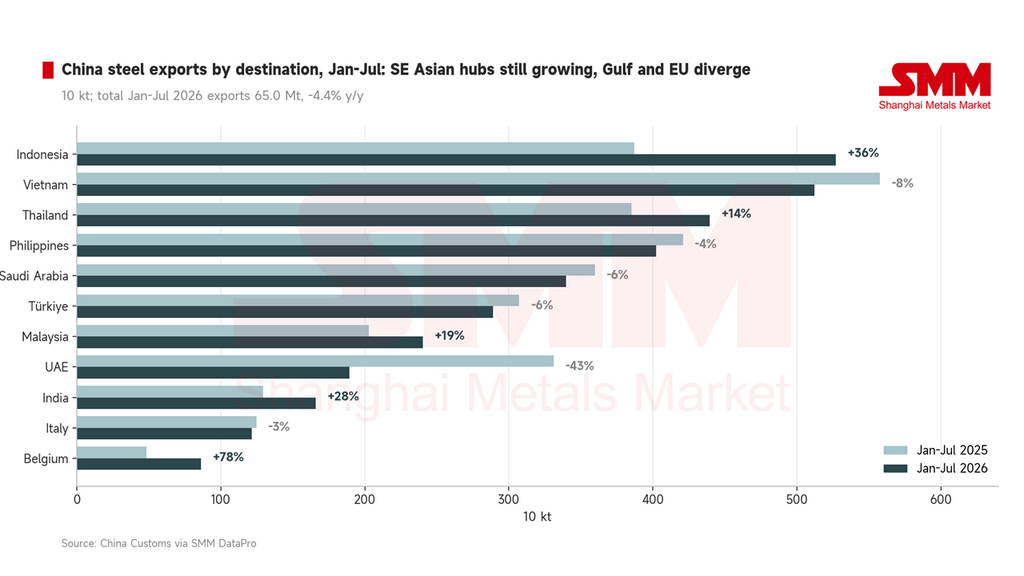
What does not fit flows back upstream, into shrinking order books at Chinese mills. Before buying Chinese HRC, third-country processors will weigh the quota risk; when the answer is uncertain, the rational choice is to switch substrate source. The transmission chain is clear: EU tightens traceability → Chinese-melt steel lacks quota cover → third-country processors cut Chinese substrate purchases → Chinese coil export demand falls → Chinese mills' export schedules come under pressure. And the data show Chinese steel is still flowing into Southeast Asian processing hubs in growing volumes: exports totalled 65.0 million mt in January–July 2026, down 4.4% year on year, but exports to Indonesia rose 36% to 5.27 million mt, to Thailand 14% and to Malaysia 19%, while exports to Vietnam fell 8% to 5.12 million mt and to the UAE 43%. The Chinese steel heading to Southeast Asian processing hubs is precisely the tonnage that will be traced shipment by shipment after 1 October. Markets typically react one to two quarters ahead, so the real impact on order books could well surface in the first half of 2027.
VI. CBAM's second lock: a wide China–Vietnam carbon-cost gap that could nearly double by 2034
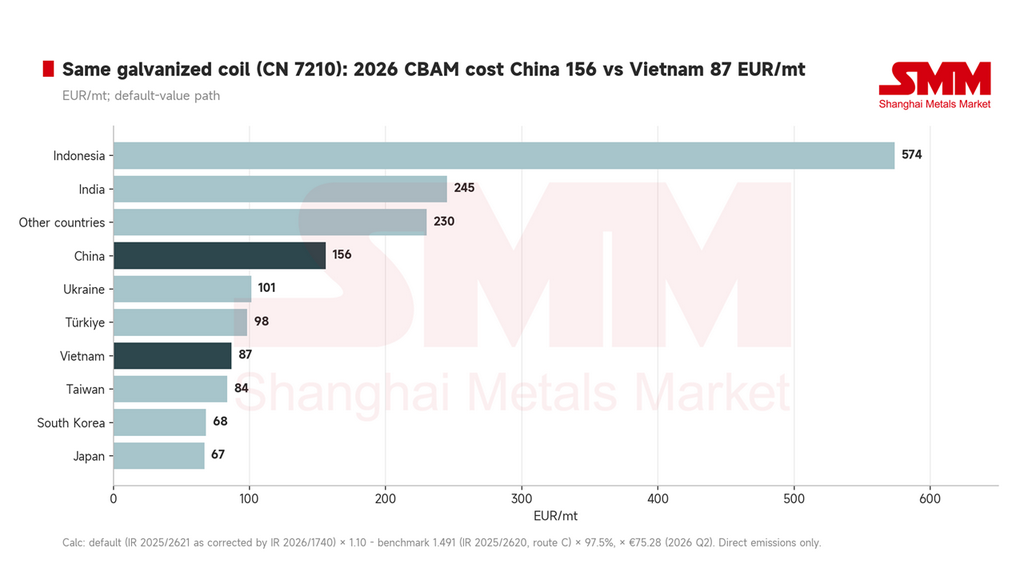
Melt-and-pour settles the question of where the steel was made; CBAM, the Carbon Border Adjustment Mechanism, answers what that steel must pay for its carbon. There is no formal interface between the two yet, but the direction of tightening is the same. CBAM default values are looked up by customs origin. For galvanized coil (CN 7210) under the current 2026 default-value path — a 10% mark-up on the default, a benchmark of 1.491, a CBAM factor of 97.5% and the second-quarter certificate price of €75.28 — a China-melted coil carries a carbon cost of about €156/mt, against roughly €87 for Vietnam, €98 for Türkiye, €68 for South Korea and €245 for India. Chinese HRC galvanized in Vietnam and entering the EU as Vietnamese origin pays about €70/mt less on the default path — the same logic as consuming another country's quota share.
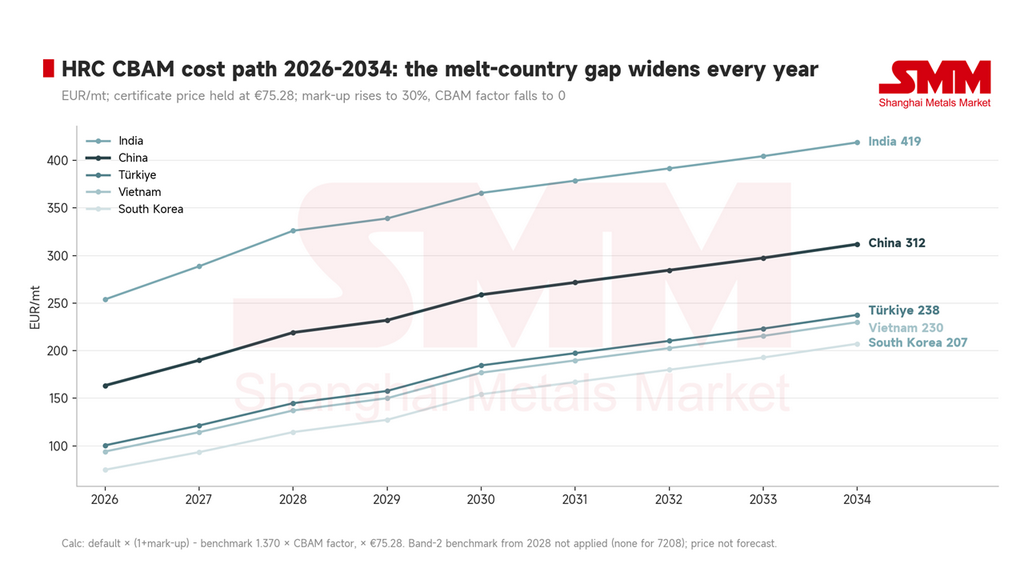
As free allocation is phased out, this gap widens sharply year by year. The default-value mark-up rises to 20% in 2027 and is fixed at 30% from 2028, while the CBAM factor tied to free allocation falls from 97.5% to zero by 2034. Even with the certificate price held at today's €75.28, the CBAM cost of China-melted HRC climbs from €163/mt in 2026 to €312/mt in 2034. Worth watching: the Council of the EU adopted its general approach in June, adding a definition of "abusive practices" to the CBAM revision to target resource shuffling and explicitly requiring high-risk combinations to prove the actual production site. The melt-and-pour declarations that begin on 1 October are building exactly the underlying dataset that future CBAM anti-circumvention provisions will draw on.
VII. The quota calendar keeps pressing: EU weekly arrivals down 32% since July, and first-year utilisation decides the fate of carry-over
1 October is a starting point, not an end point; the quota-tightening calendar is moving fast. Under the Steel Regulation, over the next two years the EU will complete its first product-scope review by 31 December 2026, assess by 30 June 2027 whether to bring in steel-intensive downstream goods, feed melt data into country quota allocation from 1 October 2027, and assess by 30 June 2028 whether melt origin should become the basis for quota eligibility. One further provision bears directly on quota headroom: in the first yearly period (1 July 2026 – 30 June 2027), unused quarterly quota carries over to the next quarter, but after year one the Commission decides by implementing act whether carry-over continues, weighing import pressure, average utilisation over the first three quarters — the regulation states that where utilisation exceeds 80%, carry-over should be allowed — and downstream supply.
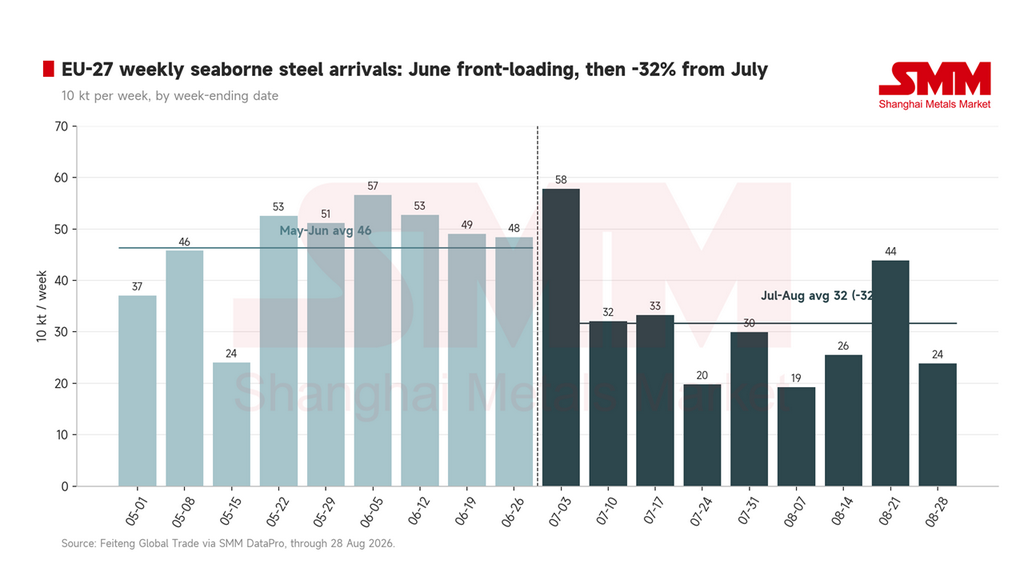
Actual port arrivals have already set the tone for the first quarter. In May–June, before the new regime took effect, EU-27 seaborne steel arrivals averaged 460,000 mt a week and spiked to 570,000 mt in early June as cargo was rushed in ahead of the deadline. From the week of 3 July, weekly arrivals shrank quickly to an average of 320,000 mt — a 32% drop — and fell to a low of 240,000 mt in the last week of August; July arrivals totalled 1.40 million mt, down 22% year on year. Squeezed between expectations of tighter quotas and a heavy wait-and-see mood, first-quarter utilisation may well fall short of the 80% line, and that will directly determine the headroom available in the second half of 2027 for major categories such as HRC.
Outlook: a four-week window to rebuild compliance processes, not to patch a document
For carbon-steel exporters the waiting is over and the countdown stands at four weeks; every item of preparation has to start now — confirm with suppliers whether they can issue compliant MTCs, assemble the alternative document set, and build a rigorous ledger tracking each heat number through to export shipment (after October 2027 the MTC becomes a hard requirement). For Chinese mills, the real way through lies in customer structure and supply-chain transparency: build a system that can hand melt country, heat number and CBAM emissions data to the customer seamlessly, before third-country processors move orders out of caution. A one-year transition sounds generous, but what it grants is time to rebuild upstream and downstream compliance processes end to end — not merely to patch a customs document.
![[Pangang Achieves New Breakthrough in Automotive Sheet Yield]](https://imgqn.smm.cn/usercenter/FFFrV20251217171719.jpg)

![[SMM Steel] Iran’s Domestic HRC Prices Rise Sharply on Weaker Rial](https://imgqn.smm.cn/usercenter/rBCZR20251217171716.jpg)