According to SMM market research, global Millberry quotations have diverged recently. During the same period, the market has seen bids of around 98.5%, 99.5%, and even close to par. Such a wide range does not necessarily reflect substantial differences in material quality or supply-demand conditions. Instead, it mainly results from differences in buyer type, pricing basis and trading strategy.
Traders and End Users Follow Different Pricing Logic
Mainstream global copper scrap payabilities largely reflect bids from traders. Ordinary traders must account for financing, transportation, hedging, quality and resale risks, leaving them with a limited margin. As a result, most traders have relatively low acceptance of payabilities above 99%, and their bids tend to remain cautious.
Direct purchases by downstream consumers can be priced considerably higher. According to SMM market research, some copper rod and copper semis producers may accept Millberry payabilities of around 99.5% to secure feedstock and reduce their reliance on refined copper. A small number of copper foil producers with stronger product margins and stricter quality requirements may even bid close to par.
In addition to product margins, consumer electronics brands’ requirements for green manufacturing, recycled content and supply-chain decarbonisation are strengthening demand from some copper foil producers for high-quality recycled copper. Apple, for example, requires its direct suppliers to achieve carbon neutrality for Apple-related production by 2030. Selected new products also use 100% recycled copper in certain printed circuit boards and copper wire and foil components. Such requirements are gradually being transmitted upstream, giving additional value to recycled copper with stable quality, traceable origins and lower carbon footprints.
These end users can process copper scrap directly and do not need to reserve a margin for resale. They may also need recycled raw materials to meet customer requirements concerning recycled content, carbon footprints and traceability. Their acceptable purchase prices are therefore generally higher than those of ordinary traders. However, such high bids normally apply to specific quality, certification, volume and delivery requirements and cannot represent the general traded level for global Millberry.
High Domestic Spot Premiums and LME 3M Pricing Create Room for Some Traders
Tight refined copper availability in China has kept domestic spot premiums elevated, lifting local copper scrap selling prices. Traders holding physical inventories can therefore sell their existing stocks at relatively high domestic prices before purchasing later-arriving imported cargoes to replenish their inventories.
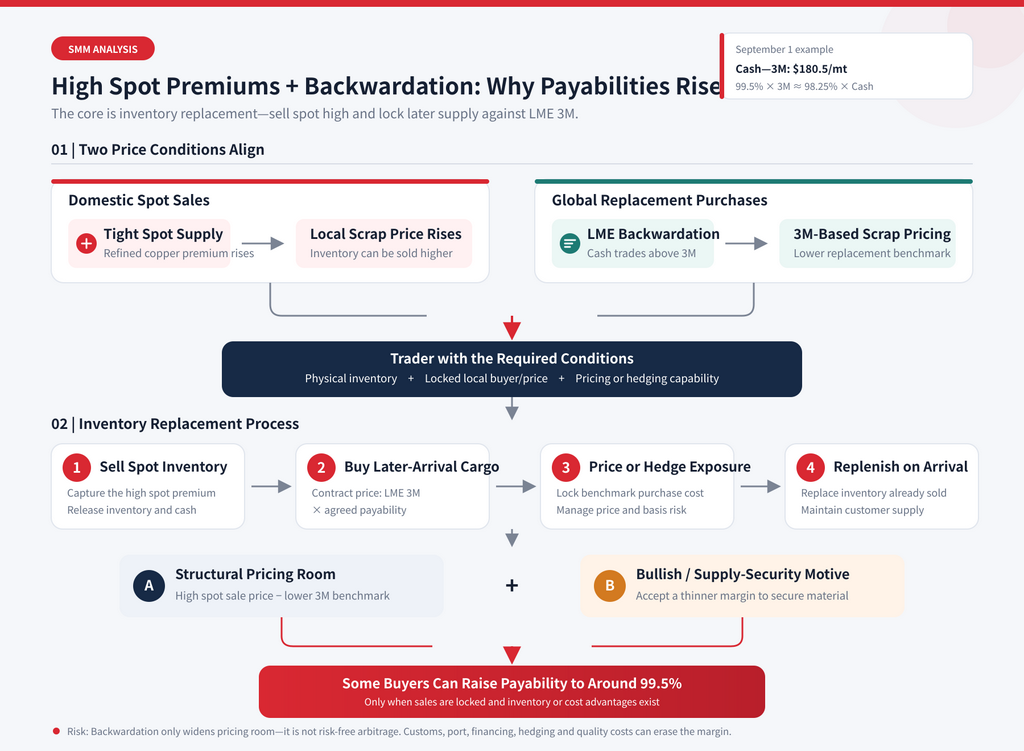
The key difference lies in the pricing benchmarks. Domestic Millberry prices mainly reference China’s refined copper spot price, spot premiums or discounts, and the refined-to-scrap copper spread. Imported copper scrap, however, is generally priced against LME 3M multiplied by an agreed payability.
When the LME copper curve is in backwardation, the 3M price is lower than the nearby Cash price. A trader can therefore sell higher-priced physical scrap in the domestic spot market while purchasing replacement cargoes priced against the relatively lower LME 3M benchmark. By fixing the LME price or hedging the exposure, the trader can lock in the purchase cost and complete an inventory replacement strategy: selling physical stocks at a high price and replenishing them with later-arriving cargoes priced against LME 3M.
On September 1, the LME copper Cash price stood at $14,395.5/mt, while the 3M price was $14,215/mt. Cash was therefore trading at a premium of $180.5/mt over 3M, equivalent to around 1.27% of the 3M price. Based solely on the LME price structure:
- $14,215/mt × 99.5% ÷ $14,395.5/mt ≈ 98.25%
In other words, although a 99.5% payability against LME 3M appears high, the resulting purchase price was equivalent to only around 98.25% of the LME Cash price that day. Raising the payability from 98.5% to 99.5% would increase the purchase cost by approximately $142.15/mt, still below the Cash–3M spread of $180.5/mt. In theory, the backwardation could therefore absorb much of the additional cost caused by raising the payability by one percentage point.
A comparison with actual tax-inclusive domestic prices provides another perspective. Based on a 99.5% payability against LME 3M, a USD/CNY exchange rate of 6.7809 and the addition of 13% import VAT, the theoretical price of imported Millberry would be:
- $14,215/mt × 99.5% × 6.7809 × 1.13 ≈ 108,377 yuan/mt
During the same period, the average tax-inclusive Millberry price in Zhejiang assessed by SMM stood at 109,100 yuan/mt, leaving a theoretical price difference of around 723 yuan/mt. At a payability of 98.5%, the comparable price would be approximately 107,287 yuan/mt, leaving a theoretical difference of around 1,813 yuan/mt.
However, this does not mean traders can directly earn 723 yuan/mt or 1,813 yuan/mt. The calculation excludes customs clearance, port handling, domestic transportation, financing, hedging, basis and quality-loss costs. After deducting these expenses, the actual margin available to an ordinary trader may already be limited at a 98.5% payability. At 99.5%, costs could even exceed the potential margin based on the Zhejiang average price.
High spot premiums and LME backwardation therefore only create conditions that allow some traders to raise their payabilities; they do not guarantee that a 99.5% bid will be profitable. Traders able to offer such prices usually need physical inventories that can be sold immediately at high prices, sales channels secured above the market average, and strong financing and hedging capabilities. Their objective is generally to replace inventory that has already been sold and secure future supply, rather than simply buying cargoes for resale upon arrival.
For ordinary traders without physical inventories or confirmed selling prices, domestic spot premiums and the LME backwardation may have narrowed by the time imported cargoes arrive. High-payability purchases therefore carry considerable price and basis risks. A payability close to 99.5% should consequently be viewed as an inventory replacement price available to a limited number of traders under specific conditions, rather than a general market level for Millberry.
Why Have High Bids Not Replaced Transactions at 98.5%?
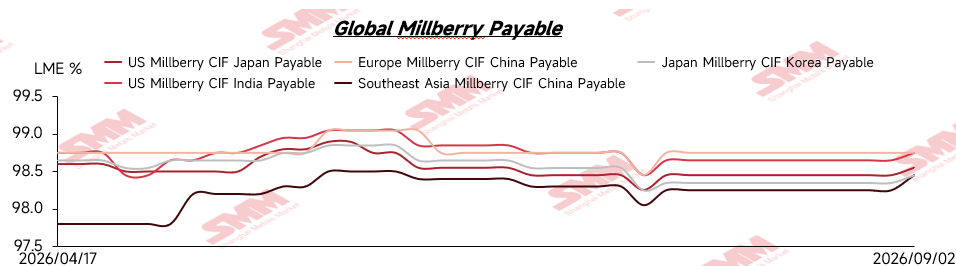
The coexistence of bids at 98.5%, 99.5% and close to par reflects different buyers and transaction terms.
Payabilities of around 98.5% mainly represent ordinary trading bids. Bids near 99.5% may come from copper rod or copper semis producers purchasing directly, or from traders capable of conducting inventory replacement under the backwardated market structure. Prices close to par are mainly associated with selected copper foil producers purchasing specific high-quality materials.
Quotations may also differ according to whether the buyer or seller holds the pricing option, whether the transaction is conducted on an FOB or CIF basis, and the applicable payment terms, delivery schedule and quality specifications. Even at the same payability, the final transaction value may differ substantially. Assessing market prices solely from the quoted payability can therefore be misleading.
Can High Payabilities Be Sustained?
For traders using the backwardated structure to raise procurement prices, the sustainability of high bids depends primarily on the Cash–3M spread and domestic refined copper spot premiums. If the backwardation continues to narrow and domestic spot premiums decline, the pricing room available to support higher payabilities will shrink, potentially pushing traders’ bids lower.
However, the supply of high-quality Millberry remains tight, inventories across major markets remain low, and some copper rod, copper semis and copper foil producers continue to purchase directly. Prices for high-quality copper scrap are therefore expected to remain resilient. The market is more likely to maintain a tiered pricing structure than to see all buyers uniformly accept payabilities of 99.5% or close to par.
SMM believes that the divergence in global Millberry quotations does not indicate a disorderly market. Instead, ordinary traders, traders capable of inventory replacement and downstream end users have formed distinct pricing tiers. Although bids near 99.5% or par do not represent the general market, they highlight the tight supply of high-quality copper scrap and intensifying competition among some end users for premium recycled raw materials.
![Sluggish market trading atmosphere, spot price pulls back to 110 yuan/mt [SMM Shandong Copper Cathode Spot Weekly Review]](https://imgqn.smm.cn/usercenter/udUol20251217171712.jpg)