SMM, September 2:

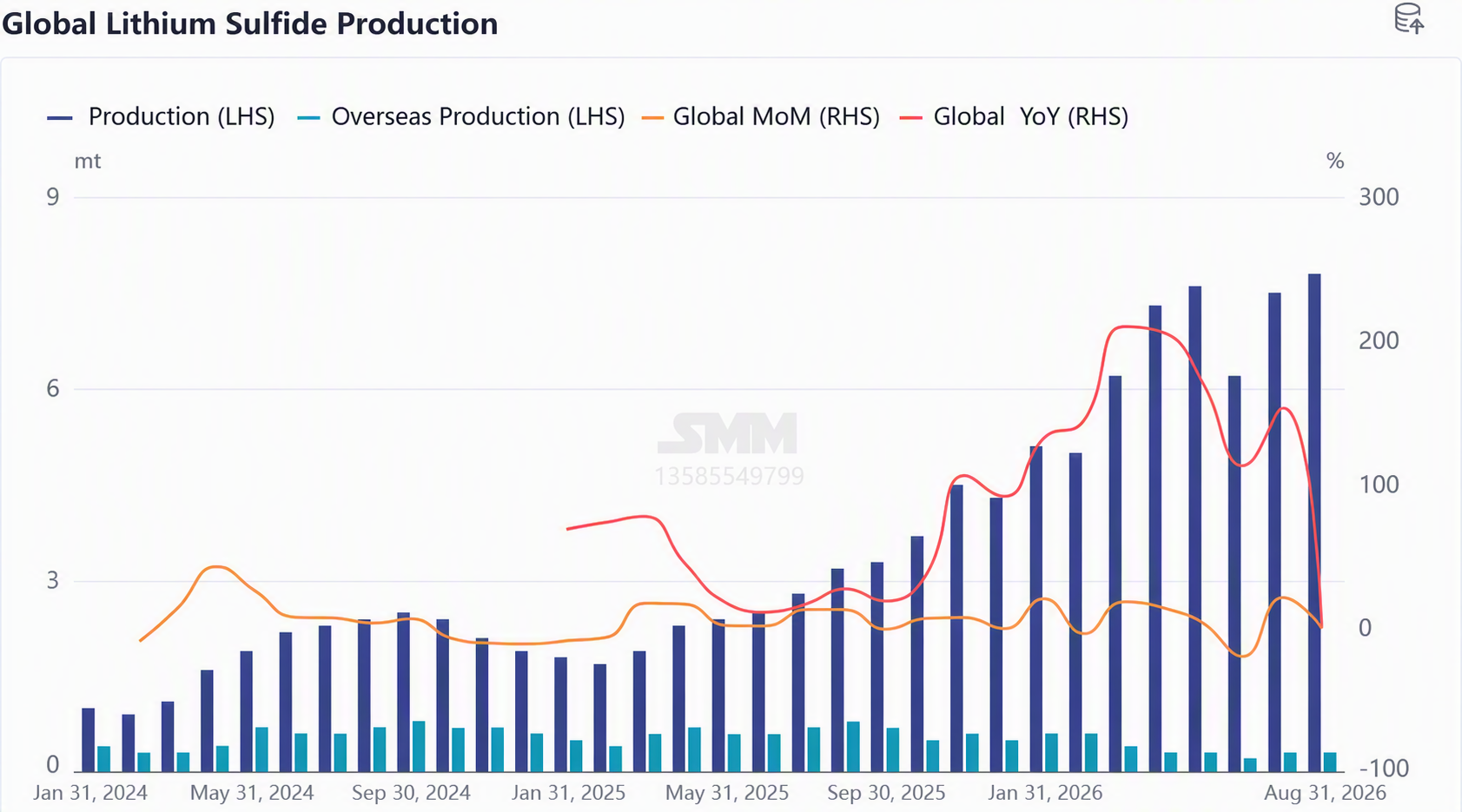
Key points: In August 2026, China's lithium sulfide production was 7.8 mt, up 3.6% MoM and up 143% YoY. Will Q4 lithium sulfide production surge? Judging from downstream demand, that is unlikely for now, but a mild volume expansion should continue. Average monthly production is expected to reach the 9-10 mt range, edging up from Q3 rather than jumping explosively.
1. January-August review: China already dominates global supply
China's cumulative January-August production was 52.9 mt, up 184% YoY, exceeding the full-year 2025 total of 34 mt. Domestic capacity release has entered a phase of substantial delivery. Outside China, production over the same period was only 3.0 mt, down 39% YoY. Enterprises in Japan and South Korea, constrained by equipment commissioning and insufficient downstream orders, are essentially in a state of "having capacity but no production." Of the global total of 55.9 mt, China accounted for 95%.
The key question is: Does China's 52.9 mt of production reflect "how much can be produced" or "how much demand requires"? The answer leans toward the latter—current output is driven more by the pace of downstream stocking than by capacity bottlenecks. Many producers are stockpiling in advance for improved demand in Q4.
2. Q3 performance: Ramp-up continues, but the slope is slowing
August data: China produced 7.79 mt, up 3.6% MoM and up 143% YoY. The MoM growth rate has narrowed from double digits in Q2 to single digits, signaling that the steepest phase of the capacity ramp-up has passed. What follows is a mild production increase rather than an explosive surge.
September expectations: China is expected to produce 8.0-8.5 mt, with a midpoint of 8.3 mt, setting a new high for the year. Three factors support this: ① stable operation of major facilities; ② rigid stocking demand from downstream solid-state battery clients at the end of Q3; ③ new capacity from Xiba, Wanbang, and others still in the low-utilization release phase. But the ceiling is equally clear—downstream battery cell clients have not yet entered a large-scale procurement cycle, so there is no basis for a jump in operating rates.
Outside China, production remained at a low of 0.3 mt, essentially negligible.
3. Q4 outlook: No expectation of a surge
Average monthly production in Q4 is expected to land in the 9-10 mt range, up about 15-25% from Q3's roughly 8 mt per month. That is a mild volume expansion, not a surge.
3.1 Factors supporting the upside:
First, new capacity release : Sichuan's all-solid-state production line is expected to come online in Q4, Xiba's hundred-tonne-scale line continues to ramp up, and Wanbang & salt lake facilities still have room to raise production. These are all "already invested but not yet full" sources of existing flexibility.
Second, downstream stocking-driven demand: Q4 is traditionally a stocking season for battery materials enterprises, and with some solid-state battery clients accelerating pilot lines, demand is expected to improve QoQ.
3.2 Factors suppressing an explosive increase:
Orders are the hard constraint: Solid-state batteries are still on the eve of commercialisation, and the sulphide electrolyte procurement volumes of leading battery cell enterprises are far from reaching the "ramp-up" stage. Without terminal orders, lithium sulphide production lines will not run at full capacity—this is not a capacity issue but an economic one.
No reliance on overseas markets: Japanese and South Korean companies will remain focused on equipment commissioning and small-batch validation in Q4, meaning global supply growth can only come from China.
Quantitative assessment: Q4 average monthly production will most likely land in the 9-10 mt range, with December potentially reaching 10-11 mt (depending on the commissioning pace of Sichuan's all-solid-state project), but full-year total production is expected to be in the 85-95 mt range, representing 2.5-2.8x growth from the 2025 base of 34 mt.
IV. Core contradiction: capacity is not the bottleneck, orders are
The real state of the lithium sulphide market is this: existing capacity in China far exceeds actual production, and actual production in turn depends on the procurement pace of downstream solid-state battery clients.
The only core variable to watch in Q4: whether electrolyte procurement volumes at leading domestic solid-state battery enterprises show a substantive MoM jump. If the answer is "yes," Q4 monthly averages could push towards 10-11 mt; if the answer is "no," 9-10 mt remains the reasonable midpoint.
V. One-sentence summary
Q4 will not see a blowout, but will maintain a pace of modest month-by-month increases. The full-year total of 85-95 mt already fully validates supply-side capability. The real "blowout" will have to wait for downstream solid-state battery installation volumes to ramp up—that is at least a post-2027 story.
Risk warning: If Q4 downstream stocking willingness falls short of expectations (especially if pilot-scale progress at solid-state battery clients is delayed), domestic enterprises may proactively reduce operating rates, and monthly production could face downside risk to around 8 mt.
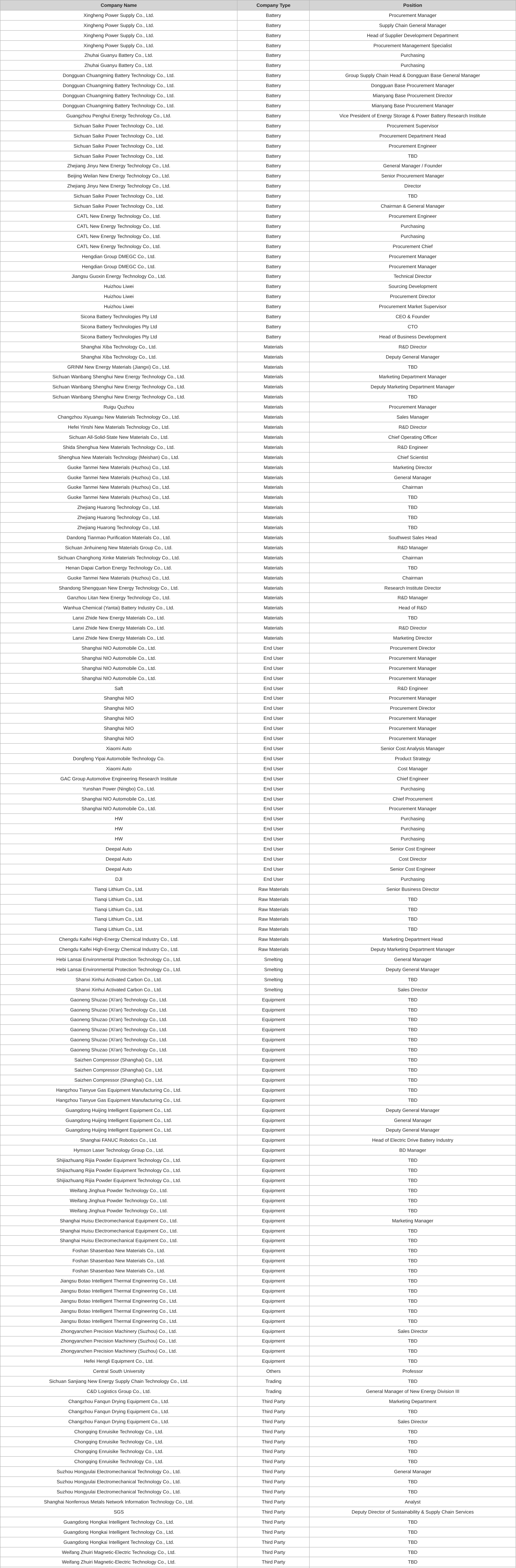
SMM Solid-State Battery Conference attendee list (partial)
Note: If you have any additional details to share regarding the points mentioned in this article or wish to follow developments in solid-state batteries, please feel free to contact:
Tel: 021-20707860 (or add WeChat 13585549799) Yang Chaoxing, thank you!

Related reading
![[SMM Flash] Albemarle Completes Wodgina Spodumene Concentrate Auction at US$2,307/dmt CIF China](https://imgqn.smm.cn/usercenter/WyqWW20251217171729.jpg)
![[Li-battery: Ruien New Energy signs deal for cell plant in Serbia with over EUR 100 million investment]](https://imgqn.smm.cn/usercenter/ajAmi20251217171726.jpg)
![[Li-battery: India mulls USD 1.4 billion incentive plan for advanced battery components]](https://imgqn.smm.cn/usercenter/ipFFo20251217171725.jpg)