Feedstock Has Yet to Ramp Up: Why Is India Expanding Battery Recycling Capacity Ahead of Demand?
India’s lithium-ion battery recycling industry is currently in a clear phase of early capacity build-out. Large-scale retirements of EV batteries have yet to emerge, and the volume of locally available end-of-life EV batteries remains relatively limited. Nevertheless, Indian recyclers, traditional smelters and new energy materials companies have increasingly invested in battery dismantling, shredding and downstream hydrometallurgical processing capacity in recent years, with investment in recycling capacity clearly outpacing the release of end-of-life feedstock.
From the current supply-demand structure, India’s lithium-ion battery recycling capacity already exceeds the amount of locally available end-of-life battery feedstock. Capacity additions are progressing faster than feedstock supply, meaning the key challenge facing the market is no longer a shortage of processing capacity, but whether existing and newly added facilities can secure sufficient, stable and economically viable feedstock.
However, this gap should not simply be interpreted as actual overcapacity. Some announced recycling projects remain under planning, construction or capacity ramp-up, meaning disclosed nameplate capacity does not necessarily translate into effective operating capacity. Meanwhile, Indian recyclers do not rely solely on locally retired EV batteries. Consumer electronics waste, battery manufacturing scrap, imported battery waste and black mass can also serve as feedstock.
India is therefore better characterised as being in a stage of “capacity build-out ahead of feedstock availability”. Companies are investing ahead of the expected increase in EV battery retirements, while also positioning themselves for the expansion of domestic cell manufacturing and growing demand for critical mineral recycling. Going forward, whether supply and demand in India’s recycling market move toward a better balance will depend on the actual commissioning of new projects, access to feedstock and capacity utilisation rates.
Critical Mineral Supply Security Drives Early Recycling Capacity Build-Out
One of the main factors behind India’s early expansion of recycling capacity is its focus on critical mineral supply security. As the country expands its electric vehicle, energy storage and domestic battery manufacturing industries, demand for battery raw materials such as lithium, nickel and cobalt is expected to continue rising, while India remains dependent on overseas supplies for parts of its upstream resources and refined products.
Against a backdrop of uncertainty surrounding international mineral prices, trade policies and supply-chain stability, recovering secondary resources through recycling is becoming an increasingly important way for India to supplement its domestic supply of critical minerals.
India’s push to develop battery recycling therefore goes beyond simply treating future battery waste. It also reflects an effort to build domestic resource circulation and materials supply capabilities in advance. Rather than waiting for large volumes of EV batteries to reach end of life before building recycling capacity, early investment in recycling and metal extraction can help companies establish feedstock channels, accumulate technical experience, build downstream customer relationships and provide additional sources of recycled materials for the future expansion of India’s battery industry.
Policy support has further strengthened investment expectations in the critical mineral recycling sector. In 2025, India introduced a INR 15 billion incentive scheme for critical mineral recycling, supporting the extraction of critical minerals from waste lithium-ion batteries, e-waste and other industrial waste streams, while providing capital and operating incentives for new and expanded projects.
In April 2026, India’s Ministry of Mines completed the first round of eligibility assessments under the scheme. A total of 58 companies qualified to participate, with the companies collectively proposing around 850,000 mt/year of recycling and processing capacity and planned investment of approximately INR 50 billion. It should be noted that this capacity covers lithium-ion batteries, e-waste and other critical-mineral-bearing waste streams, and therefore does not represent lithium-ion battery recycling capacity alone. Eligibility also does not mean that the projects have already been built or that subsidies have been granted. Financial support will depend on subsequent project development and actual commissioning.
From a policy perspective, India’s support for recycling is also shifting from basic waste treatment toward the actual extraction of critical minerals. The incentive scheme specifically supports projects capable of separating and recovering critical minerals, while operations that only produce black mass are not the main target of the incentives. This suggests that future recycling investment in India may increasingly move further downstream into hydrometallurgical processing and the recovery of lithium, nickel, cobalt and other critical minerals.
With EV Battery Retirements Still Limited, What Will Support Existing Recycling Capacity?
Before EV battery retirements begin to increase on a large scale, India’s recycling industry still needs to address a practical question: where will the feedstock for its existing capacity come from?
At present, waste batteries from consumer electronics remain an important source of lithium-ion battery recycling feedstock in India, while the volume of retired EV batteries is still relatively limited. For companies that have already built processing capacity, electrode scrap, defective cells and other battery manufacturing waste, together with some imported feedstock, are becoming important supplementary sources.
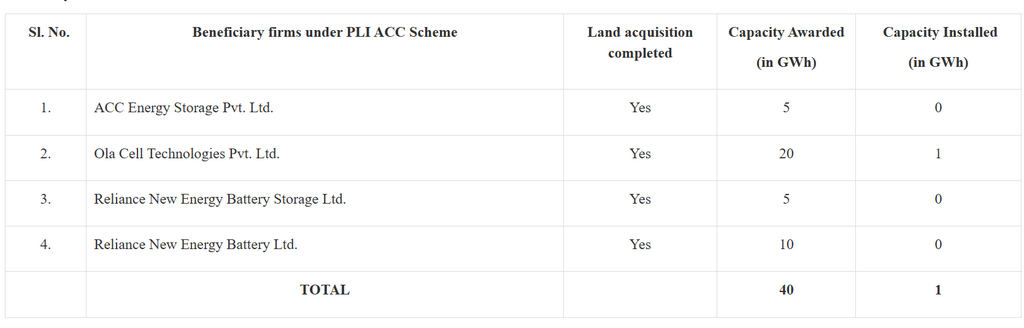
The development of India’s domestic battery cell manufacturing capacity is therefore worth close attention. In 2021, the Indian government introduced the Production Linked Incentive Scheme for Advanced Chemistry Cell Battery Storage (ACC PLI), with a planned outlay of INR 181 billion to support the establishment of 50 GWh of domestic advanced chemistry cell manufacturing capacity and reduce India’s dependence on imported battery cells.
As of March 2026, 40 GWh of the 50 GWh target had been allocated to four companies, while actual installed capacity stood at only around 1 GWh, indicating that India’s domestic cell manufacturing sector remains in the early stages of capacity construction and ramp-up. In July 2026, India’s Ministry of Heavy Industries launched bidding for the remaining 10 GWh, targeting grid-scale energy storage applications, showing that domestic cell manufacturing capacity continues to expand.
For the recycling industry, the significance of the ACC PLI extends beyond the future increase in battery production itself. As domestic cell projects gradually begin production, electrode offcuts, defective cells and other manufacturing scrap will also increase. Compared with end-of-life batteries, such material is generally more concentrated at the source, has clearer chemistry and more consistent batch quality, making it easier to establish long-term procurement and pricing mechanisms.
From the perspective of feedstock availability, battery manufacturing scrap in India could therefore become an important incremental source for recyclers before large-scale EV battery retirements emerge. However, given that actual production under ACC PLI projects remains limited at present, manufacturing scrap is unlikely to fully support the recycling capacity already planned in the short term. Its contribution to recycling feedstock supply will depend on the actual commissioning and ramp-up of new cell manufacturing projects.
Imported Feedstock Provides an Important Supplement Before Domestic Battery Retirements Ramp Up
In addition to locally generated end-of-life batteries and manufacturing scrap, imported feedstock also provides an important supplementary source for Indian recyclers.
In recent years, India has adjusted import policies for certain critical-mineral-bearing waste streams and lithium-ion battery waste, creating opportunities for domestic recyclers to source material from overseas. Before domestic end-of-life battery supply develops at scale, imported black mass and other lithium-, nickel- and cobalt-bearing waste materials can help fill part of the feedstock gap and improve capacity utilisation at operating recycling facilities.
This also means that before large-scale EV battery retirements emerge in India, recyclers are likely to continue relying on a diversified feedstock mix consisting of consumer electronics waste, manufacturing scrap, locally retired batteries and imported materials.
Feedstock Security May Become the Next Key Area of Competition
As more recycling projects move into construction and operation, competition in India’s lithium-ion battery recycling market may gradually shift away from nameplate capacity expansion toward feedstock security. While domestic EV batteries have yet to enter a concentrated retirement cycle, the ability to secure stable, compliant and economically viable feedstock will directly affect the utilisation of both existing and newly added capacity.
At present, Indian recyclers rely on a diverse range of feedstock, including consumer electronics waste, battery manufacturing scrap, limited volumes of retired EV batteries, as well as some imported battery waste and black mass. Consumer electronics waste remains relatively abundant, while manufacturing scrap is expected to become increasingly important as domestic battery cell projects gradually come online. Imported feedstock can also provide a degree of support when local end-of-life battery supply is insufficient.
However, if the supply of material entering the formal recycling system grows more slowly than processing capacity, competition for higher-quality feedstock such as consumer electronics waste and battery manufacturing scrap could intensify. This may not only affect upstream procurement costs, but also directly weigh on margins in shredding and black mass production, as well as operating rates at downstream hydrometallurgical facilities.
As a result, companies with stable partnerships with battery cell manufacturers, established collection networks and diversified procurement channels may have stronger feedstock security going forward. For India’s recycling market, the amount of feedstock companies can actually secure and the level of sustainable output they can maintain may ultimately be more meaningful than announced nameplate capacity.
India’s Battery Recycling Market Remains in a “Capacity First, Feedstock Later” Phase
SMM believes that India’s lithium-ion battery recycling industry remains in a phase where capacity is being built ahead of feedstock availability. Current industry expansion is being driven more by critical mineral supply security, domestic battery manufacturing plans and expectations for future battery retirements than by large-scale availability of retired EV batteries.
In the short term, consumer electronics waste will remain an important component of local recycling feedstock. As battery cell projects under the ACC PLI gradually come online, electrode scrap, defective cells and other manufacturing waste could become some of the earliest sources of incremental feedstock over the next few years. Imported battery waste and black mass may also help supplement domestic feedstock shortages, although actual volumes will remain influenced by trade policies, logistics costs and feedstock economics.
Over the medium to long term, continued growth in India’s EV fleet will gradually bring more traction batteries to end of life, increasing the supply of locally generated recycling feedstock. At that point, some of the recycling capacity currently being built ahead of demand could receive stronger support from domestic material flows. Competition among recyclers, however, is also likely to shift further from capacity expansion toward feedstock procurement, cost control and operational efficiency.
Therefore, assessing whether India’s lithium-ion battery recycling industry has truly entered a phase of large-scale development will require greater attention to actual commissioned capacity, feedstock mix, production volumes and capacity utilisation, rather than relying solely on companies’ announced nameplate capacity. For recyclers that have already established processing capacity, the ability to secure stable feedstock and maintain consistent operating rates will become an increasingly important indicator of competitiveness in the next stage of market development.
![[SMM News] Elevra Lithium Reports Record NAL Mined Tonnage, Underlying Ebitda Turns Positive in FY2026](https://imgqn.smm.cn/usercenter/oVqJl20251217171730.jpg)
![[SMM News] IDB Invest to Lead Up to $700-Million Financing for Posco's Lithium Expansion in Argentina](https://imgqn.smm.cn/usercenter/PBUeR20251217171730.jpg)