On late August three things happened in the same session. One Indonesian integrated producer was selling anything at or below 11% Ni at flat to the SMM average, with only a few yuan on top for higher grades. Trade-level bids for 11%-plus material came in at the index minus 10 yuan per nickel unit. And a 14% tender from a high-grade project failed to clear that day, because the best bid sat below SMM's own 14% assessment.
A month earlier none of the three was the market norm.
July's review made the point that with the index moving in a narrow band, price discovery in NPI was shifting from fixed prices onto "index plus premium". Through August the index again moved little, but the premium narrowed quickly, and the bargaining structure of the spot market changed with it.
(NPI in China is quoted in yuan per nickel unit, or mtu, on a duty-paid CIF China basis. Most spot business settles as the SMM monthly average plus or minus a premium, so the premium, not the headline number, is what the two sides actually negotiate.)
What adjusted in August was the premium, not the outright price
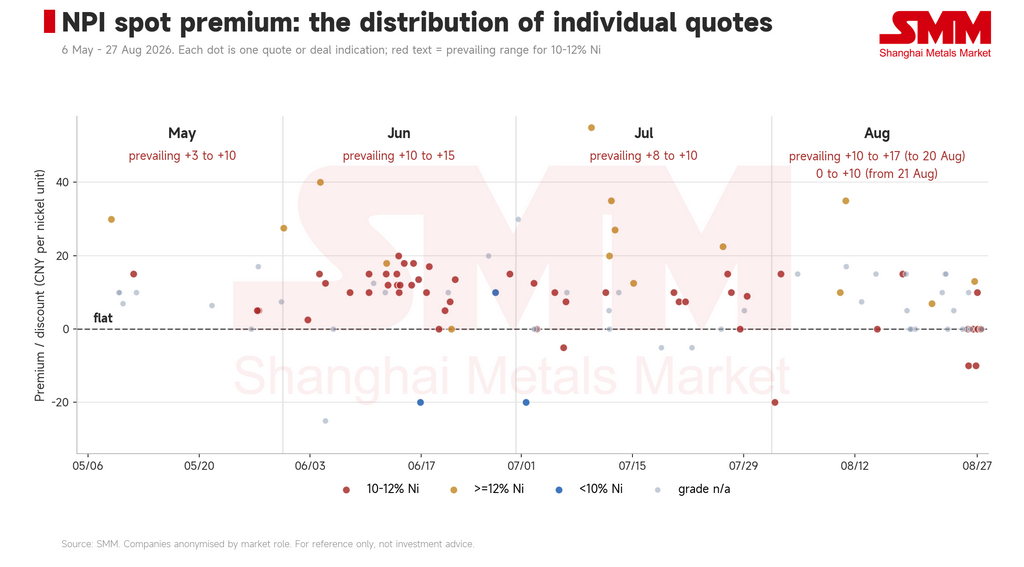
In May the market had only just begun moving from fixed prices onto index-plus-premium. Premiums on 11% Ni material clustered at 3 to 10 yuan/mtu, with quotes around 30 seen on 13%-plus.
June was the high point of this cycle. The mainstream premium on 11% material reached 10 to 15, with some indications at 18 to 20; 12%-plus commonly carried 20 to 30, one print on 13% reached 40, and sub-10% material traded at discounts of 20 to 30.
By July the mainstream on 11% had eased back to 8 to 10, and enquiries from several major mills were already going out on a flat basis.
In early August premiums of 15 to 17 were still available. By the last third of the month, 11% and below was generally trading flat, 11%-plus carried only a few yuan, and some mills had moved their buying terms to a discount of 5 to 10. The 12%-plus premium came back from 20-30 to 7-15, with only isolated delivered indications holding higher.
Over the same period the Indonesian 10-12% NPI CIF China duty-paid assessment fell from 1,155 yuan/mtu on 22 June to 1,127 on 27 August, down 2.4%, and SMM's NPI index fell from 1,156.3 to 1,130, down about 2.3%.
In two months the index adjusted about 2.4%, while the spot premium completed a full round of compression.
The clearest change in August, then, was not a sharp fall in the outright price of NPI. It was how quickly the market stopped paying up for available spot material.
The balance is still short, so why did the premium fall?
On aggregate supply and demand, SMM's NPI balance was -8.4 kt Ni in July and -7.9 kt in June, two consecutive months of deficit, while Chinese ferronickel imports fell from 98.5 kt Ni in May to 68.9 kt in July, the lowest of the year.
Read from the balance alone, a rapid fall in the premium is hard to explain.
The point is that an aggregate deficit and spot scarcity are not the same thing.
Most Indonesian NPI is absorbed through integrated internal transfers and annual contracts. The material that actually reaches the spot market and takes part in day-to-day negotiation is only a portion of total supply. The premium is therefore not very sensitive to the aggregate balance, and depends far more on how many uncommitted parcels are available in a given month.
July's elevated premium did not mean the NPI market as a whole was severely short. It meant the freely tradable spot at that moment was tight and sellers held the stronger hand.
In August that condition changed. The balance describes the aggregate; the premium describes the marginal cargo. Once the volume of parcels reaching the market increases, the premium can fall first even while the overall balance stays in deficit.
Indonesian margins stayed healthy, supply stayed high, spot scarcity eased
Indonesian NPI exports reached 854 kt gross weight in July, 96.2 kt of contained nickel, up 16.8% month on month and close to the year's high. Indonesian NPI output rose again over the same month to 130.3 kt of contained nickel.
The core of this round of supply pressure is not a sudden wave of new capacity. It is that Indonesian NPI production remains profitable, so producers have little reason to cut output voluntarily.
As ore prices continued to fall, production costs moved down with them, and for some projects the margin actually improved. Against that backdrop Indonesian NPI has held high operating rates and high output.
Indonesian domestic 1.6% laterite ore delivered to plant fell from USD 76.3/wmt in mid-June to USD 65.8 on 27 August, down 13.8% in ten weeks.
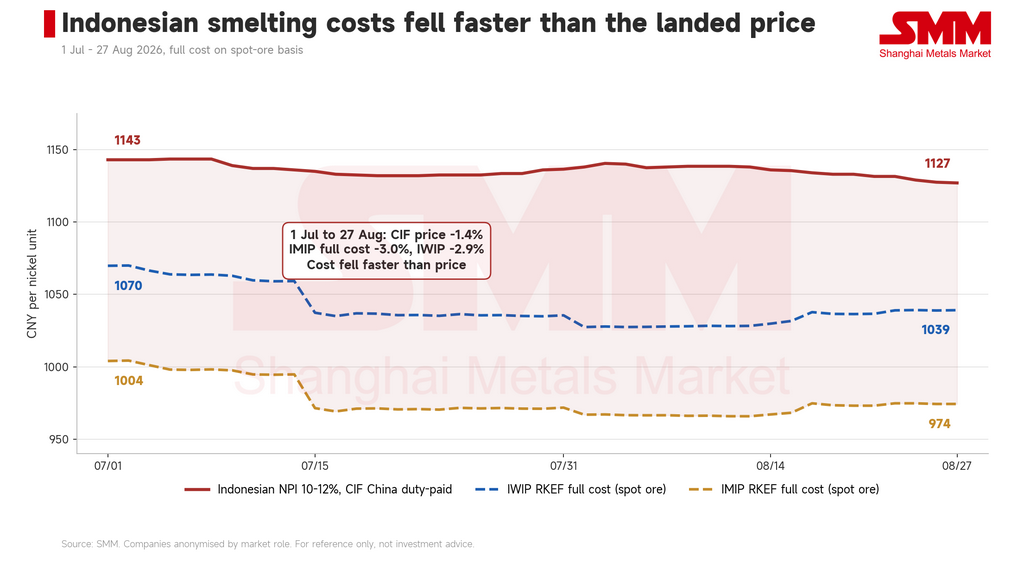
The cost side can be quantified directly. On a full-cost basis using spot ore, Indonesian RKEF cost per nickel unit fell from 1,004.0 yuan on 1 July to 974.4 on 27 August at IMIP, down 3.0%, with IWIP down 2.9% from 1,069.8 to 1,039.1. Over the same window the Indonesian 10-12% CIF China assessment fell only from 1,143 to 1,127 yuan/mtu, down 1.4%. Costs fell faster than the price.
That shows up in margins. On the same full-cost basis, the IMIP margin rose from 12.2% on 1 July to 13.5% on 27 August, and IWIP from 6.4% to 7.8%, both wider by roughly 1.4 percentage points.
For projects already in operation, a margin that is widening rather than compressing gives no economic case for cutting output voluntarily. That is the key to understanding why Indonesian supply held up in August.
Domestic Chinese smelting margins moved the other way. The Jiangsu RKEF full-cost margin fell from 4.84% on 22 June to 3.49% on 1 July and 1.42% on 27 August, a low level for the year. The pressure from this round of price adjustment has been carried mainly by Chinese producers, while Indonesian producers have not been squeezed in any real sense. Output cuts, if they come, are therefore unlikely to appear on the Indonesian side in the near term.
Mills stepped back from buying, weakening sellers' leverage
While supply held high, buying behaviour changed.
In August several major mills stopped accepting premium-based purchases, and some showed little appetite to restock even against flat-priced material. At the same time, some mills moved their terms lower again, and discount requirements began to appear.
This round of premium compression is therefore not only price pressure in the conventional sense. It reflects a decline in mills' willingness to buy spot at all.
Chinese 300-series stainless output was 1.75 Mt in July, down 8.4% month on month. Production cuts directly reduce marginal demand for nickel units and widen the room to postpone purchases.
The immediate reason for the cuts is margin. SMM's 304 cold-rolled margin, also on a full-cost basis, fell from 4.63% on 1 June to 2.95% on 1 July and 0.64% on 27 August. With margins that much narrower, a mill's capacity to absorb any form of raw material premium falls with them, and buying is more easily deferred.
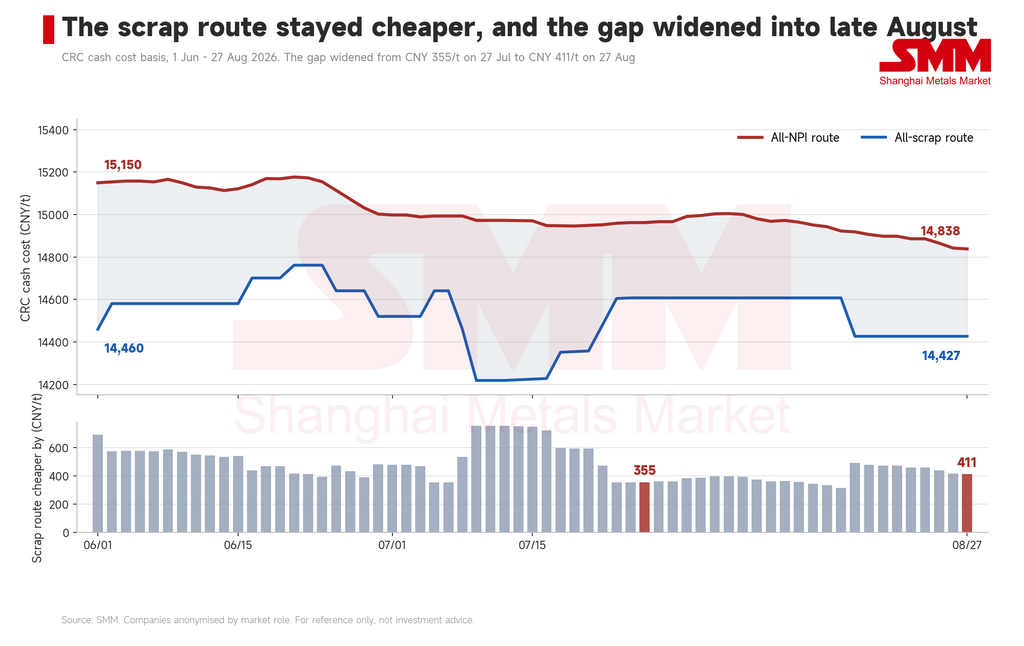
Substitution remains available on the raw material side. On 27 August, on a like-for-like cash cost basis, the all-scrap route to cold-rolled cost about 14,427 yuan/t against roughly 14,838 for the all-NPI route, leaving scrap about 411 yuan cheaper. The gap was about 355 yuan at the end of July, so through August it widened rather than narrowed.
While that gap holds or widens, mills can lower their marginal demand for NPI by adjusting the charge mix, instead of having to accept a higher premium to secure units.
For high-grade NPI, softer refined nickel prices are compressing the premium as well. SMM 1# refined nickel averaged 145,361 yuan/t in May and 129,850 in July, down about 10.7%. August's failed 14% tender, where bids came in below SMM's own 14% assessment, points the same way: high-grade material is being revalued alongside refined metal.
So August brought two changes at once. Indonesia had no reason to cut, and supply stayed high; Chinese mills needed less material, and accepted less premium. Together they moved spot bargaining power from sellers towards buyers.
Set the two ends of the chain side by side and the distribution of margin in August is markedly uneven. Of the four links, only Indonesian NPI saw its margin widen; margins at Chinese smelters and at the stainless mills both narrowed noticeably over the same period.
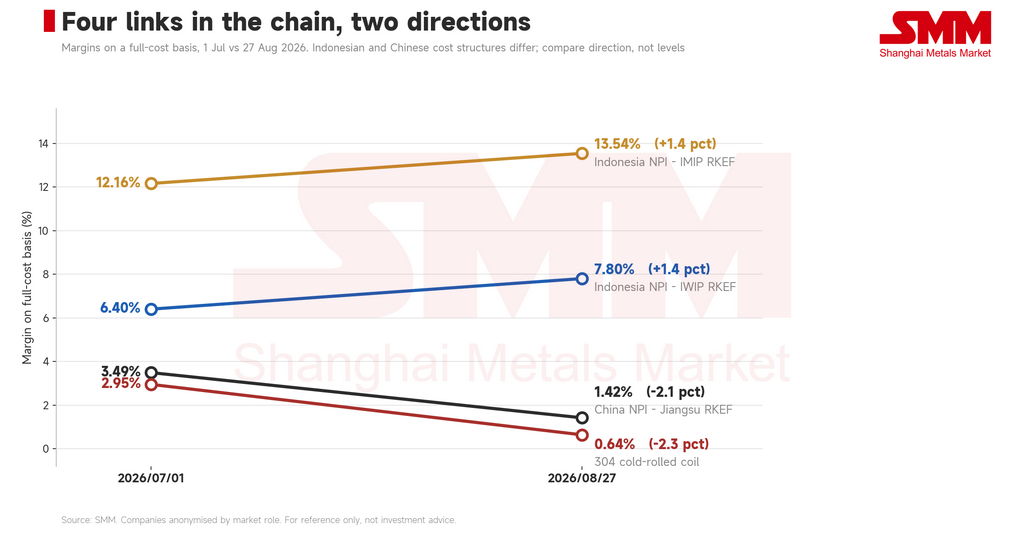
The premium is, in the end, how that margin gets divided between buyer and seller. When the upstream margin widens while both the smelting and the finished-steel links in China narrow, the buyer's capacity to pay a premium falls with them, and it is no surprise that the premium adjusted before the outright price did.
The premium still moves ahead of the index
Across the market since May, the premium has reflected marginal changes in supply and demand noticeably earlier than the index has.
The mainstream premium on 11% material had already eased from 10-15 to 8-10 during July, yet the NPI index still stood at 1,136.5 on 31 July and rose to 1,140.5 on 4 August. The index only entered a sustained decline after the middle of August.
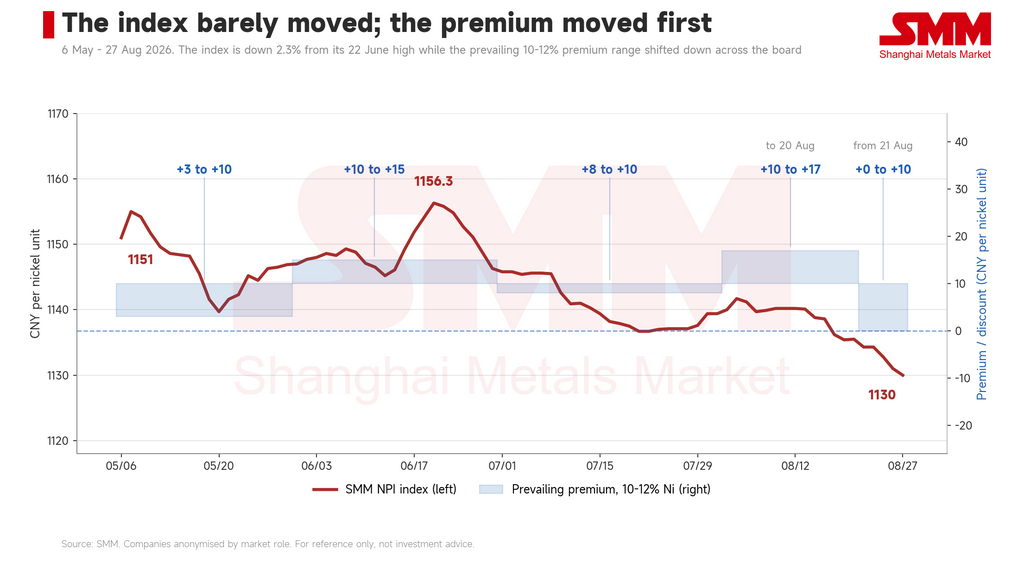
In other words, this adjustment showed up first in what buyers would accept on the premium, and only then fed through to the outright price.
The same shift has now extended into September. On 26 August a specialty-steel cluster in Jiangsu bought roughly 8,000 tonnes of 11%-plus material, weighted average around 11.5% Ni, settling against the September SMM average at flat. Flat is no longer only an August spot indication; it has entered September contract terms. On the same day, mills were asking the trade to source at the index minus 10.
Judging by the market's behaviour since May, changes in what buyers will accept on the premium generally come before the index moves. If that relationship holds, the drift from flat towards a discount in late August implies further downward adjustment in the outright price.
Conclusion
The most important change in the NPI market in August is not how far the index fell. It is that the spot premium narrowed markedly, and that some buying terms have begun to move towards a discount.
July's premium rested on tight freely tradable spot. Through August, Indonesian NPI production stayed profitable, producers had little reason to cut, and high supply continued; at the same time mills cut output, buying appetite fell, and a degree of scrap substitution remained available.
With supply high and marginal demand weaker, spot scarcity eased, and the premium adjusted first.
What matters for September is therefore not only where the NPI index trades, but three variables that bear more directly on spot pricing: whether Indonesian margins keep supply high, when major mills return to the market, and whether current discount-based buying terms convert into actual deals.
If Indonesian supply does not contract meaningfully and mill restocking stays limited, then what August completed may only be the adjustment in the premium, with the adjustment in the outright price still to come.
Written by Bruce Chew
Nickel & Stainless Steel Analyst, Shanghai Metals Market
Email: bruce.chew@metal.com
Tel: +601167087088