SMM, August 31:
August Market Review: Two Consecutive Rounds of Gains After Six Months of Grinding Lower, with Gains Accelerating at Month-End
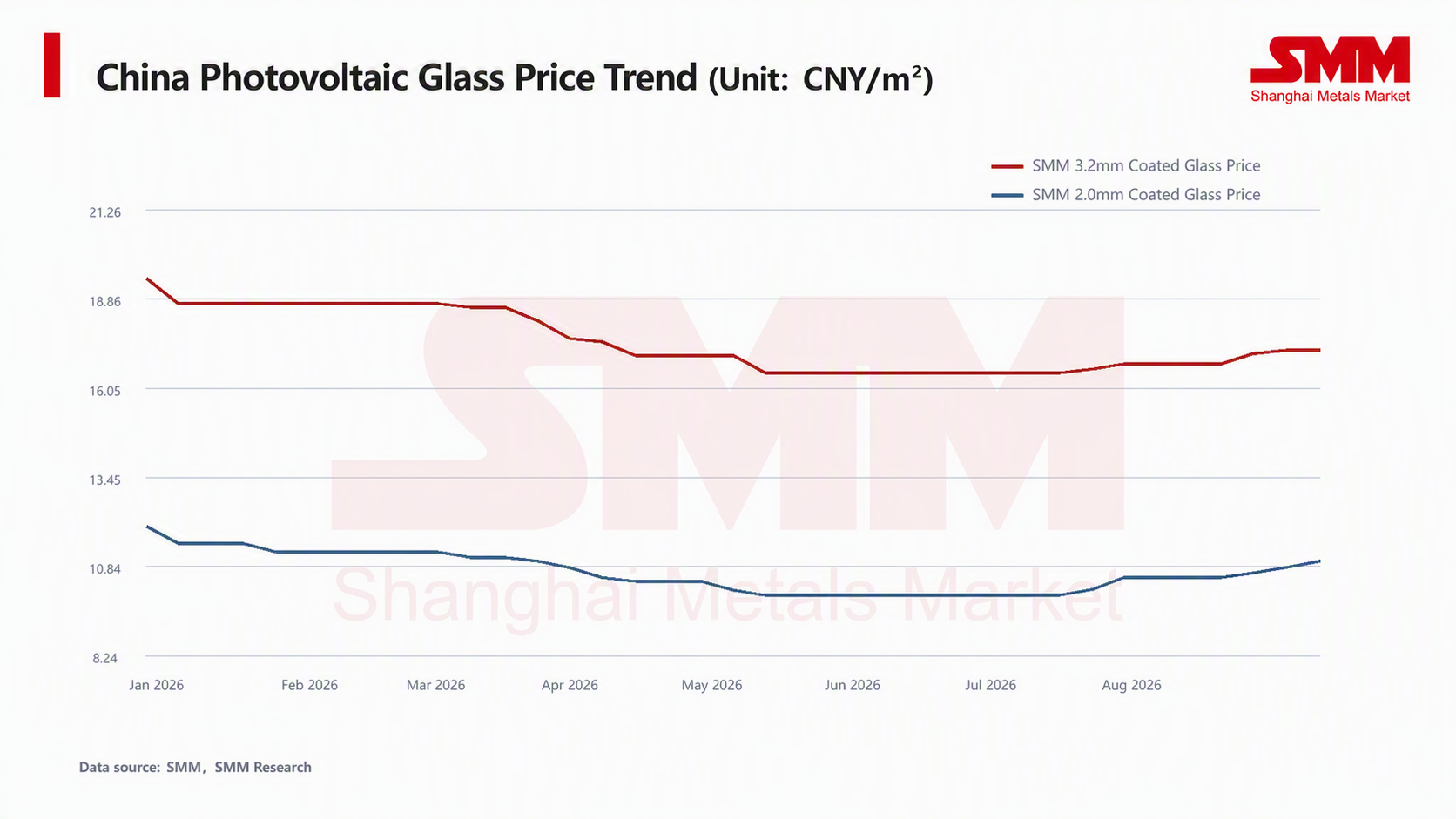
In August, the inflection point for PV glass prices was formally established. The first round of upward adjustments came in early August: the average price of 3.2mm double-layer coated glass rose from 16.6 yuan/m² to 16.75 yuan/m², and 2.0mm from 10.15 yuan/m² to 10.5 yuan/m², with the single increase for 2.0mm reaching 0.35 yuan/m². The second round of increases was concentrated at month-end: the average price of 3.2mm was raised in two consecutive steps to 17.05 yuan/m² and 17.15 yuan/m²; 2.0mm followed in tandem, rising from 10.5 yuan/m² to 10.65 yuan/m² and then 10.8 yuan/m², and on August 31 it further climbed to 11 yuan/m², with expectations of further gains ahead. Although prices have already rebounded in successive rounds, the two mainstream specifications remain below levels at the start of the year; this round of gains is more of a "bottom repair" than a trend reversal, and whether the uptrend can continue depends on the sustainability of supply contraction.
Key Driver of Price Increases: Industry-Wide Production Cuts Forced by Losses; Supply Contraction Leads the Way
The logical starting point of this round of glass price increases is on the supply side, not the demand side.
In H1, glass prices trended downward and fell below the cost line of some production lines, pushing the industry into losses. Under cash flow pressure, starting in Q2, some top-tier players successively announced cold repairs at production lines, and some small and medium-sized enterprises followed with production cuts and lower operating loads, causing the industry-wide operating rate to pull back notably from high levels.
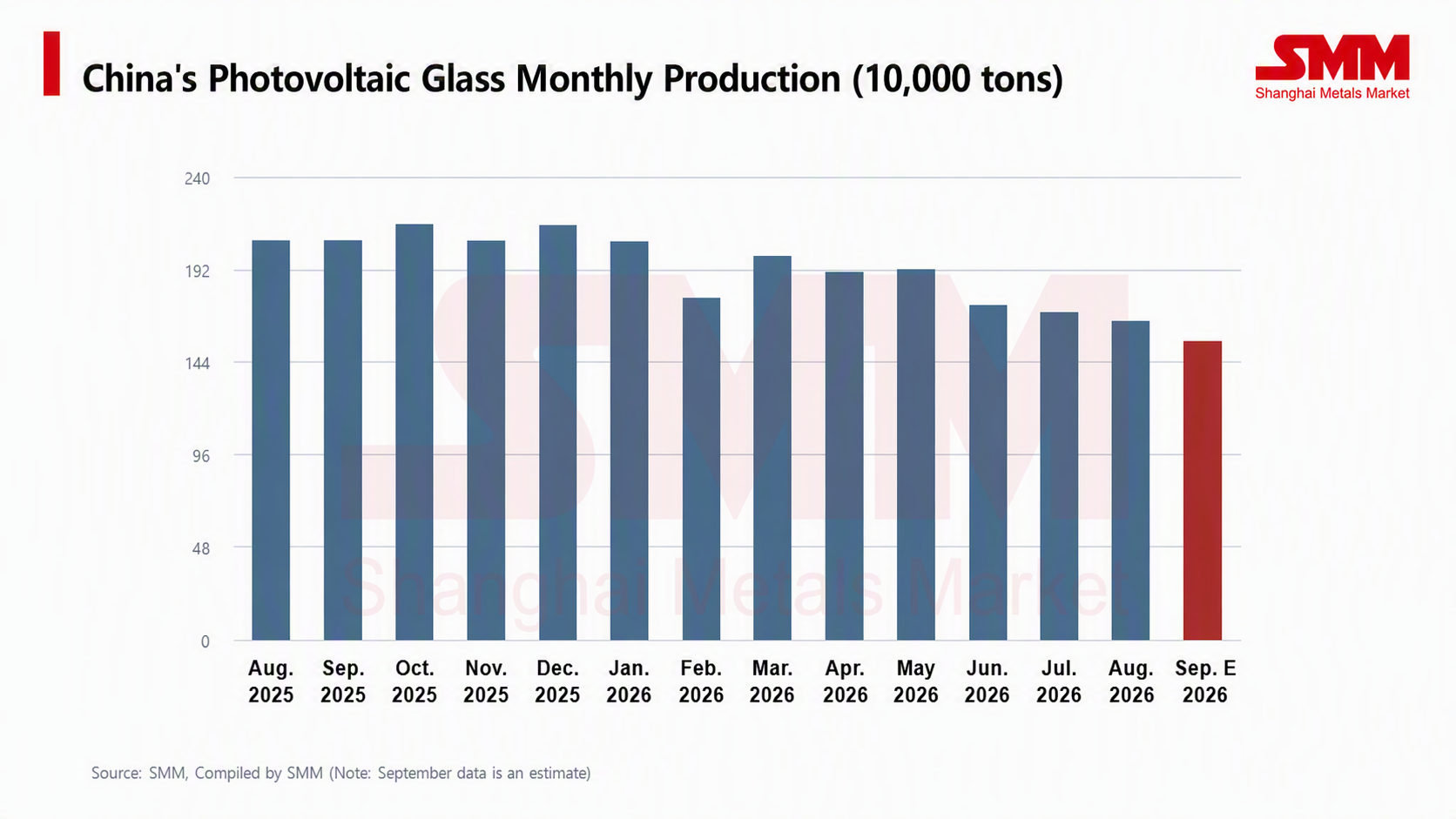
Supply contraction is directly reflected in production data. According to SMM statistics, monthly PV glass production has been pulling back continuously since January: June production fell sharply by 9.7% MoM; July production fell by a further 2.2% MoM; SMM expects September production to decline further, with a cumulative drop of close to 25% from the January peak. Supply contraction is still deepening, and output is now clearly below the roughly 2 million mt-plus level recorded in the same period last year. By thickness, 3.2mm production has fallen by about 29% cumulatively from the start of the year; 2.0mm production has fallen by about 17% cumulatively—thin glass production cuts are relatively smaller, but its demand side has benefited from the continued rise in double-glass module penetration, leading to a more obvious improvement in supply-demand alignment.
According to SMM statistics, starting last Friday, China's top-tier players began production cuts in line with the production cut plans agreed at an earlier joint meeting. In just three days, top-tier players reduced output by a total of 2,200 mt/day through furnace cold repairs, and second-tier enterprises in China also finalised production cut plans today. They will complete furnace cold repairs successively this week, with expected affected capacity of around 3,600 mt/day.
It should be noted that production resumptions after cold repairs of glass production lines are highly rigid: restarting furnaces not only requires a preparation cycle of several months but also entails high restart costs, so enterprises generally lack the incentive to resume production before prices have recovered to a reasonable profit range. This means that even if prices have been raised continuously since August, supply is unlikely to be effectively replenished in the short term, and the process of supply-demand rebalancing will continue to support prices. According to SMM, some module enterprises stepped up glass purchasing and stockpiling in August to lock in auxiliary material supply and prepare for Q3 peak-season production schedules, further amplifying the short-term supply-demand gap.
Market Outlook: Prices Still Have Upside Room in September, with 2.0mm Double-Layer Coated Glass Expected to Reach 11.5 Yuan/m²
Looking ahead to September, SMM believes PV glass prices still have the basis to continue rising, with two core reasons:
First, supply rigidity persists. Industry inventory is currently in a destocking channel overall, while operating capacity has already contracted for several consecutive months. Cold-repaired production lines have limited willingness to resume production in the early stage of price repair, so the supply side is unlikely to suppress price increases.
Second, price increase transmission is smooth. After two rounds of price adjustments in August, downstream acceptance was better than expected. As module stockpiling increased, fear of further price gains provided support, and there were fewer obstacles to price transmission.
Overall, SMM expects PV glass prices may still have room for further upward adjustment in September. However, two risks need to be watched: first, if scheduled module production falls short of expectations, the room for glass price increases will be compressed; second, if prices quickly recover above the profit range, previously cold-repaired production lines could accelerate production resumptions, and supply replenishment would constrain the continued rise in prices. Going forward, the key factors to track are: dynamics of glass furnace cold repairs and production resumptions, actual module production schedules in September, the pace of inventory destocking at glass enterprises, and marginal changes in double-glass module penetration.
![[Distributed Module Prices Edge Down Again]](https://imgqn.smm.cn/usercenter/LlMgj20251217171739.jpg)
![[SMM PV News Flash] Huadian’s 200 MW PV Project EIA Public Disclosure!](https://imgqn.smm.cn/usercenter/HdPjk20251217171741.jpg)
![[SMM PV News Flash] Lincang Tea–PV Complementary Digital Innovation Project Wins National Technology Award](https://imgqn.smm.cn/usercenter/SoBNj20251217171739.jpg)