I. Background: The Three-Tier Differentiation Framework from Two Weeks Ago
Two weeks ago, SMM proposed that the transmission of computing power leasing demand showed a three-tier differentiation of “tight upper tier, hot middle tier, stable lower tier”: high-end B300/H200 had rigid supply and rising prices; mid-end Pro6000 drew rising investor attention; lower-tier 4090/5090 had ample supply and constrained transmission. Two weeks later, the market provided enough price signals to review and update this framework.
II. 4090: A Quote Center Took Shape and a “Shift from Leasing to Buying” Signal Emerged
Leasing quotes and transaction data for 4090 collected this week showed that price signals for this product had initially taken shape, and a key structural change emerged:
Leasing Side: in east China, for the same 4090 order, the quote was 7,300 yuan/unit/month and the transaction was 7,250 yuan/unit/month; another entity subsequently transacted at 7,500 yuan/unit/month; there were also market quotes and transactions at 7,000/7,800 yuan/unit/month. The price center was roughly in the 7,000–7,800 yuan/unit/month range.
Procurement Side: 4090 recently saw substantial procurement demand, and whole-machine purchase prices jumped to above 350,000 yuan/unit. When supply of large-cluster 4090 leasing was released, some lessees proposed buying the equipment directly rather than leasing it. This “shift from leasing to buying” reflected that 4090 had become a product with a market price jump.
SMM View: the formation of a 4090 quote center is consistent with the judgment two weeks ago that “lower-tier prices were stabilizing.” However, the emergence of the “shift from leasing to buying” signal means that this product is shifting from “constrained transmission and stabilizing prices” to “demand expansion and price jumps.” The stability of the leasing price center masks the sharp rise in whole-machine purchase prices, which is a new variable that the mid-end computing power market needs to watch closely.
III. Pro6000: Price Signals Are Distorted and Reference Value Requires Caution
Unlike the formation of a 4090 quote center, Pro6000 price signals this week showed an anomaly that warrants caution:
in some channels, the volumes of spot Pro6000 and leasing orders overlapped to a high degree, with 32 units of leasing demand appearing within one day after 32 units of supply came online.
In a normal supply-demand relationship, the size and pace of spot cargo and leasing orders rarely correspond so precisely. SMM believes this anomalous overlap suggests that some current Pro6000 price signals may not be entirely driven by real demand, and their reference value should be treated with caution.
SMM View: the judgment two weeks ago that “Pro6000 was in the early stage of investor attention and had not yet formed a market of scale” should be revised to “the validity of price signals at this tier is questionable.” Pro6000 prices and popularity may have been artificially amplified to some extent, and directly using its quotes as a market reference carries distortion risk.
IV. 5090: Transactions Recovered and Upward Price Pressure Emerged
Two weeks ago, SMM judged that 5090 price increases would be limited and supply expansion would offset demand pressure. This week, upward price signals for this product became more explicit:
Single-Card Price: quotes for 5090 fan cards and blower cards have risen to about 40,000 yuan per card;
Whole-Machine Leasing: transactions for 5090 eight-card machines (512G) continued to recover, and purchase willingness driven by inference demand was clear. This week, an 800-unit inference-demand leasing order was signed, confirming that leasing demand for the 5090 series continued to rise.
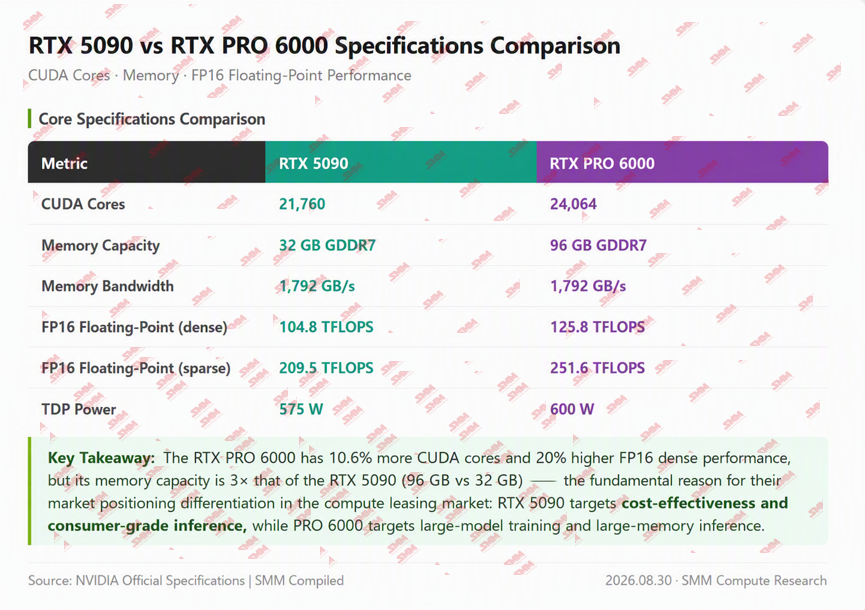
SMM View: the recovery in 5090 transactions and price increases, together with 4090's “shift from leasing to buying,” constitute dual signals of a “lower-tier upturn” in mid-end computing power. Lower-tier transmission shifted from “constrained” to “recovering,” and both 4090 and 5090 prices showed upward pressure. The old framework's characterization of “constrained lower-tier transmission” should be revised to “lower-tier transmission showed marginal thawing, and price jump signals emerged.”
V. Pricing Methodology: Transaction Center Replaces Scattered Quotes
The collection of price signals in this round exposed a key methodological issue: the divergence between quotes and transactions.
The core principle from channel feedback is: “transaction prices carry greater weight than quoted prices.” Taking 4090 as an example, for the same order, the quote was 7,300 yuan/unit/month and the transaction was 7,250 yuan/unit/month. A single transaction is affected by client negotiations and payment terms, so scattered quotes have limited reference value.
SMM View: for compiling a computing power leasing price index, priority should be given to anchoring to the transaction center rather than scattered quotes, using cross-validation of multi-source transaction data to replace linear reference from individual quotes. This methodology is especially applicable to the mid-end computing power market: in a noisy environment where quotes diverge from transactions and spot cargo overlaps with leasing orders, only the transaction center can filter out artificially amplified price signals.
VI. Conclusion: Tiered Validity of Price Signals plus Lower-Tier Price Jumps
SMM believes: the overall direction of the three-tier differentiation framework for computing power leasing prices established two weeks ago remains valid, but this week's data revealed two key updates:
Tiered Validity of Price Signals: 4090 has a clear quote center and valid signals; Pro6000 shows an abnormal overlap between spot cargo and leasing orders, and its signals are distorted; 5090 shows recovering transactions and strengthening signals.
Lower-Tier Price Jump Signal: 4090 showed a “shift from leasing to buying” and whole-machine purchase prices exceeded 350,000 yuan/unit, while 5090 prices rose to 40,000 yuan per card. Lower-tier computing power shifted from “constrained transmission” to “price jumps.”
Short Term (3–6 Months): the 4090 leasing quote center may stabilize at 7,000–7,800 yuan/unit/month, but whole-machine purchase prices may remain at elevated levels above 350,000 yuan/unit. Pro6000 price signals will need to await more complete transaction data cross-validation, and 5090 upward price pressure may persist.
Medium and Long Term: the standardization of mid-end computing power price signals will depend on the transparency of quote and transaction definitions. Only when transaction processes are traceable and the relationship between spot cargo and leasing orders is verifiable can price signals truly become an effective market reference. At the same time, the “shift from leasing to buying” and price jumps in 4090/5090 suggest that lower-tier computing power is shifting from “ample supply” to “demand expansion,” and the sustainability of this shift deserves continued tracking.
![[SMM Computing Power Flash] Mengxi Data Center Electricity Prices Stable at 0.33-0.36 yuan/kWh, Direct Green Electricity Supply Around 0.36 yuan](https://imgqn.smm.cn/usercenter/PeWqW20251217171735.jpg)
![[SMM Computing Power Flash] Ascend 910B Rental Demand Heats Up, Preference for 910B3 or Higher Specifications](https://imgqn.smm.cn/usercenter/yhuhG20251217171735.jpg)
![[SMM Computing Power Flash] A100 40G Bare Metal for Rent in East China, Monthly Rent 8,800 Yuan Excluding Tax](https://imgqn.smm.cn/usercenter/fNuSg20251217171735.jpg)