News on August 29, 2026:
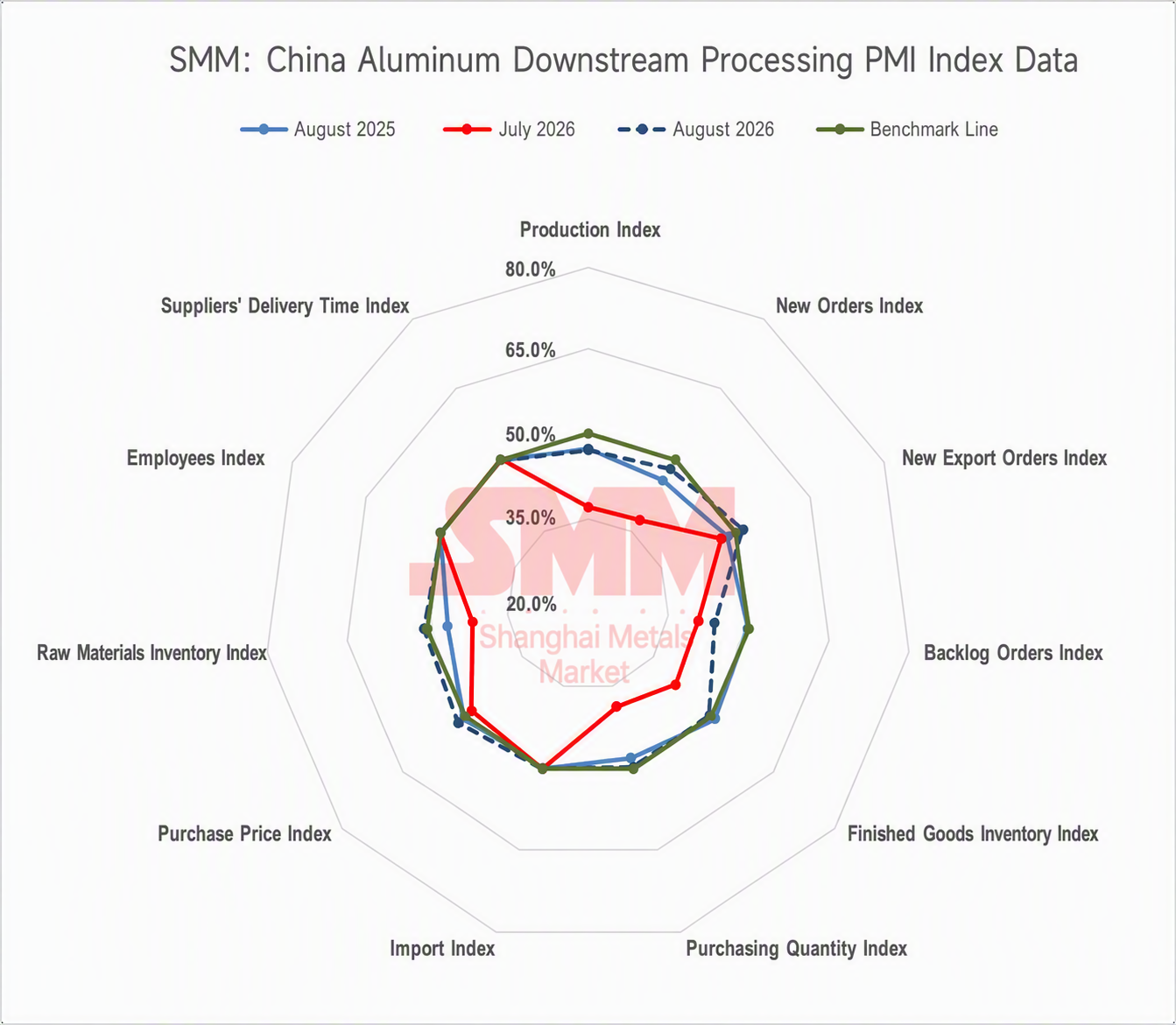
In August, China's aluminum processing industry composite PMI recorded 48.7%, up slightly from July but still below the 50 mark, with the industry overall showing "weak recovery" characteristics and significant divergence across segments. Aluminum wire and cable was the strongest performer, with a PMI of 54.5%, up 10.1 percentage points MoM; accelerating implementation of power grid orders combined with front-loaded stockpiling for the September-October peak season drove sharp rebounds in the new orders index and new export orders, and producers actively prepared materials and restocked, with only the production-side recovery pace slightly lagging the recovery in orders. Aluminum foil recorded a PMI of 52.1%, as the completion of maintenance and production resumptions in air-conditioner foil and stable battery foil demand formed twin engines, and the earlier production control and destocking strategy began to show results. Aluminum plate/sheet and strip recorded a PMI of 50.6%, returning above the 50 mark, mainly because the earlier production control and destocking strategy drew to a close and, after inventory pressure eased, industry leaders tentatively raised production; however, with can stock stockpiling largely completed, automotive sheet demand constrained, and ordinary commercial plate demand remaining sluggish, the expansion carried a clear low-base recovery tone, and high aluminum prices also suppressed end-user restocking willingness. Other segments continued to struggle in contraction territory: Industrial extrusion was at 48.2%, as energy storage, PV, and rail transit segments provided steady support, but orders for ordinary industrial extrusion showed no recovery, high temperatures disrupted production pace, and large and small enterprises diverged significantly; Secondary alloy was at 46.7%, up 9 percentage points MoM, as tax invoice issues eased marginally and orders showed signs of improvement in late August, but tight supply of compliant aluminum scrap and weak demand still constrained the recovery in operating rates; Construction extrusion was at 45.3%, as retail spot orders were sluggish and small and medium-sized enterprises proactively controlled project order intake, with some small enterprises in certain regions taking phased holidays; only long-term export orders retained some resilience; Primary alloy was at 44.3% and contracted for three consecutive months, as stockpiling at low prices in July overdrew August demand and rising aluminum prices again suppressed purchase willingness, leaving market trading persistently subdued.
By specific product type:
Aluminum plate/sheet and strip: In August, the composite PMI of the aluminum plate/sheet and strip industry ended at 50.6%, achieving a notable recovery from its July low and returning above the 50 mark. The production index and the new orders index both recorded 51.1%, expanding in tandem, mainly because the industry-wide production control and destocking strategy implemented earlier in the off-season drew to a close; as finished product inventory pressure eased noticeably from earlier levels, several industry leaders began tentatively raising production loads modestly, thereby driving a recovery in proactive production willingness. However, the expansion in new orders was relatively limited. Can stock, a previous bright spot of support, saw stockpiling for the “September-October peak season” largely completed, leaving support into September at risk of fading. Auto sheet was constrained by limited demand release caused by weak consumer confidence, while civilian ordinary sheet remained cold, and at month-end the construction sheet/plate sector had yet to see positive factors from concentrated stockpiling. On the price and inventory front, the purchase price index recorded a high of 51.7%, and persistently high aluminum prices suppressed end-user willingness to restock proactively, leaving strong wait-and-see sentiment in the market. Overall, the expansion in the August aluminum plate/sheet and strip PMI carried a fairly clear “low-base recovery” character. Against a backdrop of unrealized peak-season stockpiling expectations and high prices suppressing demand, this was in fact a “weak recovery” of demand. From this perspective, the September aluminum plate/sheet and strip PMI is also expected to extend the weak recovery trend.
Aluminum foil: The August aluminum foil industry PMI recorded 52.1%. Looking at sub-indexes, the production index (55.2%) and the new export orders index (55.2%) were the twin engines driving the composite index. The rise in the production index came from the dual impulse of the end of equipment maintenance at some air-conditioner foil enterprises earlier and sustained steady support from battery foil demand. Meanwhile, the product inventory index recorded 46.4%, showing initial results from the earlier iron-fisted strategy of “controlling production schedules and prioritizing destocking,” which effectively contained inventory buildup risks. On exports, although newly received export orders recovered slightly in August, the overall export side cooled markedly from its Q2 peak. Overall, since the internal momentum of end-use consumption has not achieved a substantive turnaround, and as the air-conditioner production resumption dividend weakens again in September, the recovery in packaging and steady battery foil output have so far not provided enough upward momentum for the aluminum foil industry's September PMI. The industry still needs to find more consumption support points to stabilize its operating trajectory.
Construction extrusion: The August construction extrusion PMI recorded 45.3%, continuing to run below the 50 mark. This month, the new production index recorded 42.1%, the new orders index recorded 41.4%, and the purchasing volume index recorded 44.2%, extending the industry's contraction. In terms of order structure, construction extrusion orders continued to contract mildly in August. Large enterprises reported that orders on hand were mainly project orders, but retail spot orders remained weak this month. Small and medium-sized enterprises, for cash flow safety, proactively scaled back project-based order intake. Overall, retail orders for construction extrusion continued to decline this month, downstream end-users maintained just-in-time procurement pace, and high aluminum price consolidation in August further suppressed downstream purchasing sentiment. In addition, some small construction extrusion enterprises in Hebei and Shandong still had periodic shutdowns this month due to insufficient orders, keeping the industry's sentiment in a weak pattern. On exports, the new export index recorded 48.4% this month. Although it remained in contraction territory, enterprises reported that while export spot orders declined recently, the ordering willingness of long-term cooperative clients did not weaken significantly, and long-term orders on hand remained ample, so export-side resilience persisted. On the inventory side, the finished product inventory index recorded 48.6% and the raw material inventory index recorded 48.8%, as enterprises continued proactive destocking and purchase-as-needed strategies. Due to falling orders, both raw material and finished product inventories were reduced this month. Looking ahead to September, the market remains cautious about how strongly the “September peak season” will materialize. With no clear marginal recovery signal in month-end end-use demand, the September construction extrusion composite PMI is expected to run just below the 50 mark.
Industrial extrusion: The August industrial extrusion industry composite PMI recorded 48.2%, continuing to run below the 50 mark, with overall industry sentiment in weak contraction territory. From sub-indexes, the production index was 45.9% and the new orders index was 48.3% this month. The industrial extrusion sector continued to show off-season characteristics, but the sector's structural resilience remained prominent. In sub-segments, demand for supporting extrusions in energy storage, PV, and rail transit stayed generally stable, forming bottom support. Dragged by the broader off-season environment, orders for ordinary industrial tubes, bars, and industrial motor housings had yet to show signs of recovery. Some small industrial extrusion enterprises reported that August orders fell further MoM, diverging clearly from the relatively stable order performance of large and medium-sized enterprises. In addition, persistent high temperatures continued to disrupt the production pace, and some enterprises temporarily halted or restricted production in the afternoon, exerting some pressure on monthly output. In terms of inventory, the finished product inventory index recorded 46.3% and the raw material inventory index recorded 49.2%. Affected by steady-but-weak sector demand, enterprises continued purchase-as-needed and produce-based-on-sales strategies, without proactive stockpiling. At month-end, some enterprises reported that, driven by the traditional peak auto sales season, demand for front-loaded stockpiling related to models scheduled for launch under orders on hand was released, and new orders for automotive-related aluminum extrusions recovered recently, further confirming demand resilience in the industrial extrusion sector. Looking ahead, the September industrial extrusion composite PMI is expected to rise back above the 50 mark.
Aluminum wire and cable: China's aluminum wire and cable industry PMI recorded 54.5% in August, up 10.1 percentage points MoM, returning from contraction territory to expansion territory and repairing industry sentiment. By sub-index, the production index recorded 47.75% (up 11.3 percentage points from 36.41% in July). Although production visibly recovered, it remained below the 50 mark, with the operating rate recovery lagging the rebound in orders. The new orders index recorded 64.95% (up 19.7 percentage points from 45.27% in July), as grid orders landed faster and “September-October peak season” stockpiling orders were front-loaded, leading to a significant surge in new orders. The new export orders index recorded 53.03% (up 29.8 percentage points from 23.19% in July), returning to expansion territory from contraction territory; the improved SHFE/LME price ratio led to intermittent opening of the aluminum stranded wire export window. The backlog order index recorded 59.06% (up 28.2 percentage points from 30.84% in July), as orders on hand were significantly replenished, supporting subsequent production scheduling. The purchasing volume index recorded 56.92% (up 18.6 percentage points from 38.35% in July), and the raw material inventory index recorded 57.89% (up 12.1 percentage points from 45.80% in July). Producers actively prepared materials and restocked for peak-season production, and raw material purchasing sentiment turned noticeably warmer. Overall, driven by faster implementation of grid orders, the aluminum wire and cable industry climbed out of the July trough in August. Orders, procurement, and inventory carried recovery expectations, but the production index had not yet stood above the 50 mark. The September aluminum wire and cable industry PMI is expected to run in expansion territory.
Primary aluminum alloy: The primary aluminum alloy industry PMI recorded 44.3% in August. Although slightly higher than the July low, it has been below the 50 mark for three consecutive months, indicating that the industry remains in deep contraction territory and the sluggish market trend has not changed. Compared with July's characteristics of weak supply and demand and strong wait-and-see sentiment, the market operating logic shifted somewhat in August. On the one hand, when aluminum prices were at relatively low levels in July, some traders and downstream enterprises carried out small-scale concentrated buying to stock up at low prices. This temporarily supported demand in that month, but also pulled forward some August procurement demand, causing new orders in August to shrink further, with the new orders index at 39.6%. On the other hand, aluminum prices in August rose from July, and the purchase price index climbed to 51.5%, returning to expansion territory. The renewed rise in cost-side pressure significantly suppressed downstream purchase willingness, and with end-use consumption still constrained by the seasonal off-season, actual transactions did not expand accordingly. Market trading sentiment remained subdued, and the spot cargo circulation pace saw no substantial improvement. In terms of corporate behavior, under the dual squeeze of insufficient new orders and rising costs, enterprises extended the conservative operating strategy seen since July. Overall, the August industry performance featured demand being pulled forward, cost pressure, and persistent wait-and-see sentiment, with limited improvement in industry sentiment. Looking ahead to September, as the traditional consumption peak season approaches, orders from sectors such as automobiles are expected to recover gradually, and downstream restocking demand may be released in a concentrated manner. The industry's supply-demand pattern is likely to improve materially, and the PMI is highly likely to return above the 50 mark.
Secondary alloy: The secondary aluminum industry PMI recorded 46.7% in August, up 9.0 percentage points MoM, repairing from the July low, though the industry remained in contraction territory overall. On the demand side, the traditional consumption off-season had not yet ended in early-to-mid August. Some downstream enterprises were still on high-temperature holidays, which weighed on die-casting enterprises' operating rates and procurement pace, leaving secondary aluminum enterprises' orders generally weak. Entering late August, as the traditional peak season gradually approached, some downstream orders showed marginal improvement, giving the demand side the characteristics of a weak recovery at the tail end of the off-season. On the supply side, enterprises' operating rates were mixed. Some enterprises reported that the problem of insufficient tax invoices eased from earlier, and with slightly improved orders, production edged up, though the overall increase was limited. Most enterprises kept operating rates basically stable, with little change in production. Some other enterprises, constrained by both weak demand and tight supply of compliant aluminum scrap, continued to see production decline. Overall, policy constraints remained in place. Compliant aluminum scrap circulation was still tight, and although the tax invoice issue eased marginally, it had not fundamentally improved, so the further recovery of production activity in the industry remained constrained to some extent. On inventory, due to relatively weak downstream demand, enterprises faced pressure in shipments and finished product inventories accumulated. Raw material inventories increased, mainly because some enterprises restocked as raw material prices pulled back periodically, reflecting stronger willingness to stockpile raw materials proactively. Looking ahead to September, orders from major downstream sectors such as automobiles and motorcycles are expected to recover seasonally, and the industry's production and order-taking pace is expected to improve accordingly. The September secondary aluminum industry PMI is likely to continue rising and return above the 50 mark. Going forward, close attention should be paid to the pace of peak-season order fulfillment, the supply of compliant aluminum scrap, and changes in tax invoice policy.
Market outlook:
As the traditional “September-October peak season” approaches, the September aluminum processing composite PMI is expected to rise to 51.9%, likely returning to expansion territory.Aluminum wire and cable will lead the expansion, supported by grid orders and ample orders on hand. Aluminum plate/sheet and strip will extend its weak recovery amid the loss of can stock support and high-price suppression. Aluminum foil will need to find new consumption support points after the air-conditioner production resumption dividend weakens. The construction extrusion market remains cautious about the strength of the “September peak season” and is expected to hover below the 50 mark. Industrial extrusion is likely to move closer to expansion territory, benefiting from front-loaded auto peak-season stockpiling. Primary aluminum alloy and secondary alloy are expected to return above the 50 mark, hoping that seasonal recovery in downstream orders from sectors such as automobiles and motorcycles will drive the concentrated release of restocking demand. Among them, secondary aluminum needs close attention to compliant aluminum scrap supply and tax invoice policy changes.Overall, industry sentiment in September is expected to improve materially, but the strength of the peak season will still depend on the tug-of-war between end-use consumption recovery and restocking willingness under high aluminum prices.
(SMM Aluminum Team)
![Aug Aluminum Processing PMI Edges Up with Sector Divergence, Sep Return to Expansion Eyed [SMM Analysis]](https://imgqn.smm.cn/usercenter/iCOMR20251217171653.jpg)