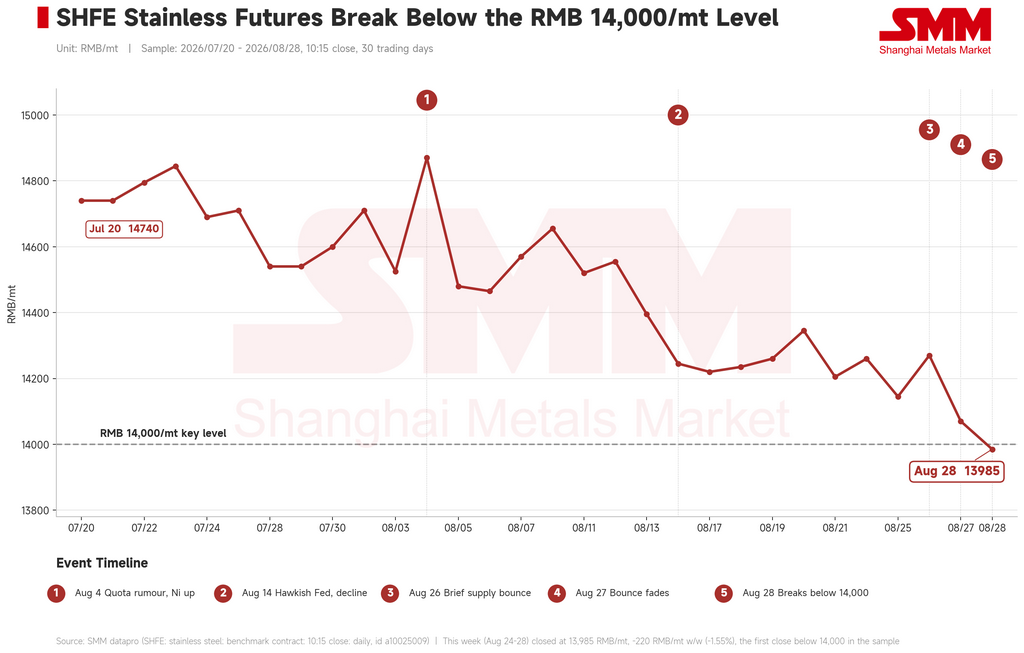
China's stainless steel futures broke decisively lower this week, closing below the RMB 14,000/mt level for the first time in the current cycle. The benchmark contract on the Shanghai Futures Exchange (SHFE) settled at RMB 13,985/mt (about $2,081/mt) on Friday, down RMB 220/mt (roughly $33/mt), or 1.55%, from the prior week's close. What matters here is not the size of the move but its timing: with the traditional September–October peak season days away, downstream buyers have shown no sign of stocking up, and inventories are building rather than drawing down.
A mid-week bounce that had no legs
The week traced a clear arc. The contract opened Monday at RMB 14,260/mt (about $2,122/mt) and eased to RMB 14,145/mt (about $2,105/mt) on Tuesday. On Wednesday, news of a supply disruption on the Nickel Pig Iron (NPI) side briefly raised concerns about raw material availability and lifted the contract to RMB 14,270/mt (about $2,124/mt). The rebound lasted barely a session — the underlying bearish picture hadn't changed — and prices fell back to RMB 14,070/mt (about $2,094/mt) on Thursday before breaking below RMB 14,000/mt on Friday.
The Fed turned more hawkish; the data cut the other way
Federal Reserve officials delivered an unusually consistent hawkish message this week. Cleveland Fed President Beth Hammack said current rates are still not restrictive enough. Boston Fed President Susan Collins argued that without evidence of sustained disinflation, rates should rise "as soon as possible." Kansas City's Jeff Schmid called policy still accommodative with inflation above target, while Chicago's Austan Goolsbee named uncontrolled inflation his biggest near-term worry, flagging tariff- and war-driven price increases as a particular challenge. Richmond's Tom Barkin warned that if US debt keeps climbing, investors will eventually stop buying Treasuries.
The data didn't cooperate. July PCE inflation held at 3.7% year-on-year, above the 3.6% consensus, nudging September hike expectations higher. But July new home sales fell to a six-month low, consumer confidence dropped to its weakest of the year, and the goods trade deficit widened to its largest since March 2025. Minutes from the European Central Bank pointed the same direction, indicating another hike may be needed absent a material improvement in the inflation outlook.
Hormuz de-escalated, but not decisively
Trump said the US Navy had confirmed that all mines in international waters within the Strait of Hormuz had been cleared or detonated. Iran and Oman issued a joint statement outlining a mutually agreed safe maritime corridor through the Strait, though Tehran stressed the waterway would not reopen immediately and, as of Friday, the two sides were still negotiating terms. An Iranian parliamentary committee approved a transit service fee on vessels using the Strait, pending a full vote, and Iran agreed to allow some Iraqi tankers through. Kuwaiti and Qatari crude exports via the Strait have recovered to roughly 70% of pre-conflict levels.
Working against that, the US Treasury widened its secondary sanctions to cover entities and countries worldwide still trading with Iran — spanning technology, gold, aviation, and shipping — and sanctioned nearly 60 entities, individuals, and vessels. Iran responded that any country joining economic restrictions against it would be treated as an adversary. Morgan Stanley raised its Brent forecast to a Q4 peak near $100 per barrel.
Trade friction escalated separately. Canada declined to finalise a deal with Washington and will impose retaliatory tariffs of 15%, 25%, or 50% on roughly $20 billion of US goods from September 8. The US is weighing an additional 7.5% tariff on Chinese goods; China's Commerce Ministry, noting that Washington has opened Section 301 investigations into 16 economies on "overcapacity" grounds, called the move textbook unilateralism and protectionism and stated firm opposition.
Beijing kept the policy taps open
China's Ministry of Finance issued guidance on tighter coordination between fiscal and financial policy to support domestic demand, and disclosed that RMB 187.5 billion (about $27.9 billion) in consumer trade-in subsidies has been deployed this year, generating roughly RMB 1.32 trillion (about $196 billion) in related retail sales across 178 million transactions. The People's Bank of China ran a RMB 500 billion (about $74.4 billion) one-year medium-term lending facility operation on August 25, plus daily overnight reverse repos capped at RMB 600 billion (about $89.3 billion) from August 27 to September 1.
One item deserves attention from anyone trading nickel-linked products: Shanghai set out plans to expand trading volumes in copper, aluminium, and other key metals and to accelerate the build-out of futures contracts for lithium, cobalt, and nickel — a structural positive for medium-term liquidity in this complex.
Mills stopped defending prices as inventories built again
The core problem this week was demand that isn't there. August is closing and the September–October season is imminent, but forward restocking simply hasn't begun. Rigid demand from downstream users stayed weak, trading was thin, and confidence was low throughout the market.
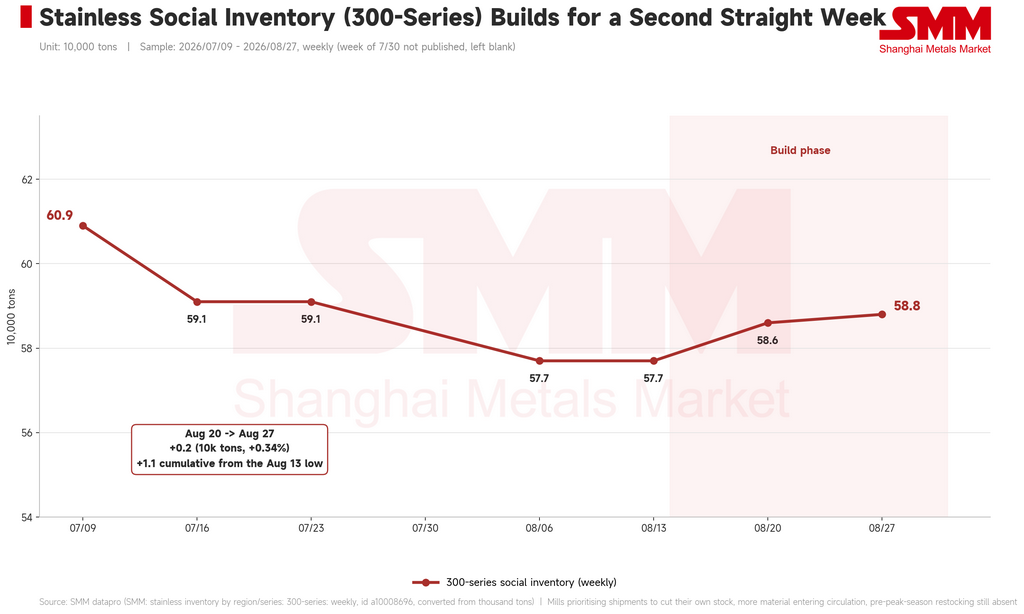
With end-user purchasing soft and shipment pressure heavy, Chinese stainless producers shifted strategy — prioritising volume to draw down their own inventories, which pushed more material into distribution channels. SMM's weekly data put 300-series social inventory at 588,000 mt on August 27, up 2,000 mt from 586,000 mt a week earlier, a 0.34% rise and the second consecutive weekly build.
The more telling signal was on pricing. Major mills issued rebates to agents on earlier allocations — a visible retreat from the price-defence stance they had held for weeks. That removed one of the last supports under spot prices, which slid alongside the futures break.
Margins are now at the edge of cost inversion
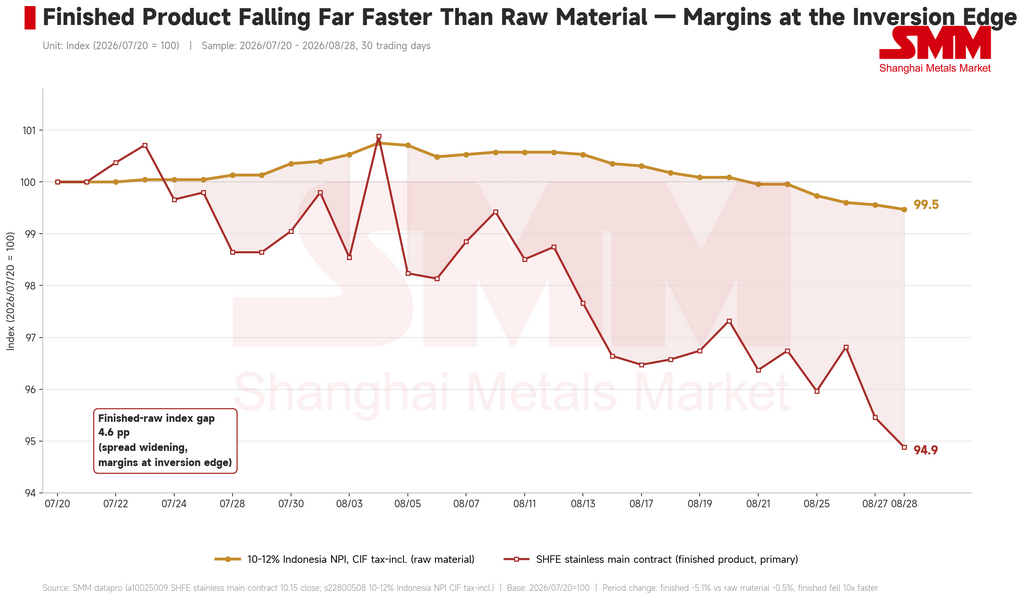
Both finished products and nickel-based raw materials fell this week, but not at the same pace. NPI eased from RMB 1,131.5/nickel point (about $168) on Monday to RMB 1,126/nickel point (about $167.5) on Friday — a nickel point being the Chinese pricing unit for each percentage point of nickel content. High-carbon ferrochrome's weekly average, last published for the week ended August 21, was RMB 7,925 per 50mt basis ton (about $1,179), down RMB 10 from RMB 7,935 (about $1,181) the week before.
Against a 1.55% weekly drop in the finished contract, those raw material declines are mild. The spread between finished product and input costs kept narrowing, compressing smelting margins to the point where Chinese producers are now operating at the edge of cost inversion. That rigidity is doing real work: it is offsetting part of the bearish pressure from both the futures market and the demand picture, and it is why spot prices are drifting rather than collapsing.
Outlook
This week set up a genuine tension. On one side: a futures market that rallied and then broke down, missing pre-season demand, mills abandoning price defence, and inventories building. On the other: costs so close to inversion that they function as a hard floor. The NPI supply disruption briefly suggested tightening availability, but against weak demand and rising stock, a single supply event was never going to reset the market's direction.
Near term, the bearish factors dominate and the weak trend looks difficult to break. Cost inversion risk should keep the decline orderly rather than steep, pointing to a weak, range-bound market. The things to watch: whether selling follows through after the technical break, how quickly peak-season restocking actually materialises downstream, changes in mill shipping and pricing policy, movement in the finished-to-raw-material spread, the trajectory of the inventory build, and whether the Hormuz safe-corridor agreement is finalised and how that feeds into the cost side.
![[SMM Nickel Market Flash] Glencore Hits First Ore at Onaping Depth in Sudbury; Full Production Targeted for 2027](https://imgqn.smm.cn/usercenter/biBGl20251217171733.jpg)
![[SMM Nickel Market Flash] Canada Nickel Upsizes Private Placement to C$21m to Fund Crawford Engineering](https://imgqn.smm.cn/usercenter/fzwTi20251217171733.jpg)
![[SMM Nickel Market Flash] Antam H1 2026 Net Profit Up 34%; Nickel Revenue Up 32% but Gold Still Drives 80% of Sales](https://imgqn.smm.cn/usercenter/NHXhQ20251217171733.jpg)