

SMM August 27 News:
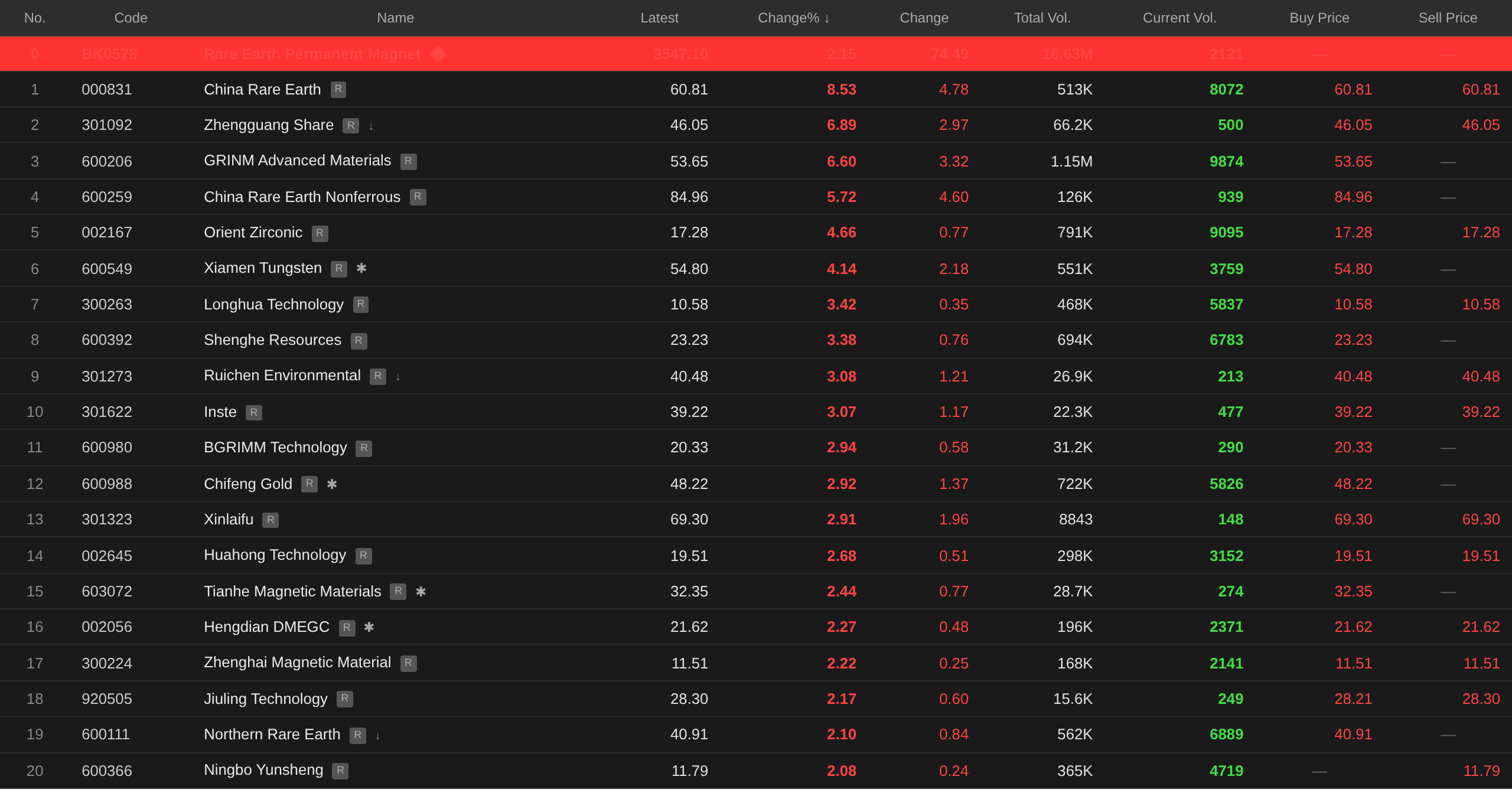
Driven by tightening low-priced spot cargoes, spot prices of rare earths such as Pr-Nd, dysprosium, and terbium kept rising. Coupled with the approaching traditional manufacturing peak season, market expectations for restocking by downstream magnetic material enterprises fueled a tug-of-war, jointly pushing the rare earth permanent magnet concept sector higher. As of the market close on August 27, the rare earth permanent magnet concept rose 2.15%. Among individual stocks, the top gainers included China Rare Earth (up 8.53%), Zhengguang Co., Ltd., Zhongxi Non-Ferrous Metals, GRIAM, Oriental Zirconium, and Xiamen Tungsten.
Spot Market
Spot market: On August 27, rare earth market prices generally held up well. In the oxide market, the price of Pr-Nd oxide was raised by 1,000 yuan/mt, dysprosium oxide by 10,000 yuan/mt, and terbium oxide by 50,000 yuan/mt. In the metal market, the price of Pr-Nd alloy was raised by 1,000 yuan/mt, dysprosium metal by 5,000 yuan/mt, and terbium metal by 25,000 yuan/mt. Notably, taking Pr-Nd oxide, dysprosium oxide, and terbium oxide as examples, Pr-Nd oxide prices rose on both August 26 and August 27. Dysprosium oxide has been on a sustained upward trajectory since it started rising on August 19. Terbium oxide’s price center has been on a sustained upward trend since it started rising on August 20.
Recently, Pr-Nd futures have fluctuated more, but spot supplier offers remain firm, limiting spot price adjustments. Supported by rising oxide costs, metal enterprises are reluctant to sell Pr-Nd alloy at low prices, and quotes were slightly raised from the previous day. However, downstream acceptance of high-priced raw materials is weak, with insufficient follow-through on high-priced orders. The Pr-Nd alloy segment remains in a loss-making state, and overall market trading is stagnant.
In the medium-heavy rare earth sector, dysprosium and terbium prices rose simultaneously. Currently, low-priced oxide cargoes are scarce, while downstream inquiries and purchasing activity have increased, prompting suppliers to continuously raise offers.
Overall, supported by tightening low-priced spot cargoes, rare earth prices held up well. However, downstream purchasing is cautious, making it difficult to scale up high-priced transactions, and actual trading remained in a stalemate. In the short term, medium-heavy rare earth prices are likely to remain strong, supported by tight supply. For the Pr-Nd series, the focus will be on downstream demand realization, and prices will most likely consolidate on a strong note within a narrow range.
Institutional Voices
A research report released by Guojin Securities on August 23 noted: The price of Pr-Nd oxide (8.1-8.21) was 726,800 yuan/mt, down 1.21% MoM. Dysprosium and terbium prices edged up, with dysprosium oxide showing a notable bottom rebound trend, possibly driven by MLCC, Aug 10-21. Since the start of the year, the price center has continued to rise; Guojin Securities believes this is largely related to supply-side documents released from 2024 to 2025, as the industry’s supply-side reform advances. Full-year exports in 2025 fell 1% YoY, while exports since early 2026 have increased significantly, indicating that restocking demand outside China remains robust. The rare earth sector will continue to see both valuation and earnings rise, and 2026 will also be a critical year for resolving horizontal competition among key targets.
A research report released by Huaxi Securities on Aug 22 shows: rare earth prices consolidated, while dysprosium and terbium series prices rebounded to some extent. As of Aug 21, the average price of praseodymium oxide was 775 yuan/kg, up approximately 0.31% from Aug 14; the average price of neodymium oxide was 797.5 yuan/kg, up approximately 3.87% from Aug 14; the average price of Pr-Nd oxide was 720 yuan/kg, up approximately 0.61% from Aug 14; the average price of dysprosium oxide was 1,455 yuan/kg, up approximately 5.05% from Aug 14; and the average price of terbium oxide was 7,000 yuan/kg, up approximately 5.74% from Aug 14. This week, the rare earth market exhibited a weak-to-strong trend: it remained weak early in the week, with insufficient downstream purchase willingness; from mid-week onward, driven by purchases from major plants, Pr-Nd oxide prices recovered somewhat, and dysprosium and terbium series prices moved higher in tandem. Overall, light rare earth ore prices traded in line with the market, while heavy rare earth dysprosium and terbium prices edged up; downstream remained mainly purchasing as needed, new orders were moderate, and short-term prices may continue to consolidate. 1) Supply side, overall supply was stable this week. Upstream separation enterprises maintained steady production, with no new capacity starting up; oxide production changes were limited, and spot circulation in the market was tight. Metal plants’ operating rates were largely stable, with no notable production cuts or shutdowns, but metal-side inventory levels were on the high side, leaving overall market supply relatively ample. By segment, Pr-Nd series spot platform quotes moved lower, and some low-priced goods were released; while low-priced spot cargo of dysprosium and terbium series tightened, and suppliers showed increased reluctance to sell. 2) Demand side, downstream demand was divergent this week. For the Pr-Nd series, end-user orders were weak, downstream inquiries lacked momentum, restocking decreased, a small number of inquiries focused on pushing for lower prices, metal plants’ shipments were sluggish, and transactions were limited. For the dysprosium and terbium series, market activity was moderate, downstream inquiries remained as needed, major plants took purchasing actions, and transaction prices steadily moved up. Gadolinium series was dragged down by the decline in Pr-Nd prices, with limited downstream inquiries and small transactions. Overall, large terminal magnetic material plants operated normally, the off-season is nearing its end, downstream inventories were at low levels, and subsequent orders could see improvement.
Western Securities analyzed that the high-end application fields of the rare earth industry maintained high prosperity, and China Northern Rare Earth’s net profit attributable to the parent surged over 120% YoY in 26H1, mainly benefiting from the strengthening of Pr-Nd oxide prices. Downstream structural differentiation is evident, with high-end NdFeB orders in tight supply. The expansion of wind power installations, the rising penetration rate of new energy heavy trucks, and surging exports of smart electric two-wheelers are jointly driving demand growth for high performance rare earth materials. The start of the industry's stockpiling cycle is expected to drive a QoQ demand recovery in Q3, and high-end materials remain the core growth driver.
Recommended reading:
![Rare Earth Prices Overall Hold Up Well, While Downstream High-Price Transactions Remain Stagnant [SMM Rare Earth Weekly Review]](https://imgqn.smm.cn/usercenter/wHkop20251217171744.jpeg)
![Rare Earth Prices Continue to Hold Up Well, but Market Trading Activity Remains Stagnant [SMM Rare Earth Daily Review]](https://imgqn.smm.cn/usercenter/UXEpx20251217171743.jpeg)