[SMM Analysis] Copper Concentrate Tightness Spreads to Scrap Market—Why Are Copper Scrap Prices Staying High?

Published: Aug 26, 2026 18:10
[SMM Analysis: opper Concentrate Tightness Spreads to Scrap Market—Why Are Copper Scrap Prices Staying High?] Tight copper concentrate supply and deeply negative TCs are pushing smelters and fabricators toward recycled feedstock. Low global inventories, slow scrap generation and shortages of compliant material in China are supporting high payabilities. SMM expects import demand to remain firm, although any release of accumulated tax-excluded scrap in China could pressure prices.

Tight copper concentrate supply is reshaping raw material procurement across the copper industry. Recycled copper is no longer merely a substitute for primary copper but is becoming increasingly important for smelters and copper fabricators seeking to secure feedstock.

As of August 21, the SMM Imported Copper Concentrate Index had fallen to -$182.14/dmt, down $6.77/dmt WoW. Deeply negative spot TCs continue to squeeze smelting margins, encouraging companies to increase their use of recycled feedstock.

How Is Mine-Side Tightness Affecting Copper Scrap?

For smelters, recycled materials can supplement concentrate supply and reduce reliance on concentrate TCs. Complex copper-bearing materials may also generate additional returns from gold, silver and other recoverable metals. Meanwhile, high-grade scrap such as Millberry can reduce copper fabricators’ dependence on copper cathode.

Rising demand has accelerated the drawdown of copper scrap inventories, while new scrap generation has failed to keep pace. As a result, payabilities remain high and falling inventories continue to support scrap prices.

Why Is China Buying More Imported Scrap?

According to SMM market surveys, tradable copper scrap inventories at Chinese companies remain low. Existing stocks are mainly No. 1 and No. 2 copper scrap, while Millberry remains relatively scarce.

Meanwhile, some tax-excluded material or cargoes with incomplete invoices continue to accumulate outside regular circulation channels. Physical inventories therefore do not fully represent the effective supply available to compliant companies.
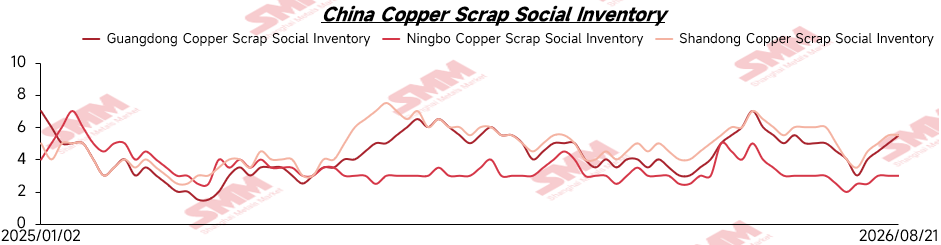
Imported copper scrap generally has complete customs, tax and invoice documentation, making it easier for compliant companies to purchase. China’s rising import demand therefore reflects both tight supply and growing compliance requirements.

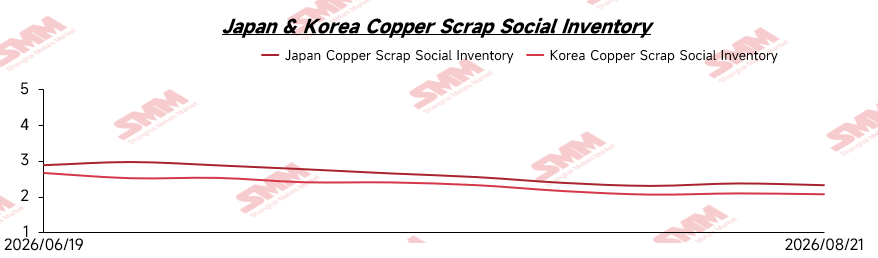
SMM data also show that copper scrap inventories in Japan and South Korea remain low, strengthening suppliers’ willingness to hold firm and supporting high-grade scrap payabilities.
Outlook

As long as copper concentrate TCs remain low and VAT-invoiced scrap supply in China stays tight, Chinese buyers are expected to remain dependent on imports, supporting global copper scrap payabilities.

However, high copper prices, weak downstream orders and squeezed processing margins will limit bids, particularly for lower-grade material. Another key variable is the tax-excluded scrap accumulated in China. If clearer tax policies allow this material to re-enter compliant circulation, domestic supply could increase and place pressure on both Chinese and global scrap prices.

SMM believes high scrap prices are being supported by concentrate tightness, low global inventories, slow scrap generation and China’s shortage of compliant material. These factors are expected to keep global inventories low and payabilities elevated.


Data Source Statement: Except for publicly available information, all other data are processed by SMM based on publicly available information, market communication, and relying on SMM's internal database model. They are for reference only and do not constitute decision-making recommendations.

For any inquiries or for more information, please contact: lemonzhao@smm.cn
For more information on how to access our research reports, please contact:service.en@smm.cn
Related News
Sinomine’s Kitumba Copper Project Enters Final Commissioning Push After Successful Primary Crusher Trial
3 hours ago
Sinomine’s Kitumba Copper Project Enters Final Commissioning Push After Successful Primary Crusher Trial
Read More
Sinomine’s Kitumba Copper Project Enters Final Commissioning Push After Successful Primary Crusher Trial
Sinomine Resource Group (002738.SZ) reported further construction progress at its integrated Kitumba copper mining, processing and metallurgical project in Zambia. As of August 2026, the project’s 38-km water pipeline had been fully commissioned, while the primary crushing plant successfully completed its first integrated trial run with ore. The core supporting infrastructure and front-end crushing system are now ready for commissioning, marking the project’s entry into the final stage of construction. Kitumba is designed to process 3.5 million tonnes of ore annually, with a metallurgical capacity of 35,000 tonnes of copper cathode per year. At steady state, the project is expected to produce an average of 33,000 tonnes of copper cathode and 55,000 tonnes of copper concentrate annually. It has a designed operating life of 15 years and is expected to produce a total of 570,200 tonnes of contained copper over that period.
3 hours ago
Data: SHFE, DCE market movement (Aug 26)
3 hours ago
Data: SHFE, DCE market movement (Aug 26)
Read More
Data: SHFE, DCE market movement (Aug 26)
The following table shows the ferrous and nonferrous metals movement on the SHFE and DCE on 26 Aug , 2026
3 hours ago
Codelco and Pucobre Form Tovaku JV, Targeting 46,000 t/y Copper Cathode Output by 2030
3 hours ago
Codelco and Pucobre Form Tovaku JV, Targeting 46,000 t/y Copper Cathode Output by 2030
Read More
Codelco and Pucobre Form Tovaku JV, Targeting 46,000 t/y Copper Cathode Output by 2030
Codelco and Pucobre have formally established a joint venture to develop the Tovaku copper project in Chile’s Antofagasta region, marking a new development milestone in a partnership that dates back to 2009. Under the ownership structure, Pucobre will hold a 60% stake and Codelco 40%. The newly formed company will now advance the project through its next development stages, giving the partners a clearer route toward construction and eventual production.​ Following formation of the joint venture, Codelco and Pucobre plan to move ahead with detailed engineering, environmental and sectoral permitting, early works and procurement of major equipment. The work programme also includes field activities, critical permitting and engineering required to prepare the project for future construction. The current development roadmap targets production by 2030, with estimated investment of approximately US$870 million.​ Tovaku is planned as an open-pit copper operation with estimated annual production of around 46,000 tonnes of copper cathodes. Codelco said the project contains 633 million tonnes of reserves and has a projected operating life of 21 years. The company also highlighted several technical characteristics, including shallow mineralisation, relatively low acid consumption and the planned use of undesalinated seawater in processing, which could reduce pressure on inland freshwater resources.​ Under the agreed financing structure, Codelco will contribute the mining concessions, while Pucobre will contribute studies already completed and assume responsibility for financing the project’s development and construction stages. This allows Codelco to maintain its 40% participation without making direct capital contributions during these phases, with the funds committed by Pucobre expected to be recovered from future distributions corresponding to Codelco’s share of the project.​ The key new development is the formal constitution of the 60/40 joint venture, which moves Tovaku from the earlier exploration and option-based arrangement into a more advanced project development phase. Pucobre had previously disclosed plans for the project, including an indicative production rate of around 43,000 tonnes of copper per year, meaning the latest announcement should not be presented as the first disclosure of Tovaku itself. The updated development plan now points to 46,000 tonnes per year of copper cathode production from 2030, while estimated investment has increased to around US$870 million, giving the project a more defined development pathway and a clearer potential contribution to Chile’s future copper supply.
3 hours ago
[SMM Analysis] Copper Concentrate Tightness Spreads to Scrap Market—Why Are Copper Scrap Prices Staying High? - Shanghai Metals Market (SMM)