

[SMM Analysis] Steel Export Price Spreads Diverge: Billet Strong, HRC Weak, Ex-China Advantage Narrows
- Price Spread Fluctuations
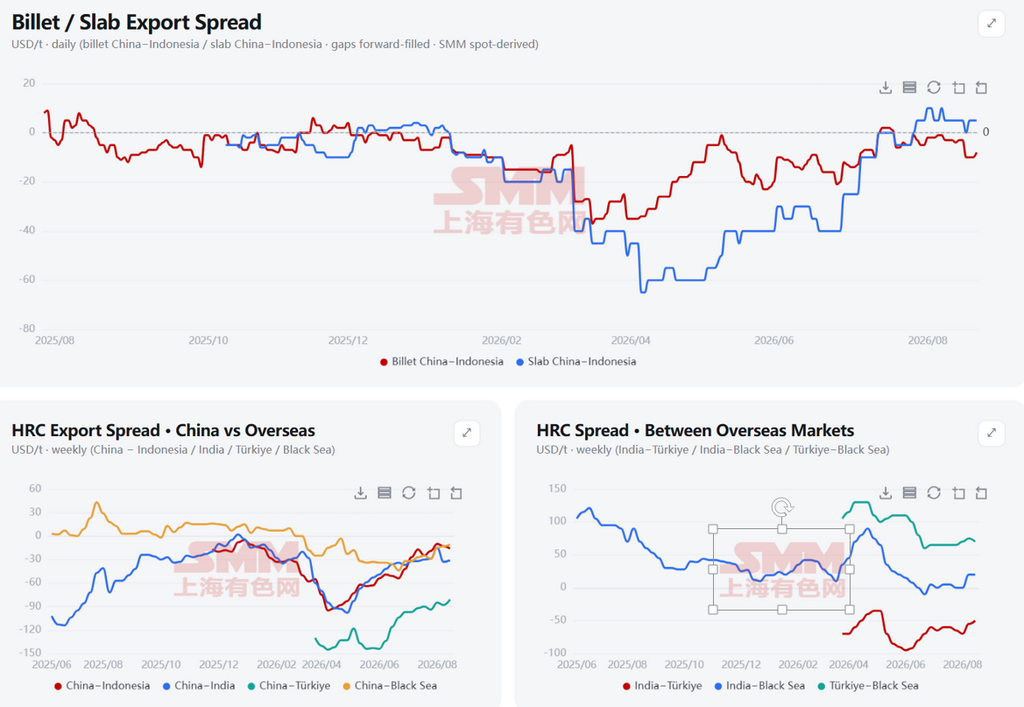
On the price spread model, China’s HRC (FOB) remained deeply inverted relative to core ex-China markets, moving sideways this week. For the week of Aug 21, the China−India spread was about −$31/mt (narrowing $2 from −$33 on Aug 14) — India’s export offers were flat WoW, while China’s edged up $2, slightly reducing the inversion. Spreads against Turkey (around −$81), the Black Sea (around −$11), and Indonesia (around −$16) also stayed inverted. With mild upward moves in both ex-China and China offers driven by cost increases, the overall price spread matrix continued to point to "China’s resources as relatively low-cost."
Data source: SMM
- By-Product Trends
1. Billet: inversion persists, spread widens. The "China-Indonesia" billet spread stays inverted. Indonesia is inclined to hold prices firm, while some domestic mills still ship at relatively low prices; with the two ends diverging, the spread widened WoW and China's export competitiveness edged up.
2. Slab: domestic warms up, spread widens. Domestic slab offers have warmed recently, and the recovery in sentiment widened the "China-Indonesia" slab spread WoW — a marked repair from the earlier deep-inversion phase, with the curve moving toward the zero line.
3. HRC: domestic pullback > overseas adjustment, spread narrows. This week China's HRC offer pulled back more than the main overseas export benchmarks (Indonesia / India / Türkiye / Black Sea), so the "China-Indonesia," "China-India," "China-Türkiye" and "China-Black Sea" lines all narrowed WoW, and China's export price advantage converged for now.
- Overall Assessment
Billet and slab still retain some export-order appeal on the "China-Indonesia" deep inversion and its recent repair; on HRC, domestic price recovery narrows China's concession room vs overseas at the margin. Meanwhile, structural spreads between overseas markets (India-Türkiye, India-Black Sea, Türkiye-Black Sea) stay firm-to-soft and choppy, so China's relative advantage in third markets is converging near-term; going forward, closely track the sustainability of the domestic price recovery and the pace of overseas order intake.
Copyright and Intellectual Property Statement:
This report is independently created or compiled by SMM Information & Technology Co., Ltd. (hereinafter referred to as "SMM"), and SMM legally enjoys complete copyright and related intellectual property rights.
The copyright, trademark rights, domain name rights, commercial data information property rights, and other related intellectual property rights of all content contained in this report (including but not limited to information, articles, data, charts, pictures, audio, video, logos, advertisements, trademarks, trade names, domain names, layout designs, etc.) are owned or held by SMM or its related right holders.
The above rights are strictly protected by relevant laws and regulations of the People's Republic of China, such as the Copyright Law of the People's Republic of China, the Trademark Law of the People's Republic of China, and the Anti-Unfair Competition Law of the People's Republic of China, as well as applicable international treaties.
Without prior written authorization from SMM, no institution or individual may:
1. Use all or part of this report in any form (including but not limited to reprinting, modifying, selling, transferring, displaying, translating, compiling, disseminating);
2. Disclose the content of this report to any third party;
3. License or authorize any third party to use the content of this report;
4. For any unauthorized use, SMM will legally pursue the legal responsibilities of the infringer, demanding that they bear legal responsibilities including but not limited to contractual breach liability, returning unjust enrichment, and compensating for direct and indirect economic losses.
Data Source Statement:
(Except for publicly available information, other data in this report are derived from publicly available information (including but not limited to industry news, seminars, exhibitions, corporate financial reports, brokerage reports, data from the National Bureau of Statistics, customs import and export data, various data published by major associations and institutions, etc.), market exchanges, and comprehensive analysis and reasonable inferences made by the research team based on SMM's internal database models. This information is for reference only and does not constitute decision-making advice.
SMM reserves the final interpretation right of the terms in this statement and the right to adjust and modify the content of the statement according to actual circumstances.
![[India Tightens Local Sourcing Requirements for Steel Used in Government Procurement]](https://imgqn.smm.cn/usercenter/ocJKj20251217171717.jpg)
![[India Tightens Domestic-Origin Rules for Steel Used in Government Procurement]](https://imgqn.smm.cn/usercenter/SduBz20251217171716.jpg)
![[China Steel Production in July 2026]](https://imgqn.smm.cn/usercenter/SEwWP20251217171716.jpg)