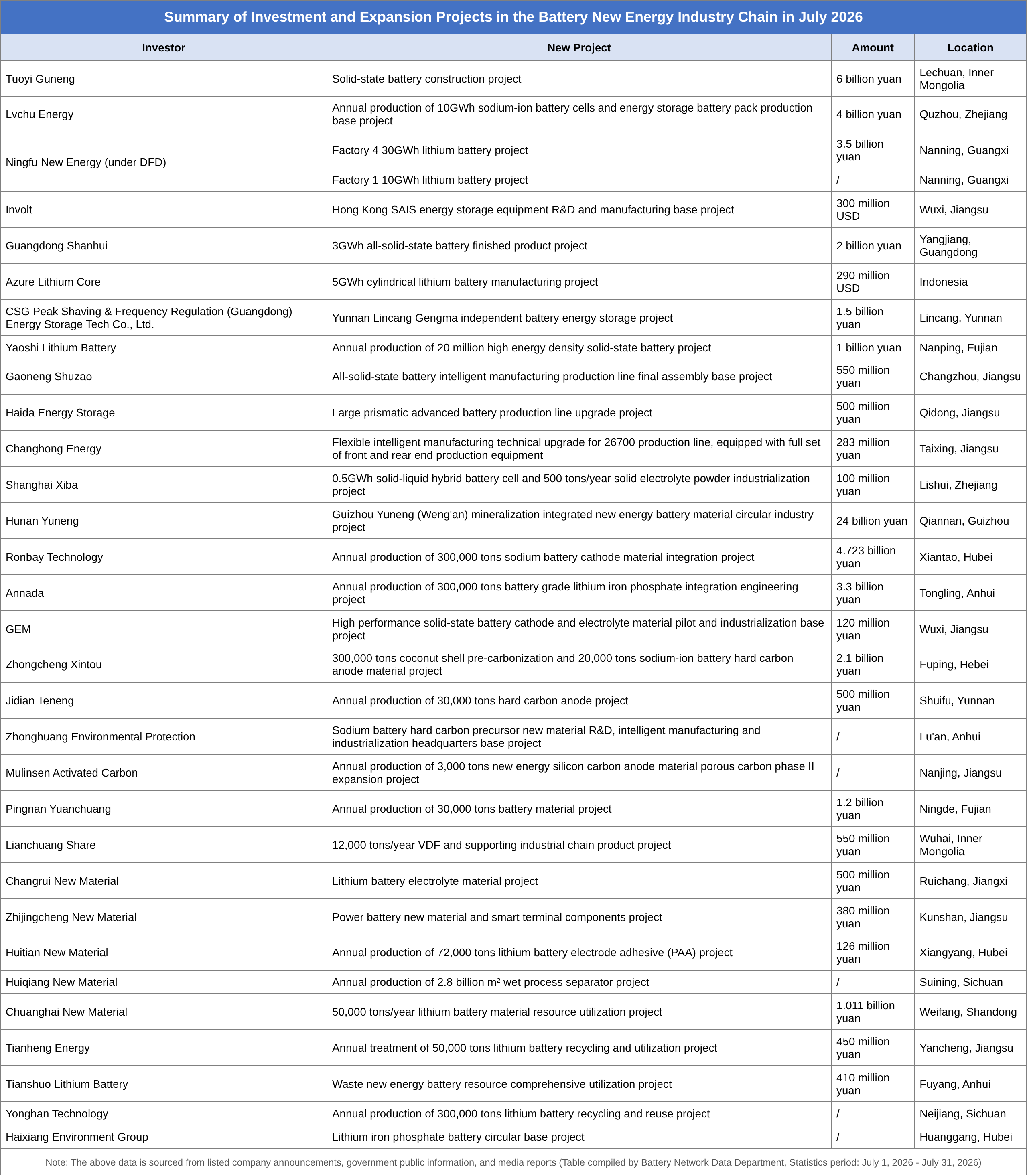
According to incomplete statistics from Battery.com, in July 2026, there were a total of 32 new publicly disclosed investment projects in the entire new energy battery industry chain, of which 26 projects disclosed investment amounts, with a total investment of 62.792 billion yuan, and an average investment of 2.415 billion yuan per project, essentially maintaining the average monthly level of investment expansion.
Looking closely at the 32 new projects, NEVs are no longer the sole driving force. The explosion in energy storage demand, the nearing mass production of humanoid robots, and the accelerated commercialization of eVTOLs, among others, are rewriting the growth logic of the new energy battery industry. The investment expansion projects in July precisely and clearly presented the real-time dynamics of this logical evolution.
Solid-State/Sodium-Ion Battery Track Attracts 21.1 billion yuan, Accelerating Entry into Capacity Competition
In July, investment enthusiasm in solid-state batteries and sodium-ion battery sectors continued to heat up, with the two major technology routes accelerating from lab to production line.
Among the 32 new projects, battery projects occupied 13 slots, of which 12 disclosed investment amounts, totaling 23.422 billion yuan. In terms of both project number and investment amount, the battery sector remained the absolute mainstay of July's investment expansion, but the investment center has markedly shifted toward next-generation technology routes represented by solid-state batteries and sodium-ion batteries.
Among them, in the solid-state battery field, July saw five battery projects and one related material project landed, with total investment of 9.775 billion yuan: Tuoyi Gufeng invested 6 billion yuan in a solid-state battery construction project in Chilechuan, Inner Mongolia; Guangdong Shanhui invested 2 billion yuan in Yangjiang, Guangdong to build a 3Gwh all-solid-state battery finished product project; Yaoshi lithium battery invested 1 billion yuan in Nanping, Fujian to sign a 200 million-unit/year high energy density solid-state battery project; Gaoneng Numerical Creation invested 550 million yuan in Changzhou, Jiangsu to land an all-solid-state battery intelligent manufacturing production line assembly base project; Shanghai Emperor of Cleaning Hi-tech Co., Ltd. announced a 100 million yuan investment in Lishui, Zhejiang to build a 0.5Gwh solid-liquid hybrid battery cell and 500 mt/year solid electrolyte powder industrialization project; GEM invested 120 million yuan in Wuxi, Jiangsu to land a high-performance solid-state battery cathode and electrolyte material pilot and industrialization base project.
From the policy side, the world's first national standard for automotive solid-state batteries, GB/T 43568, was officially implemented in July 2026, using quantitative indicators to delineate the technical boundaries of liquid, hybrid solid-liquid, and all-solid-state. All shipments are hybrid solid-liquid batteries, simultaneously scaling up in diverse scenarios of power batteries, energy storage, and low-altitude economy.
The industry expects that by 2030, humanoid robots will gradually enter daily life, and solid-state batteries will be a new turning point for household robots to enter the era of universal popularization. Liu Zhibo, Executive Vice President of Shenzhen BAK Power Battery Co., Ltd., also stated in a recent exchange with Battery.com: "In the next 3-5 years, cylindrical lithium batteries will remain the mainstay for large-scale commercial use of robots; hybrid solid-liquid battery cells will gradually penetrate into high-end humanoid and special scenarios."
Research institution EVTank expects that by 2030, global solid-state battery shipments will reach 607.2 Gwh, with a compound annual growth rate of over 130%.
In the sodium-ion battery field, July saw one battery project and four related material projects landed, with total investment of 11.323 billion yuan: Lv Chu Energy Storage invested 4 billion yuan in Quzhou, Zhejiang to build a 10Gwh sodium-ion battery cell and ESS battery pack production site project; Ronbay Technology invested 4.723 billion yuan in Xiantao, Hubei to build a 300,000 mt/year sodium-ion battery cathode material integrated project; Zhongcheng Xintou invested 2.1 billion yuan in Fuping, Hebei to build a 300,000 mt coconut shell pre-carbonisation and 20,000 mt sodium-ion battery hard carbon anode material project; Jidian Teneng invested 500 million yuan in Shui fu of Yunnan to build a 30,000 mt/year hard carbon anode project; Zhonghuang Environmental Protection landed a sodium-ion battery hard carbon precursor new material R&D and industrialization headquarters base project in Lu'an, Anhui.
The policy side also injected a shot in the arm for the sodium-ion battery track. The new battery consumption tax regulation will be officially implemented on September 1, 2026. Sodium-ion batteries are exempt from consumption tax until the end of 2028, while lithium batteries resume taxation. The tax-free dividend of over two years is expected to reduce comprehensive tax costs for sodium-ion battery enterprises, compress the end-user pricing of products, and accelerate the cost parity process between sodium batteries and LFP.
At the same time, local governments such as Inner Mongolia have also clearly prioritized supporting technology routes like sodium-ion in new-type energy storage project applications, paving the way for large-scale application of sodium batteries. Currently, in the boom of ESS battery expansion, sodium-ion batteries have become the second largest technology route after lithium batteries.
In its "China Sodium-Ion Battery Industry Development White Paper (2026)", EVTank expects that actual shipments of sodium-ion batteries will reach 435 Gwh by 2030.
Cathode Absorbs 32.1 billion yuan, Shoulering Half; Anode Bets on New-Type
Cathode material was the absolute mainstay of investment expansion in the battery new energy industry chain in July.
In July, although only four new projects were officially announced in the cathode material track, the disclosed investment amount reached 32.143 billion yuan, accounting for 51.19% of the total monthly investment, with a planned capacity of 1.4 million mt. Among them, LFP industry leader Hunan Yung announced a massive expansion plan on July 17, intending to invest 24 billion yuan to build the Guizhou Weng'an ore-integrated new energy battery material circular industry project, planning to build 80,000 mt of LFP cathode material and 1 million mt of iron phosphate precursor.
In addition, Annada plans to invest 3.298 billion yuan to build a 300,000 mt/year battery-grade iron phosphate integrated project. From these two major investment projects in the LFP track, integration has become a new consensus in this field.
Currently, the LFP industry is shifting from "competing on scale and price" to ecological competition of "resource endowment + technology adaptation + client binding." Since H2 of 2025, high-end high-compaction products have achieved both volume and price increases and improved profits, while iron phosphate has transformed from a past cost burden to a profit contributor. Meanwhile, LFP prices have nearly doubled from YoY lows, industry operating rate is around 90%, and supply of high-end capacity is tight.
In July, new-type anode materials also became a hot topic for investment in the battery new energy track. As key supporting materials for new technology routes such as sodium-ion batteries and semi-solid-state batteries, hard carbon anodes and silicon carbon anodes have become new windfalls. That month, four new anode material projects were officially announced, of which three were hard carbon anode materials and one was silicon carbon anode material.
Zhongcheng Xintou invested 2.1 billion yuan in Fuping, Hebei to build a 300,000 mt coconut shell pre-carbonisation and 20,000 mt sodium-ion battery hard carbon anode material project; Jidian Teneng invested 500 million yuan in Shuifu, Yunnan to build a 30,000 mt/year hard carbon anode project; Zhonghuang Environmental Protection laid out a sodium-ion battery hard carbon precursor new material R&D and industrialization headquarters base project in Lu'an, Anhui; Mulin Sen Active Material built a 3,000 mt/year new energy silicon carbon anode material porous carbon phase II expansion project in Kunshan, Jiangsu.
In the anode material field, a competitive landscape is forming where traditional graphite anode maintains the basic market, while hard carbon/silicon carbon anode grabs growth.
In addition, Battery.com noted that in July, the battery recycling field also saw six new projects debut. Among them, recycling was prominently listed in Hunan Yuneng's 24 billion yuan project, indicating that leading cathode material enterprises are no longer satisfied with just "selling materials" but are moving toward "controlling full life cycle resources." Battery recycling is jumping from a marginal track to a key link in the industry closed loop. Meanwhile, enterprises such as Haixiang Environment, Tianheng Energy, Tianshuo Lithium Battery, and Yonghan Technology have also made moves.
On the policy side, the new power battery recycling regulation was officially implemented on April 1, and the new battery safety national standard GB38031-2025 was enforced on July 1, marking the industry's full entry into an era of strong regulatory compliance. At the same time, the whitelist system and mandatory traceability management are accelerating the industry reshuffle, and compliant industry leaders are expected to capture more market share.
Conclusion:
Behind the 62.384 billion yuan investment scale in the battery new energy industry chain in July, the industrial logic has become clear: the industry is bidding farewell to the extensive era of "single bet" and entering a new cycle of "diversified technology, closed-loop chain."
Future winners may no longer belong to the enterprises with the largest scale, but to those that seize the lead in diversified technology layout, first achieve breakthroughs in industry chain closure, and build sustainable advantages in cost and quality.
![[Solid-state battery: Qinghai's 3,000 mt per year lithium sulfide project completed filing]](https://imgqn.smm.cn/usercenter/AYpRQ20251217171727.jpg)