The overseas secondary aluminum market remained under pressure this week as the continued pullback in LME aluminum gradually filtered through to Southeast Asian scrap and ADC12 prices. Most scrap grades in Malaysia and Thailand moved lower, although some premium-grade materials remained relatively resilient due to tight availability.
Meanwhile, Southeast Asian ADC12 prices continued to soften amid sluggish automotive and die-casting demand. Rising energy costs in Thailand, however, are providing some support to producers’ cost bases, leaving the market caught between weak downstream demand and elevated production costs.
Southeast Asia Scrap Aluminum Prices Fall, but Premium Grades Remain Resilient
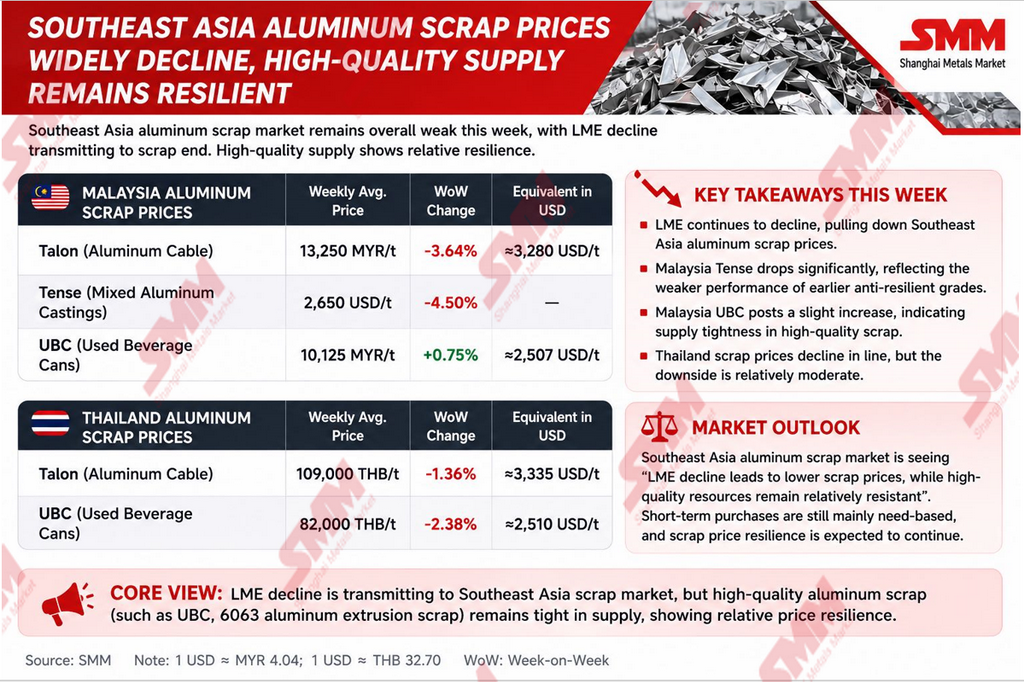 Southeast Asian aluminum scrap prices generally moved lower this week.
In Malaysia, Talon averaged MYR 13,250/mt (approximately $3,280/mt), down 3.64% week-on-week. Tense fell to $2,650/mt, down 4.50% WoW. In contrast, used beverage cans (UBC) edged higher to MYR 10,125/mt (approximately $2,507/mt), up 0.75% WoW.
In Thailand, Talon declined to THB 109,000/mt (approximately $3,335/mt), down 1.36% WoW, while UBC fell to THB 82,000/mt (approximately $2,510/mt), down 2.38% WoW.
As LME aluminum continued to retreat from its recent highs, buyers lowered their target prices and became increasingly cautious about restocking. Some scrap grades that had previously resisted the decline began to catch up with the broader market, with Malaysian Tense recording the largest weekly decline among the assessed grades.
However, the performance of Malaysian UBC highlights the continued divergence between different scrap categories. Premium-grade scrap remains relatively tight, particularly UBC and 6063 extrusion scrap, limiting suppliers’ willingness to make aggressive price concessions.
As a result, the decline in LME aluminum is increasingly being transmitted to the scrap market, but premium-grade scrap continues to show greater price resilience than ordinary mixed scrap.
Southeast Asia ADC12 Prices Edge Lower as Demand Remains Weak
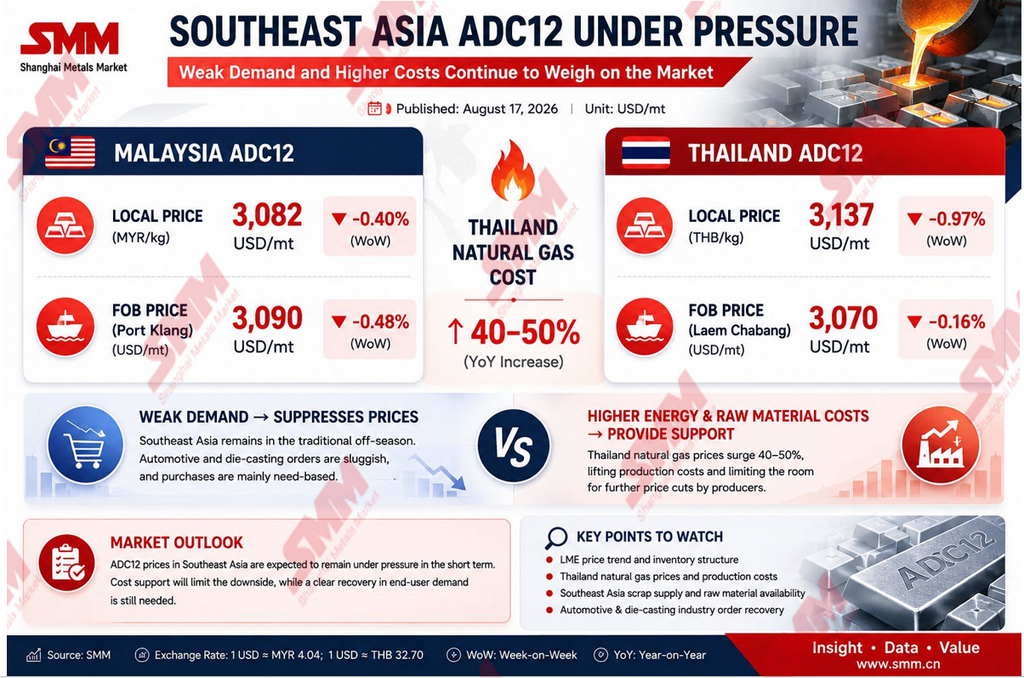 The Southeast Asian ADC12 market remained soft this week, with prices declining in both Malaysia and Thailand.
Malaysia’s domestic ADC12 price fell to MYR 12.45/kg (approximately $3,082/mt), down 0.40% WoW, while FOB Port Klang prices declined to $3,090/mt, down 0.48%.
In Thailand, domestic ADC12 prices fell to THB 102.5/kg (approximately $3,137/mt), down 0.97% WoW. FOB Laem Chabang prices slipped to around $3,070/mt, down 0.16%.
According to SMM’s recent discussions with Thai producers, export offers are currently concentrated at around $3,050–3,090/mt. Some producers have lowered their offers following the decline in LME aluminum, although overall adjustments remain relatively cautious.
Demand remains the primary source of pressure. Southeast Asia is still in the traditional seasonal lull, with automotive and die-casting orders recovering slowly. Downstream buyers continue to purchase largely on a hand-to-mouth basis, with little indication of aggressive restocking.
At the same time, production costs remain elevated. Market participants in Thailand reported that natural gas prices have recently risen significantly, with some producers indicating increases of around 40–50%. Higher energy costs are increasing secondary aluminum production costs and limiting producers’ ability to aggressively cut ADC12 prices even as LME and some scrap prices decline.
The ADC12 market therefore remains caught between downstream pressure for lower prices and production costs providing a floor.
Low-Priced Alloy Ingot Supply Adds Pressure to Asian Market
Another development attracting market attention is the increasing availability of competitively priced casting alloy ingots from Africa, Vietnam and other regions.
According to SMM’s recent market discussions, some African-origin ADC12 or similar casting alloy ingots have been indicated at around $2,850/mt, significantly below mainstream Southeast Asian ADC12 offers of approximately $3,050–3,090/mt.
Against the backdrop of falling LME aluminum prices and weak downstream demand, these lower-priced materials are influencing buyers’ price expectations and providing additional bargaining leverage when negotiating with Southeast Asian suppliers.
However, price is not the only consideration.
Feedback from market participants suggests that some low-priced imported alloy ingots have shown greater variation in chemical composition and inconsistent quality, limiting their suitability for customers with stricter production requirements.
For automotive components and die-casting applications, where alloy consistency is particularly important, buyers continue to consider product quality, stable supply and long-term reliability alongside price.
The Asian ADC12 market is therefore showing increasing price and quality segmentation, with lower-priced material pressuring market sentiment while higher-quality, specification-consistent ADC12 retains some premium.
LME Aluminum Falls Further as Supply Risk Premium Unwinds
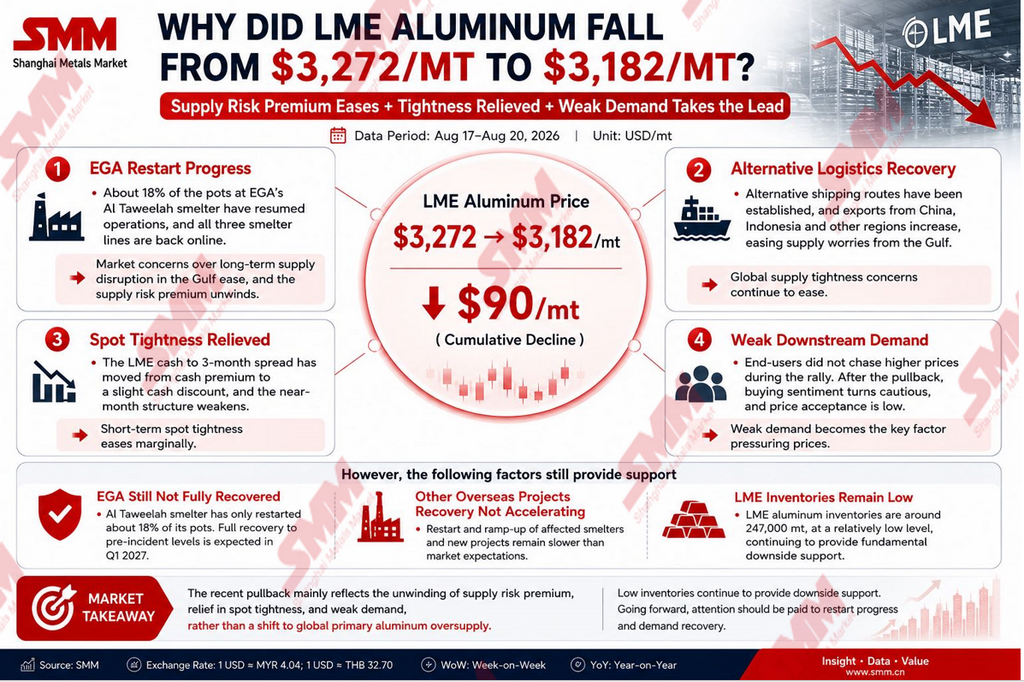 LME aluminum continued to decline this week. From August 17 to August 20, LME cash aluminum fell from around $3,272/mt to $3,182/mt, a cumulative decline of approximately $90/mt.
One factor behind the decline is the continued unwinding of the supply risk premium associated with disruptions in the Middle East.
Emirates Global Aluminium’s Al Taweelah smelter continues to restart production. Around 18% of the smelter’s pots have resumed operations, while all three potlines have been re-energised. Production is expected to return to pre-disruption hot-metal levels in the first quarter of 2027.
As the restart path becomes clearer, market concerns over a prolonged disruption to Gulf aluminum supply have eased.
Alternative logistics routes have also allowed some material and raw-material flows to continue, while increased aluminum exports from China, Indonesia and other Asian suppliers are helping offset part of the disruption to Gulf supply.
Meanwhile, signs of easing spot tightness have emerged. The LME cash-to-three-month spread has moved from backwardation toward a slight contango, suggesting that concerns over immediate physical availability have eased at the margin.
More importantly, however, downstream demand has failed to keep pace with the earlier rally in aluminum prices.
SMM’s recent discussions with market participants indicate that buyers generally did not chase prices higher during the previous rally. Once LME began to decline, purchasing targets were quickly revised downward.
This helps explain a view increasingly expressed by market participants that prices have recently been “falling faster than they rise.”
Supply Risks Ease, but the Market Has Not Shifted Into Oversupply
Despite the recent decline in LME aluminum, the global primary aluminum market should not yet be interpreted as having shifted decisively from tightness into oversupply.
Only around 18% of Al Taweelah’s pots have restarted, while a full recovery to pre-disruption production levels is not expected until the first quarter of 2027.
Other overseas restart and new capacity projects are also progressing, but the pace of actual supply recovery has yet to accelerate significantly. Some projects continue to ramp up more slowly than previously expected.
Inventories also remain supportive. LME aluminum inventories are currently around 247,000 mt, remaining at relatively low levels.
The recent LME decline therefore appears to reflect a combination of the unwinding of extreme supply risk premiums, easing near-term spot tightness and renewed focus on weak demand, rather than a fundamental shift toward substantial global primary aluminum oversupply.
Low inventories and the gradual pace of overseas supply recovery continue to provide downside support.
Outlook
SMM expects the overseas secondary aluminum market to remain soft and range-bound in the near term, with increasing divergence between different products and grades.
For aluminum scrap, further weakness in LME prices could continue to pressure Tense, Talon and other conventional scrap grades. However, premium materials such as UBC and 6063 extrusion scrap remain relatively tight, which should allow them to maintain stronger price resilience. If LME declines faster than premium scrap prices, their price-to-LME ratios could remain elevated or even rise temporarily.
For ADC12, weak downstream demand remains the key constraint. Buyers are becoming increasingly aggressive in negotiations as LME declines, but rising energy costs in Thailand and relatively firm premium-grade scrap prices are limiting producers’ room for substantial further reductions.
Lower-priced alloy ingots from Africa, Russia and other origins will also require close attention. If offers around $2,850/mt become more widely available, they could further pressure Asian buyers’ price expectations. However, differences in quality and chemical consistency mean that their impact on mainstream high-quality ADC12 could remain uneven.
For LME aluminum, further unwinding of the Middle East supply risk premium may continue to limit upside potential. Nevertheless, EGA’s recovery remains incomplete, other overseas supply has yet to accelerate significantly, and inventories remain low, leaving fundamental support on the downside.
Overall, the market’s key question is increasingly shifting from “Will supply be disrupted?” to “Can real demand absorb supply as production gradually recovers?”
Going forward, market participants should closely monitor LME price and inventory structures, the actual pace of EGA and other overseas restarts, Thai natural gas and production costs, Southeast Asian UBC and 6063 scrap availability, flows of lower-priced African and Russian alloy ingots, and the recovery of automotive and die-casting orders across Asia.
![Prebaked Anode Exports Show Volume-Price Resilience, Regional Divergence Reshapes Landscape [SMM Analysis]](https://imgqn.smm.cn/usercenter/tYQzs20251217171653.jpg)

![Aluminum imports and exports: SHFE/LME price ratio in China and overseas is gradually recovering, and net aluminum imports are expected to rebound going forward [SMM analysis]](https://imgqn.smm.cn/usercenter/ceevU20251217171653.jpg)