Executive Summary:
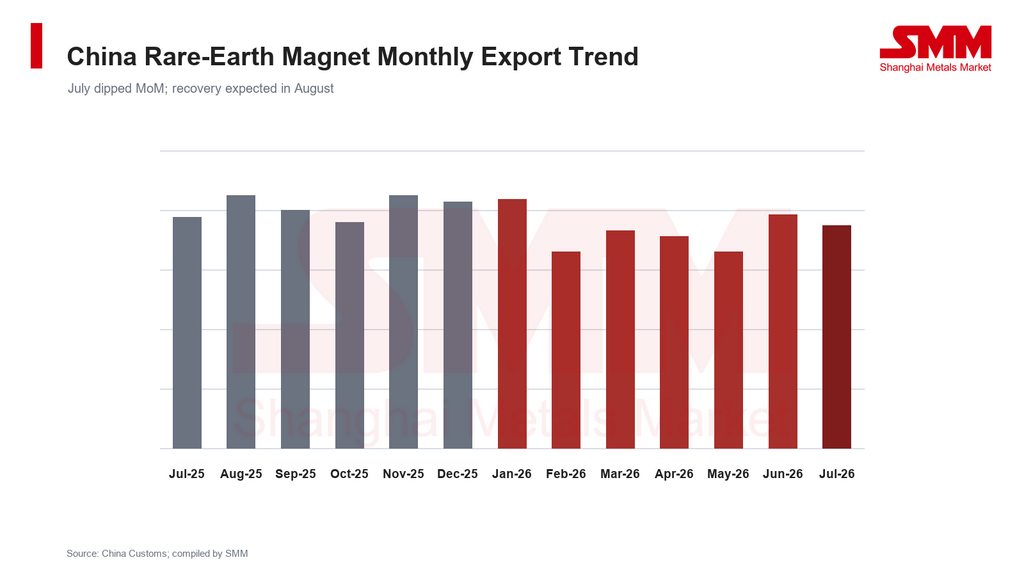
According to China Customs data, China's rare earth permanent magnet (REPM) exports reached 5,375 tons in July 2026, down 4% MoM and 3.6% YoY. Total exports for January-July amounted to 36,880 tons, with a monthly average of 5,268 tons, aligning with SMM's earlier projections. SMM maintains its full-year 2026 REPM export forecast at approximately 61,600 tons, representing a YoY increase of about 7%.
1. July Export Weakness: Seasonal Lull Meets Regulatory Delays
Looking at the past 13 months, July exports retreated after a brief surge to ~5,635 tons in June, driven by "front-loading" sentiment ahead of anticipated restrictions. While this aligns with typical summer seasonality, the pullback was relatively steep due to two primary factors:
- Seasonal Holidays: European/American end-users and Southeast Asian processors entered summer recess, leading to a temporary dip in overseas inquiries. Some existing orders were delayed for consolidated customs clearance in August.
- Licensing Bottlenecks: The approval cycle for export licenses lengthened towards the end of Q2, slowing down the release of individual shipments and indirectly suppressing monthly customs volumes.
2. YTD Rhythm: Event-Driven Volatility Intensifies
From January to July, the export rhythm exhibited a pattern of "higher earlier, lower later, with intensified intra-quarter volatility":
- Jan: Surged to 6,020 tons (pre-Lunar New Year restocking).
- Feb-Mar: Seasonal dip to 4,740 tons and 5,250 tons.
- Apr-May: Weakened again post-European restocking (5,120 tons and 4,740 tons).
- Jun: Resurgence of "front-loading" amid tightening license expectations (jumped to 5,635 tons).
- Jul: Retreated to 5,375 tons.
The widening monthly fluctuations highlight an increasing "event-driven" nature of overseas orders. Beyond traditional seasonality, policy and licensing rhythms have become the most critical disruptors.
3. Channels & Product Mix: SE Asia Restocking Remains the Core Driver
- Destinations: Southeast Asian processing channels contributed the majority of order volumes in July, but actual pickup rhythms slowed due to local holidays. Direct sales to Europe and the US weakened as terminal industrial users entered their annual maintenance season.
- August Rebound: SE Asian channels are expected to lead the recovery in pickup pace, driving an overall export rebound.
- Product Trends: NdFeB magnets remain the mainstream. The share of mid-to-high-end grades with higher PrNd content is rising, with magnets for NEV drive motors, wind power direct-drive systems, and industrial robots collectively increasing their proportion.
4. Price Linkage: Volume, Not Price, is the Issue
In July, domestic NdFeB blank prices remained stable, supported by steady PrNd oxide costs. Prices did not correct despite weaker exports, indicating the decline stems from a slowdown in restocking rhythms rather than a deterioration in per-unit bargaining power. SMM surveys show major magnet manufacturers have slightly raised their August production schedules, corroborating the export rebound expectation.
5. August Outlook: Risk Aversion to Boost Exports to ~5,500 Tons
SMM surveys indicate that concerns over potential delays or adjustments to export licenses in November are intensifying, significantly raising risk aversion among overseas buyers:
- Terminal users want to clear delayed H1 orders before the Christmas stocking cycle.
- SE Asian channels are initiating early restocking to avoid potential Q4 disruptions.
These two forces are expected to trigger concentrated ordering starting in the second half of August, boosting MoM exports.
Forecast:
- August: Rebound to ~5,500 tons (+10% MoM), with the YoY decline narrowing.
- September-October: Fluctuation within 5,400–5,800 tons (impacted by National Day and Christmas stocking).
- November: Sharp drop expected if licensing policies are adjusted as anticipated.
- December: Another surge driven by year-end front-loading.
Conclusion: SMM maintains its full-year forecast of ~61,600 tons (+7% YoY), characterized by a "lower earlier, higher later" rhythm. SMM will continue to monitor license approvals, overseas demand recovery, and the Q4 front-loading window to dynamically update this outlook.
![[SMM Analysis] India Rare Earths: Application End Potential Is Real, But Industry Chain Self-Reliance Is Still Early](https://imgqn.smm.cn/usercenter/wHkop20251217171744.jpeg)