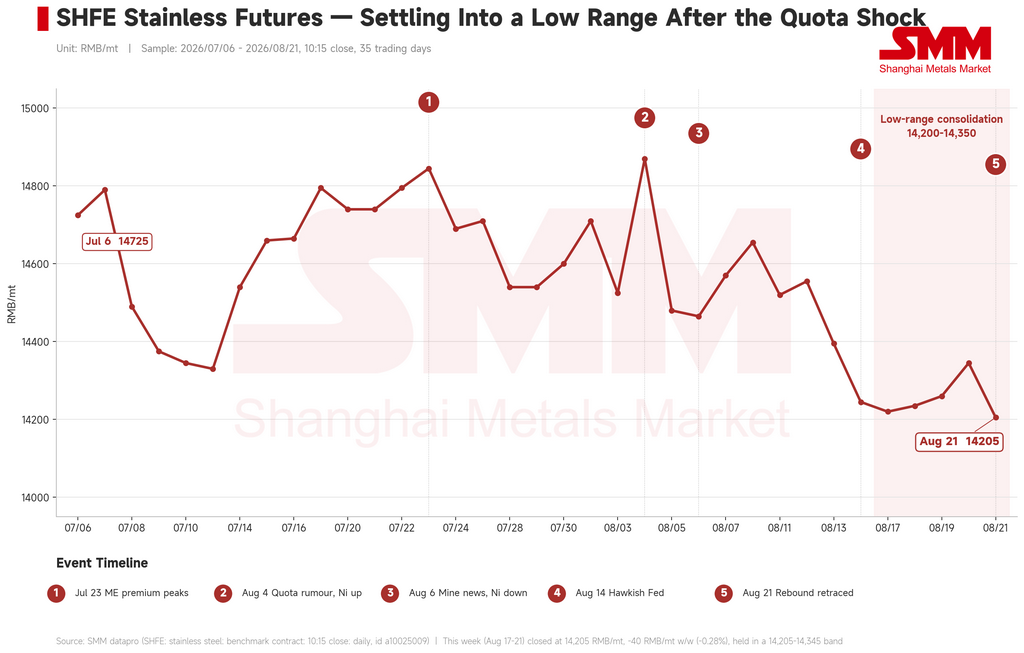
The benchmark stainless contract spent the week in a tight range, opening at RMB 14,220/mt (about $2,110/mt) on Monday, edging higher over three sessions to RMB 14,345/mt (about $2,128/mt) by Thursday, then giving all of it back on Friday to close at RMB 14,205/mt (about $2,108/mt). That left the week down RMB 40/mt (roughly $6/mt), or 0.28%, from the prior Friday's RMB 14,245/mt (about $2,114/mt), with every close confined to a RMB 14,205–14,345/mt band. Valuations had already dropped into low territory after the Indonesian RKAB quota-increase news hit earlier in the month. A general recovery across base metals gave the market a window to repair some of that damage this week, but residual bearish positioning capped the bounce and it failed to hold — a sign that bullish conviction hasn't returned.
Bond market stress and an escalating Iran standoff dominated the macro picture
Minutes from the Federal Reserve's July meeting showed "several" officials judging that a rate hike would be needed if inflation fails to come down, while "most" still expected a gradual retreat but acknowledged the risk of persistence. Participants also discussed elevated valuations among AI-related companies and volatility in the Treasury market. Fed Chair Kevin Warsh has been pushing to reduce the number of policy meetings, though no change will take effect this year. Bond markets came under visible strain: the 30-year Treasury yield touched 5.31%, a 19-year high, the 10-year reached 4.75%, its highest since January 2025, and total US federal debt crossed $40 trillion. The data leaned soft — retail sales unexpectedly contracted month-on-month, and consumer confidence fell for the first time in three months.
The Middle East picture deteriorated sharply. Trump said the US is not seeking to extend its memorandum of understanding with Iran, arguing Tehran won't agree to the terms he considers necessary. Iranian officials responded that the country has decided to shift from a defensive to a fully offensive posture, setting a deadline of several weeks for the US to fully implement the memorandum and stating they will not wait indefinitely while the naval blockade continues — though they added that the Strait of Hormuz would reopen if Washington honours its commitments. Iran's foreign ministry said the 60-day timeline had lost all meaning following US violations. During the week, the UAE suspended trade, commercial, and financial dealings with Iran and reported two ballistic missiles fired from Iran's direction toward maritime traffic, which Tehran denied. Iran seized a UAE tanker in the Strait, Houthi forces claimed an attack on a Saudi naval vessel, and Trump threatened to bomb Oman if it obstructed US efforts to reopen the waterway. US media separately reported that Washington has quietly opened its own corridor through the Strait, moving roughly 10 million barrels of oil per day.
Chinese data was mixed; trade policy moved on several fronts
Property remained the weak spot: real estate development investment reached RMB 4.30 trillion in January–July, down 19.2% year-on-year. Retail sales totalled RMB 28.77 trillion, up 1.2%, while July industrial value-added rose 4.5% in real terms. New home prices in first-tier cities went flat month-on-month after a 0.1% gain in June. Aggregate social financing rose by RMB 22.25 trillion over the first seven months, with new yuan loans at RMB 10.38 trillion. The NDRC and National Energy Administration issued the 15th Five-Year Plan for oil and gas development, and NDRC head Zheng Shanjie convened a private-enterprise roundtable on stabilising growth and encouraging effective investment. On trade, Trump paused the 50% tariff on Canada for three days, with a US-Canada agreement reportedly set to halve steel and aluminium tariffs to 25% and cut auto tariffs to 15%. China and Switzerland announced the completion of upgraded free trade agreement negotiations.
Pre-peak-season restocking never arrived
The market is now on the doorstep of the traditional September–October demand season, but downstream buyers have shown almost no appetite for forward positioning. End-user demand has not meaningfully recovered, transactions remain weak, and what activity there is comes in as-needed purchases and intermittent bursts rather than sustained restocking. With futures anchored at low levels, pessimism has carried into the spot market, and mills have eased off their price defence — pushing spot quotations lower and dragging the price centre down with them.
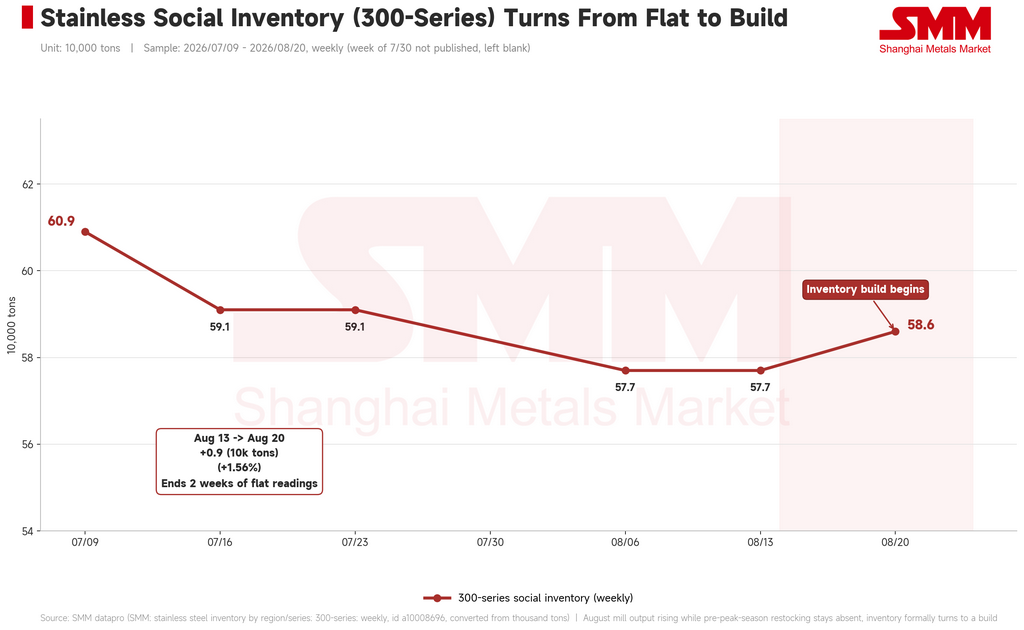
Supply pressure built further. August mill production schedules rose month-on-month, accelerating capacity release into a market where demand hasn't followed. The mismatch showed up directly in inventory: SMM's weekly reading put 300-series social inventory at 586,000 mt on August 20, up 9,000 mt from 577,000 mt the prior week — a 1.56% increase that ends two straight weeks of flat readings and marks a formal turn into build territory. The supply-demand imbalance that defines the tail end of the low season is now visible in the data.
Margins compressed toward inversion
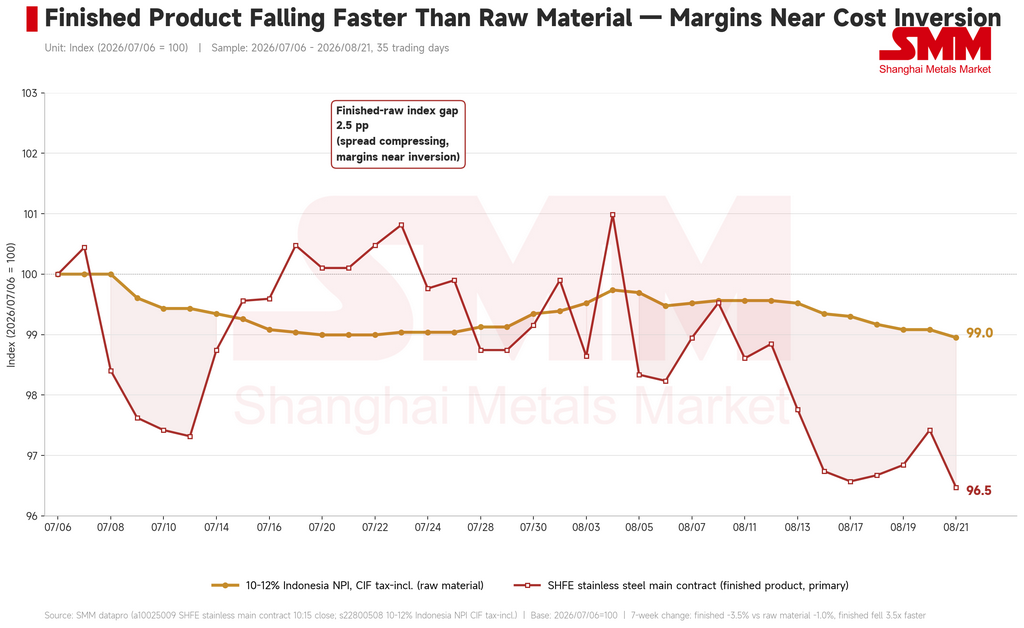
Both finished products and raw materials fell this week, but the finished side fell considerably faster. NPI eased from RMB 1,135.5/nickel point (about $168.5) on Monday to RMB 1,131.5/nickel point (about $167.9) on Friday. High-carbon ferrochrome's weekly average, most recently published for the week ended August 14, came in at RMB 7,935/50mt basis ton (about $1,177), down RMB 60 (roughly $9) from RMB 7,995/50mt basis ton (about $1,186) the week before. With raw material declines relatively contained and finished-product prices tracking the futures market lower, the spread between the two kept narrowing and smelting margins compressed further — the industry is now approaching the edge of cost inversion. That rigidity on the cost side is becoming a harder floor under spot prices, which is why the market is falling but not falling far.
Outlook
This week's market reflected a standoff: a failed low-level repair attempt in futures, spot prices dragged down alongside, absent pre-season demand, rising output feeding inventory, and costs near inversion holding up the floor. In the near term, the missing seasonal demand, higher mill output, and the formal turn to inventory building are the core bearish factors, and the weak price trend looks difficult to break. But the emerging risk of cost inversion is strengthening support from below, which should limit how far prices can fall — a weak, range-bound market is the most likely path. Worth tracking from here: whether the futures repair attempt can gain traction, the pace of any pre-season restocking downstream, changes in mill production schedules, movement in the raw material-finished product spread, the trajectory of the inventory build, and how the escalating Middle East situation transmits into nickel prices and the cost side.

![[SMM Analysis] US PPI Beat Expectations, Fueling Rate Hike Bets, Nickel Prices Under Heavy Pressure This Week](https://imgqn.smm.cn/usercenter/qLeLR20251217171733.jpg)