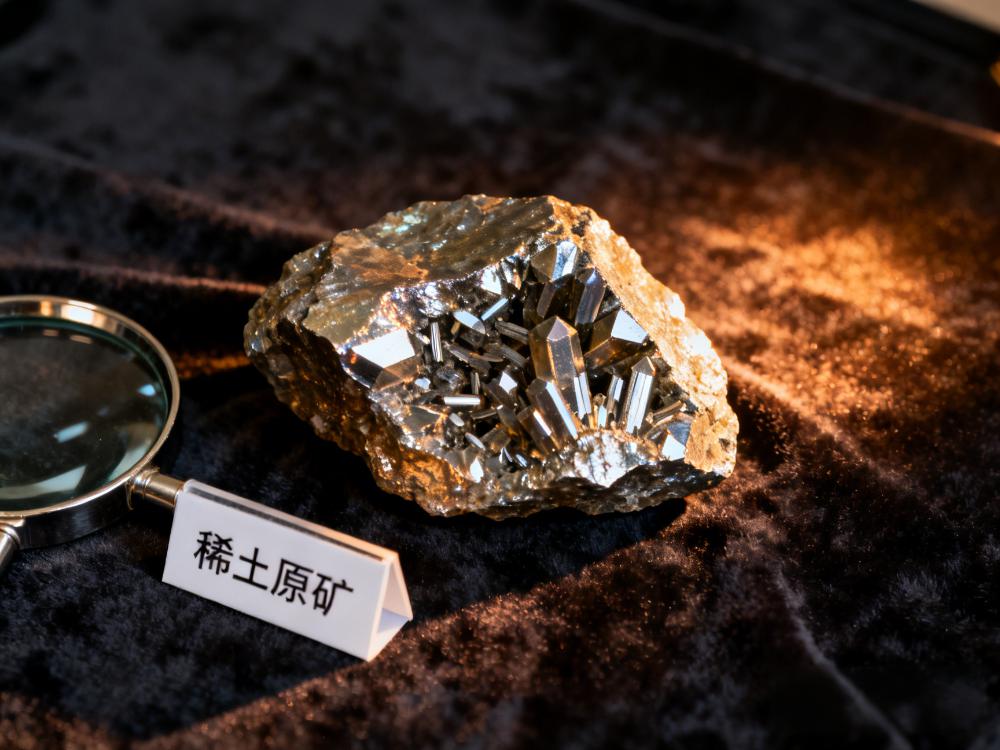
According to the latest data from the General Administration of Customs (GACC) and SMM, China’s imports of two key upstream rare-earth feedstocks diverged sharply in July 2026: rare-earth metal ore rebounded strongly month-on-month, hitting the highest monthly volume seen so far this year, while thorium ores & concentrates fell back steeply after an exceptional spike in June.
I. Rare Earth Metal Ore: MoM volume more than doubled, yet YoY remains down more than 60%
Customs figures show that China imported 1,787 tonnes of rare-earth metal ore in July 2026, a jump of 967 tonnes (+118% MoM) from the 820 tonnes recorded in June, marking the strongest month so far in 2026.
However, on a year-on-year basis, the import volume is still in a deep contraction zone. In July 2025, imports stood at 4,719 tonnes, meaning the July 2026 level is down 2,932 tonnes (-62% YoY). For the first seven months combined, total imports came to 7,434 tonnes, compared with 24,333 tonnes in the same period last year, a decline of -68% YoY, keeping the overall level at a multi-year low.
Looking at the longer-term trend, full-year imports were 55,712 tonnes in 2024 and fell to 24,333 tonnes in 2025 (-56%). The Jan–Jul 2026 cumulative volume is equivalent to only 31% of 2025 full-year imports and 13% of 2024 full-year imports. Unless there is a marked acceleration in H2 2026, the annual total is likely to fall sharply below the 2024 level for the second consecutive year.
SMM analysis indicates that the sharp MoM rebound in July primarily reflects a release of pent-up rigid purchasing demand that had been suppressed in earlier months. The deep YoY contraction, however, underscores that overseas supply availability, price expectations, and the overall operating rhythm of China’s downstream separation and smelting segments remain notably weaker than in the corresponding period last year.
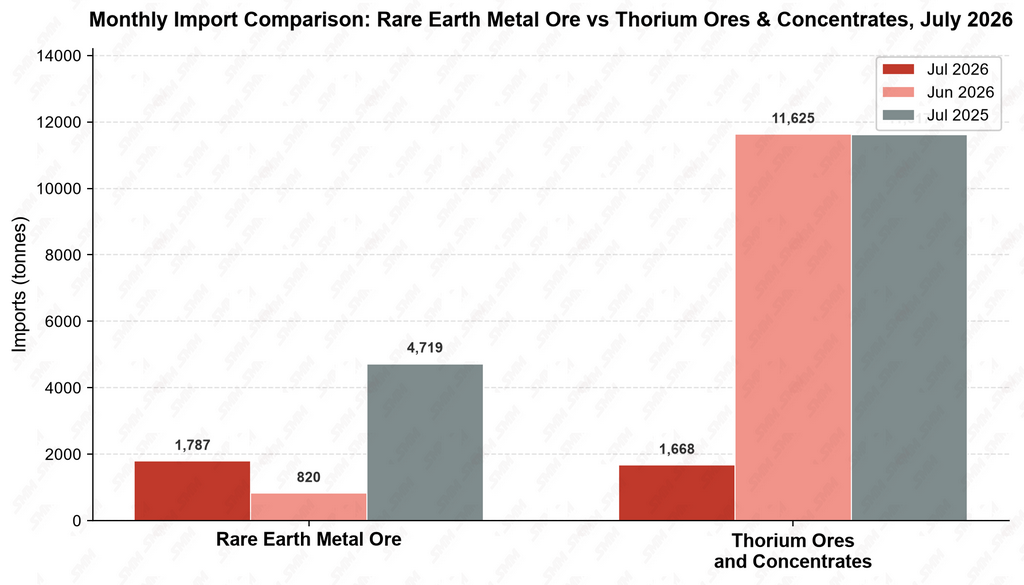
Chart: Monthly import comparison—Rare Earth Metal Ore vs Thorium Ores & Concentrates, July 2026 (Data source: GACC / SMM)
II. Thorium Ores & Concentrates: Pulling back sharply after the June spike, but YTD still up marginally
In July 2026, China imported 1,668 tonnes of thorium ores and concentrates, a -86% MoM plunge from the 11,625 tonnes seen in June, effectively falling back to a fraction of the previous month’s high. The YoY comparison is equally stark: in July 2025 imports were 11,617 tonnes, meaning the current month is also down -86% YoY.
Notably, cumulative imports for January–July 2026 reached 38,693 tonnes, slightly above the 38,293 tonnes recorded during the same period in 2025, a marginal +1% YoY increase. Overall, the import level remains within the high end of the recent historical range. In 2024, full-year imports were 48,501 tonnes, rising to 70,824 tonnes in 2025. In the first seven months of 2026 alone, China has already imported the equivalent of 55% of the 2025 full-year total, a pace that is clearly ahead of historical norms.
SMM notes that thorium ores and concentrates are a critical upstream raw material for the rare-earth supply chain, and their import rhythm is closely tied to the scheduling of China’s domestic separation and smelting capacity. The exceptionally high June figure was driven mainly by concentrated arrivals from earlier orders and a phase of restocking demand. The rapid fallback in July reflects a return to normal seasonal levels, suggesting that the June surge was more a matter of timing front-loading rather than a trend toward sustained expansion.
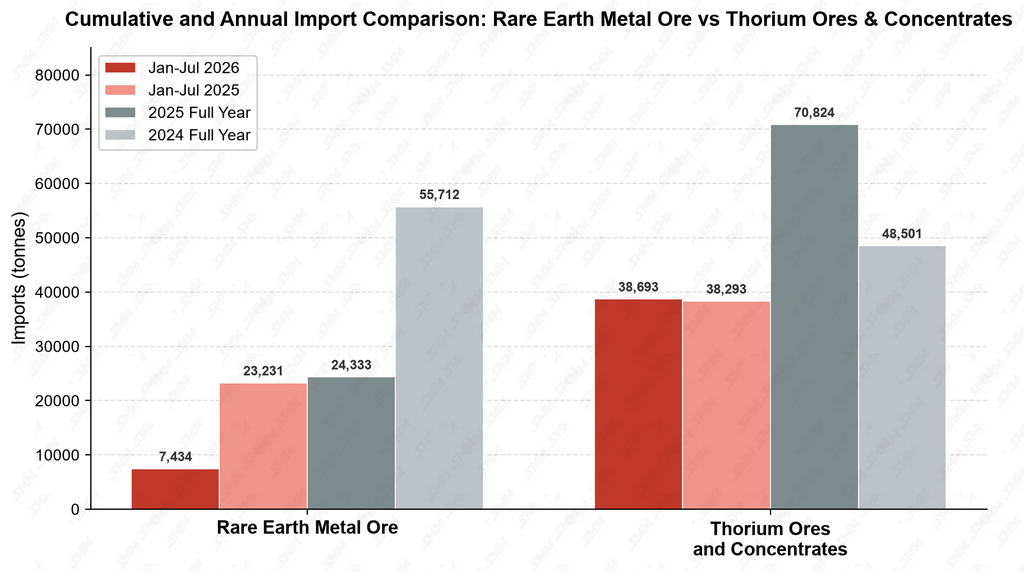
Chart: Cumulative and annual import comparison—Rare Earth Metal Ore vs Thorium Ores & Concentrates (Data source: GACC / SMM)
![Rare Earth Market Sees Scarce Low-Priced Sources, Prices Hold Up Well Overall [SMM Rare Earth Daily Review]](https://imgqn.smm.cn/usercenter/fpsaU20251217171745.jpeg)
![[SMM Rare Earth Morning Meeting Minutes] Major Producers’ Purchasing Drove a Recovery in Pr-Nd Oxide; Metals Stopped Falling and Rose in Tandem; Dysprosium Oxide Continued to Rise; Magnetic Material Scrap Stayed on the Sidelines](https://imgqn.smm.cn/usercenter/eUMRo20251217171745.jpeg)