July China Phosphate Ore Imports Plunge 87% to Near‑Three‑Year Low; Exports Drop to Zero

Published: Aug 21, 2026 14:50
In July 2026, China's phosphate ore imports fell to only 17,000 tonnes, down 87.3% month-on-month, hitting a near-three-year low, while exports dropped to zero. The average import price was USD 84.5/tonne, down 7.6% MoM. By province, only Guangxi maintained 14,000 tonnes; all others recorded zero. By origin, Egypt's volume shrank 81%, with only a tiny increase from Kazakhstan. The June export surge was followed by a July zero.

In July 2026, China's phosphate ore imports fell to only 17,000 tonnes, down 87.3% month-on-month, hitting a near-three-year low, while exports dropped to zero. The average import price was USD 84.5/tonne, down 7.6% MoM. By province, only Guangxi maintained 14,000 tonnes; all others recorded zero. By origin, Egypt's volume shrank 81%, with only a tiny increase from Kazakhstan. The June export surge was followed by a July zero, due to completed orders, off-season demand, and policy controls. Imports are unlikely to recover soon; watch winter storage and export policy changes.
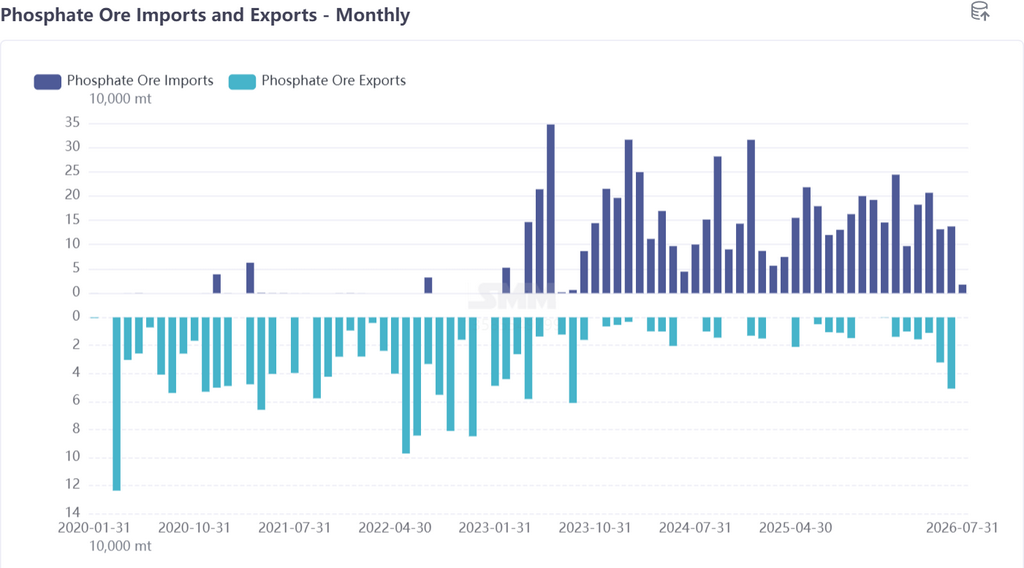
In July 2026, China's phosphate ore imports and exports experienced sharp fluctuations. Import volume was only 17,000 tonnes, a month‑on‑month drop of 87.3%, marking the lowest monthly level in nearly three years. The main reasons include high sulfur prices, weak phosphate fertilizer demand, and the seasonal off‑season slowdown in domestic procurement.
Total import value fell to USD 1.479 million, down 88.2% MoM; the average price was USD 84.5/tonne, down 7.6% MoM.
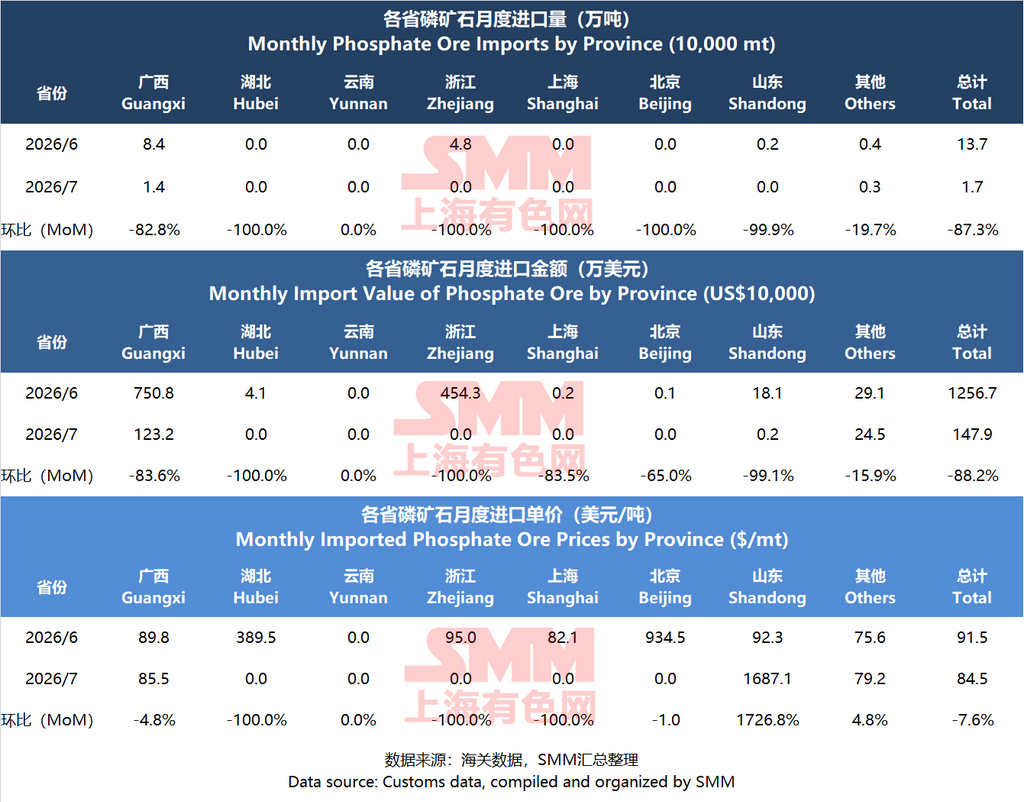

The provincial import pattern shrank across the board: Guangxi imported 14,000 tonnes (‑82.8% MoM), remaining the only province with a sizeable import volume; Hubei, Zhejiang, Yunnan, Beijing, and Shandong all recorded zero imports. Zhejiang had surged 89‑fold in June but fell to zero in July, reflecting a broad contraction in demand.
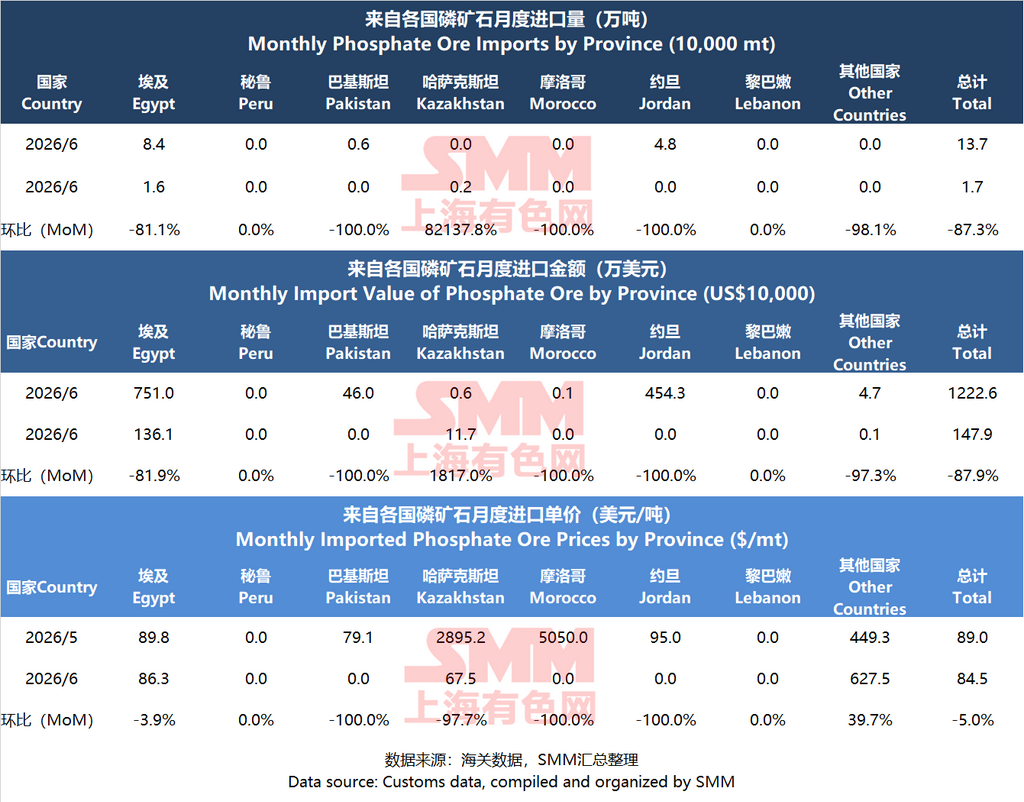


By source country, Egypt remained the dominant supplier, but its volume plummeted from 84,000 tonnes in June to 16,000 tonnes (‑81%). Kazakhstan saw a tiny increase (2,000 tonnes), while alternative suppliers like Jordan and Morocco failed to maintain upward momentum.
On the export side, after a pulse‑like surge of 51,000 tonnes in June, exports dropped to zero in July. The completion of earlier order deliveries, combined with domestic supply tightness, off‑season demand, and tightened export licensing, brought exports to a complete halt.
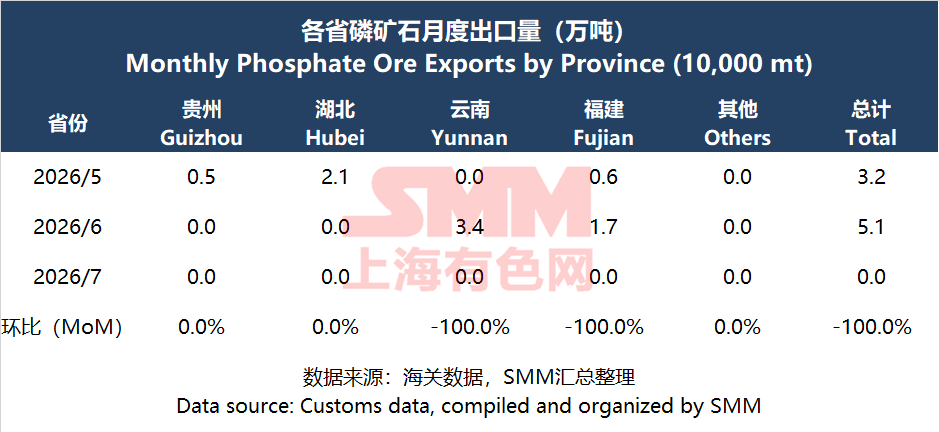

Outlook: Imports are unlikely to recover in the short term, as low downstream operating rates continue to suppress procurement. For exports, attention should be paid to August policies on calcium superphosphate and triple superphosphate, as well as the start of winter storage demand. In the first half of the year, cumulative imports reached 998,200 tonnes, keeping the annual total at a high level; exports surged 226% in H1, but H2 recovery depends on domestic supply‑demand balance and policy direction.


Note: If you have any further details to add regarding the points mentioned in this article, or if you have any questions on the phosphorus chemical industry (phosphate ore, phosphoric acid, iron phosphate, lithium iron phosphate, etc.) and solid-state batteries, please feel free to contact:

Tel: 021-20707860 (or add WeChat: 13585549799) – Yang Chaoxing. Thank you!

Data Source Statement: Except for publicly available information, all other data are processed by SMM based on publicly available information, market communication, and relying on SMM's internal database model. They are for reference only and do not constitute decision-making recommendations.

For any inquiries or for more information, please contact: lemonzhao@smm.cn
For more information on how to access our research reports, please contact:service.en@smm.cn
Related News
[SMM Separator Weekly Review] Supply-demand balance remains tight, coated products poised for price hikes
1 hour ago
[SMM Separator Weekly Review] Supply-demand balance remains tight, coated products poised for price hikes
Read More
[SMM Separator Weekly Review] Supply-demand balance remains tight, coated products poised for price hikes
[SMM Separator Weekly Review] Supply-demand balance remains tight, coated products poised for price hikes
[SMM Analysis] Separator Market Prices Remain Stable Overall
1 hour ago
Cost Support Weakens as Cobalt Prices Fall Across the Board
1 hour ago
Cost Support Weakens as Cobalt Prices Fall Across the Board
Read More
Cost Support Weakens as Cobalt Prices Fall Across the Board
1 hour ago
Core Lithium Resumes Spodumene Production at Finniss, Boosting Capacity by 20% After Two-Year Break
1 hour ago
Core Lithium Resumes Spodumene Production at Finniss, Boosting Capacity by 20% After Two-Year Break
Read More
Core Lithium Resumes Spodumene Production at Finniss, Boosting Capacity by 20% After Two-Year Break
On September 8th, Core Lithium has produced first spodumene concentrate from the recommissioned Finniss processing plant in the Northern Territory, marking a milestone in the company's staged restart of the operation. Core Lithium restarted mining at the Grants openpit in May and recommissioned the crushing circuit in August to build sufficient crushed ore stockpiles for processing. First concentrate was achieved within six months of the company's final investment decision to proceed with the Finniss restart. The company has undertaken targeted upgrades to debottleneck the processing circuit and optimise recoveries, including screen refurbishments, rolls crusher enhancements and improvements to the ferrosilicon distribution system. Crushing and dense media separation operations have been consolidated into a single control room. These upgrades are expected to increase plant throughput capacity by about 20% to 1.2 million t/y. Finniss began initial spodumene concentrate production in February 2023 before being placed on care and maintenance in mid-2024 amid a downturn in lithium prices. The project has since been repositioned as a lower-cost, long-life operation with a 20-year mine life and average production of 214,000 t/y. Finniss is the only major hard-rock lithium mine operating outside of Western Australia.
1 hour ago
July China Phosphate Ore Imports Plunge 87% to Near‑Three‑Year Low; Exports Drop to Zero - Shanghai Metals Market (SMM)