China’s hydrogen energy industry is currently in a critical transition phase from demonstration validation toward large‑scale commercial deployment. In 2026, commissioned and under‑construction renewable‑energy‑based hydrogen production capacity across China has exceeded 1 million tons per annum. Nevertheless, fossil‑fuel‑based hydrogen still dominates the supply mix, and the share of green hydrogen remains low. Recently, China’s hydrogen market has been characterised by steadily falling production‑end prices, high‑level volatility at the consumption end, prominent regional price differentials, and continuous narrowing of the price gap between grey and green hydrogen. Carbon‑market mechanisms, storage‑and‑transport infrastructure, wind‑solar resource endowments and long‑term supply contracts jointly shape current price trends. Meanwhile, the localisation of hydrogen‑production equipment and the construction of cross‑regional hydrogen‑transmission pipelines are reshaping the medium‑ and long‑term hydrogen‑price curve.
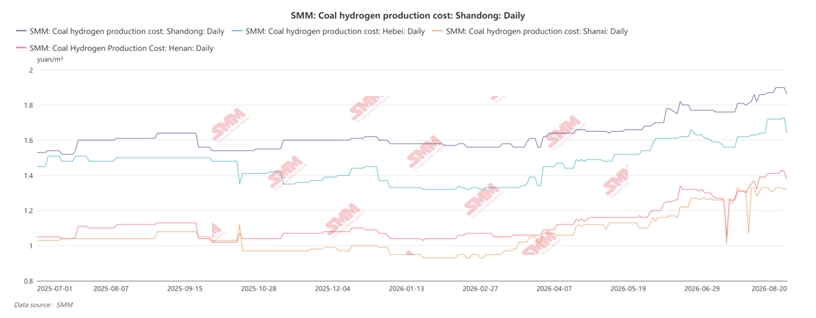
In terms of spot‑market performance, industrial hydrogen in China is traded mainly via annual and quarterly long‑term contracts, with limited spot liquidity and marked regional price divergence. According to China Hydrogen Price Index monitoring for June 2026, ordinary hydrogen in the Yangtze River Delta stood at approximately 33.69 CNY/kg, while clean hydrogen was priced at 34.34 CNY/kg. The price in Tangshan reached 34.83 CNY/kg. Constrained by supply‑demand fundamentals and logistics, the Pearl River Delta recorded 38.13 CNY/kg. Ample local supply pushed prices down to 29.33 CNY/kg in Henan Province. In Xinjiang, by contrast, insufficient hydrogen‑export capacity pushed terminal prices to 40.25 CNY/kg. On the grey‑hydrogen production side, coal‑to‑hydrogen costs in coal‑abundant central‑western China sit at around 12 CNY/kg, representing the country’s cost floor. Driven by higher feedstock costs, grey‑hydrogen production costs in eastern coastal regions range from 14 CNY/kg to 18 CNY/kg. At present, the national average production‑side hydrogen price is roughly 26 CNY/kg, yet the average terminal consumption price approaches 44‑45 CNY/kg, implying a storage‑and‑transport premium of around 18 CNY/kg. For long‑haul transport over 500 km, high‑pressure tube‑trailer costs can surge above 20 CNY/kg, largely erasing the cost advantage of low‑cost production bases.
Green‑hydrogen pricing is reaching an important inflection point. Driven by large‑scale localisation‑driven price declines of alkaline electrolyser units and falling electricity tariffs at large‑scale wind‑solar bases, green‑hydrogen production costs at selected demonstration projects in resource‑rich northwest regions such as Inner Mongolia and Xinjiang have fallen to 14‑18 CNY/kg. Projects leveraging curtailment‑based wind‑solar power can achieve even lower production costs of 11.2‑14 CNY/kg, approaching the local grey‑hydrogen cost band of 12‑15 CNY/kg, with partial price‑parity windows now materialising. It is critical to distinguish production‑gate costs from end‑user delivered prices: after long‑haul tube‑trailer shipment to eastern consumption hubs, delivered green‑hydrogen prices generally rise to 22‑30 CNY/kg, still higher than conventional grey hydrogen. The landmark West‑to‑East Hydrogen Transmission Project provides a key price benchmark. The planned Ulanqab‑Tianjin Binhai hydrogen pipeline, scheduled for completion in 2029, is expected to bring terminal hydrogen prices down to 19‑22 CNY/kg, demonstrating that pipeline transport can substantially bridge the east‑west hydrogen‑price divide.
Multiple factors drive recent hydrogen‑price movements. First, feedstock costs set the floor for grey‑hydrogen pricing, with coal and natural‑gas price fluctuations directly transmitted to production costs. Second, storage‑and‑transport represents the largest price variable at present. China’s operational pure‑hydrogen pipelines total merely around 350 km; most hydrogen is delivered by high‑pressure tube trailers, creating the structural paradox of “low prices at production sites, high prices in consumption centres”. Third, carbon‑market policies are shaping clean‑hydrogen pricing. With the full roll‑out of the EU Carbon Border Adjustment Mechanism (CBAM) and the incorporation of green hydrogen into China’s renewable‑energy assessment framework, the carbon‑abatement value of green hydrogen (around 20 tons of CO₂ abated per tonne of green hydrogen replacing grey hydrogen) will further narrow its economic gap against grey hydrogen. Fourth, expanding electrolyser capacity accelerates green‑hydrogen cost reduction. Bidding prices for mainstream alkaline (ALK) electrolysers have plunged by more than 60 % over two years, while system power consumption has dropped below 4.2 kWh/Nm³, laying a foundation for further green‑hydrogen price declines.
From a supply‑demand perspective, domestic hydrogen consumption is heavily concentrated in the chemical sector. Most chemical operators operate captive hydrogen‑production units, resulting in limited volumes of market‑traded hydrogen. The 2030‑2050 period will witness high‑speed growth of the hydrogen sector. Market‑traded hydrogen volumes will expand notably as large‑scale consumption‑end projects such as green‑hydrogen‑based ammonia synthesis, green‑methanol production and hydrogen‑metallurgy come on‑stream. Geographically, northwest China will evolve into the core domestic base for green‑hydrogen exports. With the large‑scale build‑out of pure‑hydrogen pipeline networks, regional hydrogen‑price differentials across China will keep narrowing.