World’s First Mass-Produced Amorphous Alloy Electric Drive Launched; Amorphous Alloys Open Window for Replacing New Energy Silicon Steel
GAC Aion recently officially launched the 2027 RT model. The new vehicle is equipped with the world’s first mass-produced amorphous alloy electric drive system, comes standard with CATL power batteries across all trims, and is available in four configuration versions. It delivers a maximum CLTC range of 710 km and power consumption as low as 8.571 kWh per 100 km. This three-electric powertrain combination, previously only fitted in high-end models priced above 300,000 yuan, has now expanded to lower market segments, marking that amorphous alloys have officially launched an industry-level challenge to replace new energy non-oriented silicon steel — the mainstream core material for new energy vehicle drive motors.
Range and energy consumption have long been core pain points for new energy vehicle consumers. In the past, nearly all domestic new energy traction motors adopted new energy-specific non-oriented silicon steel as the stator core material, with mainstream thin-gauge grades of 0.20–0.35 mm such as B25AV1300 and B30AV1500. The industry has been driving down iron loss by continuously thinning strip steel and optimizing smelting and annealing processes, pushing motor efficiency toward the theoretical ceiling of silicon steel materials. Nevertheless, iron loss and heat generation under high-frequency, high-speed operating conditions remain difficult to fully eliminate, and every 0.5% gain in energy efficiency comes with enormous R&D costs.
The amorphous alloy electric drive on the 2027 Aion RT uses a core made of aerospace-derived amorphous alloy strip, commonly known as "hand-tearable steel". With a thickness of only 0.025 mm — one-tenth that of mainstream 0.2–0.35 mm new energy non-oriented silicon steel laminations — and paired with a carbon fiber rotor, it cuts core loss by 75%, achieves a peak motor efficiency of 99%, and raises overall vehicle energy efficiency by one additional kilometer of driving range per kilowatt-hour of electricity.
Core Comparison: Amorphous Alloys vs. High-Grade New Energy Non-Oriented Silicon Steel
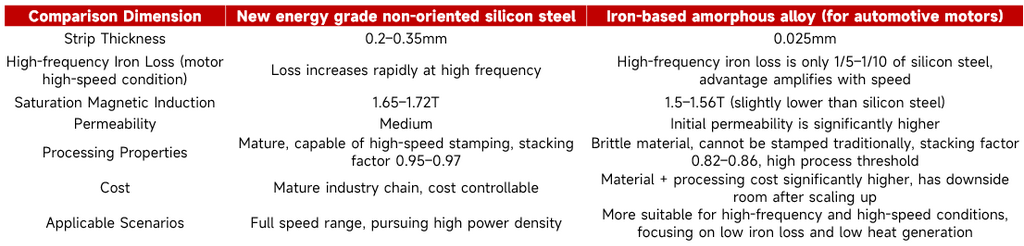
Data source: Compiled from public data
In terms of performance, new energy non-oriented silicon steel excels in higher saturation magnetic induction, mature lamination fabrication, and easier scaling of power density, making it the undisputed mainstream for current new energy motors. The greatest strength of amorphous alloys is concentrated in the high-frequency, high-speed operating range of motors: they substantially reduce iron loss and significantly lower motor heat buildup, directly improving real-world high-speed range attainment. However, limited by saturation magnetic flux density and stacking factor, power density is compromised at equal volume, and their processing difficulty is far higher than that of non-oriented silicon steel.
Historically, amorphous alloys were widely deployed in the distribution transformer sector. Hampered by technical barriers in the complete set of core cutting, stacking and annealing processes, they have long failed to achieve large-scale mass production for automotive traction motors, remaining largely at the laboratory and prototype stage. GAC Aion’s mass production breakthrough has completed the full industrial chain of amorphous alloy motors from raw materials to finished vehicles. In the short term, however, amorphous alloys will not fully replace non-oriented silicon steel, but will form a technologically complementary relationship: amorphous alloys hold prominent advantages in high-frequency, high-speed scenarios where low energy consumption is prioritized, while high-grade non-oriented silicon steel will retain its dominant position in high-overload, high-power-density applications.
The energy efficiency competition for new energy motors has shifted from structural design to rivalry at the fundamental material level. For years the industry has continuously rolled out higher-grade, thinner-gauge non-oriented silicon steel to tap the limits of the silicon steel system; the mass production and vehicle integration of amorphous alloys opens up a second technological route.
Looking forward, if production capacity is scaled up and the manufacturing cost of amorphous alloy cores continues to fall, amorphous alloys will gradually bring about partial replacement of thin-gauge new energy non-oriented silicon steel, reshaping the downstream demand structure for non-oriented silicon steel. For the domestic industrial chain, this marks the opening of an entirely new competitive dimension in the soft magnetic materials track, providing a fresh pathway for further breakthroughs in China’s three-electric (battery, motor, electric control) technology.
Data source statement:
(Data in this report other than public information are all sourced from public information (including but not limited to industry news, seminars, exhibitions, corporate financial reports, broker reports, National Bureau of Statistics data, customs import and export data, and various data published by major associations and institutions), market communication, and SMM's internal database models, and are produced by the research team through comprehensive analysis and reasonable inference; they are for reference only and do not constitute decision-making advice.)
SMM reserves the final right of interpretation of the terms of this statement and the right to adjust and amend the content of the statement according to actual circumstances.