Recently, GAC Aion's 2027 model RT was officially launched. The new car is equipped with the world's first mass-produced amorphous alloy electric drive system, and all variants come standard with CATL power batteries. A total of four configuration versions are offered, with a CLTC driving range of up to 710 km and energy consumption as low as 8.571 kWh per 100 km. This three-electric combination, previously only used in high-end car models priced above 300,000 RMB, has now trickled down, marking that amorphous alloy has officially launched an industrial-level substitution challenge against the mainstream new energy non-oriented silicon steel used in NEV motors.
Driving range and energy consumption have always been the core pain points for NEV users. In the past, almost all NEV drive motors in China used NEV-specific non-oriented silicon steel as the stator core material, with mainstream thin gauge grades of 0.20-0.35 mm, such as B25AV1300 and B30AV1500. The industry continuously reduced the strip thickness and optimized smelting and annealing processes to lower iron loss, pushing motor efficiency to the material ceiling. However, iron loss and heat generation under high-frequency and high-speed conditions remained difficult to completely solve, and every 0.5% improvement in energy efficiency required huge R&D costs.
The amorphous alloy electric drive system in the 2027 Aion RT uses an aerospace-derived amorphous alloy strip, commonly known as "hand-tearable steel", with a thickness of only 0.025 mm, which is just one-tenth of the mainstream 0.2-0.35 mm NEV non-oriented silicon steel sheets. Paired with a carbon fiber rotor, it achieves a 75% reduction in core loss and a peak motor efficiency of 99%. This allows the vehicle to travel one more kilometer per kWh of electricity consumed.
Amorphous Alloy VS High-grade Non-oriented Silicon Steel for NEV: Core Comparison
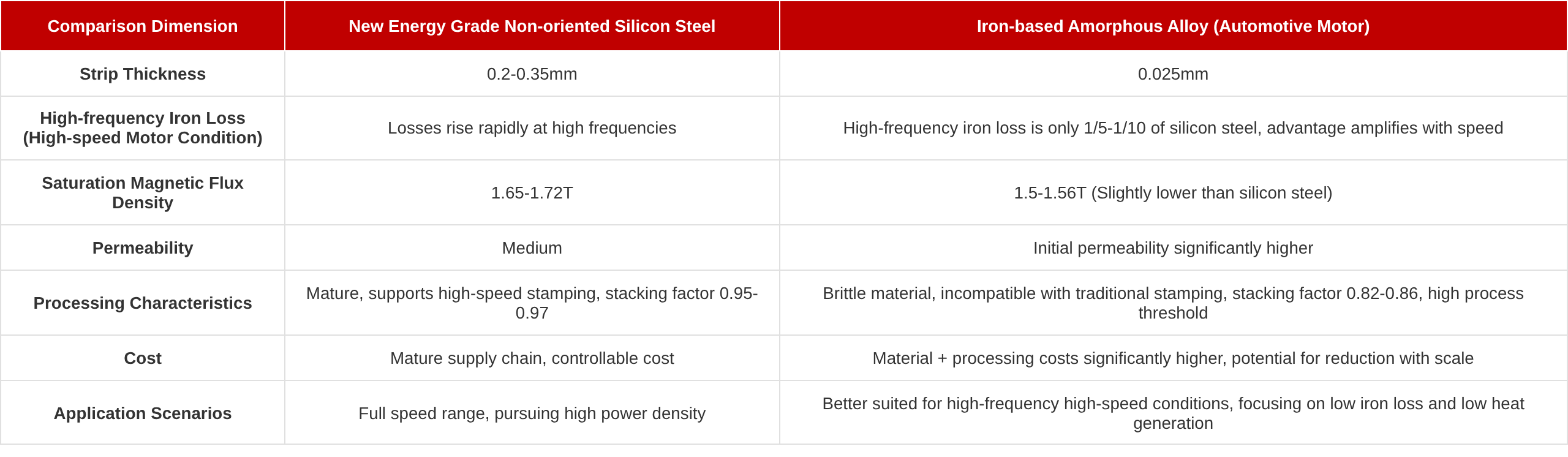
Data Source: Compiled from public data
In terms of performance, NEV non-oriented silicon steel has advantages in higher saturation magnetic induction, mature lamination process, and easier scalability of power density, making it the absolute mainstream for current NEV motors. On the other hand, the biggest advantage of amorphous alloy lies in the high-frequency and high-speed range, where iron loss is greatly reduced and motor heat generation is significantly lowered, directly improving the high-speed driving range achievement rate. However, constrained by saturation magnetic flux density and stacking factor, power density is compromised at the same volume, and the processing difficulty is much higher than that of non-oriented silicon steel.
In the past, amorphous alloy was widely used in the field of distribution transformers. Constrained by the complete set of process difficulties in core cutting, stacking, and annealing, it had been difficult to achieve mass production and installation in automotive drive motors, remaining mostly in the laboratory and prototype stage. GAC Aion has achieved mass production, opening up the industrialisation chain of amorphous alloy motors from materials to complete vehicles. However, in the short term, it will not completely replace non-oriented silicon steel; instead, it will form a technological complementarity: in high-frequency, high-speed scenarios prioritizing low energy consumption, amorphous alloy has significant advantages; in high-overload, high-power-density scenarios, high-grade non-oriented silicon steel will still maintain its dominant position.
The energy efficiency competition in new energy motors has shifted from structural design to underlying material competition. In the past, the industry has continuously iterated toward higher grades and thinner specifications of non-oriented silicon steel, pushing the limits of the silicon steel system; amorphous alloys have been mass-produced and installed in vehicles, opening a second technological route.
Looking ahead, if production lines are scaled up and released, the cost of manufacturing amorphous alloy iron cores will continue to decline, gradually leading to partial substitution for thin-gauge new energy non-oriented silicon steel, reshaping the downstream demand structure of non-oriented silicon steel. For China's industry chain, this means that the soft magnetic material track has opened a new dimension of competition, providing a new path for further breakthroughs in China's three-electric technology.
Data Source Statement:
(Other than public information, all data in this report are derived from public sources (including but not limited to industry news, seminars, exhibitions, corporate financial reports, brokerage reports, National Bureau of Statistics (NBS) data, customs import/export data, and various data released by major associations and institutions), market communication, and rely on SMM's internal database models. They are obtained through comprehensive analysis and reasonable inference by the research team, for reference only, and do not constitute decision-making advice.
SMM reserves the final right of interpretation for this statement and the right to adjust and modify the content of the statement based on actual circumstances.
![Demand Remains Steady, Slight Destocking, Iron Ore Fundamentals Unchanged [SMM Iron Ore Daily Comment]](https://imgqn.smm.cn/usercenter/bkAyC20251217171720.jpg)