SMM, August 20:
Metal market:
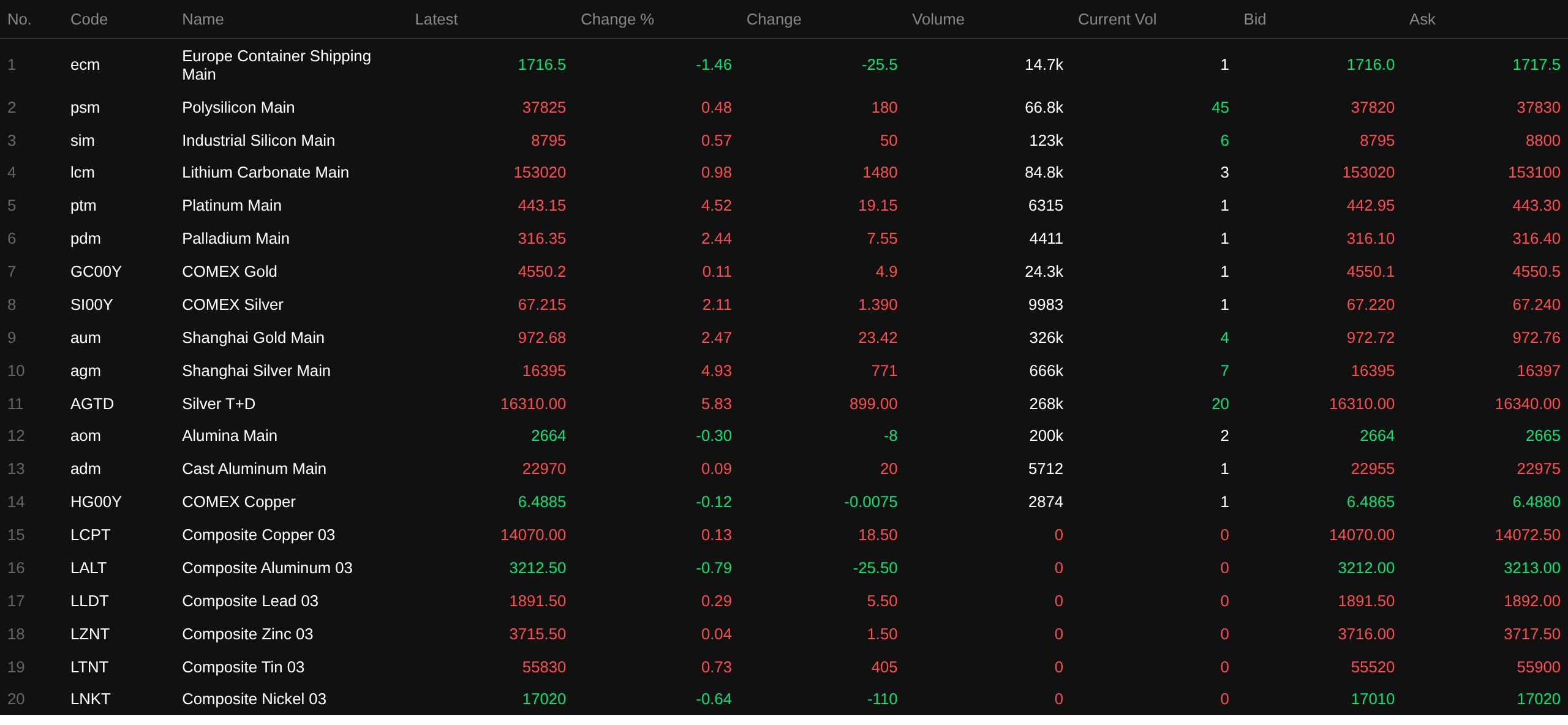
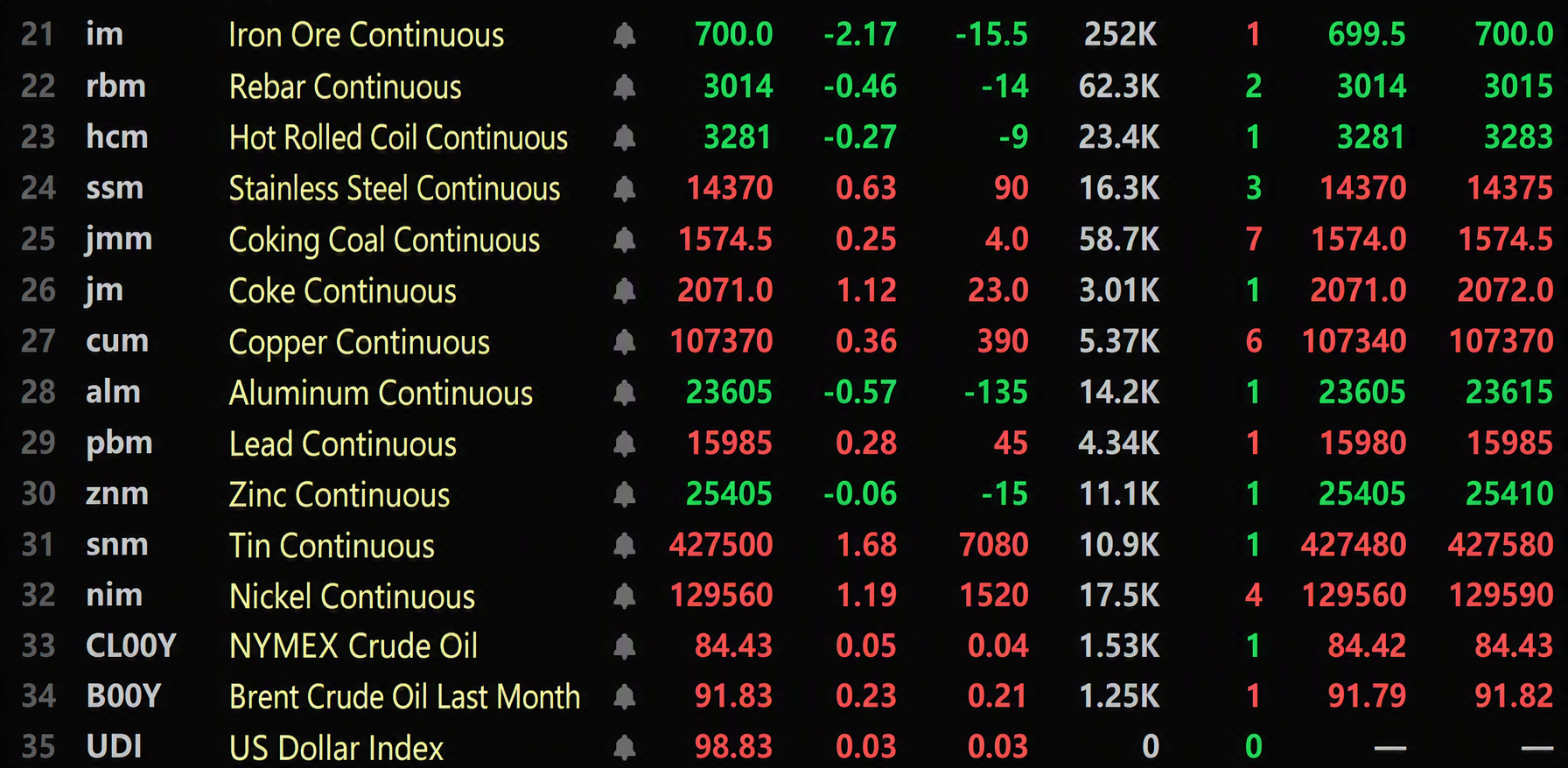
As of the midday close, base metals in the domestic market mostly rose. SHFE copper rose 0.36%, SHFE aluminum fell 0.57%. SHFE lead rose 0.28%. SHFE zinc edged down slightly. SHFE tin rose 1.68%. SHFE nickel rose 1.19%.
In addition, the most-traded foundry aluminum futures contract edged up, while the most-traded alumina futures contract fell 0.3%. The most-traded lithium carbonate futures contract rose 0.98%. The most-traded silicon metal futures contract rose 0.57%. The most-traded polysilicon futures contract rose 0.48%.
Ferrous metals showed mixed performance. Iron ore fell 2.17%, rebar fell 0.46%, and hot-rolled coil fell 0.27%. Stainless steel rose 0.63%. Coking coal and coke: the most-traded coking coal futures contract rose 0.25%, and the most-traded coke futures contract rose 1.12%.
In the overseas base metals market, as of 11:40, LME metals broadly rose. LME copper, LME lead, and LME zinc all rose within 0.3%. LME aluminum fell 0.79%. LME tin rose 0.73%. LME nickel fell 0.64%.
In precious metals, as of 11:40, COMEX gold rose 0.11% and COMEX silver rose 2.11%. In the domestic precious metals market: SHFE gold rose 2.47%, and the most-traded SHFE silver futures contract rose 4.93%.
Additionally, as of the midday close, the most-traded platinum futures contract rose 4.52%, and the most-traded palladium futures contract rose 2.44%.
As of the midday close, the most-traded containerized freight index (Europe service) futures contract fell 1.46%, to 1,716.5 points.
As of 11:40 on August 20, selected futures midday quotes:
Spot Market and Fundamentals
Aluminum: Futures prices continued their downward trend today, while the spot market in South China remained steady to firmer. The cumulative absolute price decline has been quite substantial, clearly breaking below the monthly moving average. Combined with inventory still destocking steadily and a considerable single-day decline, these two positive factors led most cargo holders to hold back from selling more decisively...
Macro Front
China:
[Unchanged for the 15th Consecutive Month! August LPR Quotes Released: Above-5-Year at 3.5%, 1-Year at 3%] China's Loan Prime Rates (LPR) for August were released on August 20, with both the 1-year and above-5-year LPRs remaining unchanged. The National Interbank Funding Center, authorized by the People's Bank of China (PBOC), announced that the LPRs for August 20, 2026 are: the 1-year LPR is 3.0%, and the above-5-year LPR is 3.5%. These LPRs are effective until the next LPR announcement. As China's 7-day reverse repo rate, the main policy rate, has remained unchanged for 15 consecutive months since its last cut in May 2025, the pricing basis for the LPR did not change this month. The last LPR adjustment occurred in May 2025, when both the 1-year and above-5-year LPRs were lowered by 10 basis points.
[Beijing E-Town: To Accelerate Large-Scale Production of 100,000-Unit-Level Embodied AI Robots] According to the official account of "Beijing E-Town", the 2026 World Robot Conference opened in Beijing E-Town on August 19. At the "Open Cooperation" main forum, Li Quan, Member of the Working Committee and Deputy Director of the Administrative Committee of the Beijing Economic-Technological Development Area, unveiled the "Beijing Machine Realm" — a vision for building a new society of human-robot integrated embodied intelligence. Beijing E-Town will accelerate the creation of 100 practical, deployable specialized robot products and promote their application in 1,000 niche fields; it will accelerate the large-scale production of 100,000-unit-level embodied AI robots and form a production capacity for 1 million sets of key core parts. (From Wallstreetcn APP)
The PBOC's 7-day reverse repo operation volume was zero for the eighth consecutive working day. Today, 327.4 billion yuan of reverse repo matured.
US Dollar:
As of 11:40, the US dollar index rose 0.03% to 98.83. Fed meeting minutes showed that several officials leaned towards a rate hike last month, while many indicated that further monetary policy tightening would be necessary if inflation failed to decline. However, uncertainty still heavily influenced Fed officials' judgments at the July meeting. The minutes said: "Regarding the outlook for monetary policy, participants reiterated that their interpretation of incoming data would be a key component of policy discussions." The FOMC decided by a 9-to-3 vote in July to maintain the benchmark rate in the 3.5% to 3.75% range. Logan, Hammack, and Kashkari dissented, favoring a 25-basis-point rate hike. Two other regional Fed presidents who did not have voting rights in July — Schmid and Musalem — have since indicated they would have supported a rate hike at that meeting if they had a vote. Most policy discussions at the July meeting revolved around differing assessments of the future inflation trajectory. The minutes stated: "Most participants expected inflation to gradually pull back over the remainder of the year as the effects of tariffs and the previous increase in energy prices faded, but many noted that the possibility of inflation persisting at elevated levels remained."
According to the CME "FedWatch": The probability of the Fed holding rates steady through September is 67.3%, and the probability of a cumulative 25-basis-point rate hike is 32.7%. Through October, the probability of the Fed holding rates steady is 58.3%, the probability of a cumulative 25-basis-point hike is 37.3%, and the probability of a cumulative 50-basis-point hike is 4.3%.
Four US Senate Democrats led by Chris Van Hollen have asked Fed Chairman Warsh to publicly disclose his conversations with Trump, following a Wall Street Journal report that the two have spoken on multiple occasions despite such calls not appearing on Warsh's calendar. The senators said that failure to disclose the contact could create the mistaken impression that the White House is directing monetary policymaking. When questioned by Van Hollen last month, Warsh did not directly address the matter. The senators are demanding that Warsh confirm in writing whether he has had any communications with Trump since being sworn in, or amend his calendar to disclose the calls. White House National Economic Council Director Hassett played down the calls in early August, stating that Trump had not pressured Warsh on interest rate decisions; Trump himself has said he had only one brief conversation with Warsh. In contrast, former Fed Chairman Powell documented his calls with Trump and disclosed several in-person meetings.
The US Treasury Department announced it is at least doubling the size of its liquidity support buyback operations for long-dated nominal coupon securities, covering both the 10- to 20-year and 20- to 30-year maturity ranges. The maximum size per operation is currently $2 billion, and future operations will be increased to at least $4 billion each. The change is effective September 9, 2026, and will be implemented for the remainder of the current quarterly refunding cycle (through November 4, 2026). The Treasury will provide more information on future buyback sizes at its next quarterly refunding meeting, scheduled for November 4, 2026. This increase in buyback operation size reflects the Treasury's intent to provide greater liquidity support for the long-dated nominal Treasury market. Details of the updated temporary Treasury buyback schedule will be released later.
US Treasury Secretary Bessent has, through a series of unconventional operations this year, become one of the most interventionist US Treasury chiefs in decades regarding financial markets, aiming to curb rising US borrowing costs. This week, the US Treasury announced plans to "at least double" the size of planned buybacks of 10- to 30-year Treasuries. Previously, Treasury had signaled the potential for reduced long-term debt issuance. On July 31, Bessent directed the first US government purchase of Japanese yen in 30 years. Former Treasury official Mark Sobel characterized Bessent as "absolutely an activist interventionist," a style reminiscent of his hedge fund background. Sobel noted that Bessent and senior administration officials are clearly concerned about rising long-term US Treasury yields. Driven by inflation, Federal Reserve monetary policy, and the fiscal deficit, 10-year US Treasury yields have continued to rise, pushing up mortgage rates and dragging on economic growth. Some analysts noted that while Bessent is attempting to stabilize markets through yield curve intervention, they warn that such a strategy is unlikely to succeed in the long run without addressing high debt and fiscal deficits. (Jinshi Data APP)
Data:
Today will see the release of Australia's July seasonally adjusted unemployment rate, Germany's July PPI month-on-month rate, Switzerland's July trade balance, the UK's August CBI industrial order difference, US initial jobless claims for the week ended August 15, the US August Philadelphia Fed manufacturing index, the US July Conference Board leading index month-on-month rate, China's total installed power generation capacity as of July this year, and its year-on-year growth rate. Additionally, attention should be paid to the Ministry of Commerce's first regular press conference for August; an interview of 2028 FOMC voter and St. Louis Fed President Musalem on CNBC; and Alibaba's earnings release.
Crude Oil:
As of 11:40, oil prices on both exchanges moved sideways. WTI crude rose 0.05%, and Brent crude rose 0.23%. Oil prices fluctuated in a narrow range amid a stalemate in US-Iran negotiations.
According to CCTV News: on August 19 local time, US President Trump stated on his social media platform "Truth Social" that Iran failed to seize an opportunity for a deal, and he therefore announced the "toughest economic actions ever imposed on any country" against Iran, calling it an "economic war and economic isolation" of unprecedented scale.
Trump stated the US is building a record amount of oil pipelines to reduce reliance on the Strait of Hormuz. He said the strait's importance will decline as more alternative supply routes emerge and US control over the waterway strengthens. Trump also remarked that while some had predicted oil prices could spike to $350, current prices remain around $84 to $85 a barrel.
Two US officials told Axios that the US military has quietly established a shipping lane for vessels entering and exiting the Strait of Hormuz, which transports millions of barrels of oil daily. While the broader war remains a stalemate, this operation has achieved notable results. The operation has been ongoing for several weeks, and 15 to 20 oil tankers have now used the southern passage along the coast of Oman to transit the strait. Officials said about 10 million barrels of oil per day are being shipped out via the strait into global energy markets, though this figure is roughly half the pre-war transit volume. This US-led operation is mitigating one of the most severe consequences of the war: oil supply disruptions that had driven a significant rise in crude prices. Officials indicated that while the volume of oil currently moving through the strait remains below pre-war levels, it is already having a tangible impact on global oil supplies. (Jinshi Data)
Separately, Venezuelan Oil Minister Paola Eñau told investors in Houston that Venezuela hopes to sign production-sharing contracts and boost output in the country holding the world's largest crude oil reserves. Eñau said there are currently 916 blocks available for exploration and production in Venezuela. While Venezuela is known for heavy crude, she noted investment opportunities also exist in light and medium crude, as well as natural gas. "We need these agreements to enter these new blocks," she said. "There's a whole world waiting to be explored." This week, Venezuela signed agreements with oilfield services giant Schlumberger (SLB.N) and independent oil producer Hunt Oil, but the country wants to attract more private investment to revive output, which has been in steady decline for the past two decades. Eñau stated that about 140 companies attended the meeting, and the scale of potential investors present demonstrates the level of market interest in investing in Venezuela.
Spot Market Summary:
►
►
►
Other base metals spot midday reviews will be updated later, please refresh to view~
![Driven by dual positives, supply-demand pattern tightens [SMM South China Spot Aluminum Daily Review]](https://imgqn.smm.cn/usercenter/zlIyw20251217171654.jpg)
![Night Session Rebounded to Reclaim 424,000, July FOMC Minutes Set the Tone for September Path [SMM Tin Morning Brief]](https://imgqn.smm.cn/usercenter/iLVGs20251217171753.jpg)