Pricing across the crystalline-silicon solar supply chain reversed sharply in August. Polysilicon suppliers withheld offers to defend prices, wafer producers cut output, and stronger international orders for solar cells improved market sentiment. Module suppliers also raised guidance prices, but export transactions did not move up in step.
The market is better described as upstream spot prices surging, module offers moving first, China domestic transactions edging higher, and export transactions lagging. It is not a synchronized price increase across the supply chain.
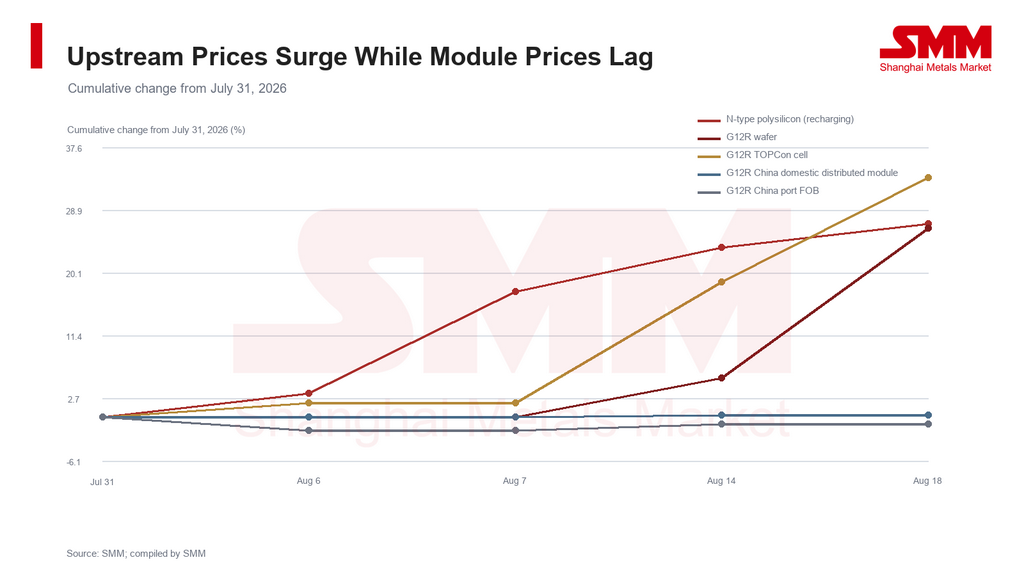
From July 31 to August 18, SMM data showed that N-type polysilicon for recharging rose 27.0% to approximately $5.96/kg (RMB 40.5/kg) from $4.70/kg (RMB 31.9/kg). G12R wafers increased 26.4% to $0.169/piece (RMB 1.15/piece) from $0.134/piece (RMB 0.91/piece), while G12R TOPCon cells climbed 33.4% to $0.0506/W (RMB 0.3435/W) from $0.0379/W (RMB 0.2575/W).
Over the same period, the average China domestic price of G12R modules for distributed solar rose only 0.3%, to approximately $0.1065/W (RMB 0.723/W) from $0.1062/W (RMB 0.721/W). The SMM China-port FOB assessment for G12R modules instead declined 0.9%, to $0.1065/W from $0.1075/W.
The data indicate that the latest price move began in upstream materials and supplier offers. Module transaction prices have yet to absorb the full cost increase, with pass-through particularly slow in export markets.
Upstream gains lifted the module cost floor
Module suppliers are raising prices primarily because of cost pressure, not because end-market demand has suddenly strengthened.
According to SMM's daily cost model, the total cost of an N-type TOPCon G12R module reached approximately $0.1032/W (RMB 0.701/W) on August 17, up $0.0105/W (RMB 0.071/W), or about 11.3%, from $0.0928/W (RMB 0.630/W) on July 31. Over the same period, the modeled margin narrowed by more than 75%, to approximately $0.0032/W (RMB 0.022/W) from $0.0134/W (RMB 0.091/W), as the China domestic transaction average remained near RMB 0.72/W.
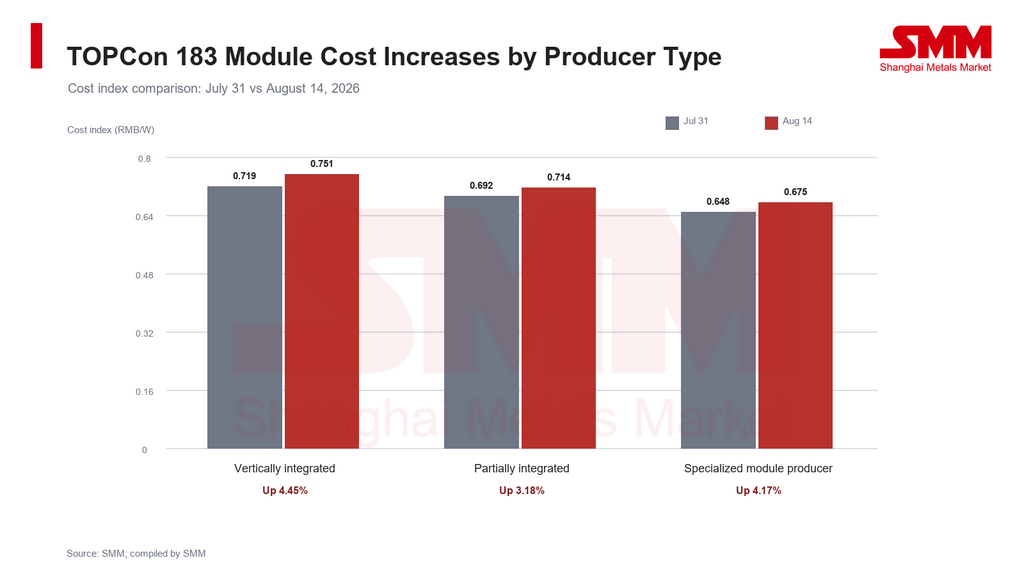
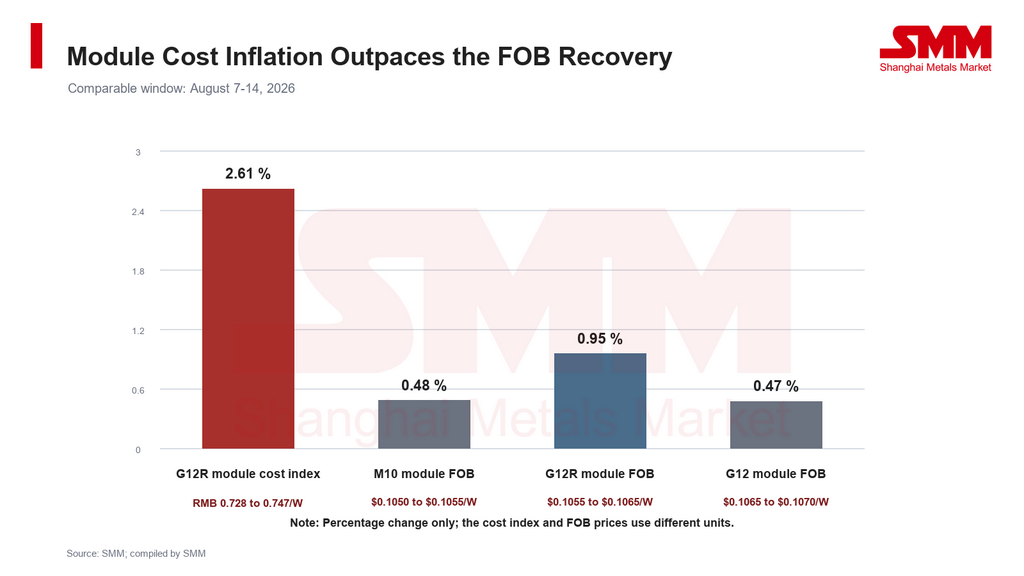
A separate weekly measure showed the same direction. As of August 14, SMM's weekly composite cost index for G12R TOPCon modules stood at approximately $0.1100/W (RMB 0.747/W), up $0.0047/W (RMB 0.032/W), or about 4.5%, from $0.1053/W (RMB 0.715/W) on July 31. The daily model and weekly composite index use different assumptions, cost boundaries and update frequencies, so their absolute levels should not be compared directly.
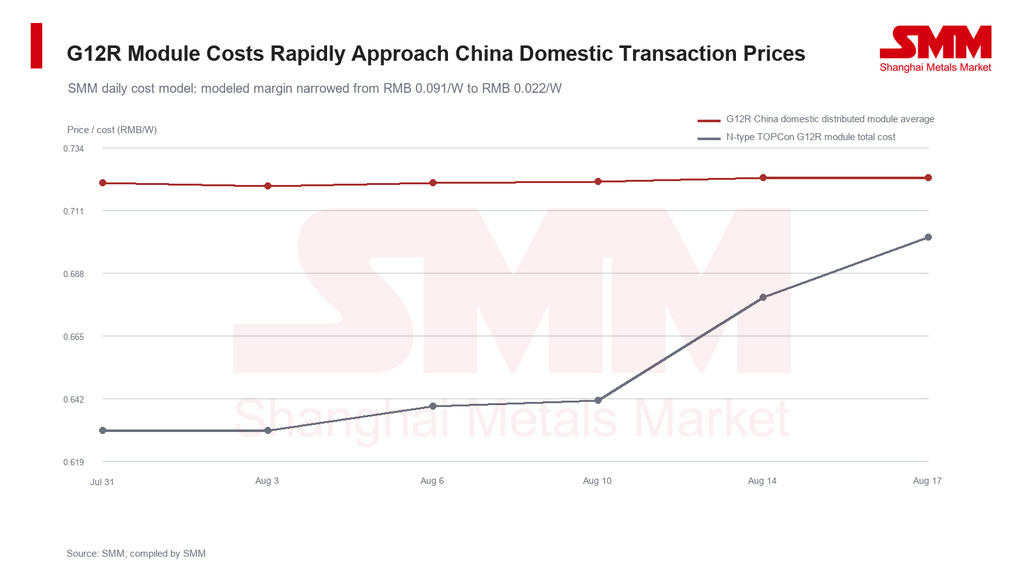
Polysilicon, wafer and cell prices all moved higher, with cells recording the steepest increase. For specialized module producers that purchase cells externally, cell price changes feed into per-watt costs more directly. Vertically integrated producers can temporarily cushion the impact through lower-cost inventories and internal transfer pricing, but they cannot remain insulated from higher spot prices indefinitely.
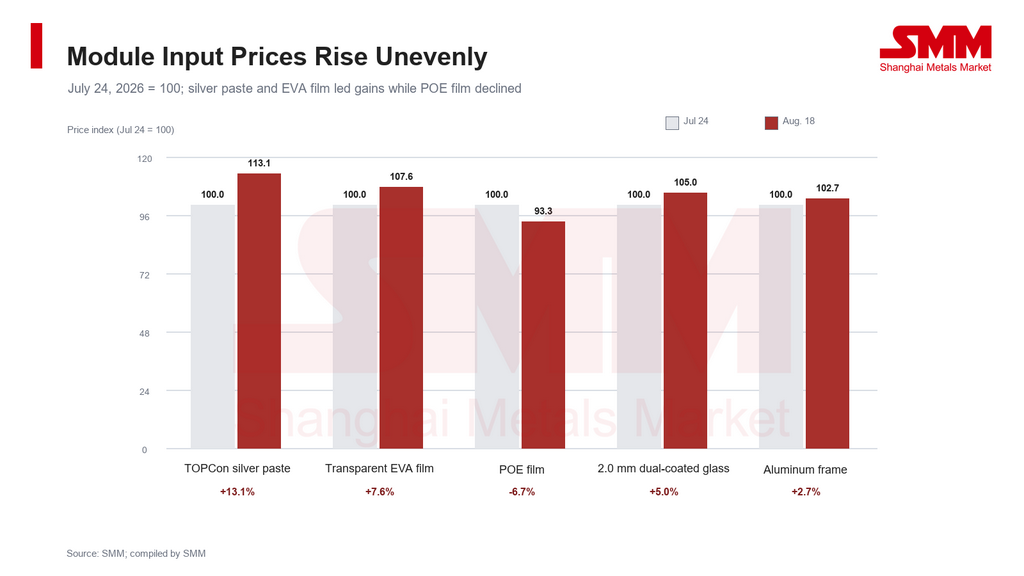
Other inputs also added cost pressure, although the move was uneven. From July 24 to August 18, SMM's assessment for TOPCon rear-side fine-grid silver paste rose 13.1%, to about $2,143/kg (RMB 14,549/kg) from $1,895/kg (RMB 12,867/kg). Transparent EVA film increased 7.6%, to $0.727/m² (RMB 4.94/m²) from $0.676/m² (RMB 4.59/m²).
The price of 2.0 mm dual-coated solar glass rose 5.0%, to $1.55/m² (RMB 10.5/m²) from $1.47/m² (RMB 10.0/m²), while aluminum frames increased 2.7%, to approximately $3,873/mt (RMB 26,300/mt) from $3,770/mt (RMB 25,600/mt). By contrast, 380 g/m² POE film declined by about 6.7%. Silver paste, EVA film, glass and frames therefore added incremental cost, while POE film provided a partial offset.
Export offers have risen, but FOB transactions remain low
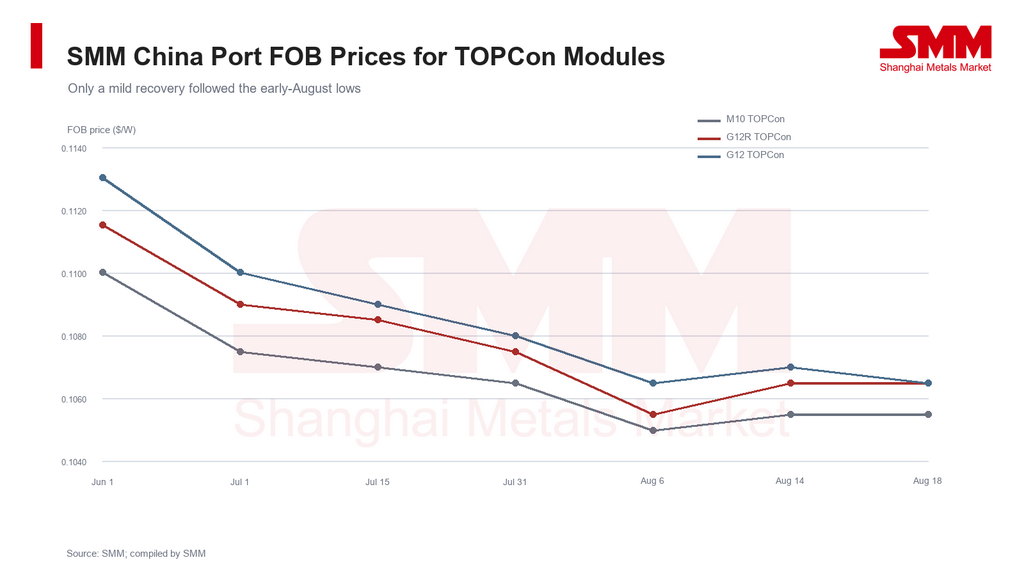
As of August 18, SMM assessed China-port FOB prices for M10, G12R and G12 TOPCon modules at $0.1055/W, $0.1065/W and $0.1065/W, respectively. Compared with their early-August levels, M10 and G12R recovered by only $0.0005/W and $0.0010/W, while G12 was broadly unchanged.
According to SMM research, some suppliers have raised export guidance prices or new offers by approximately $0.003-0.005/W. The increase has not yet been fully reflected in transactions. Guidance prices represent suppliers' cost targets and opening negotiation positions, while FOB assessments depend on the extent to which actual orders accept the increase.
With end-market demand still weak and competition among suppliers intense, buyers can continue to split orders, shorten price-lock periods, switch to second-tier brands, or postpone procurement to press for lower transaction prices.
Why is export price pass-through slower?
Contracts and inventories provide a buffer. Spot and short-term orders can reflect offer changes within one to two weeks, while ordinary projects and framework agreements generally require around two to six weeks for renewed enquiries, approvals and price fixing. If destination-market warehouses hold ample inventory, the transmission cycle can extend to one or two months, or fail to materialize if end demand remains weak.
Destination-market economics set export prices. International projects first assess project returns, financing costs, tariffs, freight and local channel expenses. As long as regional supply remains sufficient, higher manufacturing costs in China do not automatically translate into an FOB increase that buyers will accept.
Suppliers still face shipment, cash-flow and channel-share pressure. For some producers, keeping lines running, generating cash and preserving customer relationships matters more than the margin on an individual order. Even after raising guidance prices, suppliers can still concede value through rebates, payment terms, freight arrangements or product bundles.
Regional demand remains constrained. Southeast Asia and South America are highly price-sensitive markets, where buyers may repeatedly negotiate over changes of just $0.001-0.002/W. Some Middle Eastern shipping routes and project deliveries remain disrupted by geopolitical tensions, while Europe is in its summer holiday period and demand is focused on enquiries, contract signing and small replenishment orders rather than large-volume shipments.
Existing low-priced inventory continues to cap the market. Some distributors still hold stock procured at earlier, lower costs, while second-tier brands and selected specifications can offer additional discounts. New offers are more likely to become mainstream transaction prices only after lower-priced inventories are depleted and suppliers collectively reduce concessions.
Price increases serve more than near-term margin repair
First, higher offers are intended to change buyer expectations. After a prolonged decline, end users increasingly adopted a buy-as-needed strategy while waiting for still lower prices. Higher offers can reinforce the view that the market has reached a floor and encourage some buyers with firm requirements to lock in orders earlier. This behavior changes procurement timing, however; it does not create new installation demand.
Second, suppliers are establishing a higher anchor for subsequent negotiations. Module orders are often signed weeks before delivery, while upstream costs have already risen. Continuing to accept forward orders at old prices could result in larger losses at delivery. Raising guidance prices now creates room to pass through further increases in cell and other major-material costs.
If raw-material prices continue to rise and remain elevated while module transaction prices fail to follow, previously contracted low-priced forward orders could become deeply loss-making. Suppliers may then seek to renegotiate, delay or cancel deliveries, increasing contract-performance and order-cancellation risk.
Third, higher offers allow suppliers to screen out low-priced orders. They can prioritize projects with stronger payment terms and higher delivery certainty, avoid locking capacity into low-margin businesses too early, and preserve supply flexibility for a potential recovery in September demand.
Outlook: offers retain upward momentum, but transactions still need demand
Using SMM's weekly G12R composite module cost index, cost rose by approximately $0.0047/W (RMB 0.032/W) from July 31 to August 14, while the module transaction price increased by only around $0.0003/W (RMB 0.002/W). The implied stage-level cost pass-through was therefore about 6%. These ratios are snapshots rather than fixed long-term transmission coefficients, but they show that module suppliers are still absorbing most of the increase internally.
The next leg of cost inflation is more likely to come from further cell-price pass-through. Current module costs and transaction prices already reflect part of the supply-chain increase, but the earlier rise in module costs was driven more by auxiliary inputs and the initial transmission of upstream material prices. Procurement timing, the consumption of lower-priced inventories and internal settlement lags mean that the recent surge in cell prices has not yet been fully incorporated into current module production costs.
As lower-priced cell inventories are depleted and newly purchased cells enter module production, sustained G12R cell transactions around $0.0501-0.0515/W (RMB 0.34-0.35/W) would push module costs and break-even levels higher. Suppliers would have stronger incentives to raise guidance prices further and reduce acceptance of low-priced orders. The current module uptrend may therefore have further room to run, although the extent of pass-through into China domestic and export transaction prices will still depend on end demand, inventory drawdowns and project procurement schedules.
SMM expects module prices to retain cost support from late August into early September. If polysilicon remains near $5.89/kg (RMB 40/kg) and high-priced cell transactions persist, China-port FOB offers for TOPCon modules serving distributed markets could move back above $0.11/W. Whether that increase is realized will depend on a recovery in international demand and module inventory levels in destination markets; a gradual rise is more likely than a rapid jump.
If the current $0.003-0.005/W increase in export offers were transmitted in full, M10 FOB prices would reach approximately $0.1085-0.1105/W, while G12R and G12 would reach around $0.1095-0.1115/W. With Europe still in its summer holiday period, price-sensitive markets continuing to negotiate aggressively, and Middle Eastern logistics remaining unstable, near-term transactions are more likely to rise first by $0.001-0.003/W. Full realization would require international restocking, concentrated project procurement, or a material reduction in low-priced inventories.
Without stronger international demand, the market may remain characterized by higher offers, low transaction levels and widening brand differentiation. If project procurement recovers in September while high cell prices persist, export transactions could gradually converge toward suppliers' new guidance levels. The current price increase has a genuine cost basis, but the transfer from Chinese suppliers to international end markets will ultimately be determined by orders, not offers.
SMM will continue to monitor upstream price movements, module inventory changes and the pace of cost pass-through into China domestic and export transaction prices.
Exchange rate used: $1 = RMB 6.7905, based on the official central parity rate published for August 18, 2026.
Written by:
Ryan Tey Tze Yang | SMM PV Analyst
+60 127179370 | ryan.tey@metal.com
![Spot Silicon Metal Center Firm, Wafer Prices Maintain Uptrend [SMM Silicon-based PV Morning Notes]](https://imgqn.smm.cn/usercenter/hIbSC20251217171737.jpg)
![[SMM PV Flash] Public Notice on the Selection Results of 2026 Distributed Wind Power and Distributed PV Power Generation Projects in Kangbashi District, Ordos City](https://imgqn.smm.cn/usercenter/WUJtg20251217171743.jpg)