Overview
Most metals are mined in many different countries. Platinum is not. Almost three quarters of the Platinum mined in the world each year comes from one place: a huge, ancient rock formation in the Northern part of South Africa called the Bushveld Complex. The United States Geological Survey estimates that South Africa produced about 120 tonnes of Platinum in 2025, out of a world total of about 170 tonnes. That is roughly seven ounces in every ten.
But South Africa is producing less each year. The same survey estimates that South African output of Platinum group metals fell by about 9 per cent in 2025 compared with 2024, because of falling Palladium prices, the high cost of mining very deep underground and continuing electricity supply problems. The rock has not changed. The mining has become harder.
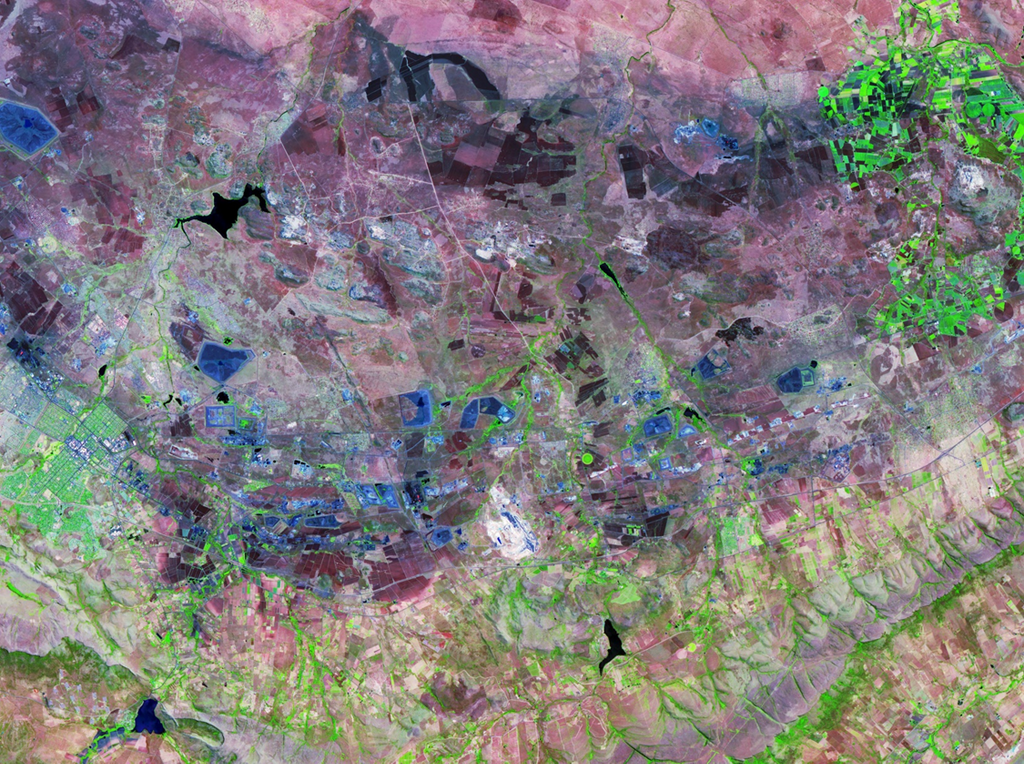
Satellite view of the Bushveld Complex. Credits: NASA/GSFC/METI/ERSDAC/JAROS and U.S./Japan ASTER Science Team
What the Bushveld Complex Is
Scientific research indicates that about two billion years ago, a vast amount of molten rock pushed up from deep inside the Earth and spread out underground. It cooled slowly over millions of years. As it cooled, different minerals turned solid at different temperatures. Heavier ones sank. Lighter ones stayed higher up. The result is a giant stack of layers which Geologists called layered intrusion, which simply means molten rock that pushed in between other rocks and then cooled in layers. The Bushveld Complex is the largest layered intrusion on Earth. It covers about 66,000 square kilometres, slightly smaller than the island of Ireland and in places the layers are around eight kilometres thick.
The layered part has a name, the Rustenburg Layered Suite. Geologists divide it into five zones. From the bottom up they are the Marginal, Lower, Critical, Main and Upper zones. Two of those zones matter for money. The Critical Zone holds the layers rich in chrome and the Platinum metals. The Upper Zone holds layers of iron ore that also contain vanadium, a metal used to make steel stronger.
The surface rock has worn away over time, so the layers now show at the surface in three curved bands called limbs. A limb is just an arm or branch of the formation. The three are the Western Limb, the Eastern Limb and the Northern Limb. Some geologists also describe a southern limb, but it is mostly buried and is not mined, so this article uses the three-limb description.
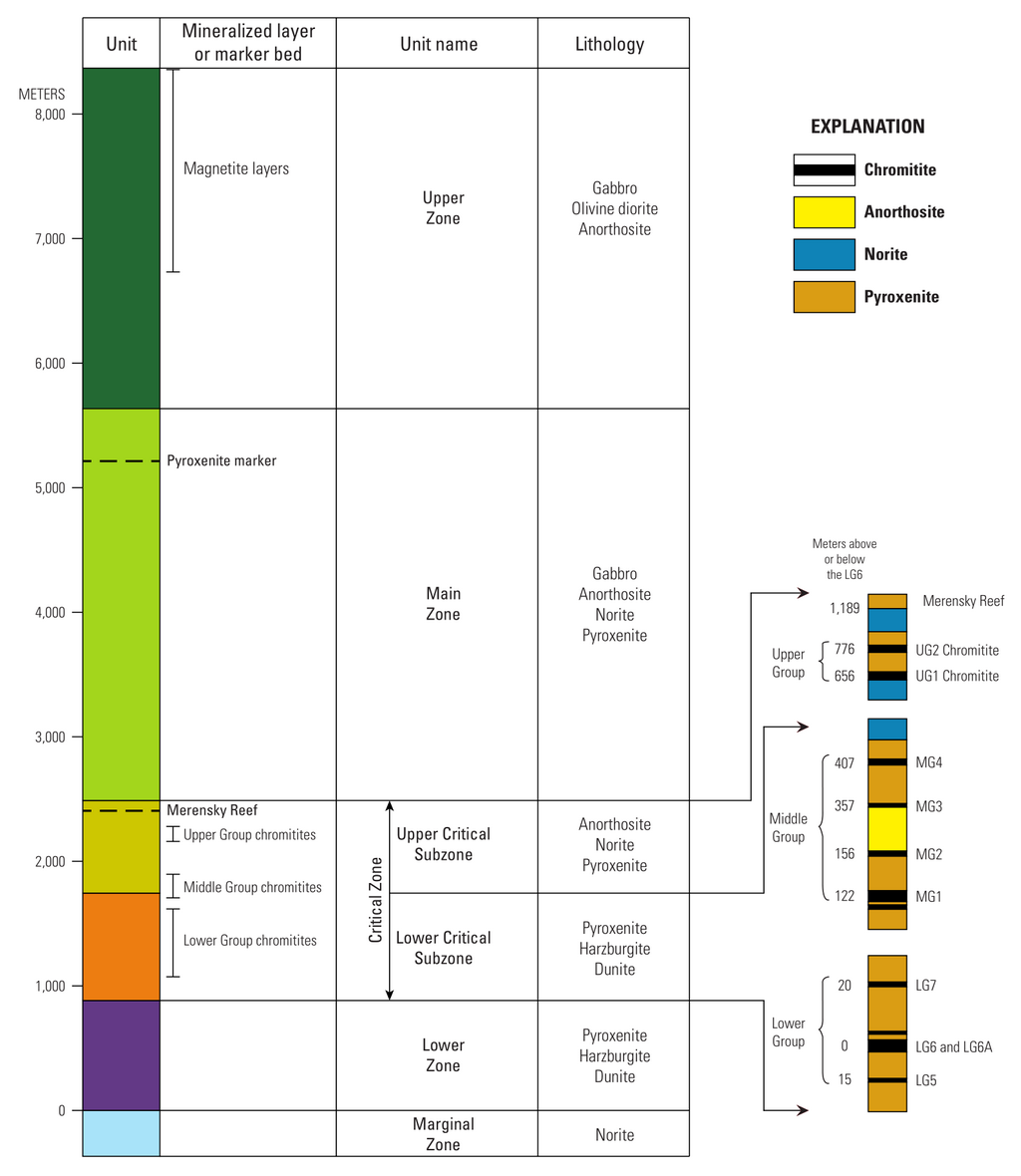
Primary stratigraphic units of the Bushveld Igneous Complex. Credits: Michael L. Zientek, J. Douglas Causey, Heather L. Parks and Robert J. Miller, USGS
What Is Mined and How It Is Reported
Six metals make up the Platinum group metals, usually shortened to PGMs. They are Platinum, Palladium, Rhodium, Ruthenium, Iridium and Osmium. They sit next to each other on the periodic table, behave in similar ways and are almost always found together in the same rock. Gold is not a PGM, but it is found alongside them in the Bushveld and is recovered at the same time.
The Bushveld also produces other things. Nickel, Copper and Cobalt come out with the Platinum metals as by-products, meaning useful materials recovered alongside the main product. Chrome comes from separate layers and also from one of the Platinum layers. Vanadium, Titanium and Iron come from the Upper Zone. Because different layers hold different metals, a single mine can earn money from more than one product.
How the numbers are written down. Mining companies rarely report each metal on its own. They add several together into a single figure called a basket and label it with a short code:
- 3E means Platinum, Palladium and Gold added together
- 4E means Platinum, Palladium, Rhodium and Gold added together
- 6E means Platinum, Palladium, Rhodium, Ruthenium, Iridium and Gold added together
Osmium appears in none of them. It is generally excluded from standard PGM reporting because it is used only in a few niche applications and is produced and marketed in very small quantities. The African Development Bank makes the same point, noting that Osmium, the sixth PGM, is not included in most statistics because of its limited use in niche applications.
This matters when reading any figure. A mine reporting "500,000 ounces of 4E" is not reporting 500,000 ounces of Platinum. It is reporting four metals combined. Comparing a 4E number with a Platinum-only number will overstate the Platinum by a wide margin.
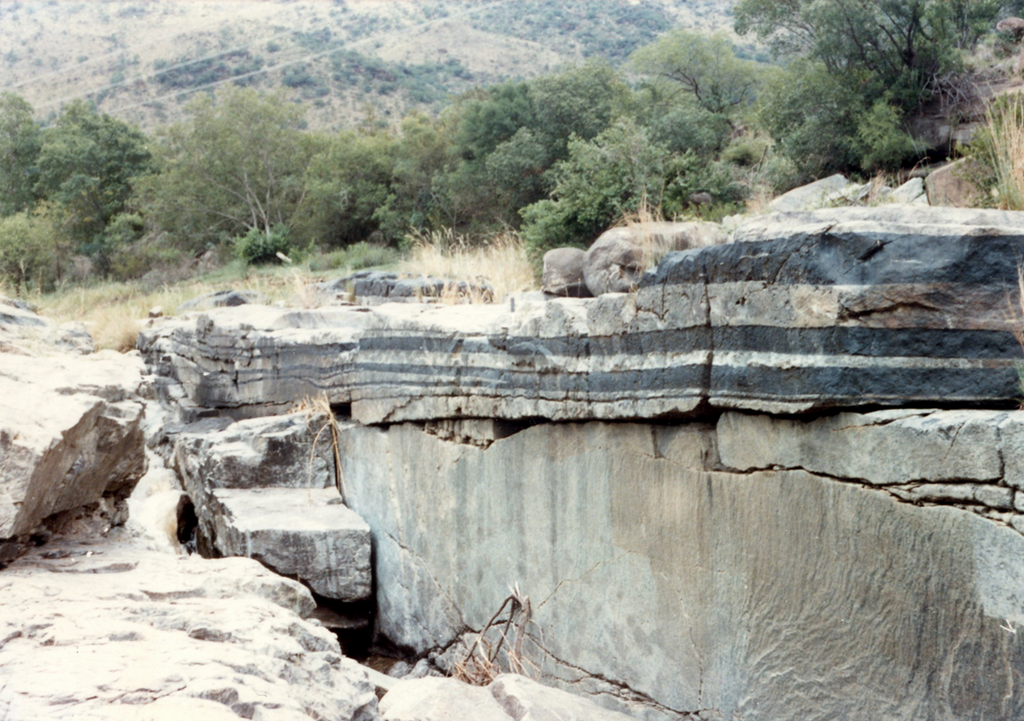
Chromitite (black) and anorthosite (light grey) layered igneous rocks in the UG1 critical zone of the Bushveld igneous complex on the Mononono River outcrop near Steelpoort. Credits: Kevinzim/ Kevin Walsh
Limbs, Reefs and Mineralised Zones
A reef in Bushveld mining is not like a coral reef. It is a thin, flat layer of rock that runs for tens of kilometres and holds the valuable metal. Three reefs matter.
|
Merensky Reef |
UG2 Reef |
Platreef |
|
|
Where |
Western and Eastern limbs |
Western and Eastern limbs |
Northern Limb only |
|
How thick is the part mined |
Around one metre |
Around one metre |
Five to ninety metres |
|
Roughly how rich |
About 3 to 8 grams of metal per tonne of rock |
About 6 to 8 grams per tonne |
Lower and much more variable |
|
How it is mined |
Deep underground, often by hand-held drills |
Deep underground, some mechanised |
Open pit and, increasingly, underground |
|
What else comes out |
Copper, nickel, cobalt, gold |
Chrome, small amounts of copper and nickel |
Nickel, copper, gold |
The Merensky Reef was found first, in the 1920s and supplied most early production. The UG2 Reef sits below it and was left alone for decades because its high chrome content damaged the furnaces used to melt the ore. Once that was solved in the 1970s and 1980s, the UG2 took over. The consultancy SFA (Oxford) reports that the UG2 now supplies over two thirds of South Africa's primary Platinum, with the Merensky Reef providing around 20 per cent.
The UG2 also carries chrome, which has become a real second income stream rather than a nuisance. Sibanye-Stillwater produced around 2.3 million tonnes of chrome in 2025, roughly a tenth of South Africa's output and has said it sees room to raise that towards 4 million tonnes a year.
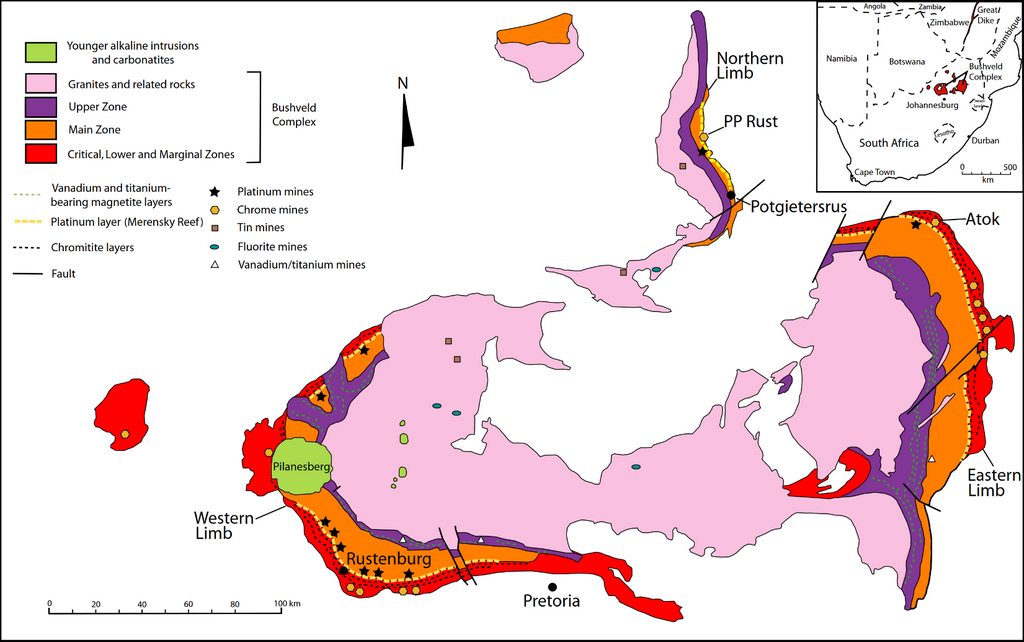
Geological map of the Bushveld complex and mine locations. Credits: Wikipedia
Major Mining Areas and Operators
Ownership in the Bushveld has changed a great deal in recent years, so the names below are current as at August 2026.
Western Limb, around Rustenburg, Brits and Thabazimbi. This is the oldest and busiest mining area, working both the Merensky and UG2 reefs. The main operators are:
- Implats (Impala Platinum), which runs Impala Rustenburg and Impala Bafokeng. Impala Bafokeng was formerly Royal Bafokeng Platinum, which Implats bought and renamed after delisting it in September 2023.
- Sibanye-Stillwater, which runs the Rustenburg and Marikana operations. Rustenburg absorbed the assets of the neighbouring Kroondal mine in January 2025, so Kroondal is no longer counted separately.
- Valterra Platinum, which runs Amandelbult. Valterra is the former Anglo-American Platinum. It was renamed and demerged from Anglo American, with the demerger taking effect on 31 May 2025.
- Northam Platinum, which runs Zondereinde and Eland.
Eastern Limb, around Steelpoort and Burgersfort. A newer area, largely UG2. SMM's asset mapping identifies five active operations here: Two Rivers (ARM and Implats), Modikwa (ARM and Valterra Platinum), Marula (Implats), Mototolo (Valterra) and Booysendal (Northam Platinum).
Northern Limb, around Mokopane. This is the growth area, working the Platreef. It holds the largest single operation, Valterra's Mogalakwena and the newest, Ivanhoe Mines' Platreef. Platreef is owned through a company called Ivanplats, in which Ivanhoe Mines holds 64 per cent, local black economic empowerment partners hold 26 per cent and a Japanese consortium of ITOCHU, JOGMEC and Japan Gas holds 10 per cent.
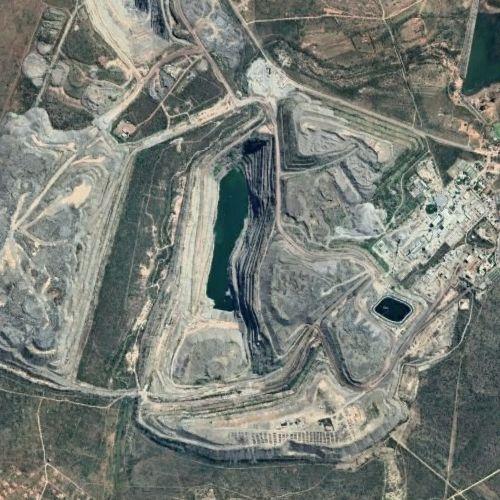
Mogalakwena Mine. Source: https://virtualglobetrotting.com/map/mogalakwena-mine/
Economic Relevance
Two different numbers get confused here, so it is worth separating them clearly. Reserves are the metal still in the ground. The United States Geological Survey estimates South Africa holds about 63 million kilogrammes of PGM reserves out of a world total of more than 76 million kilogrammes and states that the largest resources and reserves are in the Bushveld Complex. That is over four fifths of the world's known reserves.
Production is the metal actually mined each year and the picture differs by metal. For Platinum in 2025, South Africa produced an estimated 120 tonnes against a world total of about 170 tonnes. For Palladium, Russia produced an estimated 84 tonnes and South Africa 70 tonnes, out of a world total of about 190 tonnes. So, South Africa leads the world in Platinum by a wide margin, while Russia leads in Palladium.
For South Africa itself, the sector is a major employer. Minerals Council South Africa reports that mining directly employed around 469,765 people. The government's Critical Minerals and Metals Strategy identifies PGMs as the leading mining sector for employment, at around 40 per cent of the total. That makes the Platinum belt towns of Rustenburg, Brits, Mokopane and Steelpoort heavily dependent on a single industry.
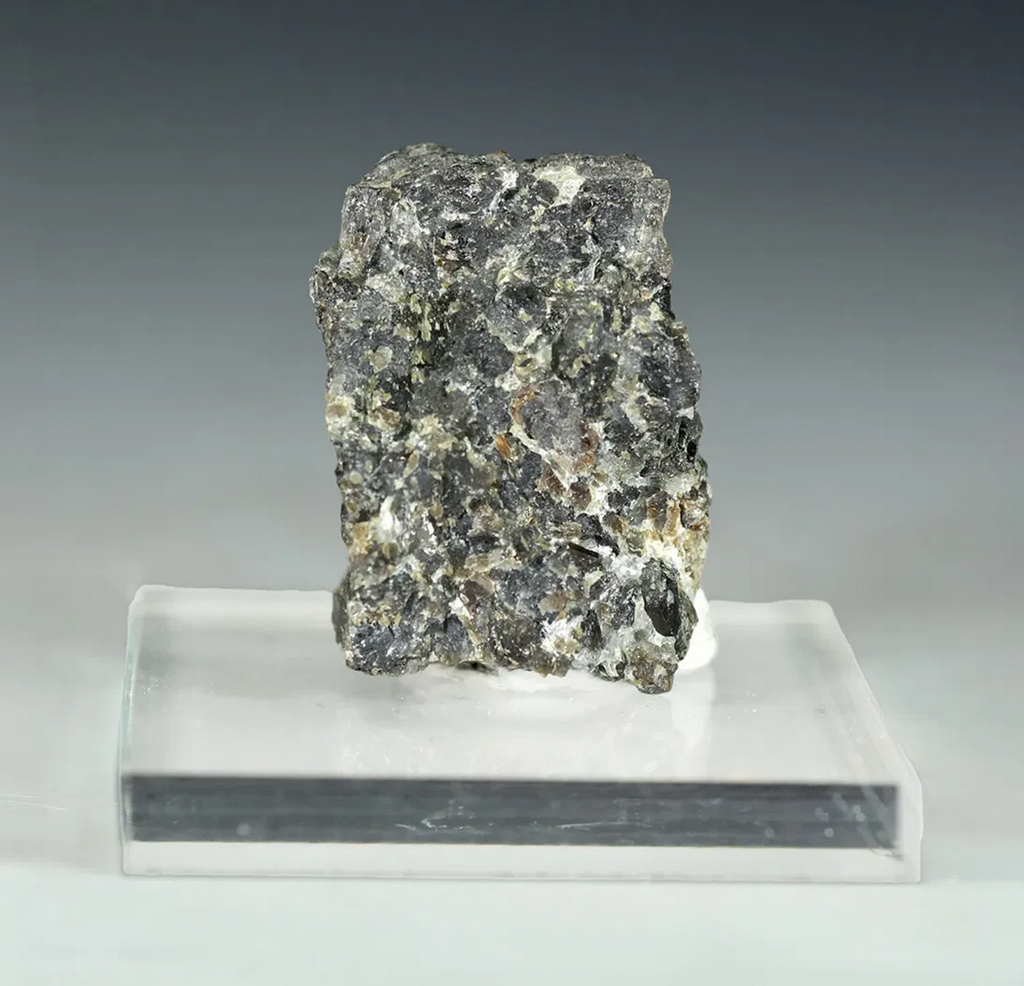
Platinum Ore from the Bushveld. Source: sciencemall-usa
Future Mine Supply and Outlook
The demand picture is tight. The World Platinum Investment Council forecasts that the Platinum market will be short of metal for a fourth year running in 2026, by 297,000 ounces and expects total supply to rise by 2 per cent to 7,377,000 ounces mainly through recycling. Mine output is expected to stay flat, because company guidance collectively points to stable production despite several years of high prices. High prices normally bring more supply. In the Bushveld they have not, for four reasons.
Depth. Zondereinde is the deepest PGM mine in the world, working at around 2,300 metres. Deep rock is hot, unstable and expensive to reach.
Cost and capital. Companies cut spending hard during the price slump of 2024 and have been slow to restart it.
Electricity and water. The USGS names electricity supply disruption directly as a cause of falling South African output.
Time. A new shaft takes many years. Northam's Zondereinde Western extension shows the scale involved. Its No. 3 Shaft opened in July 2026, reaching 1,382 metres vertically and forms part of a project that extends the mine's life by 40 years and opens access to more than 20 million ounces of PGMs in the Merensky and UG2 reefs.
Against that, three things could add supply. The Northern Limb is growing, because the thick Platreef suits machines in a way the thin reefs never will. Ivanhoe's Platreef produced its first concentrate on 18 November 2025 and a second phase targeted for completion in the last quarter of 2027 would lift output to around 450,000 ounces of Platinum, Palladium, Rhodium and gold. Recycling is growing faster than mining. And chrome recovery from UG2 waste is turning old tailings into revenue. The conclusion is simple. South Africa is unlikely to face a geological shortage of Platinum in the current century. Whether it can maintain production at today's levels depends much more on capital, electricity, mining costs and engineering than on the availability of Platinum-bearing rock.
![Precious Metals Remain Range-Bound as Macro Enters Key Validation Window [SMM Precious Metals Macro Analysis]](https://imgqn.smm.cn/usercenter/yhuhG20251217171735.jpg)