El Niño Risk Exposes Zambia’s Hydropower Dependence as Copper Expansion Raises Power Demand

Published: Aug 18, 2026 14:56

Zambia’s exposure to El Niño-related rainfall weakness is emerging as a renewed risk to the country’s copper-growth ambitions, with hydropower still accounting for the majority of installed electricity capacity while planned mine expansions are expected to require significantly more power.​

The risk had already been flagged domestically in June, when Zambia’s Ministry of Green Economy and Environment highlighted forecasts for a new 2026–27 El Niño season and warned of the potential for drought, water shortages, reduced crop yields and other climate-related challenges. More recent international forecasts have since strengthened the outlook for a significant El Niño event during late 2026 and early 2027.​

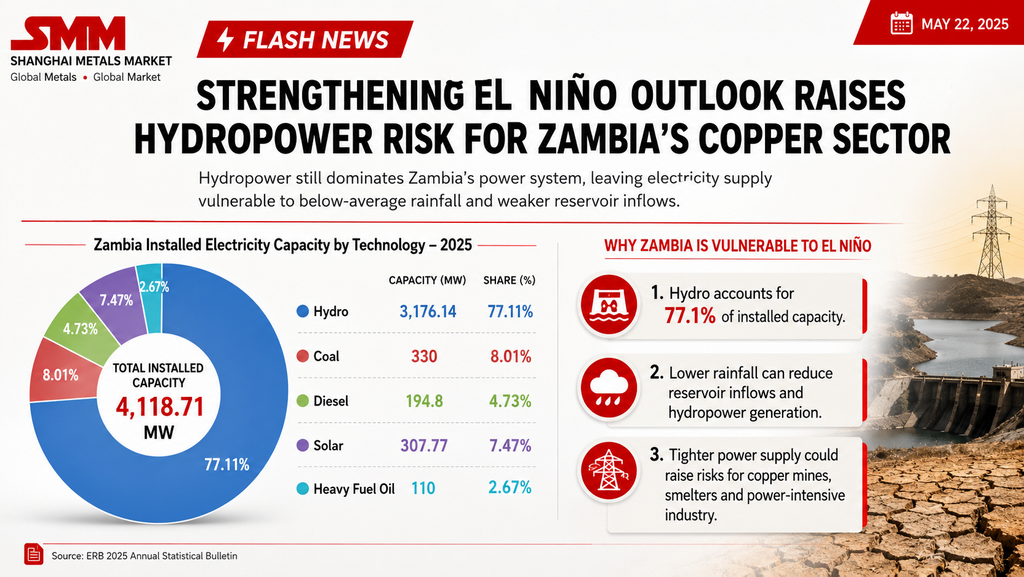
According to the Energy Regulation Board’s 2025 Annual Statistical Bulletin, Zambia had 4,118.71 MW of installed electricity generation capacity at the end of 2025. Hydropower accounted for 3,176.14 MW, or 77.11% of total capacity, followed by coal at 8.01%, solar at 7.47%, diesel at 4.73% and heavy fuel oil at 2.67%. This generation mix leaves electricity availability particularly sensitive to rainfall patterns and reservoir inflows.​

The exposure is significant because Zambia’s copper-growth strategy will require substantially more electricity. The country is targeting annual copper production of 3 million tonnes by 2031, supported by mine expansions, new developments and additional processing capacity. Industry estimates indicate that approximately 2,000 MW of additional power capacity will be required to support the expansion of the mining sector and associated industrial demand.​

El Niño therefore presents a potential constraint on both sides of Zambia’s copper-growth equation. While mining investment is increasing future electricity demand, prolonged rainfall weakness could simultaneously restrict output from the hydropower system that currently supplies more than three-quarters of installed generation capacity.​

The experience of the 2023–24 drought illustrates this vulnerability. Weak rainfall and lower reservoir inflows sharply reduced hydroelectric generation, contributing to severe electricity shortages and increased reliance on imports and load-management measures. A repeat of similar conditions during the 2026–27 rainy season could again tighten the power balance as mining demand continues to rise.​

The key issue for Zambia is therefore not simply expanding installed capacity, but increasing the resilience of the electricity system. Continued investment in solar, thermal generation, regional power imports, transmission infrastructure and other non-hydro sources will be increasingly important if the country is to insulate copper production growth from rainfall variability.​

For the copper market, the strengthening El Niño outlook adds a potentially important supply-side risk to Zambia’s medium-term production ambitions. With hydropower still representing 77.1% of installed capacity and the mining sector requiring roughly 2,000 MW of additional power, the ability to diversify electricity supply could become a critical determinant of whether Zambia can translate its expanding project pipeline into the targeted 3 million tonnes of annual copper production.

Data Source Statement: Except for publicly available information, all other data are processed by SMM based on publicly available information, market communication, and relying on SMM's internal database model. They are for reference only and do not constitute decision-making recommendations.

For any inquiries or for more information, please contact: lemonzhao@smm.cn
For more information on how to access our research reports, please contact:service.en@smm.cn
Related News
Copper Price Correction Boosts Downstream Orders, Enameled Wire Production Rises Ahead of Holidays
37 mins ago
Copper Price Correction Boosts Downstream Orders, Enameled Wire Production Rises Ahead of Holidays
Read More
Copper Price Correction Boosts Downstream Orders, Enameled Wire Production Rises Ahead of Holidays
The recent copper price correction has driven concentrated release of downstream orders. With the Mid-Autumn Festival and National Day holidays approaching, enameled wire enterprises have launched pre-stocking, boosting production enthusiasm. The industry operating rate is expected to maintain an upward trend. Next week, focus on copper price fluctuations and the pace of downstream pre-holiday stocking.
37 mins ago
Copper Price Pullback Sparks Concentrated Order Release, New Weekly Orders Rise Markedly
43 mins ago
Copper Price Pullback Sparks Concentrated Order Release, New Weekly Orders Rise Markedly
Read More
Copper Price Pullback Sparks Concentrated Order Release, New Weekly Orders Rise Markedly
This week (Sep 11–17), the operating rate of the enameled wire industry rose by 5.2 percentage points month-on-month, exceeding expectations. Copper prices drifted lower starting last Friday, releasing pent-up downstream rigid demand previously suppressed by high copper prices. New orders jumped 16.67 percentage points from the prior week.
43 mins ago
KCM Signs US$498 Million Contract for Copper Tailings Recovery Plant, Adding 70,000 t/y of Copper Capacity
43 mins ago
KCM Signs US$498 Million Contract for Copper Tailings Recovery Plant, Adding 70,000 t/y of Copper Capacity
Read More
KCM Signs US$498 Million Contract for Copper Tailings Recovery Plant, Adding 70,000 t/y of Copper Capacity
Konkola Copper Mines (KCM) has signed a US$498 million EPC contract with China Nerin Engineering for a new Tailings Leach Plant in Chingola, Zambia. The facility will use hydrometallurgical leaching technology to recover copper from existing mine tailings and is designed to add approximately 70,000 tonnes of copper production per year. KCM says it will become Africa's largest facility of its kind once completed. China NERIN will undertake engineering, procurement, construction and installation, as well as provide commissioning, performance-testing and workforce-training support. The new plant will operate alongside KCM's existing tailings-processing facilities at Nchanga and forms part of Vedanta's broader investment programme to increase KCM's copper production toward approximately 300,000 t/y.
43 mins ago