Glencore’s copper production from its Democratic Republic of Congo operations increased sharply in the first half of 2026, while cobalt output fell significantly as the country’s export quota regime influenced operating priorities across its Congolese assets.
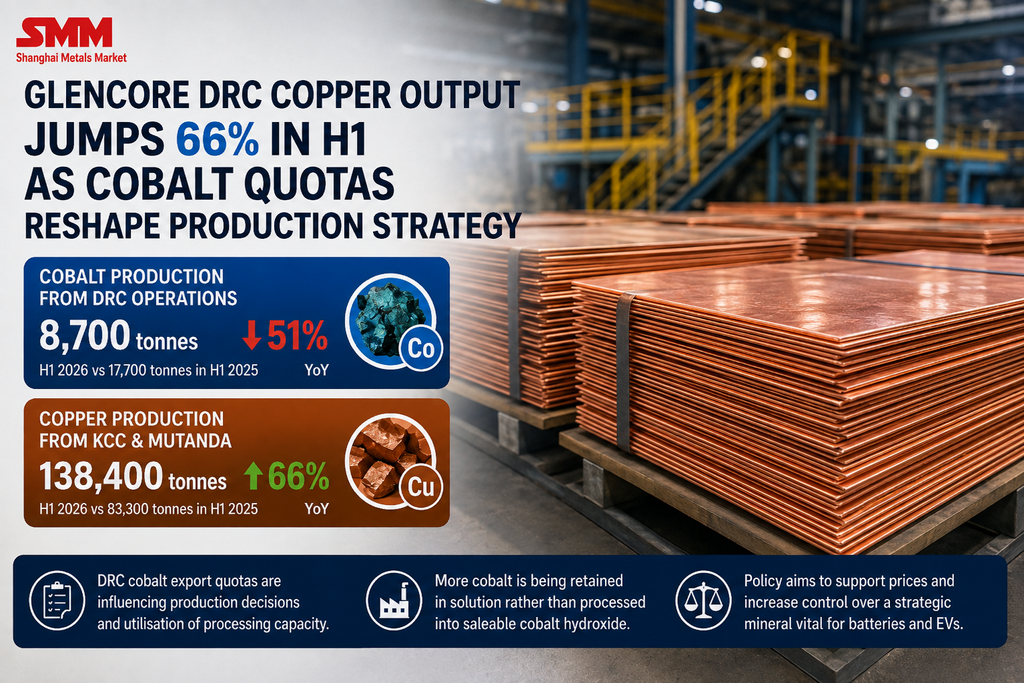
Copper production from Kamoto Copper Company (KCC) and Mutanda Mining reached 138,400 tonnes in H1 2026, up 66% year on year. Over the same period, cobalt production from Glencore’s DRC operations fell to 8,700 tonnes, down 51% from 17,700 tonnes in the first half of 2025.
The contrasting production trends reflect the impact of the DRC’s cobalt export quota system on how mixed copper-cobalt ore is processed. With cobalt exports restricted, Glencore has retained more cobalt in solution rather than processing and drying it into saleable cobalt hydroxide, while copper production has taken on greater importance within the operating mix.
The DRC introduced cobalt export quotas in an effort to address oversupply, support market prices and strengthen control over a mineral in which the country holds a dominant global position. Glencore has previously indicated that its combined cobalt export allocation for 2026, including volumes carried over from 2025, stands at around 22,800 tonnes.
The policy is therefore having effects beyond cobalt exports alone. By influencing processing decisions and the utilisation of available capacity, the quota regime is also reshaping the production balance between cobalt and copper at major Congolese operations.
From a copper-market perspective, the 66% increase in Glencore’s DRC copper output highlights the growing importance of copper within the company’s Congolese portfolio as it adapts to a more restrictive cobalt environment. The development also illustrates how mineral-specific regulation in the DRC can have spillover effects on the production profile of associated metals.