SMM News on August 15:
Metals market:
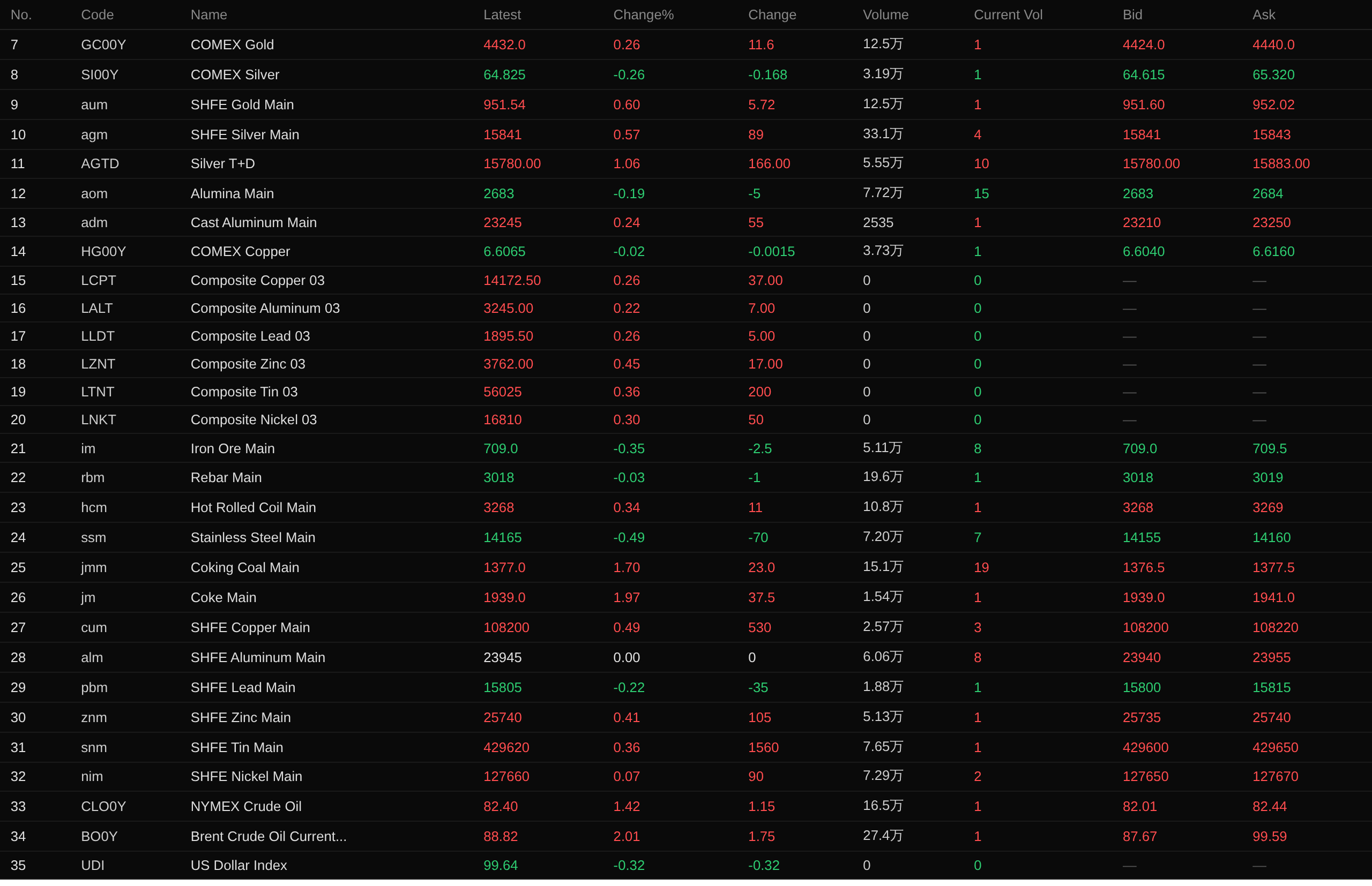
Overnight, domestic base metals generally rose. SHFE copper gained 0.49%; on a weekly basis, SHFE copper fell 0.31% for the week. SHFE aluminum was flat at 23,945 yuan/mt. SHFE lead slipped 0.22%, SHFE zinc rose 0.41%, and SHFE tin increased 0.36%. SHFE nickel edged up 0.07%. In addition, the most-traded alumina futures contract fell 0.19%, while the most-traded casting aluminum contract rose 0.24%.
Overnight, ferrous metals showed mixed performance. Stainless steel fell 0.49%, iron ore declined 0.35%, and rebar dipped 0.03%. Hot-rolled coil rose 0.34%. For coking coal and coke: the most-traded coking coal contract rose 1.7%, and the most-traded coke contract gained 1.97%.
Overnight, overseas metals: LME base metals all rose. LME copper increased 0.26%; on a weekly basis, LME copper extended gains for seven consecutive weeks, up 1.07% for the week. LME aluminum rose 0.22%. LME lead gained 0.26%. LME zinc climbed 0.45%. LME tin rose 0.36%. LME nickel increased 0.3%.
Overnight, precious metals : COMEX gold rose 0.26%; COMEX gold posted a fourth consecutive weekly gain, up 0.73% for the week. COMEX silver fell 0.26%; COMEX silver recorded a second consecutive weekly gain, up 2.09% for the week. Overnight, the most-traded SHFE gold contract rose 0.6%; SHFE gold posted a fourth consecutive weekly gain, up 1.68% for the week. The most-traded SHFE silver contract rose 0.57%; SHFE silver extended gains for four consecutive weeks, up 3.45% for the week.
As of 7:17 on August 15, overnight closing prices:
Macro front
China:
[PBOC: Aggregate Social Financing Growth Totaled 22.25 trillion yuan in the First Seven Months; M2 up 7.7% YoY in July] According to preliminary statistics from the PBOC, in the first seven months of 2026, the cumulative growth in aggregate social financing totaled 22.25 trillion yuan, down 174 billion yuan from the same period last year. Among them, RMB loans issued to the real economy increased by 10.17 trillion yuan, 214 billion yuan less than the same period last year; foreign-currency loans issued to the real economy, converted into RMB, increased by 169.4 billion yuan, 241.9 billion yuan more than the same period last year; entrusted loans decreased by 81 billion yuan, 12.1 billion yuan more than the same period last year; trust loans decreased by 67.2 billion yuan, 226.4 billion yuan more than the same period last year; undiscounted bankers’ acceptances decreased by 178.6 billion yuan, 41 billion yuan less than the same period last year; net financing of enterprise bonds was 252 billion yuan, 110 billion yuan more than the same period last year; net financing of government bonds was 776 billion yuan, 115 billion yuan less than the same period last year; and domestic equity financing by non-financial enterprises was 406.1 billion yuan, 184.7 billion yuan more than the same period last year. In the first seven months, RMB loans increased by 1.038 trillion yuan. By sector, household loans decreased by 827.1 billion yuan, including a decrease of 928.1 billion yuan in short-term loans and an increase of 101 billion yuan in medium and long-term loans; loans to enterprises and public institutions increased by 1.1 trillion yuan, including an increase of 434 billion yuan in short-term loans, an increase of 532 billion yuan in medium and long-term loans, and an increase of 119 billion yuan in bill financing; loans to non-bank financial institutions decreased by 394.4 billion yuan. At end-July, the balance of broad money (M2) stood at 35.551 trillion yuan, up 7.7% YoY. The balance of narrow money (M1) stood at 11.546 trillion yuan, up 4% YoY. The balance of currency in circulation (M0) stood at 1.482 trillion yuan, up 11.6% YoY. Net cash injection in the first seven months totaled 725.5 billion yuan.
[Shanghai: Promoting the Momentum Build-Up of Leading Industries Such as Integrated Circuits, Civil Aviation, Intelligent Vehicles, and High-End Equipment] Today (August 14), Shanghai Party Secretary Chen Jining spent the entire day conducting a survey in the Lin-gang Special Area of the China (Shanghai) Pilot Free Trade Zone and chaired a symposium. Chen Jining noted that the Lin-gang Special Area must always place advanced manufacturing in a prominent position and unswervingly enhance its capacity level and core competitiveness. Seizing opportunities in digital-intelligent and green transformation, while ensuring project implementation, it should place greater emphasis on fostering an industrial ecosystem, cultivating industry leaders and high-growth enterprises, developing industrial platforms and enhancing service capabilities, strengthening the resilience and stickiness of industrial development, and promoting the momentum build-up of leading industries such as integrated circuits, civil aviation, intelligent vehicles, and high-end equipment. Leveraging the advantage of abundant manufacturing scenarios, it should advance the digital-intelligent transformation of industry by increasing the application of industrial robots, vertical models, and intelligent agents in key links such as production and manufacturing and equipment operation and maintenance, thereby driving systematic transformation across the full process, including industrial design, pilot-scale validation, inspection and detection, and marketing and operations. It should optimize the business environment and improve services for enterprises, and accelerate the cultivation of world-class enterprises. It should deepen reforms of management systems in development zones and refine and improve reform plans around key links such as functional positioning, spatial integration, professional services, and assessment and evaluation. (Shanghai Release)
US dollar:
Overnight, the US dollar index fell 0.32% to 99.64. Weekly: the US dollar index rose on a weekly basis, up 0.04% for the week.
US retail sales for July released on Friday fell 0.6% MoM, the biggest drop in more than a year. Combined with this week’s mild inflation data, market pricing for a US Fed rate hike in September further collapsed. The US dollar index declined. With mild CPI on Wednesday, PPI at zero growth MoM on Thursday, and a downside surprise in retail sales on Friday, the three-hit combination drove the probability of a September rate hike down from 75% at end-July to around 25%. CME FedWatch showed that 67% of traders bet on no change in September. The focus of market pricing has shifted from “how many more rate hikes” to “whether this rate-hike cycle has already ended.” (Wallstreetcn)
The US Department of Commerce announced on Friday that July retail sales fell 0.6% MoM, the biggest decline in more than a year, versus market expectations of a slight increase. Core control group sales excluding autos, building materials, and gas stations fell 0.4%, the weakest performance since January 2025. The preliminary University of Michigan consumer sentiment index for August released the same day came in at just 51, well below the expected 54.5. (Wallstreetcn)
As households grew concerned about worsening business conditions and rising inflation, US consumer sentiment fell for the first time in three months. According to survey data released by the University of Michigan on Friday, the preliminary August consumer sentiment index dropped to 51, below the final July reading of 55.2. The median economist forecast was 55. Consumers expect prices to rise 4.3% over the next year, edging up MoM and well above the level before the Iran conflict broke out in February. They also expect prices to rise at an annual rate of 3.3% over the next five to 10 years. After improving for two consecutive months, consumers’ confidence in both the short-term and long-term economic outlook deteriorated. Since the start of the year, consumers’ expectations for the labour market have changed relatively little. The survey showed consumers are increasingly worried about inflation, while concerns about unemployment have eased. The survey covered responses collected from July 28 to August 10. During this period, the US national average gasoline price hovered above $4 per gallon. Another report released on Friday showed US retail sales in July posted the biggest drop in more than a year, as consumers cut back on purchases of autos and from online stores. (Jinshi Data APP)
US Fed’s Goolsbee said he supported the decision to keep interest rates unchanged in July. He noted that the latest two productivity readings were not ideal, and if productivity continues to weaken, the US Fed may need to reassess market expectations for artificial intelligence (AI). Goolsbee said the latest CPI data were encouraging, but more data are needed before making a judgment; persistent weakness in consumption is concerning, though the current retail sales weakness is only a one-month performance. Meanwhile, US GDP and the labour market were basically stable overall. (From the Wallstreetcn APP)
According to CME “FedWatch”: the probability that the US Fed will keep rates unchanged through September is 67.5%, and the probability of a cumulative 25-bp hike is 32.5%. The probability that the US Fed will keep rates unchanged through October is 53.3%, the probability of a cumulative 25-bp hike is 39.8%, and the probability of a cumulative 50-bp hike is 6.8%. (Jin10 Data APP)
On the macro front:
Next week will see the release of data including China’s July total retail sales (YoY), China’s July industrial value-added above designated size (YoY), Canada’s July CPI (MoM), the US August New York Fed Manufacturing Index, the US August NAHB Housing Market Index, the UK three-month ILO unemployment rate for June, the UK July unemployment rate, the UK July claimant count, Germany’s August ZEW Economic Sentiment Index, the eurozone’s August ZEW Economic Sentiment Index, the weekly change in US ADP employment for the week ending August 1, US July housing starts (annualized), US July building permits, US July import price index (MoM), US July industrial production (MoM), US July pending home sales index (MoM), the UK July CPI (MoM), the UK July retail price index (MoM), the eurozone’s June current account (seasonally adjusted), the eurozone’s final July CPI (YoY), the eurozone’s final July CPI (MoM), the share of RMB payments via Swift in global payments for China in July, China’s one-year loan prime rate through August 20, Australia’s July unemployment rate (seasonally adjusted), Germany’s July PPI (MoM), Switzerland’s July trade balance, the UK August CBI industrial trends orders balance, US initial jobless claims for the week ending August 15, the US August Philadelphia Fed Manufacturing Index, the US July Conference Board Leading Index (MoM), the UK August GfK Consumer Confidence Index, Japan’s July core CPI (YoY), the UK July public sector net borrowing, the UK July retail sales (MoM, seasonally adjusted), France’s preliminary August manufacturing PMI, Germany’s preliminary August manufacturing PMI, the eurozone’s preliminary August manufacturing PMI, the UK preliminary August manufacturing PMI, the UK preliminary August services PMI, Canada’s June retail sales (MoM), the US S&P Global preliminary August manufacturing PMI, the preliminary global services PMI, and the eurozone’s preliminary August consumer confidence index, among others.
In addition, next week’s key events include: the National Bureau of Statistics (NBS) releasing the monthly report on residential selling prices in 70 large and medium-sized cities; the State Council Information Office holding a press conference on national economic performance; ECB President Lagarde attending the “Global Economic Outlook” session at the World Economic Forum International Business Council (IBC) meeting; the US Fed releasing the minutes of its monetary policy meeting; and Hang Seng Indexes Company announcing the review results for the Hang Seng Index Series for 2026 Q2.
On crude oil:
Overnight, both oil futures rose, with WTI up 1.42% and Brent up 2.01%. On a weekly basis, WTI futures rose 5.4% for the week; Brent posted a positive weekly close, up 6.31% for the week.
International oil prices rose, driven by an almost complete standstill in traffic through the Strait of Hormuz. Two vessels were attacked in the Strait of Hormuz that day, bringing passage to a near standstill. The US said it could maintain its maritime blockade of Iran indefinitely, and Trump also said he would impose severe economic blows on Iran. Capital Economics estimated that crude oil flows through the Strait of Hormuz were currently only about 4 million to 5 million barrels per day, far below pre-conflict levels. Prompt Brent maintained a spot premiums structure, indicating continued tight physical supply. Capacity at three of the world’s four major refining hubs was damaged, and the surge in refined product prices was being directly passed through to end consumers. (Wallstreetcn)
Traders said that as the Strait of Hormuz remained largely closed, Asian refiners were seeking alternative supplies for delivery later this year, and at least four Asian refiners purchased US crude oil this week. Both the US and Iran claimed control of the Strait of Hormuz, and vessel traffic through the strait fell below this month’s average in the latter half of the week. With no sign in the near term that shipping through the strait would resume smoothly, tightening fuel supply will lift refining margins, prompting refiners to lock in crude oil inventory needed for the coming months from markets outside the Gulf region. South Korea’s GS Caltex bought 2 million barrels of Mars crude from Shell, planned for delivery in November. Traders said the cargo was priced at a premium of about $13-14 per barrel to the October Dubai benchmark price. Japan’s third-largest refiner, Cosmo Energy Holdings, bought Mars crude from Trafigura; Japan’s largest refiner, ENEOS, purchased 2 million barrels of WTI crude from Trafigura, planned for delivery in November, at a premium of more than $10 per barrel to the October WTI price. (Jinshi Data APP)
US Energy Information Administration (EIA): US oil production is expected to average 13.83 million barrels per day in August, versus 13.82 million barrels per day in July; September is expected to average 13.77 million barrels per day. (Jinshi Data APP)
Notably, NYMEX New York crude oil September futures, affected by position rolling and contract rollover, will complete the last floor trading at 2:30 on August 21 and the last electronic trading at 5:00 a.m. Please pay attention to the exchange’s expiry and rollover notices to manage risk. In addition, the expiry time for US crude oil contracts on some trading platforms is usually one day earlier than the official NYMEX schedule; please pay close attention.
Recommended Reading:


![[South Korea's July ICT Exports Grew 140%, Setting a Record High for July]](https://imgqn.smm.cn/usercenter/LLUUJ20251217171751.jpeg)