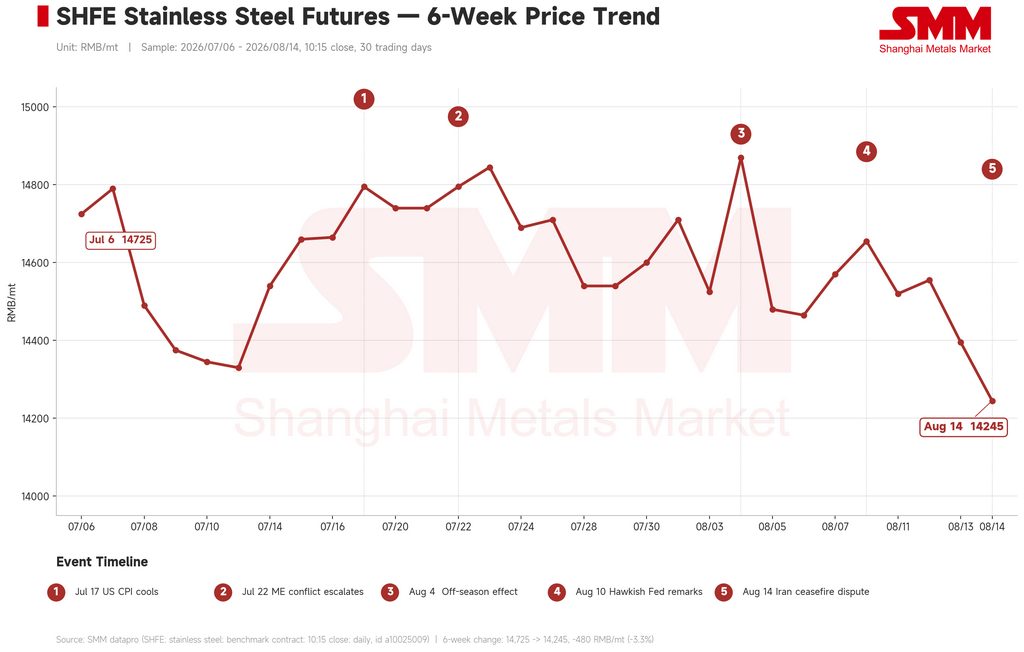
China's stainless steel futures extended their slide for a fourth consecutive week, weighed down by persistent macro uncertainty. The benchmark contract opened at RMB 14,655/mt (about $2,175/mt) on Monday, August 10, then posted losses on four of the next four sessions: RMB 14,520/mt (about $2,154/mt) on Tuesday, a brief bounce to RMB 14,555/mt (about $2,160/mt) on Wednesday before renewed pressure, RMB 14,395/mt (about $2,136/mt) on Thursday, and RMB 14,245/mt (about $2,114/mt) at Friday's close. That left the week down RMB 325/mt (roughly $48/mt), or 2.23%, from the prior Friday's close of RMB 14,570/mt (about $2,162/mt), with bearish sentiment dominant throughout.
A split Fed added to the uncertainty
Several strands of bearish macro news converged this week, and disagreement within the data itself compounded the uncertainty. A cluster of Federal Reserve officials struck a hawkish tone: Cleveland Fed President Beth Hammack reiterated that a rate hike is still needed and that multiple hikes may be required to bring down inflation, adding that July's jobs data wouldn't change that view. Richmond Fed President Tom Barkin and Chicago Fed President Austan Goolsbee separately signaled that further tightening may be necessary to meet policy goals, with Goolsbee noting that much of the current inflationary pressure stems from tariffs, followed by oil prices, and voicing hope it proves a one-time shock rather than a trend. Yet the data pointed the other way: July's US CPI came in mild, bond markets priced the odds of a September hike down to roughly 40%, and rate futures now price in just 23 basis points of Fed tightening for the rest of the year — no longer a full hike's worth. The gap between hawkish rhetoric and dovish pricing left the policy path more uncertain than usual. Separately, President Trump denied frequent contact with Fed Governor Kevin Warsh, saying the two have spoken only once since Warsh took office — a comment that pushed back somewhat on market concerns about Fed independence.
Iran ceasefire dispute drags on
Middle East dynamics stayed in their now-familiar pattern of alternating conflict and diplomacy. Iran's foreign ministry said talks with Oman are focused on establishing secure shipping routes and have not yet touched on transit fees, though the proposed agreement would include maritime service charges. At the same time, after Iran raised the issue of war reparations, Trump said the US would pursue its own claims against Iran and would fold that demand into all future negotiations — leaving the two sides still far apart. US military activity continued as well: a US helicopter fired on a cargo vessel bound for Iran, forcing it to a halt, and Trump said Iran "says one thing to your face and another behind your back," adding that the US could use "overwhelming force" if needed. One US official said Trump would be more inclined to extend the current ceasefire indefinitely if Washington can contain Iran's nuclear program and shipping through the Strait of Hormuz returns to normal — but an Iranian source quickly countered that the ceasefire arrangement has no effective date to begin with, so there is no "extension" to speak of, underscoring how differently the two sides still read the truce. Pakistan's interior minister visited Tehran and met with Iran's president during the same period, a sign that regional mediation efforts continue. Overall, whether the Strait reopens fully and whether a ceasefire actually holds remain the key variables shaping risk appetite, oil prices, and — by extension — cost expectations across base metals.
Indonesian ore policy stayed a drag; Chinese trade data was strong
On the industry side, Indonesia's nickel ore miners association said it would issue additional 2026 production quotas selectively — continuing the cautious, limited-increase stance that has weighed on the market for months, and remaining one of the core industry-side factors pressuring sentiment this week. In China, July CPI rose 0.5% year-on-year. Customs data showed China's total goods trade reached RMB 30.13 trillion in the first seven months, up 17.3% year-on-year, with July auto exports at 1.043 million units, up 81.3%. The People's Bank of China conducted a RMB 1 trillion outright reverse repo (six-month tenor) on August 14 and planned overnight reverse repo operations on August 14 and 17–19, capped at RMB 600 billion per day — a sizeable liquidity injection. Elsewhere, US strategic petroleum reserves fell below 300 million barrels, the Bank of Japan governor hinted at a possible September rate hike (prompting coordinated yen buying with the US), and Black Sea grain shipping took another hit as three major Russian grain terminals were damaged, sending international wheat and corn futures sharply higher — all signals that overseas macro and geopolitical risk continue to weigh on commodity sentiment on multiple fronts.
Spot held up better than futures as a typhoon offset rising mill output
Fundamentally, the market showed a weak futures-spot linkage alongside soft supply-demand conditions but resilient inventories. Spot prices edged only modestly lower, with limited room to fall further. The market remains deep in its traditional low season, with no signs yet of the pickup that typically precedes September–October peak demand. Downstream buyers stayed cautious, purchases were largely on an as-needed basis, and there was no concentrated restocking — keeping underlying demand too weak to support higher spot prices.
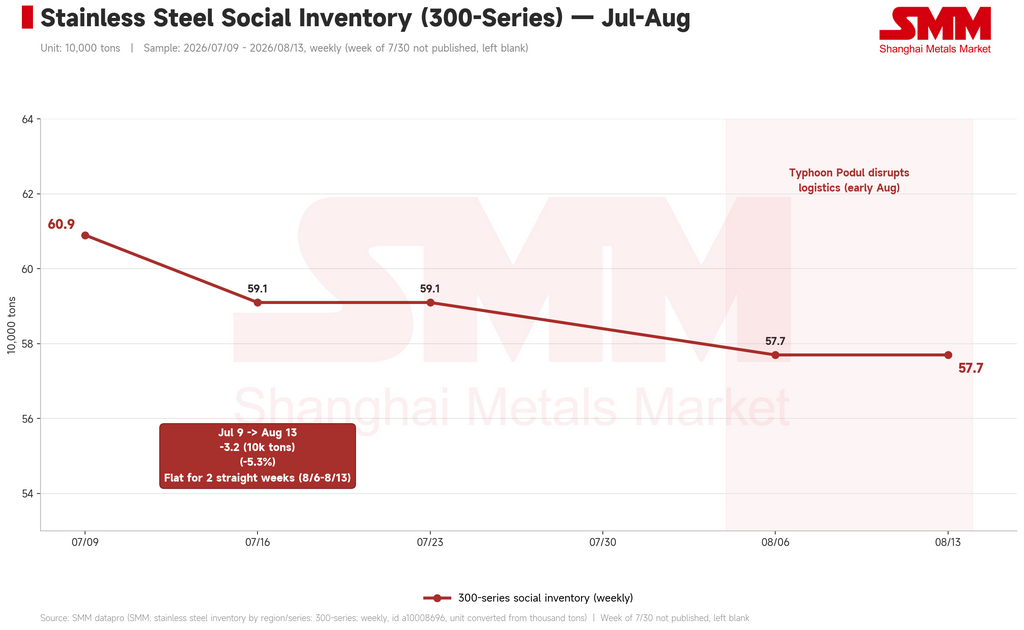
On the supply side, mills continued ramping production through August, accelerating capacity release just as end-user demand failed to recover in step — nudging the supply-demand balance further out of alignment. However, Typhoon Podul made landfall in East China during the week, disrupting operations at major ports and inland logistics routes and slowing both shipments and cargo arrivals. That disruption partially offset the incremental supply pressure: SMM's weekly social inventory reading held essentially flat, with no meaningful build. The latest print, as of August 13, came in at 577,000 mt, unchanged from the prior week's reading on August 6 — a stable inventory picture that's helping put a floor under spot prices.
Firm raw material costs limited the downside
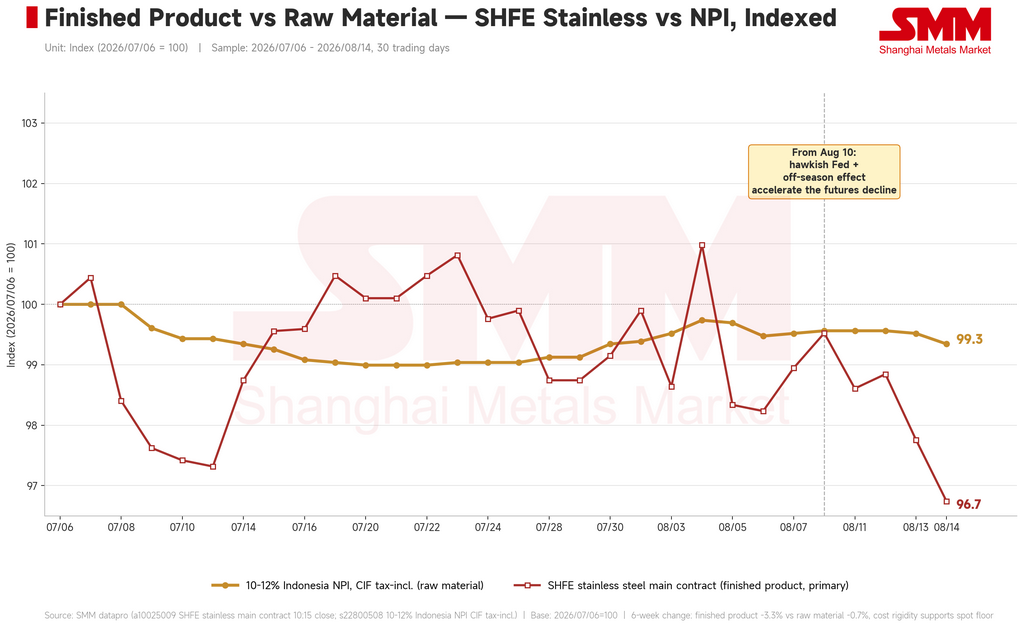
On costs and margins, finished-product prices tracked the futures decline lower this week, and mills showed somewhat less resolve in defending their sales prices, nudging spot quotes down modestly. Raw material costs, however, proved resilient enough to meaningfully limit the decline. Nickel Pig Iron (NPI) prices held relatively firm, trading in a RMB 1,136–1,138.5/nickel point (about $168.6–$168.9/nickel point) range from August 10 to 14 with only a slight softening — a firmness that lines up with the industry-side logic around Indonesia's continued tight ore quota policy. Because finished-product prices fell faster than raw material costs, the spread between the two narrowed, and mill smelting margins compressed slightly as a result. High-carbon ferrochrome's weekly average, most recently reported for the week ended August 7, came in at RMB 7,995/50mt basis ton (about $1,186), down RMB 40 (about $6) from RMB 8,035/50mt basis ton (about $1,192) the week before; the reading for the week ending August 14 had not yet been published. Overall, the rigidity on the cost side effectively prevented a deeper spot-price decline, leaving the market in a "futures down, spot soft, costs holding the floor" pattern.
Outlook
This week's stainless steel market reflected a tug-of-war between macro headwinds pressuring futures, soft off-season demand, rising mill output, stable inventories providing support, and resilient raw material costs limiting the downside — with disagreement over the Fed's policy path and uncertainty around the Iran ceasefire further amplifying the market's sensitivity to headline news. In the near term, the fundamental picture skews weak: as mills continue ramping output, the pressure on future demand will only build, and prices carry the risk of a further near-term pullback. But a reasonable inventory level and firm raw material costs form a dual floor that should limit how far prices can fall, keeping the broader trend a weak, range-bound one. Key things to track going forward: Fed commentary ahead of the September meeting, whether the Iran ceasefire arrangement is actually formalized, the pace of Indonesian nickel ore quota releases, the timing of a seasonal demand recovery, how mill output increases play out, and the pattern of inventory turnover.