In the first half of August, LME copper prices maintained strong performance overall, and after shooting up quickly they shifted into high-level consolidation. At the beginning of the month, LME copper prices climbed from around $13,850/mt, recorded a first-week gain of 2.8%, and returned to the historically high range. In the second week, copper prices probed further upward and then consolidated at highs mainly in the $13,950-14,280/mt range. With copper prices staying at high levels, on the one hand they supported ex-China copper scrap prices, while on the other hand they gradually dampened downstream procurement demand, further intensifying the supply-demand tug-of-war between sellers and buyers in the ex-China copper scrap market.
In terms of prices, in the first half of August ex-China copper scrap payable indicators overall stayed high, but divergence gradually emerged among different grades. At the beginning of the month, because available copper scrap inventories in major consumption regions such as China, Japan, South Korea and India were generally low, ex-China supply remained tight, and suppliers showed a strong willingness to hold prices firm. The ex-China offer payable indicators for bare bright copper mainly held at 98.5%-99%, those for No. 1 copper were about 97%-98%, and those for No. 2 copper were concentrated at 94%-96%.
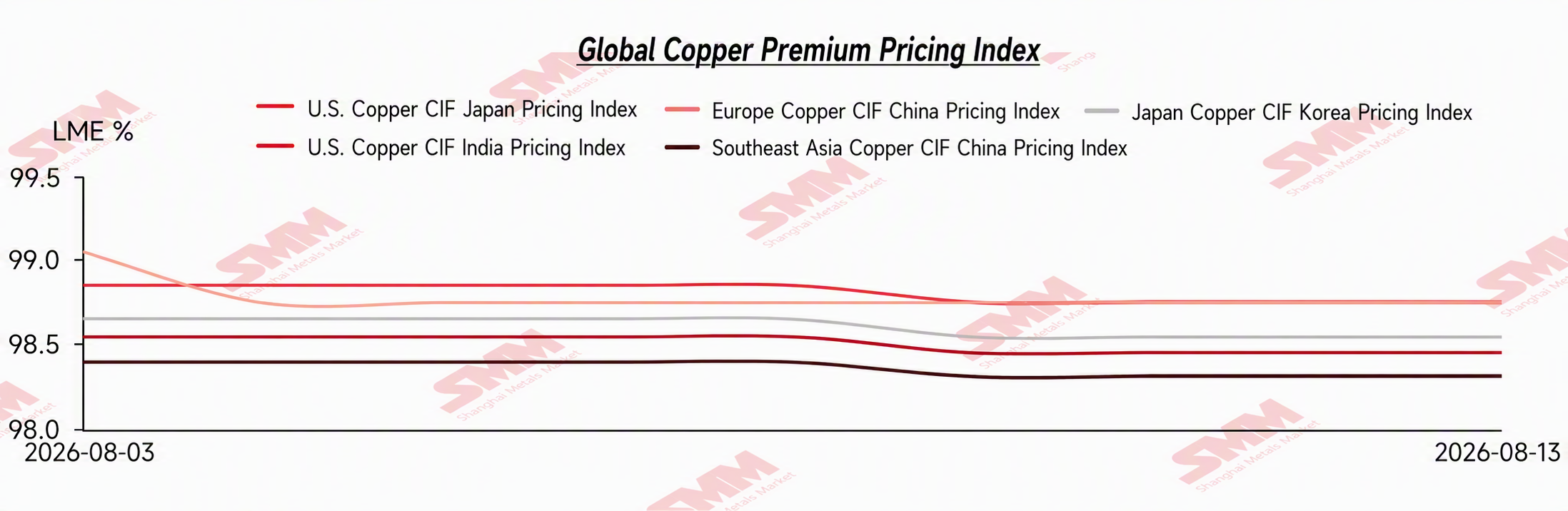
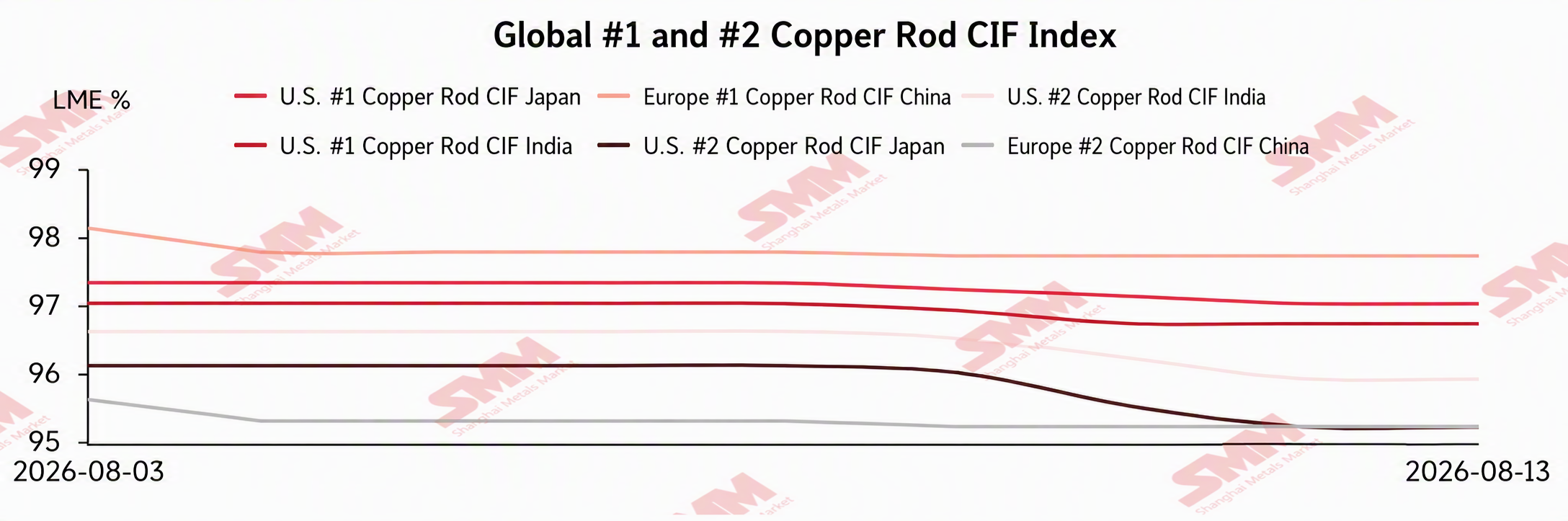
However, as copper prices rose further, the dampening effect of high prices on demand began to emerge. In particular, affected by maintenance at some smelters, the consumption off-season and high copper prices, procurement demand for No. 1 and No. 2 copper slowed somewhat, and transaction payable indicators pulled back to a certain extent. As of mid-August, the transaction payable indicator for No. 1 copper had pulled back to around 96%-97%, US No. 2 copper was about 95.5%, and European No. 2 copper mainly traded around 94.5%-95%. By contrast, because supply of bare bright copper remained tight and it is a strong direct substitute for copper cathode, its price found clear support on the downside, and its offer payable indicators stayed high at 98.5%-99% without notable easing.
In terms of transactions, the market in the first half of August was generally characterized by "tight supply and cautious demand". The rapid rise in copper prices at the start of the month boosted ex-China suppliers' willingness to sell, but with limited spot availability, sellers remained strongly inclined to hold prices firm. Faced with historically high copper prices, downstream enterprises clearly leaned toward just-in-time procurement and had limited willingness to build inventories proactively; therefore, although transactions improved compared with earlier, the overall volume expansion was still constrained.
After mid-August, as copper prices continued to consolidate at highs, the impact of the traditional consumption off-season on downstream orders became more evident, enterprises' wait-and-see sentiment strengthened, and market transactions turned sluggish again. Meanwhile, affected by the need to recoup funds, some traders became more willing to sell and could only promote transactions by moderately conceding prices, which was also one of the important reasons for the pullback in payable indicators for No. 1 and No. 2 copper.
From a fundamental perspective, the biggest support for the ex-China copper scrap market still comes from the supply side. The impact of earlier tight supply of copper ore and concentrates is gradually being transmitted to the secondary resources segment. Market attention on and procurement demand for copper scrap remain at relatively high levels, while copper scrap supply itself has limited elasticity and can hardly release incremental supply quickly in the short term. At the same time, social inventories of copper scrap in major consumption regions remain at relatively low levels, making the tight supply of high-grade copper scrap, especially bare bright copper, more pronounced.
Looking ahead to the second half of August, against a backdrop in which copper prices remain at historically high levels and the traditional consumption off-season has not yet clearly ended, downstream enterprises are expected to continue to rely mainly on just-in-time procurement, and social inventories of copper scrap in some regions may accumulate slightly. In terms of prices, supported by tight supply and substitution demand, the payable indicator for bare bright copper is expected to remain high; No. 1 and No. 2 copper, affected by slowing smelting demand and weak market transactions, still face some pullback pressure on prices. Overall, the ex-China copper scrap market may continue to show a divergent pattern in the short term, with "firm prices for high-grade raw materials and pressure on medium- and low-grade raw materials".
![Ahead of the Weekend, Scrap Utilization Enterprises Buy the Dip [SMM Secondary Copper Daily Review]](https://imgqn.smm.cn/usercenter/ZCsFN20251217171710.jpg)

![[SMM Copper Cathode Rod Flash] Raw Material, Finished Product Inventories Rise Amid Sluggish Demand and Price Pullback](https://imgqn.smm.cn/usercenter/HfIIS20251217171709.jpg)