Key points: This week, the Chicago Summit clarified the industry timeline: oxide electrolytes will be prioritized for deployment within 2–3 years, while all‑solid‑state sulfide batteries will be delayed until 2028–2030. The Baihu Lake Laboratory achieved a breakthrough in boride‑based solid‑state batteries with 400 Wh/kg, wide temperature range, and low‑pressure operation, targeting low‑altitude economy and robotics applications. The Sichuan Advanced Battery Innovation Center will be delivered by the end of August, Shandong Chuanglu’s hundred‑ton‑scale production line is about to enter mass production, and Derr’s PACK pilot line has been completed. Ruizhi New Energy and Guxin Energy secured over 100 million yuan in combined financing, and a joint laboratory for robot batteries was established. Solid‑state batteries have fully shifted from the laboratory to production‑driven development.
I. Preface: Prices and Markets
During this week (August 6 – August 13, 2026), upstream prices in the solid‑state battery industry chain remained generally stable, but structural divergences continued to intensify.
Price analysis of solid‑state battery related products
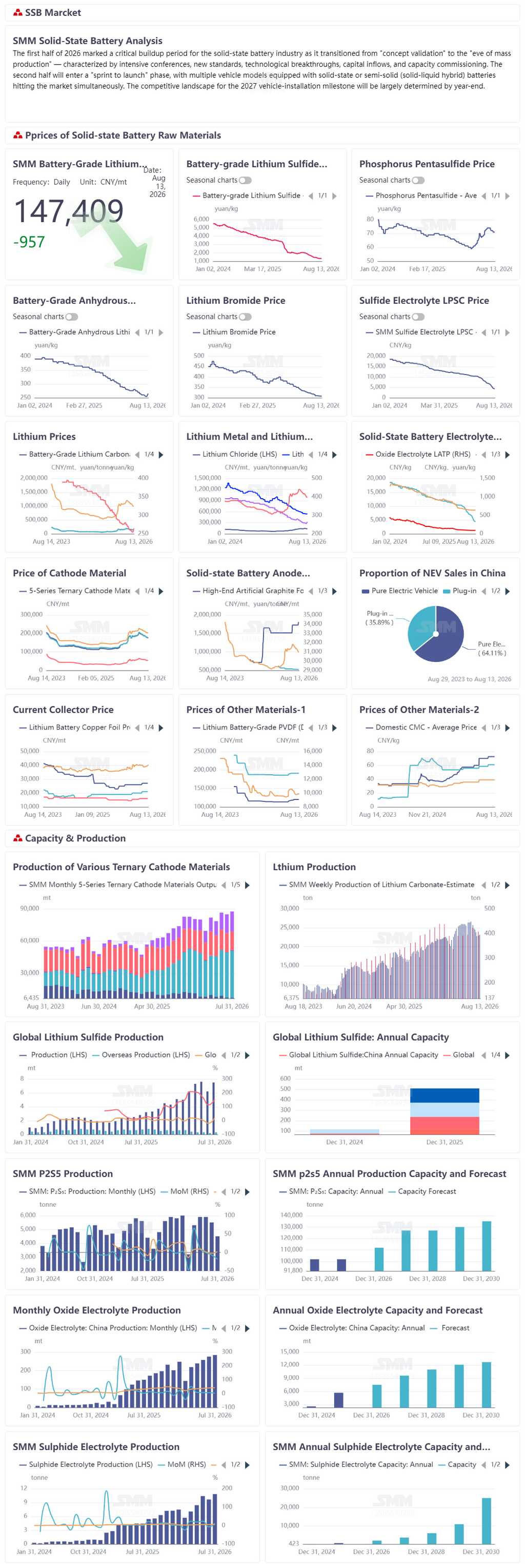
Lithium carbonate: Battery‑grade lithium carbonate prices continued to rise this week. According to SMM data, on August 12 the domestic average price of battery‑grade lithium carbonate was 148,000 yuan/ton, up 3,250 yuan/ton in a single day; on August 13 the quoted range was 145,000–151,000 yuan/ton. Downstream material manufacturers remained cautiously watchful, with procurement strategies leaning toward replenishing stocks on dips as needed; upstream lithium salt producers faced tight supply due to concentrated maintenance shutdowns in July–August. Lithium hydroxide prices remained volatile above 150,000 yuan/ton.
Sulfide systems: Prices of core raw materials for sulfide solid electrolytes continued to decline. Lithium sulfide has fallen more than 50% in the past six months and is expected to drop further to 1,300 yuan/kg, while LPSC has retreated to below 5,000 yuan/kg.
1.1 Solid electrolytes: Sulfides down slightly, oxides stable
This week, the two major solid electrolyte categories diverged: sulfide electrolyte LPSC (Li₆PS₅Cl type) gradually fell from 4,400 yuan/kg to 4,300 yuan/kg over the week, a weekly decline of about 2.27%. After being quoted at 4,400 yuan/kg on August 7, it held at 4,375 yuan/kg from August 10–12, and further dropped to 4,300 yuan/kg on August 13.
Oxide electrolyte LLZO (lanthanum‑zirconium‑titanium oxide type) remained unchanged throughout the week at 638 yuan/kg, showing no movement for several consecutive weeks.
The weakening of sulfide electrolyte prices is directly linked to the recent acceleration of industry capacity expansion. Industry developments this week show that Tianci Materials’ hundred‑ton‑scale sulfide solid electrolyte pilot line is expected to be completed and put into operation in the third quarter of 2026; Tianshi Kefeng completed tens of millions of yuan in new financing to boost sulfide electrolyte capacity. These supply‑side expectations have put some pressure on prices. Shandong Chuanglu’s 150‑ton‑per‑year solid electrolyte production line has completed installation and commissioning and is about to enter the large‑scale industrialization stage. Ruizhi New Energy focuses on active functional separators and membrane‑form solid electrolytes, compatible with liquid/semi‑solid/all‑solid‑state systems.
Oxide electrolyte LATP has a high degree of process maturity, with prices dropping from 480 yuan/kg in early 2024 to just over 90 yuan/kg in August 2026—about 15% of LLZO’s price—offering significant cost advantages and driving semi‑solid batteries from technical validation toward large‑scale commercial adoption.
1.2 Silicon‑carbon anode materials (weekly update): Clear price tiers
Deposition‑method (resin‑based) silicon‑carbon anode prices are as high as 525,000 yuan/ton, 2.2 times that of ball‑milling method (235,500 yuan/ton), reflecting the significant premium due to process barriers. Guxin Energy, as the only domestic company mass‑producing 400 Wh/kg semi‑solid batteries using a lithium‑silicon‑carbon anode route, has its production lines running at full capacity with orders booked through September, indicating strong demand for high‑end silicon‑carbon anodes.
On August 14, SMM officially launched a series of porous carbon price points, covering resin‑based perfect spherical porous carbon, resin‑based quasi‑spherical porous carbon, and other categories, providing more comprehensive spot price references for key raw materials upstream of silicon‑carbon anodes.
1.3 Upstream lithium sources and cathode materials: Lithium hydroxide notably stronger, ternary materials stable with slight upward movement
Cathode materials: Ternary cathode material prices rebounded slightly this week, but raw material prices for nickel sulfate and cobalt sulfate continued to decline. Although lithium carbonate and lithium hydroxide prices have recovered, overall ternary cathode material quotations showed little change and remain at relatively low levels. For lithium‑rich manganese‑based cathode materials, Shandong Chuanglu has completed pilot validation and its thousand‑ton‑scale production line has entered trial production.
This week coincided with the 6th Annual Global Solid‑State Battery Summit, where industry consensus further solidified—solid‑state batteries have fully transitioned from "laboratory stories" to "order‑ and production‑driven" development.
II. Materials: Cathode and Anode
2.1 Cathode materials: High‑nickel for the near term, lithium‑rich manganese for the medium term. The Chicago Summit clarified that the oxide route will be prioritized for deployment within 2–3 years, linked to the volume ramp‑up of semi‑solid/hybrid batteries. High‑nickel ternary (Ni≥83%), with its mature processes, has become the absolute mainstream for pilot and mass‑production projects of Yibin Innovation Center, Derr, Ruizhi New Energy, and others. Sulfide all‑solid‑state has been postponed to 2028–2030, constrained by high‑voltage interfacial side reactions, and will later switch to lithium‑rich manganese‑based materials. The Baihu Lake boride new route targets low‑altitude economy and 3C applications, and is expected to be adapted to high‑voltage lithium cobalt oxide. Lithium iron phosphate (LFP) accounts for a very small share in solid‑state systems due to its energy density ceiling. Overall, high‑nickel ternary represents the most certain incremental cathode material in the next two years.
2.2 Solid‑state battery anodes follow a dual‑track evolution: "silicon‑carbon first, lithium‑metal in the longer term." In the 2026–2027 semi‑solid/solid‑state volume ramp‑up phase, CVD silicon‑carbon anodes are the primary choice, with BTR, Putailai, Doshin, and others advancing ton‑ to thousand‑ton‑scale production lines, adapted to high‑nickel ternary to achieve 350–400 Wh/kg, and already introduced in Yibin Innovation Center, Derr pilot lines, and Guxin semi‑solid mass‑production projects. Lithium‑metal anodes (including anode‑free frameworks) aim for 450–500 Wh/kg but are constrained by dendrite formation, external pressure requirements of 5–40 MPa, and cycle life—only Ganfeng, BTR, and a few others have small‑scale or 20 Ah‑level validation, far from mass production. The Baihu Lake boride wide‑temperature battery has not disclosed its anode grade; its low‑pressure operation favors lithium‑metal or composite silicon‑carbon. Overall, the near‑term anode increment is definitely in high‑end silicon‑carbon, while lithium‑metal is a deliverable for all‑solid‑state after 2028.
III. Cells: Cell and System Progress
Several notable breakthroughs at the cell level occurred this week.
Baihu Lake Laboratory boride solid‑state battery breakthrough. The research team adopted a boride electrolyte route and successfully developed a solid‑state battery that operates stably over a wide temperature range from –20 °C to 120 °C, with an energy density of 400 Wh/kg, cycle life exceeding 2,000 cycles, and thermal box safety tolerance up to 180 °C. To address the industry pain points of low ionic conductivity and the need for external pressures above 40 MPa, the team innovatively integrated the anode and electrolyte layers, reducing the required external pressure to below 5 MPa. In early 2026, they successfully trial‑produced a 20 Ah large‑capacity cell, which can increase drone endurance by 30%–40% at the same volume, and have locked in three major application directions: low‑altitude unmanned aerial vehicles, embodied intelligent robots, and high‑end 3C products.
Derr's PACK pilot line completed. Derr announced that its solid‑state battery PACK pilot line has been completed, while the cell pilot line is under construction with related equipment being delivered sequentially, aiming for completion by the end of September. The company has been engaged in solid‑state battery R&D since 2018, and this pilot line milestone marks a critical step in its industrialization process.
IV. Projects: Capacity Build‑out and Platform Launches
Sichuan Advanced Battery Innovation Center nearing delivery. Construction began on this project in June this year. At present, infrastructure works including plant renovation, cleanroom, and fire protection are nearly completed, with overall project progress reaching 80%. It is scheduled for delivery by the end of August. The project has a total floor area of over 8,600 square meters, focusing on key technologies of composite electrolytes and semi‑solid/quasi‑solid battery cells, while concurrently carrying out technology scale‑up piloting, industrial chain incubation, and commercialization of research outcomes. Lab equipment commissioning is expected to start in Q4 this year, with operations commencing in Q1 next year for small‑scale R&D, and simultaneous construction of the second‑phase pilot workshop.
Shandong Chuanglu's hundred‑ton‑scale solid electrolyte to enter mass production soon. The company has completed pilot validation for its full range of solid electrolytes and lithium‑rich manganese‑based cathode materials, with product batch stability and mass‑production processes fully meeting standards. The 150‑ton‑per‑year solid electrolyte production line has completed installation and commissioning, and the thousand‑ton‑scale cathode material line has entered trial production.
Tianqi Lithium advancing lithium sulfide pilot project. The company is promoting a 50‑ton‑per‑year lithium sulfide pilot project in Meishan, Sichuan, targeting sulfide solid‑state battery electrolyte materials.
V. Financing and Cooperation
Ruizhi New Energy completes tens‑of‑millions yuan Pre‑A+ round. This round was exclusively funded by the Shanghai Chenyao Yichuang Investment Fund, a joint venture between Shanghai Guotou Kechuang and Yixing Economic Development. The funds will be used for capacity expansion at the Yixing base, accelerating the localization of solid‑state lithium materials. Ruizhi, spun off from Northwestern Polytechnical University, focuses on active functional separators and membrane‑form solid electrolytes, with core products already in the supply chains of several top battery manufacturers.
Guxin Energy completes over 100 million yuan financing round. Led by Toukong Donghai and followed by Jianyuan Fund, this financing marks Guxin’s formal upgrade from a specialized high‑end battery supplier to a core energy infrastructure service provider for embodied intelligence, low‑altitude economy, and commercial aerospace. As a key commercialization vehicle of the Institute of Physics, Chinese Academy of Sciences, the company operates high‑end battery manufacturing bases in Liyang, Jiangsu, and Ji'an, Jiangxi.
CESI, JD.com, and Sunwoda establish joint laboratory for robot batteries. The three parties signed a cooperation agreement in Beijing on August 7, focusing on standard development, product development, testing and validation, and typical applications for robot batteries. CESI has led the drafting of China’s only existing robot battery standard; JD provides large‑scale application scenarios and real‑world testing iteration through its logistics operations; and Sunwoda is responsible for custom cell development and mass production. Following the signing, two robot battery standard discussion meetings were held with over 60 experts in attendance.
VI. Overseas Progress
6th Annual Global Solid‑State Battery Summit held in Chicago. On August 11, participants including Toyota, Nissan, and Ford gathered to discuss sulfide and oxide electrolytes, high‑nickel ternary, silicon‑carbon anodes, and mass‑production processes. The summit reached an important industry consensus: oxide electrolytes will be prioritized for deployment in the next 2–3 years, while sulfide all‑solid‑state mass production will be delayed until 2028–2030.
Korea Marine Drone Technology and Solitec sign strategic cooperation agreement. The two parties will collaborate on R&D for solid‑state batteries and ultra‑high‑energy‑density batteries (500 Wh/kg class) for drone platforms. Cooperation focuses on drone‑specific battery pack design, safety and reliability validation, flight testing, system optimization, and performance verification in real‑world mission scenarios including maritime patrol and severe weather. Solitec was founded with participation from experts in energy engineering at the Daegu Gyeongbuk Institute of Science and Technology (DGIST), specializing in next‑generation battery materials and solid‑state battery technologies.
Asahi Kasei signs first Chinese licensing agreement for Acetolyte™ electrolyte technology. Asahi Kasei signed a non‑exclusive licensing agreement with Gao Chemical (Shanghai) for its Acetolyte™ high‑ionic‑conductivity electrolyte technology, marking the first such license in the Chinese market.
VII. Industry Voices This Week
"In 2026, solid‑state batteries have fully shifted from 'laboratory stories' to 'order‑ and production‑driven' development. Equipment first, materials positioning, and application diversification have become the current market themes."
"In the second half of this year, as hundred‑ton‑scale and above production lines come online successively, the industry will move from 'kilogram‑scale trading' to 'ton‑scale trading,' and economies of scale will significantly push the price center downward."
The 6th Annual Global Solid‑State Battery Summit reached consensus: "Oxide electrolytes will be prioritized for deployment within 2–3 years, while sulfide all‑solid‑state mass production will be delayed until 2028–2030."
Summary: This week saw the solid‑state battery summit set the direction, technological breakthroughs, capacity sprints, and capital escalation. The Chicago Summit clarified the industry cadence—oxides first, sulfides postponed to 2028–2030. The Baihu Lake Laboratory achieved substantial breakthroughs in wide‑temperature and low‑pressure operation of boride‑based solid‑state batteries. Projects such as the Sichuan Advanced Battery Innovation Center and Shandong Chuanglu’s hundred‑ton‑scale line are approaching delivery and mass production. Ruizhi New Energy and Guxin Energy completed new financing rounds, with capital continuing to flow in. Solid‑state battery industrialization is moving from "sporadic breakthroughs" to "systematic advancement."
**Note:** For further details or inquiries regarding solid-state battery development, please contact:
Phone: 021-20707860 (or WeChat: 13585549799)
Contact: Chaoxing Yang. Thank you!
![Solid-State Battery Next Decade Series, Part 9 of 9: A Brand-New Track, Not a "Simple Sequel" to Liquid Lithium Batteries [SMM Analysis]](https://imgqn.smm.cn/usercenter/ezoBg20251217171730.jpg)
![[Solid-state: Chunli New Energy's 1GWh solid-state battery plant starts production in Jiangxi]](https://imgqn.smm.cn/usercenter/MaxcL20251217171730.jpg)
![National Day Holiday Solid-State Battery Industry Review: Strong Policy Push but Slow Industrial Progress [SMM Analysis]](https://imgqn.smm.cn/usercenter/QxQbN20251217171727.jpg)