August 13, 2026:
This week, the operating rate of China's leading downstream aluminum processing enterprises was 59.9%, down 0.2 percentage points WoW. The industry remained in the traditional consumption off-season; with high temperatures and weak end-use demand weighing on activity, most sectors were broadly under pressure. The primary aluminum alloy operating rate edged down 0.2 percentage points to 58%; weakening automobile production and higher aluminum prices curbed downstream purchases, new spot orders were extremely limited, and the sector remained in the doldrums. The aluminum plate/sheet and strip operating rate was unchanged at 69.0%; construction sheets & plates stockpiling expectations were not realized, can stock and automotive sheet orders were stable, and after concentrated export deliveries the market returned to real demand, leaving little upward driver in the short term. The aluminum wire and cable operating rate rose 0.4 percentage points to 62.4%; improved domestic-to-overseas price ratios slightly opened the export window, but limited new orders and slow State Grid cargo pick-up provided only mild support. The aluminum extrusion operating rate fell 0.8 percentage points to 50.8%; high temperatures shortened working hours and higher aluminum prices raised costs. Both construction and industrial extrusion weakened, and afternoon suspensions in south-west China further dragged output. The aluminum foil operating rate was unchanged at 70.1%; demand was weak during the air-conditioner end-user maintenance period, mid-month inventory built up, and enterprises mainly controlled production schedules and destocked; an inflection point in operating rates remains to be seen. The secondary aluminum operating rate edged down 0.3 percentage points to 49.1%, a low for the same period in recent years; tight compliant aluminum scrap, tax invoice uncertainty, and disruptions from high temperatures and typhoons made near-term improvement difficult. Overall, with the off-season constraint persisting and high-temperature disruptions, industry operating rates remained at low levels. In the short term, each segment is expected to stay mostly weak but stable, while aluminum wire and cable may move sideways due to the phased opening of the export window.
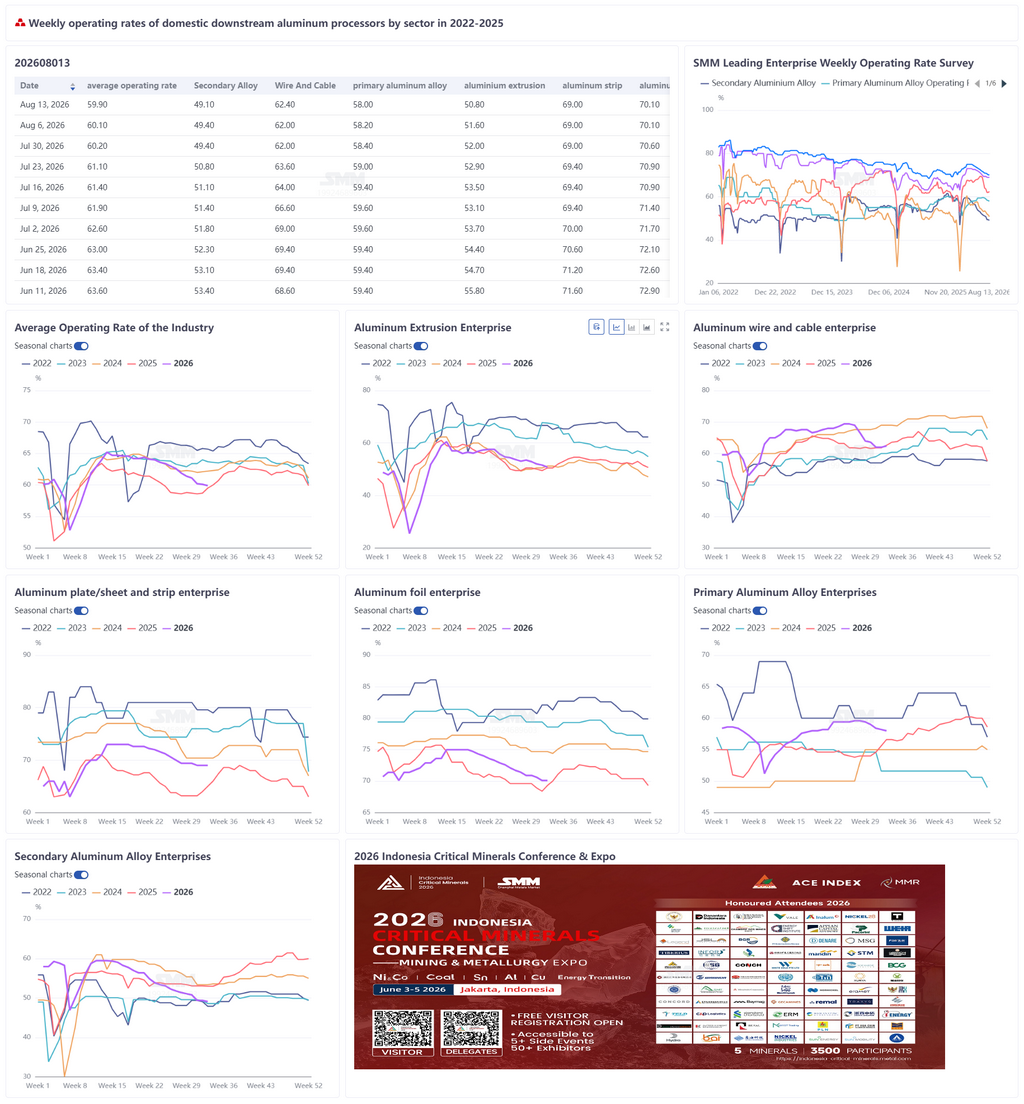
Primary aluminum alloy: This week, the operating rate of China's leading primary aluminum alloy enterprises was 58%, down 0.2 percentage points WoW, continuing the weak operating trend. At present, the market was still in the traditional consumption off-season. According to CAAM data, China's automobile production in June was 2.37 million units, down 240,000 units MoM, and overall production in July and August is still expected to remain at low levels. Automobile consumption demand continued to weaken, clearly dragging on the primary aluminum alloy market. At the industry level, enterprise production schedules were still dominated by annual long-term contracts; new spot orders were extremely limited, overall orders edged down slightly from earlier, and overall operating rate fluctuations were relatively small. Meanwhile, the aluminum price center shifted somewhat higher during the week, further denting downstream purchasing sentiment; inquiry and spot transaction activity cooled noticeably, the trading atmosphere was subdued, and this placed some restraint on operating rates. Overall, the market lacked clear positive drivers in the short term; enterprises mostly stayed on the sidelines with limited willingness to ramp up production on their own initiative. Leading enterprises' operating rates are expected to hold at current levels next week, continuing the weak operating pattern.
Aluminum plate/sheet and strip: This week, the operating rate of leading aluminum plate/sheet and strip enterprises was unchanged WoW at 69.0%. In terms of orders by product, the construction sheets & plates industry had not yet warmed up; as of this week, there was no concentrated stockpiling, and the industry lacked confidence that the August off-season to peak-season transition period would lift consumption. Orders on hand for hot-rolling downstream products such as can stock, automotive sheet, and 3C materials were relatively stable. The aluminum plate/sheet and strip operating rate is expected to recover in late August. In exports, after concentrated delivery of export orders received in Q2, the market gradually returned to real demand levels. In the short term, August stockpiling expectations have not yet been realized, and the demand side lacks drivers for substantive improvement; operating rates are expected to remain low and stable.
Aluminum wire and cable: This week, the operating rate of China's aluminum wire and cable industry was 62.4%, up 0.4 percentage points WoW. During the week, thanks to improved domestic-to-overseas price ratios, the export window for aluminum stranded wire opened slightly, and some enterprises received a small number of new orders again, providing some support to operating rates. However, profit margins in this window were limited, overall new order sizes were small, and it was difficult to return to the previous high export prosperity level; the boost was mild. Domestically, State Grid cargo pick-up remained slow, and with the industry in the consumption off-season, domestic demand was generally weak and lacked strong support. Overall, neither domestic nor external demand showed clear improvement. The aluminum wire and cable industry is likely to mainly move sideways in the short term, with limited room for operating rates to rise or fall.
Aluminum extrusion: This week, the weekly operating rate of China's aluminum extrusion industry was 50.8%, down 0.8 percentage points WoW. This week, the weak demand pattern in construction extrusion did not improve. Under persistently high temperatures, downstream construction site working hours were shortened, and purchase demand for construction extrusion declined further. Recently, aluminum prices drifted higher, raising raw material costs; downstream processing producers turned more cautious in procurement and maintained a purchase-as-needed strategy. On the supply side, some enterprises actively controlled the volume of engineering construction extrusion orders to optimize cash flow and took a prudent approach to new project orders. As multiple bearish factors compounded, the operating rate of the construction extrusion segment continued to move lower this week. In industrial extrusion, new orders for industrial motor housings, machinery equipment parts, and general industrial extrusion products declined, dragging the industrial extrusion operating rate slightly lower. In addition, some enterprises in south-west China reported that recent high temperatures were severe, workshop temperatures in the afternoon were too high, and work had to be suspended in the afternoon for rest, so overall output in August will decline. Overall, the short-term fundamentals of high-temperature disruptions and weak end-use demand in the off-season have not yet improved. Under the combined pressure of these two factors, operating rates in the aluminum extrusion industry will continue to weaken in the near term.
Aluminum foil: This week, the operating rate of leading aluminum foil enterprises was unchanged WoW at 70.1%. At the enterprise operation level, the market was in the traditional off-season stage of consolidating at lows. Some aluminum foil producers reported that August sales completion rates were low, mid-month inventory build-up pressure was relatively large, and controlling production schedules and prioritizing destocking remained their primary strategy. In terms of order structure, air-conditioner end-users were in a period of large-scale summer equipment maintenance, providing little additional support to overall operating rates in the short term. Overall, deep weakness in air-conditioner foil and the packaging off-season effect remained the dominant factors, and as operating rates had already fallen to a relatively low level, the inflection point in operating rates remains to be seen.
Secondary aluminum: This week, the operating rate of leading enterprises in the secondary aluminum industry edged down 0.3 percentage points WoW to 49.1%, still at a low level for the same period in recent years. On the raw material side, compliant aluminum scrap supply was tight, enterprise procurement cost pressure was relatively large, and tax invoice policy uncertainty continued to constrain raw material purchases and production. On the demand side, the market was still in the end-use consumption off-season, downstream order release was insufficient and mainly rigid demand, and enterprises showed weak willingness to schedule production. In addition, high temperatures and typhoon-related rainstorms disrupted production in some regions, further limiting production release. Under the combined impact of raw material constraints, off-season demand, and weather disruptions, the operating rate is expected to remain low in the short term. Going forward, attention will focus on the recovery of end-use orders and changes in tax invoice policy.
![Upstream Raw Materials Diverge, Aluminum Fluoride Prices Hold Steady in Short-Term Stalemate [SMM Fluoride Salt Weekly Review]](https://imgqn.smm.cn/usercenter/uoPaX20251217171651.jpg)
![Petroleum Coke Divergence Pattern Becomes Prominent, Prebaked Anode Overall Cost Edges Down Slightly [SMM Prebaked Anode Weekly Review]](https://imgqn.smm.cn/usercenter/SUuNM20251217171651.jpg)
![Mild Inflation Pullback Eases Macro Anxiety, Production Resumptions Accelerate, and Market Sentiment Turns Around [SMM Aluminum Price Weekly Review]](https://imgqn.smm.cn/usercenter/wStpx20251217171650.jpg)