Key Points:Nuvvon is a New Jersey–based solid‑state battery startup pursuing a pure solid polymer electrolyte (SPE) route, free of sulfides or oxides. Its cells operate at ambient temperature and pressure, requiring no cooling, heating, or pressurisation systems. The company's 1Ah and 5Ah pouch cells feature NMC811 cathodes and lithium‑metal anodes, delivering over 2,000 cycles and operating across a temperature range of –20°C to +60°C. They have successfully passed independent nail penetration tests, validating their intrinsic safety. Nuvvon is now transitioning from laboratory‑scale development to commercial sample delivery, having secured $5.3 million in seed funding and recently opened a new R&D laboratory.

Preface
Nuvvon is a solid‑state battery technology company headquartered in Parsippany, New Jersey, USA, focused on the R&D and commercialisation of next‑generation energy storage solutions. The company was founded in 2022 (though some sources trace its nanotechnology research back to 2017) by Dr. Simon Madgwick (engineering) and Manveer Sidhu (polymer battery scientist). Nuvvon’s core technology is its proprietary solid polymer electrolyte (SPE), aiming to deliver all‑solid‑state batteries with high safety, high energy density, and low cost. Since 2025, the company has achieved a series of breakthroughs, including the inauguration of a new laboratory, launch of cell samples, and independent safety validation, making it a notable US‑based innovator in the global solid‑state battery arena.

I. Technology Route
Nuvvon pursues a solid polymer electrolyte (SPE) route, falling into the all‑solid‑state battery category.
1.1 Core Characteristics
Pure polymer system – Nuvvon’s SPE is a purely polymeric system, free of any sulfide or oxide nanoparticles. This sets it apart from the mainstream sulfide‑ and oxide‑based inorganic solid electrolyte routes.
Multi‑functional integration – The electrolyte simultaneously acts as catholyte, anolyte, and separator, achieving an integrated “one‑material‑multiple‑roles” design.
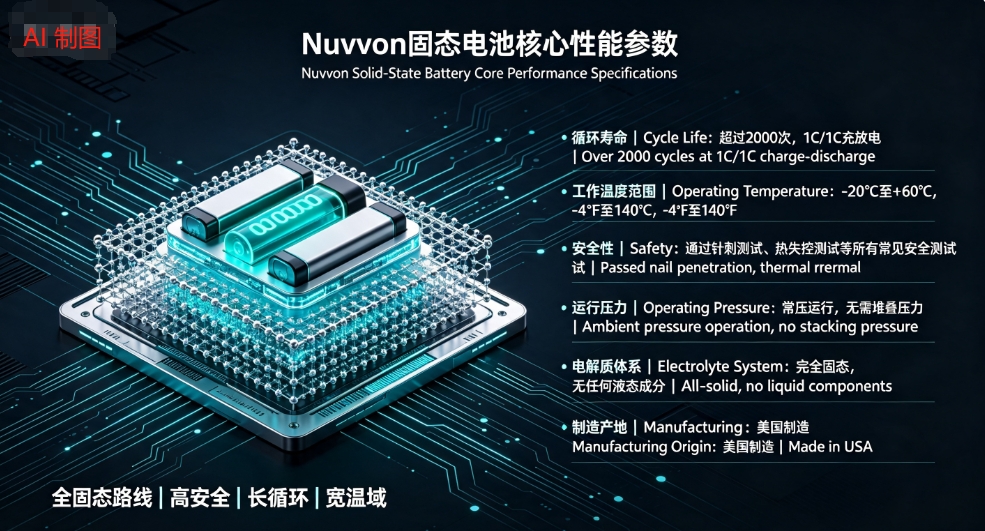
Zero liquid, zero pressure – The cells are fully solid, containing no liquid components (not even plasticisers). Moreover, the battery operates at ambient (atmospheric) pressure, eliminating the need for the high stacking pressures required by many ceramic electrolytes.
Wide temperature operation – It functions normally across a temperature range of –20°C to +60°C without the need for cooling, heating, or pressurisation systems.
Room‑temperature ionic conductivity – >1 mS/cm at 25°C.
Ultrathin separator – Achievable separator thickness ≤20 μm.
1.2 Positioning of Technical Advantages
Nuvvon’s technology aims to address four critical challenges of solid‑state batteries:
Pressure issue – Ceramic electrolytes suffer from high interfacial resistance and require high pressure or liquid assistance; Nuvvon’s SPE requires no pressure.
Temperature issue – Liquid electrolytes are unstable above 40°C, and conventional solid polymers cannot work below 70°C; Nuvvon’s SPE operates at room temperature and elevated temperatures.
Compatibility issue – Many electrolytes are incompatible with lithium metal and high‑voltage cathodes (e.g., LNMO); Nuvvon’s SPE is compatible with both.
Process issue – Novel ceramics and other technologies are difficult to produce on existing equipment; Nuvvon’s pouch cells can be directly manufactured on standard lithium‑ion production lines.
II. Battery Specifications
Nuvvon currently offers solid‑state rechargeable lithium‑ion pouch cells with NMC811 cathodes and lithium‑metal anodes.
2.1 Key Performance Parameters (Nuvvon)
2.2 Product Models
72 mAh – early laboratory‑grade prototype
1 Ah and 5 Ah – commercial‑grade samples, officially launched in autumn 2025
10‑20 Ah – customisable upon customer request
20 Ah – planned for Q4 2025 launch
2.3 Safety Validation Milestone
In October 2025, Nuvvon’s SPE technology underwent an independent nail penetration test at the University of Texas at Austin (UTA). Standard 1 Ah commercial‑grade cells were tested side‑by‑side: one with Nuvvon’s SPE and the other with conventional liquid electrolyte. The liquid‑electrolyte cell exploded instantly, while the Nuvvon SPE cells (both graphite‑NMC811 and Li‑NMC9 systems) showed no fire or explosion.
III. Production Capacity Plans
Nuvvon is still in the early commercialisation phase and has not disclosed GWh‑level mass‑production capacity plans. However, its development trajectory is as follows:
Laboratory phase – Initial R&D at the Rutgers University EcoComplex incubator.
New laboratory opening – In February 2025, Nuvvon inaugurated a new laboratory in Parsippany, quadrupling its previous floor space, integrating R&D, manufacturing, and testing. The facility supports scale‑up of the solution casting process, enabling in‑house production of 1‑2 Ah lithium solid‑state cells and further development of solid‑state lithium‑sulfur batteries.
Sample sales phase – 1 Ah and 5 Ah commercial‑grade cells are now being produced and sold for prototype analysis by interested parties.
Overall, Nuvvon’s current focus is transitioning from laboratory validation to commercial sample delivery; large‑scale capacity construction remains in early preparatory stages.
IV. Company Profile and Patent Portfolio
4.1 Company Profile
Nuvvon Inc. is a US high‑tech company specialising in the R&D and commercialisation of solid polymer electrolytes and all‑solid‑state batteries. Headquartered in Parsippany, New Jersey, it was founded in 2022 (though some trace its nanotechnology roots to 2017). It is privately held and backed by venture capital, with approximately 9 employees. The core management team includes CEO Dr. Simon Madgwick, COO Jonathan Lex, and President & Head of Innovation Manveer Sidhu.
Nuvvon’s core technology is its proprietary solid polymer electrolyte (SPE), a pure polymer system free of sulfide or oxide nanoparticles, exhibiting room‑temperature (25°C) ionic conductivity >1 mS/cm and enabling separator thickness ≤20 μm. Based on this technology, Nuvvon has developed fully solid‑state pouch cells that operate stably over a wide temperature range without cooling, heating, or external pressure systems. The technology is also “plug‑and‑play” compatible with existing lithium‑ion production lines.
4.2 Patent Portfolio
Nuvvon holds 10 patent documents (including applications and grants), of which 5 are granted and 5 are pending. Representative patents include:
High‑performance solid‑state electrolyte and battery based on polysiloxane Si‑tripodand polymers – pending, filed 19 May 2023.
Solid‑state polymer electrolyte with elastic properties and method of making the same – pending, filed 18 January 2023.
High‑performance solid‑state electrolyte and battery based on cyanoethylated polymers and additives (WO) – inactive, filed 19 May 2023.
Core technology covers polysiloxane‑based polymer electrolytes, elastic solid polymer electrolytes, and cyanoethylated polymer electrolytes.
V. Financing and Partnerships
5.1 Financing
Nuvvon is at an early stage with relatively modest funding to date:
12 April 2024 – Seed round of $5.3 million completed; revenue already generated.
The company is seeking a new round of up to approximately $10.3 million. Overall valuation has not been publicly disclosed.
5.2 Partnerships
Thermo Fisher Scientific – Collaboration on material solutions to advance all‑solid‑state battery manufacturing.
Rutgers University EcoComplex – Early incubation at the EcoComplex; the company graduated in May 2025 and moved to its new larger facility.
VI. Company Milestones
February 2025 – Nuvvon held a ribbon‑cutting ceremony for its new R&D laboratory in Parsippany, quadrupling its previous space and integrating R&D, manufacturing, and testing.
May 2025 – Nuvvon successfully graduated from the Rutgers EcoComplex incubator and relocated to the expanded facility.
20 June 2025 – Nuvvon announced a major technological breakthrough and confirmed the autumn 2025 launch of 1 Ah and 5 Ah solid‑state rechargeable lithium‑ion pouch cell samples, marking that its technology has moved beyond the laboratory prototype stage.
October 2025 – Nuvvon’s SPE technology passed an independent nail penetration test; both graphite‑NMC811 and Li‑NMC9 cells showed no fire or explosion, validating the inherent safety of the technology.
2026 – The company continues to push commercialisation. Its products are seen by industry observers as a significant US breakthrough, enabling the country to compete on a level playing field in the solid‑state battery race, especially given the current US lag in liquid‑based battery technology relative to China.
From an industry analyst’s viewpoint, Nuvvon’s pure‑polymer SPE approach offers a distinctive and pragmatic alternative to the prevailing sulfide/oxide inorganic solid‑electrolyte routes. Its ability to operate at ambient pressure and temperature, while being compatible with existing Li‑ion manufacturing infrastructure, significantly lowers the barrier to commercial adoption—a critical advantage over many competitors still grappling with high‑pressure and high‑temperature requirements. The independent nail‑penetration test further underscores its intrinsic safety, a key selling point for automotive and aerospace applications.
However, challenges remain. The reported cycle life (>2,000 cycles) is promising, but energy density figures have not been disclosed; to compete with top‑tier liquid‑based systems and other solid‑state contenders, Nuvvon will need to demonstrate competitive gravimetric and volumetric energy densities at scale. Moreover, while 5 Ah samples are a positive step, scaling to 20 Ah and beyond—and eventually to GWh‑level production—will require substantial capital, process engineering, and supply‑chain development. The planned $10.3 million funding round, if successful, would provide a vital bridge, but it is modest compared to the multi‑hundred‑million investments seen in the sector.
For Chinese battery players, Nuvvon’s progress highlights the importance of technological diversification. While most domestic efforts are concentrated on sulfide‑ and oxide‑based electrolytes, the polymer route—if it can deliver competitive performance—offers a faster path to mass production with lower manufacturing costs. Chinese enterprises should monitor Nuvvon’s scale‑up closely and consider whether hybrid or polymer‑enhanced strategies could complement their existing roadmaps. In the medium term, Nuvvon is unlikely to pose an immediate threat to Chinese incumbents, but it represents a credible US‑based alternative that could capture niche high‑value segments (e.g., aviation, premium EVs) if it successfully navigates the valley of death between prototype and production.
Overall, Nuvvon’s trajectory is a positive signal for the global solid‑state industry, proving that multiple routes can coexist. Its success will depend on execution, partnerships, and sustained funding—but the initial technical validation is undeniably impressive. We will continue to watch its commercialisation progress and its potential impact on the competitive landscape.
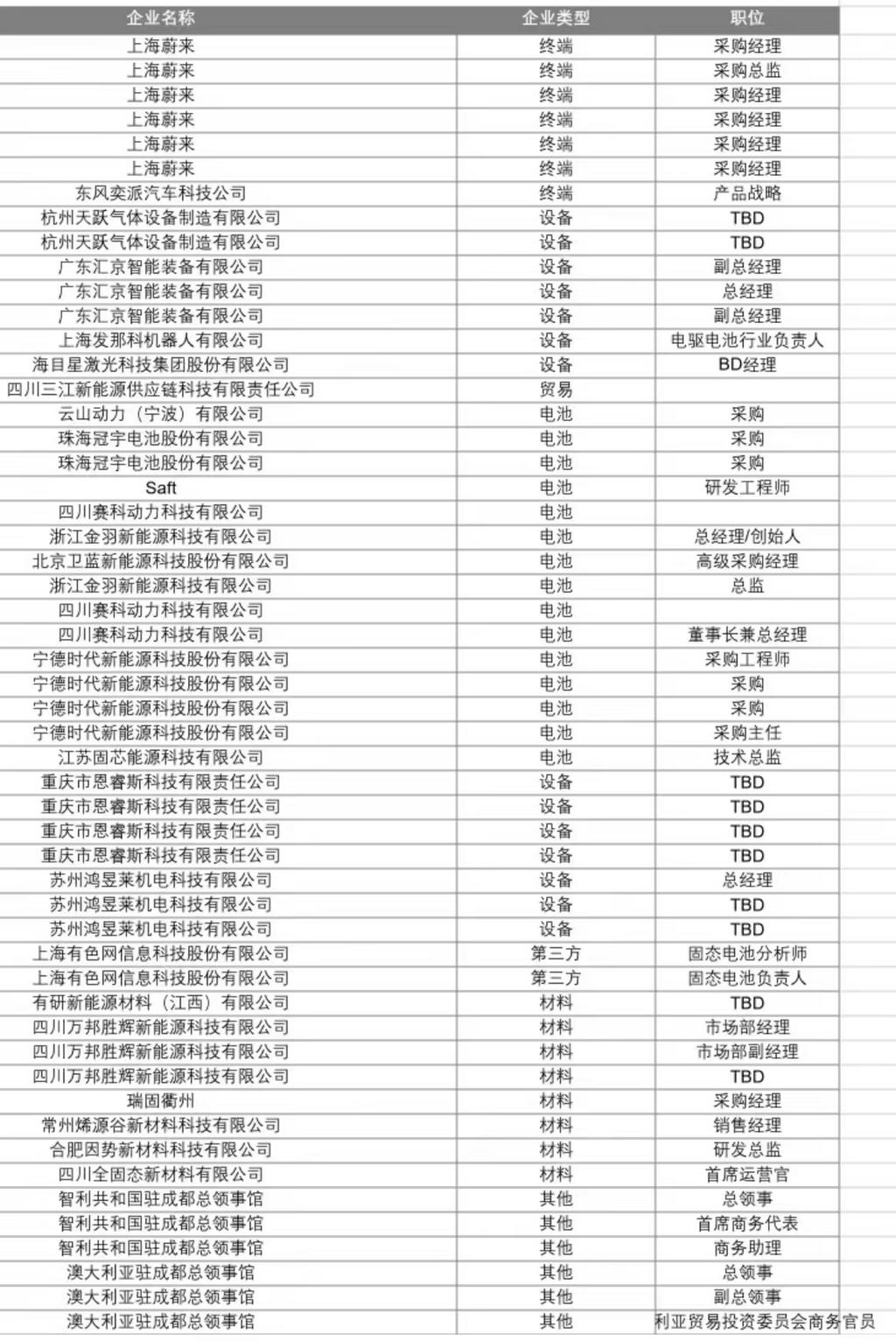
Finally, we recommend SMM's premium conferences. Current progress and some participating companies and representatives are as follows:
This week (July 31 – August 6, 2026) saw a triple convergence of technological validation, capacity deployment, and capital influx in the solid-state battery industry. Zhongke Yuanben completed China's first on‑road vehicle test of a sulfide‑based all‑solid‑state battery, validating full‑stack technology integration. Sinocera finished construction of its sulfide electrolyte mass‑production line, while Ronbay Technology approaches a 100‑ton‑level cathode material demand. Tuoyi Guneng announced a RMB 6 billion, 30 GWh project in Inner Mongolia, and Weilan New Energy launched a Pre‑IPO round at a RMB 20 billion valuation. Overseas, Solid Power advanced its continuous electrolyte pilot line, and Factorial partnered with SK On to explore using existing Li‑ion production facilities for solid‑state battery manufacturing. 2026, as a critical window for industrialization, is shifting from "single‑point breakthroughs" to "systematic advancement."
**Note:** For further details or inquiries regarding solid-state battery development, please contact:
Phone: 021-20707860 (or WeChat: 13585549799)
Contact: Chaoxing Yang. Thank you!
![Solid-State Battery Next Decade Series, Part 9 of 9: A Brand-New Track, Not a "Simple Sequel" to Liquid Lithium Batteries [SMM Analysis]](https://imgqn.smm.cn/usercenter/ezoBg20251217171730.jpg)
![[Solid-state: Chunli New Energy's 1GWh solid-state battery plant starts production in Jiangxi]](https://imgqn.smm.cn/usercenter/MaxcL20251217171730.jpg)
![National Day Holiday Solid-State Battery Industry Review: Strong Policy Push but Slow Industrial Progress [SMM Analysis]](https://imgqn.smm.cn/usercenter/QxQbN20251217171727.jpg)