SMM Africa Chromium Market | 2000–2025 Production Review
Introduction
South Africa's chrome industry is built on a paradox that has only deepened over the past 25 years. The country holds more than 40% of the world's chrome ore reserves, yet its ability to convert that endowment into higher-value ferrochrome has steadily eroded even as raw ore output has climbed to record levels. Between 2000 and 2025, chrome ore production nearly quadrupled, while ferrochrome output — after peaking mid-cycle — is estimated to end the period below where it started.
This report traces that 25-year arc era by era, from the integrated, smelting-led industry of the early 2000s through the financial crisis, the commodity super cycle, a decade of Eskom load-shedding, the COVID-19 shock, and the logistics and power crises of 2022–2025 that have left the domestic ferrochrome sector at its most constrained point on record. The story that emerges is less about geology than about cost structure and infrastructure — and it sets the context for where South Africa's chrome value chain goes from here.
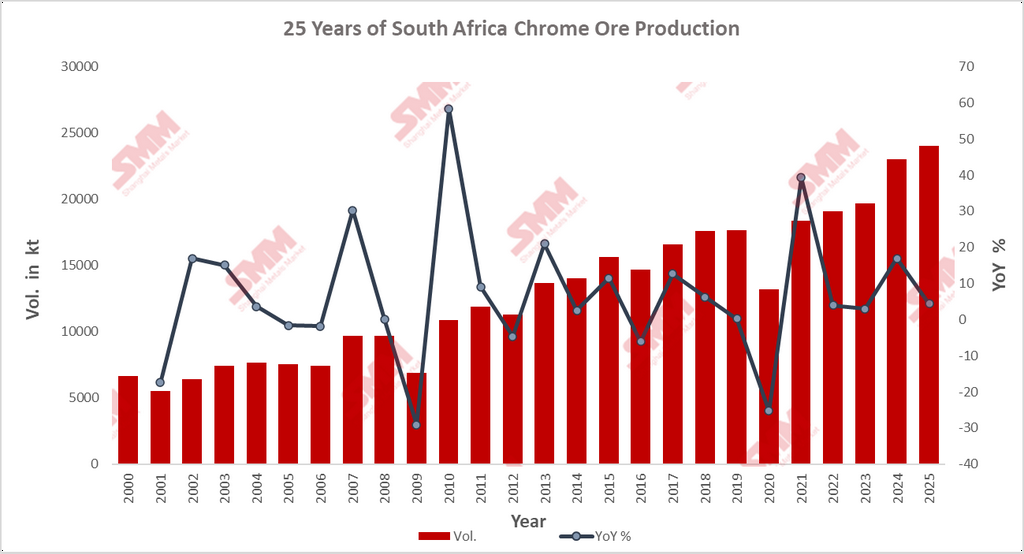
Figure 1
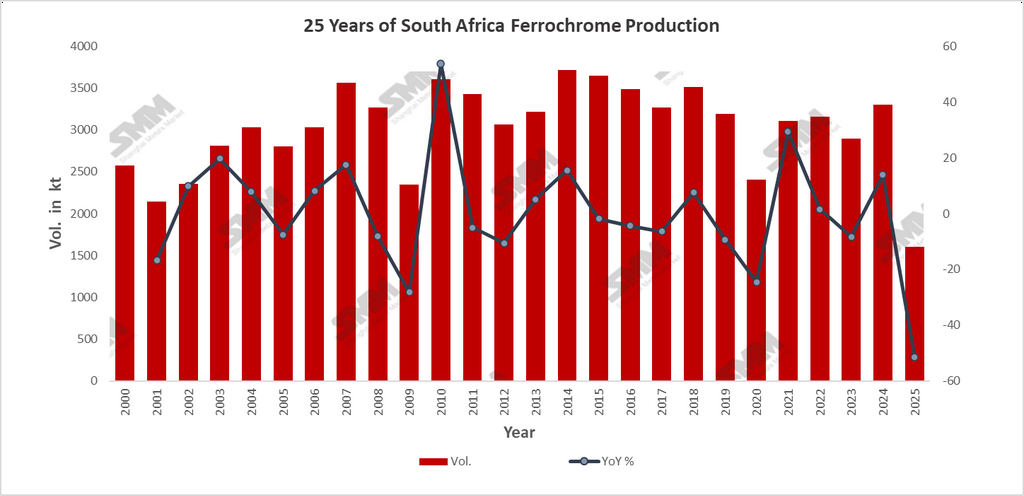
Figure 2
2000–2007: An Integrated, Dominant Industry
South Africa entered the millennium as the undisputed leader of the global chrome value chain. Chrome ore output rose from 6,662kt in 2000 to 9,665kt in 2007, while ferrochrome production grew from 2,574kt to 3,561kt over the same period. By the early 2000s, roughly 90% of domestically mined chrome ore was smelted locally into ferrochrome, supported by an electricity-intensive refining base built on cheap apartheid-era power. China's urbanization-driven stainless steel boom pulled demand steadily higher through the decade, though early power-supply strain toward the mid-2000s signaled the disruption to come.
2008–2010: Financial Crisis and a Sharp Rebound
The global financial crisis cut ferrochrome output from 3,561kt in 2007 to 2,346kt in 2009, a 34% peak-to-trough decline — as furnace shutdowns tied to the 2008 crisis spread across the sector. Chrome ore followed a similar path, falling to 6,865kt in 2009 before both products rebounded sharply in 2010 (10,871kt ore; 3,607kt ferrochrome) on the back of China's stimulus-led steel recovery. This period also marked a structural inflection: South Africa remained the world's dominant ferrochrome producer only until 2010, after which China's rise began reshaping the industry.
2011–2014: Peak Volumes, First Signs of Smelting Strain
Chrome ore output climbed from 11,865kt to 14,038kt across this period, while ferrochrome stagnated, dipping to 3,063kt in 2012 after a forced power buy-back agreement curtailed 40% of one major producer's capacity between December 2012 and March 2013. By 2012, China had overtaken South Africa as the world's largest ferrochrome producer, a lead it would not relinquish. Ore mining nonetheless proved resilient through South Africa's five-month platinum strike in 2014, since ferrochrome producers with captive chromite mines saw little disruption to output.
2015–2019: Load-Shedding Entrenches the Chrome Ore–Ferrochrome Split
This is where the divergence between the two products becomes unmistakable. Chrome ore rose almost every year, from 15,656kt to 17,661kt, while ferrochrome fell from 3,650kt to 3,188kt, a 12.7% decline. Eskom's rolling blackouts, which reached stage 4 in February 2019 and a first-ever stage 6 in December 2019, hit smelters hardest, since large industrial users such as smelters were first in line for curtailment and risked furnace damage from unplanned shutdowns. Ore mining, unconstrained by the same continuous-power requirement, kept growing.
2020–2021: Pandemic Shock, V-Shaped Recovery
COVID-19 delivered the sharpest single-year contraction on record. Chrome ore fell 25% to 13,197kt and ferrochrome fell 25% to 2,404kt in 2020, as South Africa's 21-day national lockdown forced mines and smelters into care and maintenance and Transnet suspended rail and port operations. It was in this year that government first proposed a chrome ore export tax, in October 2020, aimed at protecting domestic smelting. Both products rebounded sharply in 2021, ore up 39% to 18,381kt, ferrochrome up 29% to 3,110kt — as demand normalized.
2022–2025: Logistics Gridlock, Record Chinese Demand, and a 2025 Power Crisis That Gutted the Smelting Base
Chrome ore output extended its run through this period, 19,105kt (2022), 19,669kt (2023), an estimated 23,000kt (2024) and 24,000kt (2025) — as Transnet's rail and port underperformance pushed exporters toward road routes, with Maputo handling more than half of South Africa's chrome exports by 2023. China remained the anchor of demand, sourcing over 80% of its chrome ore imports from South Africa even as its own smelters overtook South Africa's as the world's largest ferrochrome producers.
Ferrochrome, by contrast, entered outright collapse. After holding near 2,900–3,300kt through 2022–2024, output is estimated to have fallen to just 1,600kt in 2025 — the lowest level in the 25-year series. The proximate cause was a full-blown power-cost crisis: electricity tariffs for smelters rose more than 900% since 2008, driving South Africa's ferrochrome smelter fleet down from a peak of 66 to just 11 operational units — an 83% shutdown rate — as Glencore-Merafe suspended its Boshoek, Wonderkop and Lion smelters in 2025 and initiated formal retrenchment proceedings. Government has since negotiated a discounted 62c/kWh tariff for major producers in an attempt to bring idled capacity back online, but the scale of 2025's contraction underscores how acute the crisis became.
Bottom Line
Across 25 years, South Africa's chrome ore output has grown almost fourfold, from 6,662kt to an estimated 24,000kt, while ferrochrome production has round-tripped from 2,574kt to an estimated 1,600kt — below where it started. The divergence is not a resource story: South Africa's reserve base remains the world's largest. It is a cost and infrastructure story — electricity pricing, grid reliability, and rail/port logistics have progressively priced domestic smelting out of the market, shifting the country's role from processor to raw material supplier for China's expanding ferrochrome industry. Whether the new electricity tariff framework can meaningfully reverse this by restoring idled smelter capacity, rather than simply stabilizing what remains, will define the next chapter.
![[SMM Chromium Daily Review] Stalemate in Tug-of-War between Sellers and Buyers Chromium Market Temporarily Steady](https://imgqn.smm.cn/usercenter/ZVhtl20251217171724.jpeg)