August 9, 2026, afternoon — a private steel plant in Ramgarh district suffered a furnace explosion. High-temperature molten metal was ejected, leaving at least nine workers with burn injuries, two of them in critical condition. In terms of single-plant output, this is an incident with virtually no measurable impact on the market. But placed against the backdrop of India's crude steel capacity expanding by 40 million tonnes over three years while utilisation rates have been declining, it points to something else entirely.
Viewed within the 2026 timeframe, this incident is not isolated. On January 22, an explosion in the dedusting chamber of a sponge iron plant in Baloda Bazar, Chhattisgarh killed six workers and injured five; the plant was subsequently sealed by local authorities. On April 6, in the early hours, a furnace explosion at another private steel plant in the Hesla area of the same Ramgarh district injured nine workers — seven of whom sustained burns covering more than 60% of their body surface area — and ultimately claimed three lives. The state's Labour and Employment Department formed a seven-member investigation panel, and India's National Human Rights Commission (NHRC) took up the case suo motu. On June 8, a ladle containing approximately 1,500°C of liquid steel exploded in the continuous casting section of Steelmaking Shop No. 1 at the state-owned Visakhapatnam Steel Plant (RINL), killing eight workers on the spot and injuring six; by June 14, the death toll had risen to ten.
Public reporting did not name the plant involved in the August incident, but the configuration of private steel mills in Ramgarh district follows a highly templated pattern that allows capacity to be inferred. Taking Jharkhand Ispat in Hesla — within the same district — as a reference: the facility operates four coal-based rotary kilns at 100 tonnes/day on approximately 14 acres, producing 120,000 tonnes/year of sponge iron (DRI), paired with two 12-tonne induction furnaces and a two-strand continuous caster, yielding 72,000 tonnes/year of billets. Aloke Steels and Ramgarh Sponge Iron within the county share the same four-kiln, 100-tonne/day configuration; the latter's expansion plan adds a 350-tonne/day kiln to bring DRI output to 225,000 tonnes/year. A separate pre-feasibility report submitted to the environmental regulator reveals that a mill in Marar village within the same district plans to replace its existing 3-tonne and 6-tonne induction furnaces with three 10-tonne units, lifting billet capacity from 75,000 to 158,400 tonnes/year. Taken together, the typical single-plant billet capacity range for this category of mill runs between 70,000 and 160,000 tonnes/year — which is precisely why this incident will leave no measurable imprint on either national or state-level supply balances, even if melting operations are suspended for several weeks. What genuinely warrants attention is the shifting weight of this capacity tier within the aggregate, and the pace at which it continues to expand.
India's Steel Value Chain: Capacity Expanding, Utilisation Declining
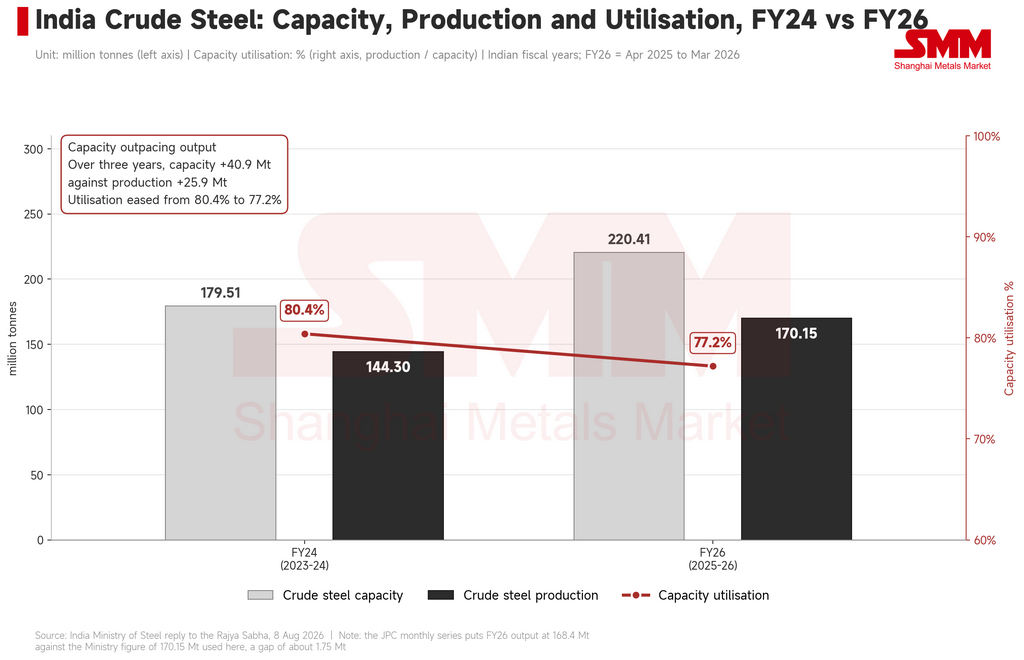
According to the response submitted by India's Ministry of Steel to the Rajya Sabha on August 8, 2026, national crude steel output rose from 144.3 million tonnes in FY2023-24 to 170.15 million tonnes in FY2025-26, while capacity expanded from 179.51 million tonnes to 220.41 million tonnes over the same period; per capita finished steel consumption climbed from 97.7 kg to 115.7 kg. Yet within the same submission, capacity utilisation slipped from 80.4% to 77.2%. Capacity is growing faster than output — this is the essential starting point for understanding everything that follows.
India's secondary steelmaking strategy follows a distinctly different path from that of Western economies. Whereas electric arc furnace (EAF) steelmaking in developed markets is predominantly scrap-fed, India — constrained by insufficient scrap generation but endowed with abundant iron ore resources — has developed the coal-based DRI paired with induction furnace (DRI-IF) route. India has been the world's largest producer of direct reduced iron (DRI) for multiple consecutive years, with approximately 80% of output coming from coal-based rotary kilns. SMM tracking data shows that India's sponge iron output grew from 34.7 million tonnes in FY2018-19 to 51.5 million tonnes in FY2023-24, a CAGR of 8% — outpacing crude steel's 5% CAGR over the same period — with 71% of FY2023-24 production attributable to SMEs. For the April–September 2025 period, India's sponge iron output reached approximately 29 million tonnes, up 9% year-on-year.
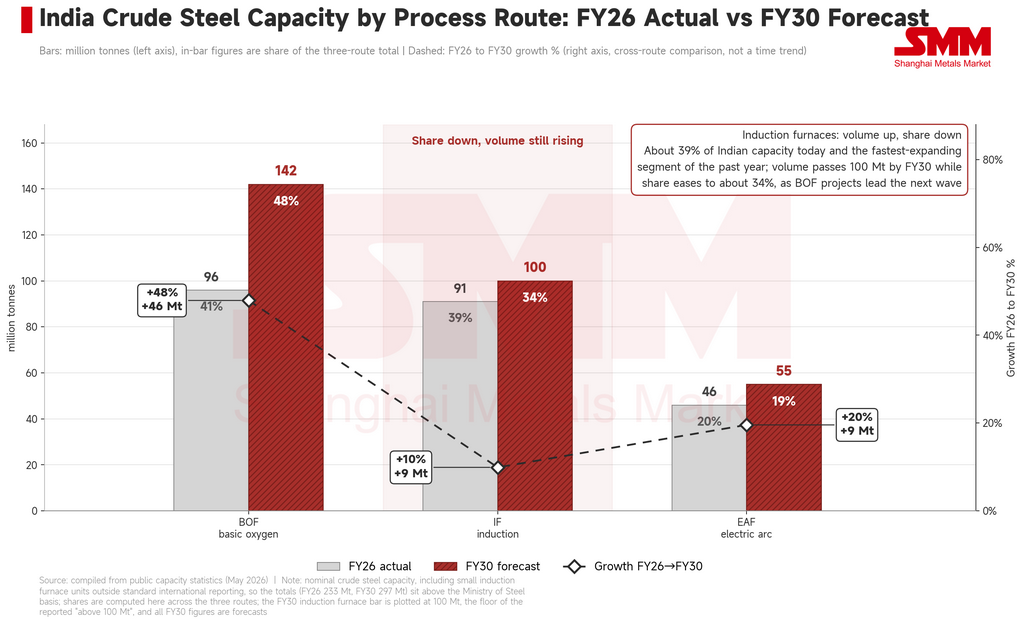
Against the backdrop of India's rapid steel industry expansion, it is precisely the smallest enterprises — those with the weakest capital expenditure capacity — that are bearing the highest-risk operational segments. Their capacity has also expanded the fastest over the past year under market incentives: in FY2025-26, India's crude steel capacity grew 10% year-on-year to 233 million tonnes, with induction furnace capacity surging 16% to 91 million tonnes — outpacing the 7% growth in BOF (basic oxygen furnace) capacity and 6% in EAF capacity.
When capacity expansion, declining utilisation, and intensifying competition in the long products market converge, the expenditure line items that are typically compressed first are not output volumes — but rather incoming raw material inspection, drying and covered stockyard management, and the replacement frequency of personal protective equipment (PPE).
India's steel capacity expansion has outrun its safety carrying capacity. Over three years, installed capacity added 40.9 million tonnes while output grew by only 25.85 million tonnes; utilisation fell from 80.4% to 77.2%. The fastest-expanding segment — sponge iron and induction furnaces — is also the one with the weakest capital expenditure capacity. Under this combination, expenditures that generate no immediate revenue — raw material inspection, stockyard cover, PPE replacement — are readily deferred under competitive pressure. These accidents therefore look less like isolated incidents of bad luck, and more like a predictable by-product of the expansion cycle itself.
![[SMM Hangzhou Construction Steel Inventory] Typhoon Impact: Resource Arrivals and Demand Release Both Limited](https://imgqn.smm.cn/usercenter/bkAyC20251217171720.jpg)
![[China's 15th Five-Year Plan: 15 Trillion Yuan for Urban Renewal, Focusing on Green Development and Safety]](https://imgqn.smm.cn/usercenter/UrrTG20251217171717.jpg)
![[SMM Lecong HRC Inventory] Lecong inventory continued to destock this week.](https://imgqn.smm.cn/usercenter/ENDOs20251217171718.jpg)