Earnings Improve Faster Than Shipments; High-Nickel Growth Remains Selective While New ESS Demand Shifts Toward LFP
Major Korean cathode and precursor producers released their 2Q26 earnings from late July through early August. While some companies reported revenue growth and a return to profitability, the pace of recovery in actual sales volumes varied significantly. New high-nickel projects, higher selling prices and inventory valuation effects stemming from raw material price increases, as well as contributions from non-battery businesses, created a visible gap between earnings improvement and underlying material demand.
SMM expects Korea’s ternary cathode material output to decline around 4.8% in 2026 from 2025. Even if production temporarily rebounds between June and August, much of the year-on-year improvement in the second half is expected to reflect the low production base from last year. Recent earnings improvements therefore do not yet indicate that Korea’s NCM/NCA market has entered a broad recovery cycle.
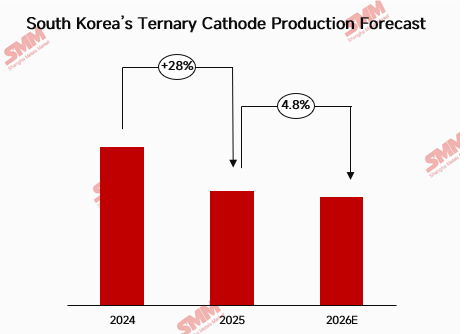
High-Nickel Demand Shows Selective Improvement Rather Than a Broad Recovery
The Korean high-nickel cathode market showed clear divergence by product and customer in the second quarter. One major producer posted record quarterly cathode shipments, supported by stronger sales of 46-series products to a new North American customer. Its second-quarter revenue increased by more than 70% year on year, while operating profit returned to positive territory.
However, this strength was not seen across the broader high-nickel market. Another major materials producer improved profitability in its advanced materials business, supported in part by higher cathode selling prices, but growth in cathode sales volumes remained limited due to North American demand conditions and adjustments to customer production schedules. The company also indicated that a slower-than-expected recovery in the North American EV market could make it difficult to achieve its full-year cathode sales target.
This suggests that the high-nickel market is seeing selective improvement rather than a broad-based recovery. High-specification products linked to new cylindrical battery projects have shown relatively strong demand, while NCM materials for existing EV platforms remain highly sensitive to vehicle sales, customer production schedules and inventory adjustments.
Earnings Improvement Continues to Outpace the Recovery in Actual Sales
Similar divergence was evident across other major cathode producers. One producer saw its average selling price rise 5% quarter on quarter due to the lagged pass-through of higher metal prices, but sales volumes remained flat amid sluggish North American EV demand and model-change effects at a European customer. Revenue and operating profit both declined from the previous quarter.
Another large materials producer reported an improvement in consolidated operating profit, even as cathode revenue fell by more than KRW 100 billion quarter on quarter. Some sales were deferred, while inventory valuation effects on products and raw materials helped support profitability in the cathode business. A significant portion of consolidated earnings was also generated by non-battery businesses.
Meanwhile, a mid-sized cathode producer showed signs of improving utilization. Second-quarter revenue and operating profit increased year on year, while cathode capacity utilization also improved from the previous quarter. However, the company’s electronic materials business also benefited from stronger AI and semiconductor demand. The improvement in cathode utilization therefore indicates some recovery from a low base, but the overall earnings improvement cannot be attributed solely to stronger battery-material demand.
The latest earnings results highlight the need to distinguish between profitability and underlying cathode demand. Changes in raw material prices are reflected in product prices and inventory valuation with a time lag, while non-battery businesses can also support consolidated earnings. Actual shipments and plant utilization are therefore more useful indicators than headline revenue or operating profit when assessing whether Korea’s cathode market is entering a sustainable recovery.
External Customer Expansion Becomes a Key Growth Variable for Precursors
A clear recovery in domestic precursor demand was also difficult to identify. One Korean precursor producer increased second-quarter revenue by 7% quarter on quarter and 129% year on year, supported by higher sales to external customers. However, a temporary disruption at an overseas upstream facility limited the improvement in profitability. The company expects shipments to new overseas customers and a normalization of upstream operations to support performance in the second half.
The revenue increase appears to reflect an expansion of sales beyond affiliated customers rather than a broad recovery in Korea’s precursor market. With operating rates at domestic cell and cathode producers remaining relatively low, Korean demand alone is unlikely to fully absorb existing precursor capacity. At the same time, efforts in North America and Europe to reduce dependence on Chinese materials could create new opportunities for Korean precursor suppliers.
As a result, customer qualification and actual shipments to external overseas buyers could become increasingly important growth drivers for Korea’s precursor sector. However, profitability depends on more than shipment growth. Nickel feedstock and MHP procurement conditions, operating rates at overseas refineries and price competition with Chinese precursor suppliers will also remain important. Even if external sales continue to rise, elevated raw material and processing costs could delay a meaningful earnings recovery.
ESS Growth Does Not Necessarily Translate Into a Recovery in Ternary Cathodes
SMM sees the recent improvement in battery demand as being relatively stronger in ESS than in EVs, with a significant share of new ESS demand increasingly centered on LFP chemistry. Growth in the ESS market therefore should not be directly equated with higher utilization of Korea’s existing NCM/NCA cathode capacity.
One domestic ternary cathode supplier saw its ESS-related sales decline 54% quarter on quarter in the second quarter. However, the company attributed the decline mainly to a North American customer diversifying its supply allocation. The figure should therefore not be interpreted as direct evidence of an LFP shift. Rather, it illustrates that overall ESS market growth does not necessarily translate into higher sales for every individual ternary cathode supplier.
At the same time, Korean cathode producers are moving their LFP businesses from development toward commercial supply. One producer has completed sample shipments of ESS-grade LFP to multiple customers and is preparing to begin commercial supply from late in the third quarter, with annual shipments expected to exceed 50,000 mt in 2027. Another producer is converting part of its existing production capacity to LFP while also expanding dedicated capacity.
For the second half, the key issue will therefore be whether new LFP projects move beyond customer qualification and sample shipments into actual mass production and commercial deliveries. The extent to which new LFP volumes can offset low utilization in existing NCM/NCA businesses could become an important factor differentiating company performance.
Overall, Korea’s cathode and precursor market in 2026 appears to be in a phase of selective stabilization from a low production base rather than a broad recovery. Some new high-nickel projects have generated strong shipments, but sales volumes and utilization across the wider NCM/NCA market have yet to show a clear recovery. Recent earnings improvements have also been supported in part by higher selling prices, inventory valuation effects and contributions from non-battery businesses.
In the second half, actual cathode shipments and operating rates will be more important than headline profitability. The pace of LFP commercialization and shipments to external overseas precursor customers will also need to be closely monitored. Rather than a broad rebound in conventional ternary materials, the key question is whether selected high-nickel projects, LFP-based ESS demand and overseas external sales can emerge as new growth drivers for Korea’s midstream battery-material sector.
![[SMM Analysis] Anode Production in July Steadily Climbed, Driven by Dual Drivers of EV and ESS Demand](https://imgqn.smm.cn/usercenter/hoPFT20251217171727.jpg)
![[SMM Analysis] July Supply-Demand Boom and Solidified Costs: Artificial Graphite Price Awaits an Upward Window](https://imgqn.smm.cn/usercenter/ipFFo20251217171725.jpg)