In July 2026, procurement volume of hydrometallurgical black mass fell 6% MoM, with sluggish transactions and a focus on destocking [SMM Analysis]

Published: Aug 10, 2026 17:47
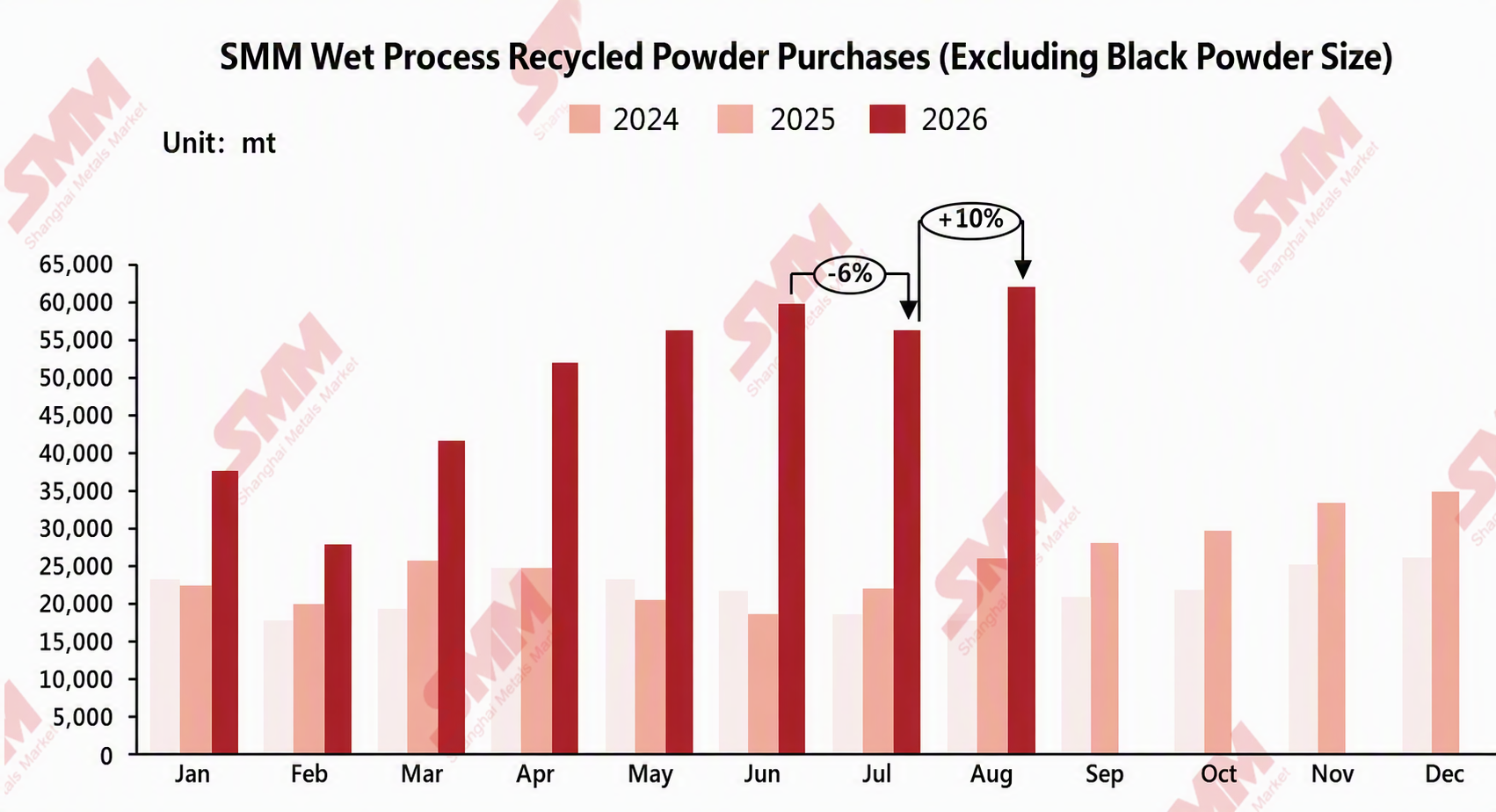
[July 2026 Hydrometallurgical Black Mass Procurement Volume Down 6% MoM, Sluggish Transactions and Destocking Dominated] According to SMM's latest survey data, in July 2026, the scrap procurement volume (in black mass equivalent terms) of China's mainstream hydrometallurgical plants fell approximately 6% MoM from the June high. However, as market conditions stabilize and demand expectations improve, August procurement volume is expected to rebound 10%. Looking back at the July market, both supply and demand sides and price gaming showed notable structural divergence. The expectation misalignment between grinding enterprises and hydrometallurgical plants was the core factor leading to sluggish market transactions.

According to the latest SMM survey, in July 2026, the procurement of battery scrap (on a black mass equivalent basis) by mainstream hydrometallurgical plants in China fell by approximately 6% MoM from the high level in June. Nevertheless, as market conditions stabilize and demand expectations improve, procurement in August is expected to rebound by 10%. Looking back at the July market, both supply and demand sides and price negotiations showed significant structural divergence. The misaligned expectations between grinding enterprises and hydrometallurgical plants were the core factor behind the sluggish trading.
Demand side, although end-user demand from the energy storage and power battery sectors edged up slightly in July, most enterprises already held relatively ample raw material inventory due to the earlier mid-year target push by some hydrometallurgical plants. Their procurement strategy shifted to purely making just-in-time procurement, which led to lower actual transaction volumes and subdued overall market activity throughout the month. Supply side, as scrap material supply from production scrap and end-of-life battery channels continued to increase, the overall supply of black mass in the market gradually shifted from tight to loose. However, there were structural differences: except for LFP electrode black mass, whose supply remained relatively tight due to expanding repair demand for LFP, the supply pressure for other raw material black mass was effectively eased. In terms of material composition, LFP black mass still dominated the current market.

The key variable behind the decline in July procurement was price negotiation across the industry chain. Lithium carbonate prices drifted lower for most of the month, with only a mild pullback at month-end, which directly led to grinding enterprises’ extremely low willingness to sell. The underlying reason is that most grinding enterprises built their inventory when lithium carbonate prices were at earlier highs, whereas hydrometallurgical plants are now quoting black mass procurement prices essentially linked to lithium carbonate futures or spot prices, far below the psychological expectations of grinding plants. As a result, grinding enterprises generally held back from selling. For ternary and LCO black mass, cobalt sulphate prices continued to grind lower, while nickel sulphate touched bottom and edged up slightly later in the month after declining in the first half. Weighed down by the continuous decline of cobalt salts, black mass offers moved lower in tandem, and hydrometallurgical plants showed low acceptance of high prices, leaving the market in a destocking posture overall.

In July, total domestic black mass production pulled back slightly MoM but the decline was mild, with overall volumes remaining historically high. By product type, LFP black mass saw procurement difficulties for hydrometallurgical plants as grinding plants held back from selling, leading to lower operating rates. Ternary black mass production also edged lower, pressured by end-user caution and tightening production schedules. LCO continued to be depressed by sluggish consumer electronics demand. Going forward, as power battery and energy storage orders are released steadily and the earlier raw material tightness gradually eases, overall supply and demand are expected to move toward equilibrium, though the low-level operating environment for LCO is unlikely to reverse in the short term.

Data Source Statement: Except for publicly available information, all other data are processed by SMM based on publicly available information, market communication, and relying on SMM's internal database model. They are for reference only and do not constitute decision-making recommendations.

Images in this article contain AI-translated captions for reference only.

For any inquiries or for more information, please contact: lemonzhao@smm.cn
For more information on how to access our research reports, please contact:service.en@smm.cn
Related News
Korea Zinc Was Mentioned in U.S. Critical Minerals Supply Chain Discussion
2 hours ago
Korea Zinc Was Mentioned in U.S. Critical Minerals Supply Chain Discussion
Read More
Korea Zinc Was Mentioned in U.S. Critical Minerals Supply Chain Discussion
According to Roll Call and other U.S. congressional media outlets on August 10, President Trump held a roundtable meeting with about 200 mining industry officials at the State Department in Washington, D.C., on August 7 local time to discuss ways to strengthen the U.S. critical minerals supply chain. During the meeting, Secretary Lutnick directly mentioned Korea Zinc’s USD 7.4 billion U.S. critical minerals smelter project as a key example of supply chain investment by the U.S. government, emphasizing the need for cooperation with allied countries.
2 hours ago
Sinomine Resource Group: Subsidiary’s Two High-Purity Lithium Chemicals Production Lines Resume Production
2 hours ago
Sinomine Resource Group: Subsidiary’s Two High-Purity Lithium Chemicals Production Lines Resume Production
Read More
Sinomine Resource Group: Subsidiary’s Two High-Purity Lithium Chemicals Production Lines Resume Production
[Sinomine Resource Group: Subsidiary’s Two High-Purity Lithium Chemicals Production Lines Resume Production] On August 10, Sinomine Resource Group announced that its wholly-owned subsidiary Jiangxi Sinomine Lithium Industry, due to a mismatch between lithium concentrates transportation and production scheduling, temporarily shut down the "Annual 30,000 mt High-Purity Lithium Chemicals" and "Annual 35,000 mt High-Purity Lithium Chemicals" production lines for maintenance starting from June 30, 2026. With the maintenance now completed, the company has decided to resume production at the "Annual 30,000 mt High-Purity Lithium Chemicals" line on August 10, 2026, and plans to gradually resume production at the "Annual 35,000 mt High-Purity Lithium Chemicals" line in mid-August 2026.
2 hours ago
Black Mass Imports: Policy Channels Opened, Market Circulation Still Faces Multiple Bottlenecks [SMM Analysis]
2 hours ago
Black Mass Imports: Policy Channels Opened, Market Circulation Still Faces Multiple Bottlenecks [SMM Analysis]
Read More
Black Mass Imports: Policy Channels Opened, Market Circulation Still Faces Multiple Bottlenecks [SMM Analysis]
[Black Mass Imports: Policy Channel Open, Yet Market Circulation Still Faces Multiple Bottlenecks] On June 1, 2025, a joint announcement by the Ministry of Ecology and Environment, the Ministry of Industry and Information Technology, and the General Administration of Customs officially took effect, removing compliant waste lithium-ion battery powder from the Catalogue of Solid Wastes Forbidden from Import and subjecting it to import management as ordinary goods. This marked a long-awaited policy breakthrough for China’s lithium battery recycling industry—prior to this, the channel for raw materials from outside China had never been legally accessible, and the industry relied almost entirely on domestically retired power batteries and off-cuts from battery factories.
2 hours ago
Register to Continue Reading
Gain access to the latest insights in metals and new energy
Already have an account?Sign in here