On August 7, South Korean research firm SNE Research released global (ex-China) EV (EV, PHEV, HEV) power battery installations data for H1 2026.
The data showed that in H1 2026, power battery installations outside China reached about 269 GWh, up 26.3% YoY, continuing a steady growth trend.
In H1, the supply landscape of the power battery market outside China underwent an accelerating restructuring. Chinese enterprises represented by CATL and BYD, leveraging expanded global OEM supply, the overseas expansion of Chinese-brand vehicles, and the cost advantages of LFP, continued to enhance their influence in markets outside China. In the top 10 rankings for power battery installations outside China in H1 2026, Chinese firms’ growth rates far exceeded the market average, while the market shares of the three major South Korean battery companies and Panasonic all declined.
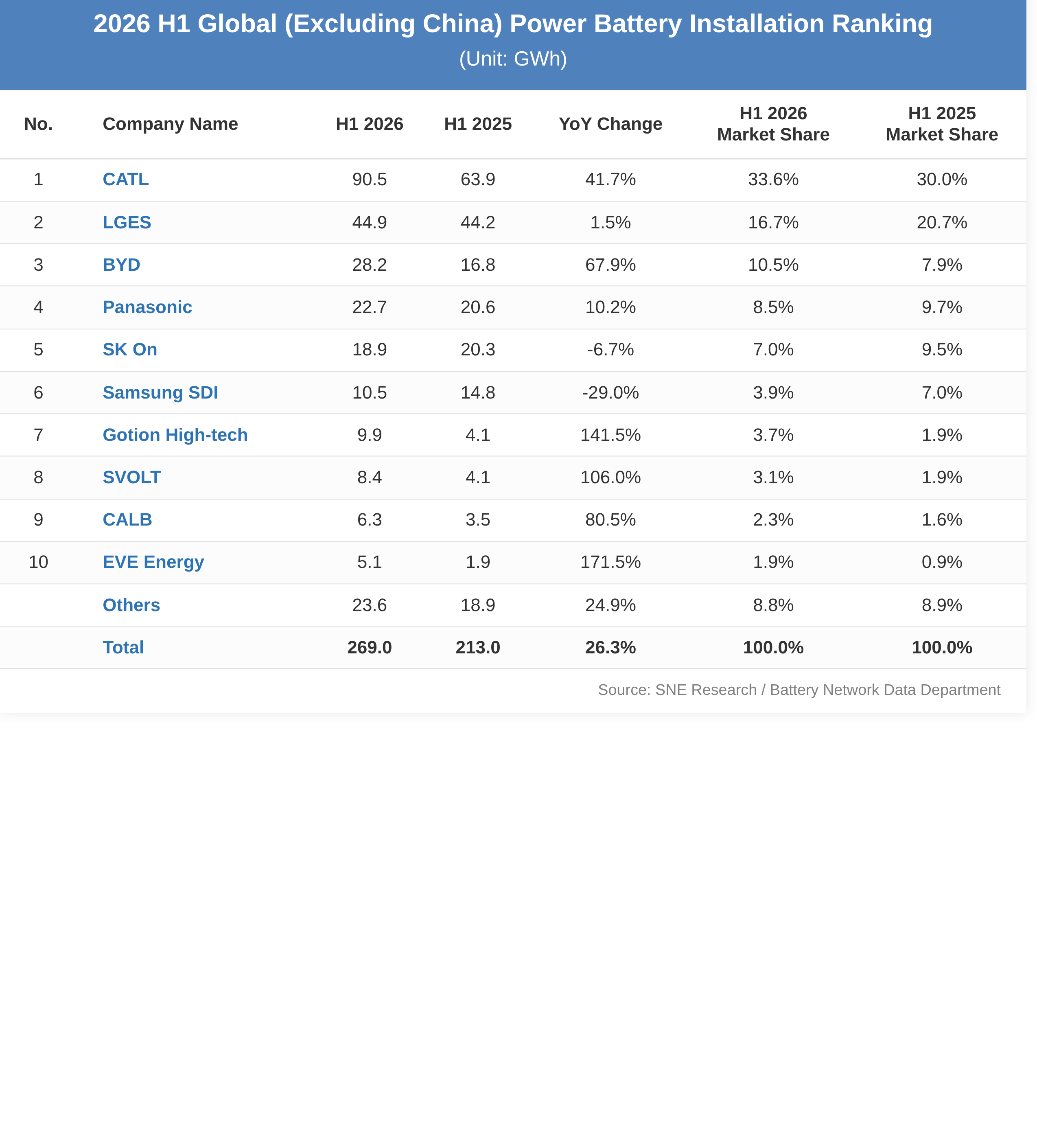
In terms of ranking changes,compared with H1 2025, CATL and LG Energy Solution continued to hold the top two spots; BYD jumped from sixth to third place, overtaking Panasonic and SK On to become the third-largest power battery supplier outside China; Panasonic remained in fourth place; SK On dropped from third to fifth, while Samsung SDI, previously fifth, fell to sixth; Gotion High-tech and SVOLT Energy Technology rose from ninth and tenth to seventh and eighth respectively; CALB and EVE newly entered the list, ranking ninth and tenth; Farasis Energy and Tesla fell out of the top 10.
From the YoY change in installations,EVE, Gotion High-tech, and SVOLT Energy Technology achieved more than doubling growth, with increases of 171.5%, 141.5%, and 106.0%, respectively; CALB, BYD, and CATL also recorded growth rates well above the industry average, at 80.5%, 67.9%, and 41.7%, respectively; Panasonic grew by 10.2%, below the industry average, and its market share was eroded; LG Energy Solution rose only 1.5%, while SK On and Samsung SDI posted negative growth, at -6.7% and -29.0%, respectively.
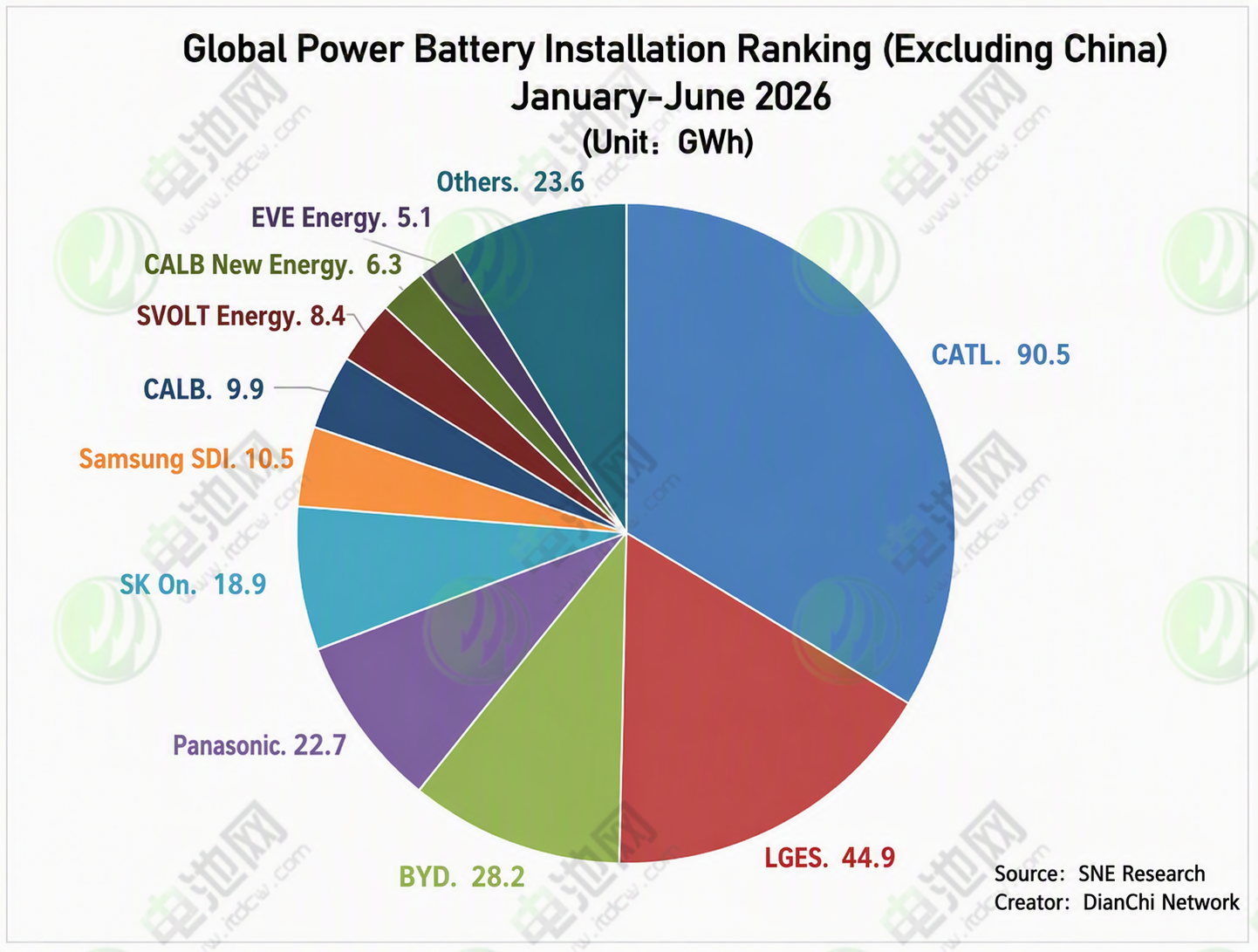
Competitive landscape,in the top 10 for power battery installations outside China in H1 2026,the combined share of the six Chinese companies on the listrose further from 44.2% in H1 2025 to 55.1%, a net increase of 10.9 percentage points, reinforcing their global dominance.
Among them, CATL’s power battery installations outside China in H1 reached 90.5 GWh, up 41.7% YoY, holding the top spot; its market share rose from 30.0% to 33.6%, up 3.6 percentage points. In markets outside China, CATL continued to expand supply to major global automakers such as Tesla, BMW, Mercedes-Benz, Toyota, and Kia, while also covering the overseas demand of Chinese OEMs in key regions such as Europe and Asia and deepening ties with global OEM clients, driving dual-engine growth. Its cost competitiveness centered on LFP, combined with a broad product portfolio, further cemented its position in the power battery market outside China.
BYD, Gotion High-tech, SVOLT Energy Technology, CALB, and EVE also delivered standout performances. Riding on the improving overseas sales of Chinese-brand vehicles, leveraging cost-effective LFP products, local production, and partnership strategies, these five companies are rapidly expanding their supply footprint in the power battery market outside China.
BYD ranked third with 28.2 GWh of installations, up 67.9% YoY, and its market share rose from 7.9% to 10.5%, up 2.6 percentage points. The growth in overseas sales of its own EVs was the main driver of the increase in BYD’s battery usage; the cost and safety strengths of the blade battery also provided strong support for this growth.
According to the latest data released by BYD, its cumulative overseas sales of passenger vehicles and pickups in the first seven months of this year reached 969,000 units, with overseas sales accelerating again and just a step away from one million units.
Currently, BYD is progressively breaking through its business structure previously dominated by domestic demand in China, accelerating the deployment of vehicle sales networks and production sites in regions such as Europe, Asia, and Latin America. Its overseas power battery demand is expected to maintain a relatively high growth rate for some time.
Gotion High-tech recorded installations of 9.9 GWh, up 141.5% YoY, with its market share rising from 1.9% to 3.7%; SVOLT Energy Technology recorded 8.4 GWh, up 106.0% YoY, and its market share rose from 1.9% to 3.1%; CALB recorded 6.3 GWh, up 80.5% YoY, and its market share rose from 1.6% to 2.3%; EVE recorded 5.1 GWh, surging 171.5% YoY, leading the top 10 growth chart, with its market share rising from 0.9% to 1.9%.
Turning to South Korean battery companies,the combined installations of the three South Korean battery makers—LG Energy Solution, SK On, and Samsung SDI—reached 74.3 GWh, down 6.3% YoY; their combined market share slipped from 37.2% in the same period last year to 27.6%, a drop of 9.6 percentage points.
Specifically, LG Energy Solution’s installations were 44.9 GWh, up 1.5% YoY, but the growth rate was far below the overall level of 26.3%, and its market share fell from 20.7% to 16.7%, down 4.0 percentage points. The company supplies major global automakers such as Tesla, GM, Hyundai Motor Group, and Volkswagen, with increased EV sales of some clients providing a certain boost to installations.
SNE believes that against the backdrop of expanding overseas supply from Chinese enterprises and the continuously rising adoption rate of LFP batteries, if LG Energy Solution is to reverse the downward trend in its market share going forward, it will need to focus on improving local production efficiency in North America and Europe and advancing the diversification of its client structure and product portfolio.
SK On’s installations were 18.9 GWh, down 6.7% YoY, and its market share fell from 9.5% to 7.0%. The company mainly supplies batteries to automakers such as Hyundai Motor Group, Ford, Volkswagen, and Mercedes-Benz. The launch of some new EV models by Hyundai Motor Group offered a degree of support for SK On’s installations, but the impact of slowing sales from major clients in North America and Europe and production adjustments for certain models far exceeded the incremental volume contributed by new models. In particular, intensifying demand volatility in the North American EV market, coupled with ongoing production pace adjustments by automakers, caused SK On’s installations to fluctuate markedly in line with its clients’ sales performance.
Samsung SDI’s installations were 10.5 GWh, down sharply by 29.0% YoY—the largest decline among the top 10—and its market share contracted from 7.0% to 3.9%. Although the company continues to supply core clients such as BMW, Audi, and Rivian, sluggish sales at Rivian, which has a high exposure to North America, together with slowing demand for the existing electrified models of its major European clients, directly led to the decline in installations. While new model launches added some volume, it was not enough to offset the losses from the shrinking sales of key existing models.
SNE noted that against the backdrop of double-digit growth in the overall market, the combined installations of the three major South Korean battery companies actually declined, widening the gap with their Chinese competitors. Going forward, how to respond to the overseas expansion of Chinese enterprises and the popularization trend of LFP batteries, while optimizing their own localized footprint and client structure in North America and Europe, will be a critical task facing South Korean battery producers.
As for Japanese battery companies,Panasonic ranked fourth with 22.7 GWh of installations, up 10.2% YoY, though its market share fell from 9.7% to 8.5%. Its batteries are mainly fitted in models produced in North America by its core client Tesla. Currently, while maintaining its Tesla-centric supply system, Panasonic is actively advancing the mass production and market deployment of next-generation cylindrical batteries and improving production efficiency at its North American plants. However, given its high client concentration, changes in Tesla’s sales and production strategies across different regions will be a key variable affecting Panasonic’s subsequent performance fluctuations.
Looking ahead, SNE believes that regional demand trends and supply chain regulatory rules will be the two core variables affecting corporate competitiveness.
In Europe, EV penetration rates continue to climb, and Chinese enterprises are accelerating their deployment; meanwhile, the EU’s digital product passport system officially went live on July 20, and the battery passport has entered the implementation preparation stage, significantly raising the importance of supply chain traceability and local response capabilities.
In North America, policy uncertainty combined with production adjustments by automakers means that local production efficiency and the ability to secure non-China supply chains have become the current core focus.
Overall, the key dimensions of future competition in the power battery market will not be limited to price, but will depend more on regional capacity deployment and localization capabilities, solid partnerships with global OEMs, technological reserves in LFP and next-generation batteries, and supply chain transparency and resilience—these factors together determine the long-term competitive position of each enterprise.
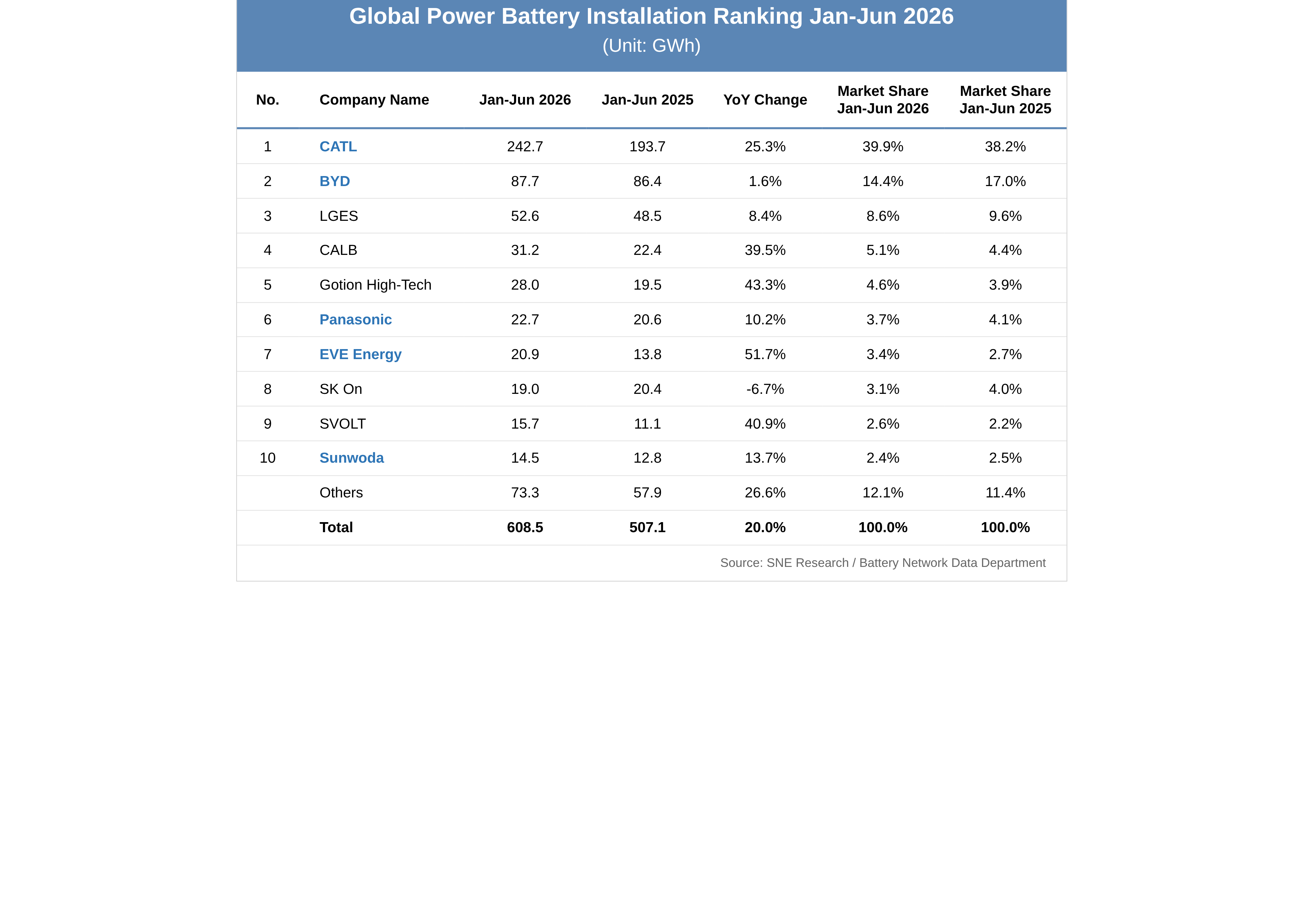
Looking at the global power battery market including China,in H1 2026, total global power battery installations reached 608.5 GWh, up 20% YoY. Among the top 10, seven Chinese companies held a combined 72.4% market share, up 1.5 percentage points YoY.
In terms of YoY change in installations, only SK On among the top 10 global power battery producers posted a decline in H1 2026, down 6.7%, while the remaining nine all achieved YoY growth, with Gotion High-tech, EVE, and SVOLT Energy Technology all growing by over 40%.
From a market share perspective, compared with the same period in 2025, CATL, CALB, Gotion High-tech, EVE, and SVOLT Energy Technology achieved positive YoY growth in H1 2026, while BYD, LG Energy Solution, SK On, Panasonic, and Sunwoda saw varying degrees of decline.