SMM August 8:
Base metals market:
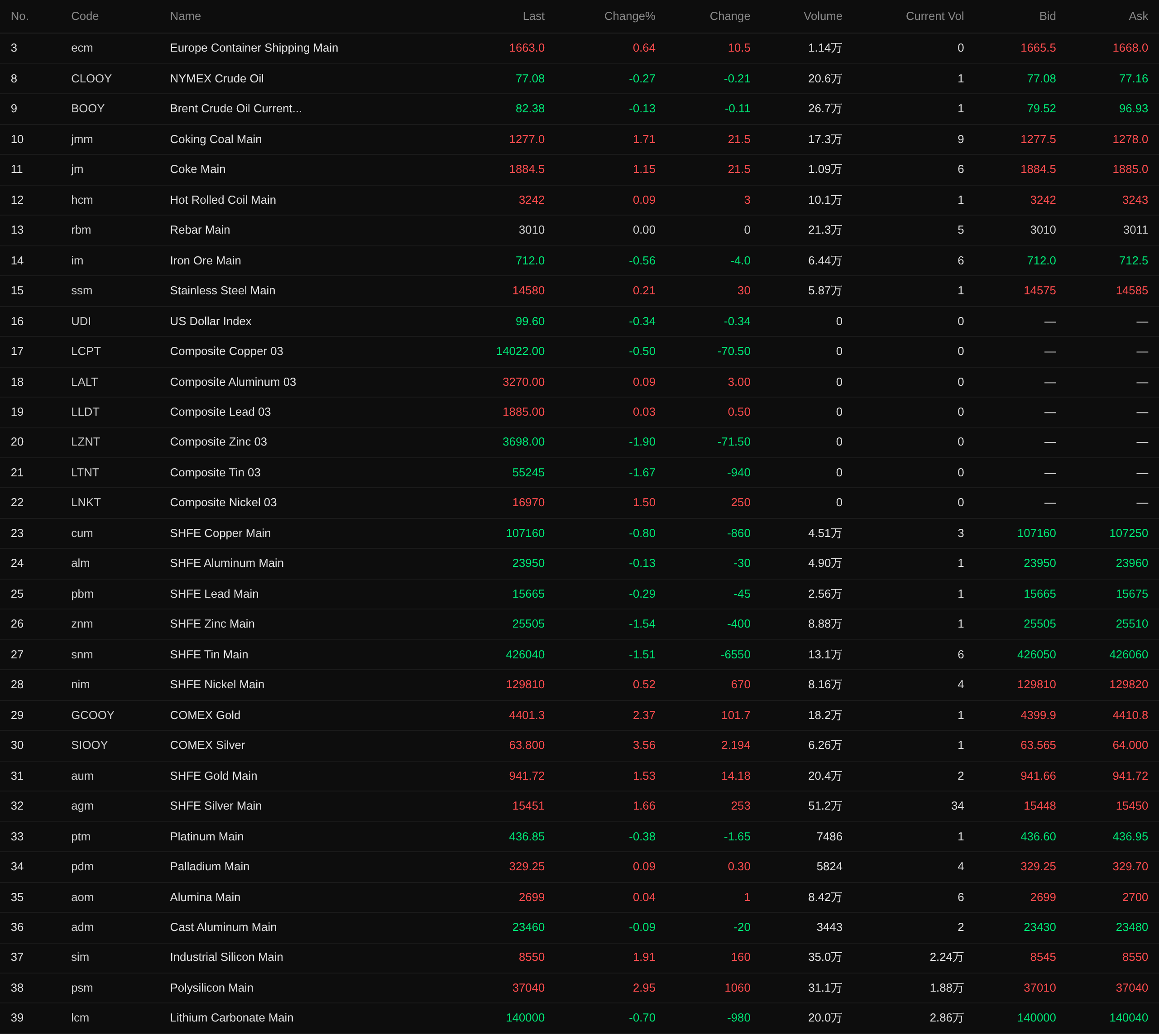
Overnight, base metals on both domestic and overseas markets generally fell, with only LME aluminum, LME lead, LME nickel, and SHFE nickel rising. LME nickel led the gains with a 1.5% increase, SHFE nickel rose 0.52%, LME aluminum rose 0.09%, and LME lead rose 0.03%. LME zinc led the declines with a 1.9% drop, LME tin fell 1.67%, SHFE zinc fell 1.54%, and SHFE tin fell 1.51%. The rest of the metals fell within 1%. Alumina main contract rose 0.04%, while cast aluminum main contract fell 0.09%.
Overnight, ferrous metals showed mixed performance. Stainless steel rose 0.21%, rebar closed flat at 3,010 yuan/mt, and iron ore fell 0.56%. In the coking coal and coke sector, coking coal rose 1.71% and coke rose 1.15%.
Overnight, precious metals: COMEX gold rose 2.37% overnight, reclaiming $4,400/oz, with a weekly surge of 7.17%. COMEX silver rose 3.56% overnight, with a weekly surge of 10.41%. Domestically, SHFE gold rose 1.53% and SHFE silver rose 1.66%. SHFE gold jumped 5.03% weekly, and SHFE silver surged 9.43% weekly.
UBS Chief Investment Officer Ulrike Hoffmann-Burchardi and her team said, "This gold rally is supported by fundamentals. We expect gold prices to approach $5,000/oz in H1 2027." Since the US and Israel launched a war against Iran at the end of February, gold prices came under pressure and pulled back. UBS strategists noted that risks remain in the near term. If oil prices rise, or if the market prices in expectations of a more hawkish Fed monetary policy and rising bond appeal, gold could face pressure. However, the institution maintains an optimistic outlook on gold's medium- to long-term trend. Hoffmann-Burchardi said the team expects inflation to gradually ease, and the Fed is likely to keep rates unchanged this year and restart an interest rate cutting cycle in 2027. "The growing expectation of lower policy rates is likely to depress real yields and drag on the US dollar, thereby boosting investment demand for gold and creating a more favorable market environment for the metal," she said. (Wallstreetcn)
As of 7:40 on August 8, overnight closing prices:
Macro Front
Domestic:
[Exceeding 30 Trillion Yuan! China’s Goods Trade Import and Export Continued Growth Momentum in First 7 Months] China's General Administration of Customs today released statistics showing that in the first seven months of this year, China's total goods trade import and export value reached 30.13 trillion yuan, up 17.3% YoY, continuing a solid growth trend. Exports amounted to 17.44 trillion yuan, up 14%, while imports stood at 12.69 trillion yuan, up 22%. In July, imports and exports totaled 4.66 trillion yuan, up 19.2% YoY. Exports reached 2.71 trillion yuan, up 17.8%, while imports were 1.95 trillion yuan, up 21.2%.
SMM, based on data released by the General Administration of Customs, has compiled the import and export situation of some products in the metals industry, as follows:
[Aluminum industry profits in H1 up about 115% YoY; exports of aluminum semis and aluminum products up about 14% YoY]In H1 2026, aluminum industry profits rose about 115% YoY. This came as aluminum prices increased, while raw material prices such as alumina pulled back. Some enterprises further adopted green power like hydropower and expanded the use of new energy, making production greener and securing more cost advantages. Not only were domestic clients rushing to place orders, but overseas clients were also increasing their orders. In H1 this year, China exported a total of 5.62 million mt of aluminum semis and aluminum products, an increase of about 14% compared with the same period last year. With more orders and busier production lines, environmental protection facilities also operated at full capacity. (CCTV Finance)
[Beijing: moderately raising the maximum loan amount for housing provident fund; a married couple may borrow up to 3.4 million yuan for their first home purchase]On the evening of the 7th, the Beijing Municipal Commission of Housing and Urban-Rural Development, the Beijing Municipal Commission of Planning and Natural Resources, and the Beijing Housing Provident Fund Management Center jointly issued the "Notice on Further Optimizing and Adjusting the City's Real Estate Policies." It mentioned moderately raising the maximum loan amount for housing provident fund. For a home-buying family with one provident fund contributor, the maximum loan amount for a first home purchase is 1.2 million yuan, and for a second home, it is 1 million yuan; if both spouses are contributors, the maximum loan for a first home is 2.4 million yuan, and for a second home, it is 2 million yuan. The maximum loan amount can be further increased under the following conditions: 1. For a household with household registration in the six central urban districts that purchases a first home outside those six districts, the maximum can be increased by 200,000 yuan; 2. For a home purchase that complies with the city's green building development support policies, the maximum can be increased by 400,000 yuan; 3. For families with two or more children of Beijing household registration, the loan amount can be increased by 400,000 yuan. If multiple conditions are met simultaneously, the increases can be stacked. For a family with one provident fund contributor, the maximum increase is 600,000 yuan; for a family where both spouses are contributors, the maximum increase is 1 million yuan. The actual loan amount will be determined based on the family's repayment ability. (Jinshi Data APP)
In terms of the US dollar:
As of the overnight close, the US dollar index fell 0.35% to 99.6, declining 0.18% for the week and logging a second straight weekly loss. US nonfarm payrolls unexpectedly fell by 23,000 in July, far below market expectations of an increase of 80,000, while the May and June figures were revised down by a combined 103,000. The labour force participation rate dropped to the lowest in more than five years. The disappointing employment data sent the probability of a September rate hike plunging from 55% to 44%, the 10-year US Treasury yield diving from 4.68% to 4.65%, and the US dollar index breaking below 99.5 during the session.
‘New Fed Wire’ Nick Timiraos: The July employment report will be a difficult one for the Fed to interpret. There is no new evidence of a re-acceleration in the labour market, which may somewhat weaken the case for a rate hike next month, but this still depends on whether inflation data can improve further. Officials held rates steady last week, but three of the twelve officials voted to raise rates. The decline in the unemployment rate will keep the focus on inflation data. (Wallstreetcn)
The latest survey results from the New York Fed show that Americans’ overall expectations for the labour market improved in July, and their inflation expectations also changed. Consumers’ one-year-ahead inflation expectations edged down to 3.6% from 3.7%. Three-year-ahead and five-year-ahead inflation expectations were unchanged at 3.3% and 3%, respectively. The perceived probability of finding a new job among unemployed workers rose to 46.2%, the highest this year. This increase was most pronounced among those with a high school diploma or less and households with an annual income below $50,000. Consumers grew more optimistic about the stock market, with the probability that stock prices will be higher a year from now reaching the highest level since this data series began in April 2021. (Wallstreetcn)
According to CME’s ‘FedWatch’ tool: The probability that the Fed will keep rates unchanged in September is 59.9%, while the probability of a cumulative 25bp rate hike is 40.1%. For October, the probability of keeping rates unchanged is 45.3%, with a 44.9% probability of a cumulative 25bp hike and a 9.8% probability of a cumulative 50bp hike. (Jin10 Data APP)
On the macro front:
Next week, China will release data including the July M2 money supply year-on-year rate; the US will release data including the July NFIB Small Business Optimism Index, the ADP employment change for the week ending July 25, the July existing home sales annualized total, the July unadjusted CPI year-on-year rate, the July seasonally adjusted CPI month-on-month rate, the July seasonally adjusted core CPI month-on-month rate, the July unadjusted core CPI year-on-year rate, the awarded yield on the 10-year Treasury auction for the week ending August 12, the bid-to-cover ratio on the 10-year Treasury auction for the week ending August 12, the initial jobless claims for the week ending August 8, the July PPI year-on-year rate, the July PPI month-on-month rate, the July retail sales month-on-month rate, the August preliminary one-year inflation expectations, the June business inventories month-on-month rate, and the August preliminary University of Michigan consumer sentiment index; the Eurozone will release data including the August Sentix investor confidence index, the June industrial production month-on-month rate, the Q2 GDP year-on-year revised reading, the Q2 seasonally adjusted employment change final quarter-on-quarter rate, and the June seasonally adjusted trade balance; the UK will release data including the Q2 GDP year-on-year preliminary reading, the June three-month GDP month-on-month rate, the June manufacturing production month-on-month rate, the June seasonally adjusted goods trade balance, and the June industrial production month-on-month rate; data including the France final July CPI month-on-month rate, the Canada June wholesale sales month-on-month rate, the Japan June trade balance, the Australia Reserve Bank of Australia interest rate decision for the week of August 11, and the Germany final July CPI month-on-month rate will all be released.
Additionally, the National Energy Administration releases nationwide electricity consumption data around the 15th of each month. The Bank of Japan released the summary of opinions from its July monetary policy meeting. The Reserve Bank of Australia announced its interest rate decision and monetary policy statement. RBA Governor Bullock held a monetary policy press conference. 2026 FOMC voting member and Cleveland Fed President Hammack delivered remarks. 2027 FOMC voting member and Richmond Fed President Barkin spoke on the economic outlook. RBA Governor Bullock attended a hearing.
Crude oil:
Oil prices fell in overnight trading, with WTI crude down 0.27% and Brent crude down 0.13%. On a weekly basis, WTI crude fell 8.96% and Brent crude fell 6.31%. The market remained focused on negotiations between the US and Iran regarding the Strait of Hormuz. Expectations of US-Iran peace talks suppressed geopolitical risk premiums. Goldman Sachs’ energy research team estimated Brent’s fair value at $80/bbl and maintained its view of a consolidation range of $80–90/bbl.
On August 7, US officials stated that Oman and Iran had made progress on the Strait of Hormuz issue, and an agreement is expected to be reached soon. Once an agreement to restore unimpeded commercial shipping is announced, the US will lift its blockade of Iranian ports. US actions will continue to be performance-based and linked to Iran’s fulfillment of its commitments. There was no immediate response from Iran or Oman to the above. (CCTV)
It was reported on August 7 that Hassan Qashqavi, spokesperson for Iran’s Parliamentary National Security and Foreign Policy Committee, stated that Iran and Oman had finalized the general framework of a memorandum of understanding on shipping in the Strait of Hormuz, with the final text and specific details to be publicly released shortly. On August 6, Iran publicly disclosed preliminary textual details of its proposed strategic management plan for the Strait of Hormuz, which includes provisions barring hostile parties from transiting the strait, with violators subject to fines of up to 20% of cargo value. Iran has repeatedly emphasized in recent days that arrangements related to the Strait of Hormuz should be decided solely through consultations between Iran and Oman, and that no external interference will be accepted. Meanwhile, US President Trump stated on the 6th that the US is participating in negotiations concerning the Strait of Hormuz. (CCTV)
Next week, the EIA will release its Short-Term Energy Outlook, the IEA will publish its monthly Oil Market Report, and OPEC will issue its monthly Oil Market Report (specific release dates for the monthly reports are to be determined, generally published around 18:00–21:00 Beijing time). A new round of price adjustments for domestic refined oil products in China will open.
![[CPCA: In July 1-31, the national passenger car new energy market retail sales reached 970,000 units, down 2% YoY]](https://imgqn.smm.cn/usercenter/JYbQQ20251217171736.jpg)
![[Samsung Unveils BV-NAND, zHBM, and zNAND-O: 10x Density, 3x Energy Efficiency Over HBM5]](https://imgqn.smm.cn/usercenter/BVoXk20251217171736.jpg)
![[TSMC's N2 Process Capacity Sufficient but DRAM Shortage, Apple iPhone 18 Stockpiling Faces Pressure]](https://imgqn.smm.cn/usercenter/obeMy20251217171735.jpg)